Aerospace Quality Management Services Market (2026-2036)
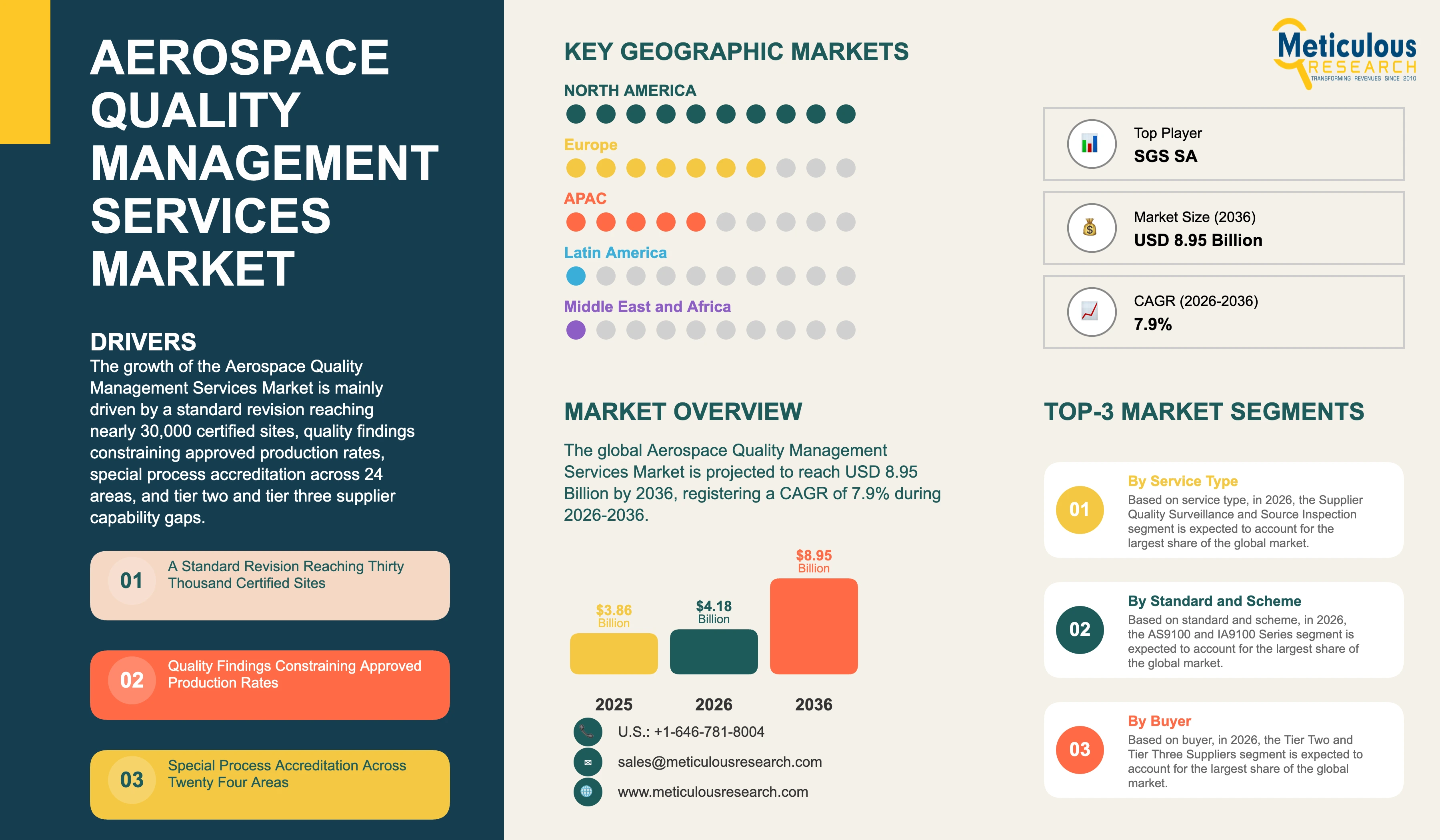
The global Aerospace Quality Management Services Market was valued at USD 3.86 billion in 2025. This market is expected to reach USD 8.95 billion by 2036 from an estimated USD 4.18 billion in 2026, registering a CAGR of 7.9% during the forecast period (2026-2036).
- Published
- Nov 2026
- Pages
- 269
- Format
- PDF + Excel
- Report ID
- MRAD - 1042836
- Base year
- 2025
- 2025 · BASELINE
- $3.86B
- 2036
- $8.95B
- CAGR 2026–2036
- 7.9%
2025 baseline · 2026–2036 forecast at 7.9% CAGR · hover a bar for the value
Key highlights
The global Aerospace Quality Management Services Market is projected to reach USD 8.95 billion by 2036, driven by a standard revision reaching nearly 30,000 certified sites, quality findings constraining approved production rates, special process accreditation across 24 areas, and tier two and tier three supplier capability gaps.
North America is expected to account for the largest market share in 2026 and is also projected to register the fastest growth during the forecast period, supported by the concentration of airframe, engine and defense prime contractors in the region together with the largest certified supplier base and the deepest pool of qualified auditors.
By service type, Supplier Quality Surveillance and Source Inspection are expected to account for the largest market share, whereas Quality Consulting and Implementation are projected to witness the fastest growth through 2036.
By standard and scheme, the AS9100 and IA9100 Series are expected to account for the largest market share, whereas Special Process Accreditation Schemes are projected to witness the fastest growth through 2036.
By buyer, Tier Two and Tier Three Suppliers are expected to account for the largest market share, whereas Maintenance, Repair and Overhaul Providers are projected to witness the fastest growth through 2036.
The aerospace quality management standard was last revised as AS9100 Revision D in 2016, and under a 2022 agreement with SAE International its next revision is renumbered to the IA9100 series.
Publication of IA9100 moved to an estimate of the fourth quarter of 2026 after the decision to revise the underlying quality management system standard, following a first draft released in November 2023 against which the sectors consolidated 388 comments.
Nearly 30,000 sites hold certification to the aerospace quality management standard, audited by nearly 100 certification bodies, which sets the scale of the transition the revision creates.
More than 5,000 supplier audits are scheduled annually under the principal special process accreditation program, with approximately 4,700 suppliers holding over 8,000 accreditations.
That program covers 24 accreditation areas, each with its own task group, spanning additive manufacturing, composites, heat treating, nondestructive testing and welding among others, with nearly 60 subscribing original equipment manufacturers participating.
The program is administered by a not-for-profit trade association established in 1990 with offices in the United States, the United Kingdom, China and Japan, and it replaces redundant auditing of suppliers with one approved audit.
Supplier survey results published by that association record 91% observing quality improvements, 85% crediting improved customer satisfaction to participation, 70% reporting fewer product defects and 94% considering accreditation to have added value.
Quality performance now sets approved output directly, with the Federal Aviation Administration raising the Boeing 737 MAX production cap from 38 to 42 aircraft a month in October 2025 after a period in which the rate was held at a regulated ceiling.
Report summary
| Particulars | Details |
|---|---|
| Forecast Period | 2026-2036 |
| Base Year | 2025 |
| Estimated Year | 2026 |
| CAGR (Value) | 7.9% |
| Format | PDF, Excel & Cloud Portal · 269 pages |
| CAGR (Volume) | 5.3% |
| Market Size (Value) in 2026 | USD 4.18 billion |
| Market Size (Value) in 2036 | USD 8.95 billion |
| Market Size (Volume) in 2026 | 11.60 million audit and inspection service days |
| Market Size (Volume) in 2036 | 19.40 million service days |
| Average Selling Price, 2026 | USD 360 per service day |
| Average Selling Price, 2036 | USD 461 per service day |
| Segments Covered | By Service Type: Supplier Quality Surveillance and Source Inspection, Certification Audit and Registrar Services, Quality Consulting and Implementation, Special Process Accreditation Audit Support, First Article and Dimensional Inspection Services, Auditor and Quality Training. By Standard and Scheme: AS9100 and IA9100 Series, Special Process Accreditation Schemes, Customer-Specific Supplier Requirements, Regulatory and Airworthiness Requirements, Other Schemes. By Buyer: Tier Two and Tier Three Suppliers, Tier One Suppliers, Airframe and Engine Original Equipment Manufacturers, Maintenance, Repair and Overhaul Providers, Other Buyers. By Delivery Model: On-Site Deployed Services, Scheduled Audit Engagements, Managed Service and Outsourced Quality Function, Remote and Hybrid Assessment. |
| Countries Covered | U.S.; Canada; France; Germany; U.K.; Italy; China; India; Japan; South Korea; Mexico; Brazil |
| Key Companies | SGS SA, Bureau Veritas SA, Intertek Group plc, TÜV SÜD AG, DNV AS, and The British Standards Institution |
Report overview
Segments covered: service type, standard and scheme, buyer, delivery model.
In volume terms, the market is estimated at 11.60 million audit and inspection service days in 2026 and is expected to reach 19.40 million service days by 2036, registering a CAGR of 5.3% during the forecast period. The average selling price is estimated at USD 360 per service day in 2026 and USD 461 per service day in 2036.
The growth of this market is mainly driven by a standard revision estimated for publication in the fourth quarter of 2026 that reaches nearly 30,000 certified sites, quality findings that constrain approved production rates, special process accreditation covering 24 areas against more than 5,000 audits scheduled annually, and capability gaps across the tier two and tier three supplier base. However, factors such as the availability of qualified auditors and source inspectors, audit rationalization that replaces redundant supplier auditing with a single approved audit, quality spend treated as overhead by smaller suppliers, and certification body capacity measured against a fixed transition window are expected to restrain the growth of this market to some extent.
Among buyers, Tier Two and Tier Three Suppliers are expected to account for the largest market share in 2026, while Maintenance, Repair and Overhaul Providers are projected to register the highest CAGR during the forecast period. Geographically, North America is expected to account for the largest share of this market in 2026 and is also expected to register the highest CAGR during the forecast period.
The Aerospace Quality Management Services Market comprises third-party and outsourced services that establish, assess and maintain quality management systems and process approvals across the aerospace supply chain, taken at the service provider gate with volume expressed as audit and inspection service days delivered. The market includes Supplier Quality Surveillance and Source Inspection, Certification Audit and Registrar Services, Quality Consulting and Implementation, Special Process Accreditation Audit Support, First Article and Dimensional Inspection Services, and Auditor and Quality Training, delivered against the AS9100 and IA9100 series, special process accreditation schemes, customer-specific supplier requirements and regulatory and airworthiness requirements, for tier two and tier three suppliers, tier one suppliers, airframe and engine original equipment manufacturers, and maintenance, repair and overhaul providers. Quality management software and digital platforms, nondestructive testing and materials testing performed as production operations, calibration equipment and metrology hardware, airworthiness certification performed by regulators, and the in-house cost of employed quality staff fall outside the scope.
An aerospace supplier cannot sell into a program without a certified quality management system and, where it performs a controlled process, a separate process accreditation held per process and per site. Both are assessed by third parties rather than asserted, so the cost of market access in this industry is paid in audit days. Nearly 30,000 sites hold certification to the aerospace quality management standard and nearly 100 certification bodies perform those audits, which is the base from which all other demand in this market follows.
The standard behind that base is changing for the first time in a decade. AS9100 was last revised as Revision D in 2016, its next revision is renumbered to the IA9100 series under a 2022 agreement with SAE International, and publication moved to an estimate of the fourth quarter of 2026 after the decision to revise the underlying quality management system standard. A first draft was released in November 2023 and the sectors consolidated 388 comments against it. Every certified site has to be reassessed against the revised requirements inside a transition window, which converts a routine surveillance market into a concentrated wave of gap assessment, implementation and recertification work.
Process approval runs on a separate track and at a different cadence. More than 5,000 supplier audits are scheduled annually under the principal special process accreditation program, with approximately 4,700 suppliers holding over 8,000 accreditations across 24 accreditation areas, each governed by its own task group and covering additive manufacturing, composites, heat treating, nondestructive testing and welding among others. Nearly 60 subscribing original equipment manufacturers participate, and the program replaces redundant auditing of suppliers with one approved audit.
The program is run by a not-for-profit trade association established in 1990 with offices in the United States, the United Kingdom, China and Japan, which places the largest single volume of aerospace process audits outside the commercial certification bodies. Supplier survey results published by that association record 91% observing quality improvements, 85% crediting improved customer satisfaction to participation, 70% reporting fewer product defects and 94% considering accreditation to have added value, which is the evidence primes cite when they extend the scheme rather than audit suppliers themselves.
Quality performance now sets approved output rather than merely documenting it. The Federal Aviation Administration held the Boeing 737 MAX production rate at a regulated ceiling before raising the cap from 38 to 42 aircraft a month in October 2025, and Boeing cited airplane quality and supply chain stability as the rationale for completing the acquisition of Spirit AeroSystems on 8 December 2025. Where a quality finding limits the rate at which an aircraft can be built, quality services stop being a compliance cost and become a route to delivered revenue.
Demand concentrates where capability is thinnest rather than where the standards are written. Tier Two and Tier Three Suppliers hold the largest buyer share of this market at 40.0% in 2026, because a machine shop or process house carries the same certification and accreditation burden as a prime without the quality staff to absorb it. Value grows ahead of volume throughout the forecast period at 7.9% against 5.3%, as day rates rise with auditor scarcity faster than the number of service days delivered can expand.
Additive manufacturing is among the 24 accreditation areas covered by the principal special process program, each governed by its own task group. As processes that were development activities enter qualified production, they bring new accreditation scope to suppliers that already hold others, which adds audit cycles without adding suppliers. Providers with auditors qualified in the newer process areas face the least competition for that work.
Surveillance effort directed by supplier performance data rather than by a fixed calendar concentrates audit days where escape risk is highest and reduces them elsewhere. For a prime managing thousands of supplier sites against a limited pool of inspectors, that reallocation delivers more coverage from the same spend, and providers able to run the analysis alongside the inspection sell a managed outcome rather than a day rate.
North America is expected to account for the largest share of this market in 2026 at 41.0%, supported by the largest certified supplier base, the deepest pool of qualified auditors and the prime contractors that set customer-specific requirements for the wider industry.
Europe accounts for 30.0% of this market in 2026 and is projected to grow at 7.4%. The region hosts one of the three sector organizations that develop the aerospace quality standards and a large certified supplier base across France, Germany, the United Kingdom and Italy serving Airbus and the regional engine and systems primes, with the special process program administrator maintaining a United Kingdom office. Publication of the IA9100 series in the fourth quarter of 2026 reaches the same certified base here as elsewhere, and transition scheduling rather than demand will govern how quickly the regional work is completed.
The Middle East & Africa region holds 3.5% of this market in 2026 with projected growth of 9.2%, concentrated in maintenance, repair and overhaul operations at the Gulf hub carriers and in manufacturing established alongside defense procurement, where imported auditor capability makes travel and scheduling a larger part of delivered cost. Latin America holds 4.5% with projected growth of 8.8%, with Mexico accounting for most regional volume through the machining, special process and assembly capacity in the Querétaro and Chihuahua clusters, and Brazilian demand following regional jet manufacture.
Some of the key players operating in the aerospace quality management services market are SGS SA, Bureau Veritas SA, Intertek Group plc, TÜV SÜD AG, DNV AS, and The British Standards Institution, among others.
Key strategies include training and qualifying auditors against the revised standard ahead of its publication in the fourth quarter of 2026, extending from certification auditing into managed quality functions and source inspection, adding auditor capability in the newer process accreditation areas such as additive manufacturing, placing delivery capacity close to growing supplier clusters in Asia-Pacific and Mexico, and combining performance data analysis with inspection to sell risk-based surveillance rather than day rates.
Report infographic
Market dynamics
17 factors across 5 forcesA Standard Revision Reaching Thirty Thousand Certified Sites
The aerospace quality management standard was last revised as AS9100 Revision D in 2016, its next revision is renumbered to the IA9100 series under a 2022 agreement with SAE International, and publication moved to an estimate of the fourth quarter of 2026 after the decision to revise the underlying quality management system standard. A first draft was released in November 2023 and the sectors consolidated 388 comments against it. Nearly 30,000 sites hold certification to the standard, and each has to be reassessed against the revised requirements inside a transition window rather than at its own convenience. Quality Consulting and Implementation is projected to be the fastest-growing service type in this market at 10.4% as a result, because gap assessment and implementation work precedes the audit itself.
Quality Findings Constraining Approved Production Rates
The Federal Aviation Administration held the Boeing 737 MAX production rate at a regulated ceiling before raising the cap from 38 to 42 aircraft a month in October 2025, and Boeing cited airplane quality and supply chain stability as the rationale for completing the acquisition of Spirit AeroSystems on 8 December 2025, bringing approximately 15,000 employees across five sites into the company. A quality finding that limits approved output costs an airframer delivered revenue rather than audit fees, which changes how quality services are valued throughout the chain. Spending that was treated as compliance overhead becomes a condition of rate, and primes extend surveillance into suppliers they previously assessed on paper.
Special Process Accreditation Across Twenty Four Areas
More than 5,000 supplier audits are scheduled annually under the principal special process accreditation program, with approximately 4,700 suppliers holding over 8,000 accreditations across 24 accreditation areas, each governed by its own task group and spanning additive manufacturing, composites, heat treating, nondestructive testing and welding among others. Nearly 60 subscribing original equipment manufacturers participate. More than one accreditation per supplier on average means a process house carries several independent audit cycles, each with its own preparation, findings and corrective action. Special Process Accreditation Schemes are projected to grow at 9.4% in this market, ahead of certification audit work, because accreditation scope widens as new processes enter qualified production.
Tier Two and Tier Three Supplier Capability Gaps
A machine shop, process house or component supplier carries the same certification and accreditation obligations as a prime contractor without the quality engineering staff to meet them internally. Supplier survey results published by the program administrator record 91% observing quality improvements and 70% reporting fewer product defects, which indicates how much of the capability arrives with the scheme rather than existing beforehand. Tier Two and Tier Three Suppliers accordingly hold the largest buyer share of this market at 40.0% in 2026. Because the obligation is fixed and the internal capability is not, these suppliers buy the function rather than the project, which is why Managed Service and Outsourced Quality Function is the fastest-growing delivery model at 11.2%.
Escape Investigation and Corrective Action Demand
A nonconforming part that reaches an assembly line triggers containment, root cause investigation, corrective action and verification across every affected supplier and part number, and the work is carried out to a schedule set by the customer rather than by the supplier. Surveillance exists to reduce the frequency of those events, and the program administrator reports 70% of participating suppliers recording fewer product defects. Supplier Quality Surveillance and Source Inspection holds the largest service type share of this market at 38.0% in 2026 on that basis. Escape-driven work also arrives without notice and is priced accordingly, which lifts the average day rate above the scheduled audit rate across the market.
Table of contents
12 chapters · 139 sections · 269 pages · click to expandSegmental analysis
| Segment | Largest share (2026) | Fastest growth (2026–2036) |
|---|---|---|
| By Service Type | Supplier Quality Surveillance and Source Inspection | Quality Consulting and Implementation |
| By Standard and Scheme | AS9100 and IA9100 Series | Special Process Accreditation Schemes |
| By Buyer | Tier Two and Tier Three Suppliers | Maintenance, Repair and Overhaul Providers |
| By Delivery Model | On-Site Deployed Services | Managed Service and Outsourced Quality Function |
| Other segments | AS9100 and IA9100 Series | — |
By Service Type
- Supplier Quality Surveillance and Source Inspection are expected to account for the largest share of the global Aerospace Quality Management Services Market.
- The large share of this segment is mainly due to the number of supplier sites a prime or tier one has to oversee continuously rather than periodically, and the cost of an escape reaching an assembly line relative to the cost of inspecting at source.
- However, Quality Consulting and Implementation are projected to register the highest CAGR during the forecast period.
- The rapid growth of this segment is attributed to the transition work created by publication of the IA9100 series, estimated for the fourth quarter of 2026 against nearly 30,000 certified sites, where gap assessment, documentation revision and internal auditor retraining precede the transition audit itself.
- Supplier Quality Surveillance and Source Inspection are expected to account for the largest market share in 2026.
- Quality Consulting and Implementation are projected to register the highest CAGR during the forecast period, owing to the transition work created by publication of the IA9100 series, estimated for the fourth quarter of 2026 against nearly 30,000 certified sites, where gap assessment, documentation revision and internal auditor retraining precede the transition audit itself.
- Special Process Accreditation Schemes are projected to register the highest CAGR during the forecast period, owing to accreditation held per process and per site rather than once per supplier, with approximately 4,700 suppliers carrying over 8,000 accreditations across 24 areas, and scope widening as newer processes enter qualified production.
- Maintenance, Repair and Overhaul Providers are projected to register the highest CAGR during the forecast period, owing to growth in the installed fleet and in shop visit volumes, together with approval requirements on repair processes and parts documentation that expand as older aircraft remain in service longer.
- Managed Service and Outsourced Quality Function are projected to register the highest CAGR during the forecast period, owing to the inability of smaller suppliers to justify a quality manager, an internal auditor and a metrology function separately, which makes a retained service cheaper than the equivalent headcount.
By Standard and Scheme
- The AS9100 and IA9100 Series are expected to account for the largest market share.
- The large share of this segment is mainly due to the requirement for certification as a condition of supplying any aerospace program, held by nearly 30,000 sites and audited by nearly 100 certification bodies.
- However, Special Process Accreditation Schemes are projected to register the highest CAGR during the forecast period.
- The rapid growth of this segment is attributed to accreditation held per process and per site rather than once per supplier, with approximately 4,700 suppliers carrying over 8,000 accreditations across 24 areas, and scope widening as newer processes enter qualified production.
By Buyer
- Tier Two and Tier Three Suppliers are expected to account for the largest market share.
- The large share of this segment is mainly due to certification and accreditation obligations identical to those of a prime contractor carried without the internal quality engineering staff to meet them, which forces the work outside the company.
- However, Maintenance, Repair and Overhaul Providers are projected to register the highest CAGR during the forecast period.
- The rapid growth of this segment is attributed to growth in the installed fleet and in shop visit volumes, together with approval requirements on repair processes and parts documentation that expand as older aircraft remain in service longer.
By Delivery Model
- On-Site Deployed Services are expected to account for the largest market share.
- The large share of this segment is mainly due to the requirement to witness operations, verify records and inspect product in place, which process audits and source inspection cannot satisfy remotely.
- However, Managed Service and Outsourced Quality Function are projected to register the highest CAGR during the forecast period.
- The rapid growth of this segment is attributed to the inability of smaller suppliers to justify a quality manager, an internal auditor and a metrology function separately, which makes a retained service cheaper than the equivalent headcount.
Other segments
- The AS9100 and IA9100 Series are expected to account for the largest market share in 2026.
- Tier Two and Tier Three Suppliers are expected to account for the largest market share in 2026.
- On-Site Deployed Services are expected to account for the largest market share in 2026.
Geographic analysis
Asia-Pacific
Fastest growthAsia-Pacific holds 21.0% of this market in 2026 and is projected to be the fastest-growing region at 10.0%, with India projected to be the fastest-growing country at 12.2%. Work packages transferring into the region create newly certified sites rather than reassessing established ones, so the demand is for first certification, accreditation and capability building at the same time. The program administrator already maintains offices in China and Japan, which indicates where scheme infrastructure is being placed. Asia-Pacific represents 21.0% of this market in 2026 and is projected to be the fastest-growing region at 10.0%. India is projected to be the fastest-growing country in this market at 12.2%, with work packages transferring into the region creating newly certified sites rather than reassessing established ones, so first certification, accreditation and capability building arrive together. China holds the largest regional volume across domestic programs and work package manufacture, and the special process program administrator maintains offices in both China and Japan. Japan is projected to be the slowest-growing country at 5.6%, where the supplier base is long established and already certified. Asia-Pacific is projected to register the highest CAGR at 10.0%, as work package transfer creates newly certified sites rather than reassessing established ones, with India projected to be the fastest-growing country at 12.2%. Asia-Pacific and India Supplier Base Growth Geographic Analysis
North America
Largest shareNorth America holds the largest share of this market in 2026 at 41.0% and is projected to grow at 7.0%. The United States carries the largest certified supplier base, the deepest pool of qualified auditors and the airframe, engine and defense prime contractors that set customer-specific requirements for the rest of the industry. Regulatory oversight bears directly on demand, with the Federal Aviation Administration raising the Boeing 737 MAX production cap from 38 to 42 aircraft a month in October 2025 after holding the rate at a ceiling, and Boeing citing airplane quality and supply chain stability in completing the Spirit AeroSystems acquisition on 8 December 2025. Canadian demand follows a supplier base concentrated in aerostructures, engine components and simulation. Mexico accounts for most regional volume, with the machining, special process and assembly capacity concentrated in the Querétaro and Chihuahua clusters requiring both certification and process accreditation to serve North American programs, and Brazilian demand following regional jet manufacture and its supplier base. Because accreditation is held per process and per site, a regional cluster generates several audit cycles per supplier rather than one.
Europe
Europe accounts for 30.0% of this market in 2026 with projected growth of 7.4%. The region hosts one of the three sector organizations that develop the aerospace quality standards and a large base of certified suppliers across France, Germany, the United Kingdom and Italy serving Airbus and the regional engine and systems primes. The program administrator for special process accreditation maintains a United Kingdom office, which places scheme delivery capability inside the region. Publication of the IA9100 series in the fourth quarter of 2026 reaches the same certified base here as elsewhere, and transition scheduling rather than demand will govern how quickly the regional work is completed.
Latin America
Latin America holds 4.5% of this market in 2026 and is projected to grow at 8.8%.
Middle East & Africa
The Middle East & Africa region accounts for 3.5% of this market in 2026 and is projected to grow at 9.2% from a small base. Demand is concentrated in maintenance, repair and overhaul operations at the Gulf hub carriers and in manufacturing capability established alongside defense procurement programs. New sites require first certification and accreditation together with the auditor capability to support them, and because that capability is largely imported, travel and scheduling form a larger part of the delivered cost than in established regions.
Competitive landscape
The global Aerospace Quality Management Services Market is moderately fragmented, with competition among global testing, inspection and certification groups, accredited certification bodies and specialist aerospace quality consultancies. Market participants compete primarily on accreditation to audit against the aerospace standards, qualified auditor coverage by process area and geography, scheduling availability against transition deadlines, ability to combine certification with surveillance and inspection, and day rate.
training and qualifying auditors against the revised standard ahead of publication, extending from certification into managed quality functions and source inspection, adding auditor capability in the newer process accreditation areas, and placing delivery capacity close to growing supplier clusters
The report provides a comprehensive competitive assessment of the leading companies operating in the global Aerospace Quality Management Services Market. The key players profiled in the report include SGS SA (Switzerland), Bureau Veritas SA (France), Intertek Group plc (U.K.), TÜV SÜD AG (Germany), DNV AS (Norway), and The British Standards Institution (U.K.).
- SGS SA
- Bureau Veritas SA
- Intertek Group plc
- TÜV SÜD AG
- DNV AS
- British Standards Institution
Expert perspectives
A revision estimated for the fourth quarter of 2026 against nearly 30,000 certified sites is the single largest identifiable event in this market, and it is finite. Every site transitions once, inside a window, and the work then reverts to the surveillance cadence it had before. Providers should price and staff the transition as a peak rather than as a new baseline, because nearly 100 certification bodies cannot add permanent auditor capacity against demand that arrives on a fixed date and subsides, and the suppliers who book late will find the constraint is calendar rather than cost.
The scheme that drives accreditation volume also suppresses audit volume, and both effects should be read together. More than 5,000 audits a year across approximately 4,700 suppliers holding over 8,000 accreditations exist precisely because the program replaces redundant auditing with one approved audit accepted by nearly 60 subscribing original equipment manufacturers. Each prime that joins removes its own supplier audits from the market, so growth in this segment comes from widening accreditation scope into areas such as additive manufacturing rather than from more audits per certificate.
Where quality findings limit approved production rate, this market stops being a compliance cost. The Federal Aviation Administration held the 737 MAX rate at a ceiling before lifting the cap from 38 to 42 aircraft a month in October 2025, and Boeing took approximately 15,000 Spirit AeroSystems employees in house on 8 December 2025 citing airplane quality and supply chain stability. The defensible positions sit with providers that can be bought as a function rather than a visit, which is why Managed Service and Outsourced Quality Function grows at 11.2% and Tier Two and Tier Three Suppliers hold 40.0% of the market in 2026.
Customer perspectives
“We have thousands of supplier sites and a finite number of inspectors, so the question is never whether to audit, it is where to put the days. An escape at final assembly costs us more in one week than a year of source inspection at the supplier that caused it. We have moved most of our resource to where the performance data says the risk sits.”
“The revision is the whole conversation with clients at the moment. Thirty thousand sites have to transition inside a window, and an aerospace auditor takes years to qualify, so we cannot simply hire into the peak. We are training now and we are telling clients to book early, because what will run out first is calendar, not budget.”
“We carry the same certificate and the same process approvals as a company fifty times our size, and we cannot employ a quality manager, an internal auditor and a metrology engineer to do it. So we buy the function. It is cheaper than the headcount and the provider owns the audit outcome, which is what our customers actually ask us about.”
Frequently asked questions
The global Aerospace Quality Management Services Market is estimated at USD 4.18 billion in 2026.
The market is projected to reach USD 8.95 billion by 2036.
The market is expected to grow at a CAGR of 7.9% during 2026-2036.
Growth is driven by publication of the IA9100 series, estimated for the fourth quarter of 2026, which reaches nearly 30,000 certified sites; by quality findings that constrain approved production rates; and by special process accreditation covering 24 areas. Capability gaps across tier two and tier three suppliers, which hold 40.0% of the market in 2026, and escape investigation and corrective action demand also contribute.
AS9100 was last revised as Revision D in 2016, and under a 2022 agreement with SAE International the next revision publishes as IA9100 rather than as Revision E. Publication is estimated for the fourth quarter of 2026, and nearly 30,000 certified sites require transition assessment against the revised requirements.
More than 5,000 supplier audits are scheduled annually, with approximately 4,700 suppliers holding over 8,000 accreditations across 24 accreditation areas. Nearly 60 subscribing original equipment manufacturers participate, and the program replaces redundant auditing of suppliers with one approved audit.
Supplier survey results record 91% observing quality improvements, 85% crediting improved customer satisfaction, 70% reporting fewer product defects and 94% considering accreditation to have added value. Those results are the basis on which primes extend the scheme rather than conducting their own supplier audits.
The principal challenges are the availability of qualified auditors, audit rationalization that withdraws customer-specific audit work, quality spend treated as overhead by tier three suppliers, and certification body capacity against a fixed transition window. Uneven acceptance of remote assessment also keeps On-Site Deployed Services at 46.0% of the market in 2026.
Emerging technologies and methods include remote and hybrid audit delivery, audit data recording and certification databases, and statistical process control with data-driven surveillance. Digital first article inspection, risk-based audit scheduling and accreditation extended to newer processes such as additive manufacturing are also cited.
Compliance rests on certification to the aerospace quality management standard, currently AS9100 Revision D pending the IA9100 series, and on accreditation of certification bodies against the 9104 series requirements. It also rests on special process accreditation held per process and per site, and on customer-specific supplier quality requirements imposed by primes.
Supplier Quality Surveillance and Source Inspection are expected to account for the largest market share in 2026.
Quality Consulting and Implementation are projected to register the highest CAGR during the forecast period, owing to the transition work created by publication of the IA9100 series. Gap assessment, documentation revision and internal auditor retraining precede the transition audit itself.
the AS9100 and IA9100 Series are expected to account for the largest market share in 2026.
Special Process Accreditation Schemes are projected to register the highest CAGR during the forecast period, owing to accreditation held per process and per site rather than once per supplier. Scope is also widening as newer processes enter qualified production.
Tier Two and Tier Three Suppliers are expected to account for the largest market share in 2026.
Maintenance, Repair and Overhaul Providers are projected to register the highest CAGR during the forecast period, owing to growth in the installed fleet and shop visit volumes. Approval requirements on repair processes and parts documentation also expand as older aircraft remain in service longer.
On-Site Deployed Services are expected to account for the largest market share in 2026.
Managed Service and Outsourced Quality Function are projected to register the highest CAGR during the forecast period, owing to the inability of smaller suppliers to justify a quality manager, an internal auditor and a metrology function separately. A retained service is cheaper than the equivalent headcount.
North America is expected to account for the largest share of this market in 2026 at 41.0%, supported by the largest certified supplier base, the deepest pool of qualified auditors and the prime contractors that set customer-specific requirements for the wider industry.
Asia-Pacific is projected to register the highest CAGR at 10.0%, as work package transfer creates newly certified sites rather than reassessing established ones. India is projected to be the fastest-growing country at 12.2%.
Europe accounts for 30.0% of this market in 2026 and is projected to grow at 7.4%, supported by a large certified supplier base across France, Germany, the United Kingdom and Italy. Transition scheduling rather than demand will govern how quickly the regional IA9100 work is completed.
The Middle East & Africa region holds 3.5% of this market in 2026 with projected growth of 9.2%, concentrated in maintenance, repair and overhaul operations and defense-linked manufacturing. Latin America holds 4.5% with projected growth of 8.8%, with Mexico accounting for most regional volume and Brazilian demand following regional jet manufacture.
Some of the key players operating in the aerospace quality management services market are SGS SA, Bureau Veritas SA, Intertek Group plc, TÜV SÜD AG, DNV AS, and The British Standards Institution, among others.
Key strategies include training and qualifying auditors against the revised standard ahead of its publication, extending from certification auditing into managed quality functions and source inspection, and adding auditor capability in newer process accreditation areas. They also place delivery capacity close to growing supplier clusters in Asia-Pacific and Mexico, and combine performance data analysis with inspection to sell risk-based surveillance rather than day rates.
Cite this report
Meticulous Research. (2026). Aerospace Quality Management Services Market - Global Opportunity Analysis and Industry Forecast (2026-2036) (Report No. MRAD - 1042836). Meticulous Market Research Pvt. Ltd. https://www.meticulousresearch.com/product/aerospace-quality-management-services-market-7519