Aerospace Fasteners Market (2026-2036)
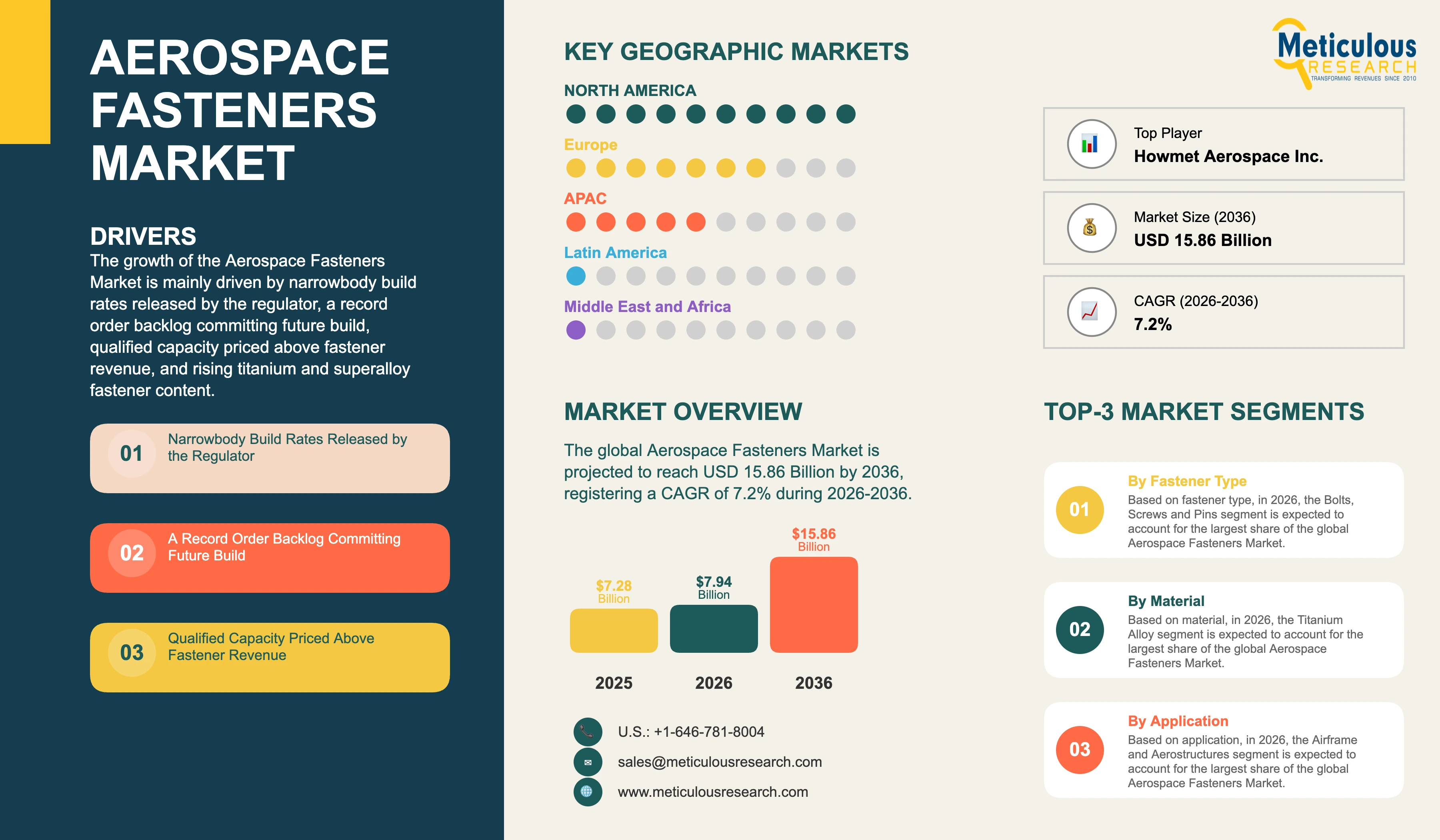
The global Aerospace Fasteners Market was valued at USD 7.28 billion in 2025. This market is expected to reach USD 15.86 billion by 2036 from an estimated USD 7.94 billion in 2026, registering a CAGR of 7.2% during the forecast period (2026-2036).
- Published
- Nov 2026
- Pages
- 278
- Format
- PDF + Excel
- Report ID
- MRAD - 1042834
- Base year
- 2025
- 2024 · HISTORICAL
- $1.58B
- 2036
- $15.86B
- CAGR 2026–2036
- 7.2%
2024–2025 baseline · 2026–2036 forecast at 7.2% CAGR · hover a bar for the value
Key highlights
The global Aerospace Fasteners Market is projected to reach USD 15.86 billion by 2036, driven by narrowbody build rates released by the regulator, a record order backlog committing future build, qualified capacity priced above fastener revenue, and titanium fastener content on composite airframes.
North America is expected to account for the largest market share in 2026 and is also projected to register the fastest growth during the forecast period, supported by the concentration of airframe and engine final assembly in the region together with the largest installed base of qualified fastener manufacturing and special process capacity.
By fastener type, Bolts, Screws and Pins are expected to account for the largest market share, whereas Blind Fasteners and Blind Rivets are projected to witness the fastest growth through 2036.
By material, Titanium Alloy fasteners are expected to account for the largest market share, whereas Nickel-Base Superalloy fasteners are projected to witness the fastest growth through 2036.
By application, Airframe and Aerostructures are expected to account for the largest market share, whereas Engines and Nacelles are projected to witness the fastest growth through 2036.
The Federal Aviation Administration raised the Boeing 737 MAX production cap from 38 to 42 aircraft a month in October 2025, which releases narrowbody fastener demand that had been held at a regulated ceiling.
Airbus delivered 793 commercial aircraft in 2025 against 766 in 2024, comprising 93 A220, 607 A320 family, 36 A330 and 57 A350 aircraft, and took 1,000 gross and 889 net orders from 57 customers.
The Airbus backlog stood at a year-end record 8, 754 aircraft at the end of 2025, with a record widebody backlog of 1,124 aircraft, which commits fastener demand well beyond the forecast period.
Boeing delivered 600 commercial airplanes in 2025, comprising 447 of the 737 family, 88 of the 787, 35 of the 777 and 30 of the 767, alongside 131 defense, space and security deliveries.
Howmet Aerospace recorded Fastening Systems third-party sales of USD 1, 745 million in 2025 against USD 1,576 million in 2024, up 11%, with segment adjusted EBITDA of USD 530 million against USD 406 million, up 31%, at a margin of 30.4% against 25.8%, the growth attributed primarily to the commercial aerospace market.
LISI AEROSPACE reported revenue of EUR 1, 191.1 million in 2025 against EUR 1,030.1 million in 2024, up 15.6% and 18.3% organically, with fastener sales in North America up 18.4% on the Boeing ramp-up and sales price catch-up and in Europe up 14.4% following Airbus and the gradual A350 ramp-up, and a book-to-bill ratio well above 1.
Qualified fastener capacity is transacting at close to four times sales, with Howmet Aerospace agreeing on 22 December 2025 to acquire Consolidated Aerospace Manufacturing from Stanley Black & Decker for approximately USD 1.8 billion in cash against expected 2025 revenue of USD 405 million to USD 415 million, and TriMas completing the divestiture of TriMas Aerospace to PennAero on 16 March 2026 for approximately USD 1.45 billion in cash against 2025 net sales of USD 396.4 million.
Titanium alloys, nickel alloys and stainless steels are named as the important raw material inputs for aerospace fastening systems, which ties fastener cost and availability to mill product supply in three separately constrained alloy families.
Report summary
| Particulars | Details |
|---|---|
| Forecast Period | 2026-2036 |
| Base Year | 2025 |
| Estimated Year | 2026 |
| CAGR (Value) | 7.2% |
| Format | PDF, Excel & Cloud Portal · 278 pages |
| CAGR (Volume) | 4.9% |
| Market Size (Value) in 2026 | USD 7.94 billion |
| Market Size (Value) in 2036 | USD 15.86 billion |
| Market Size (Volume) in 2026 | 24.60 billion fasteners shipped |
| Market Size (Volume) in 2036 | 39.80 billion fasteners |
| Average Selling Price, 2026 | USD 0.323 per fastener |
| Average Selling Price, 2036 | USD 0.399 per fastener |
| Segments Covered | By Fastener Type: Bolts, Screws and Pins, Solid Rivets, Blind Fasteners and Blind Rivets, Nuts, Collars and Nutplates, Quick-Release and Latching Hardware, Other Fasteners. By Material: Titanium Alloy, Aluminum Alloy, Stainless Steel and Alloy Steel, Nickel-Base Superalloy, Other Materials. By Application: Airframe and Aerostructures, Engines and Nacelles, Landing Gear and Actuation, Interiors and Systems Installation, Other Applications. By End Use: Commercial Aircraft OEM, Defense Aircraft and Rotorcraft, Aftermarket and MRO, Space Launch and Satellites, Other End Uses. |
| Countries Covered | U.S.; Canada; France; Germany; U.K.; Italy; China; Japan; India; South Korea; Mexico; Brazil |
| Key Companies | Howmet Aerospace Inc., Precision Castparts Corp., LISI S.A., PennAero, and Incora |
Report overview
Segments covered: fastener type, material, application, end use.
The growth of this market is mainly driven by narrowbody build rates released by the regulator when the Federal Aviation Administration raised the 737 MAX production cap from 38 to 42 aircraft a month in October 2025, a record Airbus year-end backlog of 8,754 aircraft, qualified fastener capacity transacting at close to four times sales, and rising titanium fastener content on composite airframes. However, factors such as qualification and special process approval timelines that fix short-run supply, concentration of titanium alloy, nickel alloy and stainless steel mill product supply, fastener shortages that stop assembly lines rather than merely delaying them, and limited build rate visibility against the capacity investment required are expected to restrain the growth of this market to some extent.
The Aerospace Fasteners Market comprises fasteners and associated installed hardware supplied for aircraft, engine, rotorcraft and space vehicle assembly and maintenance, taken at the fastener manufacturer gate with volume expressed as fasteners shipped. The market includes Bolts, Screws and Pins, Solid Rivets, Blind Fasteners and Blind Rivets, Nuts, Collars and Nutplates, and Quick-Release and Latching Hardware, supplied in titanium alloy, aluminum alloy, stainless steel and alloy steel, and nickel-base superalloy, for airframe and aerostructures, engines and nacelles, landing gear and actuation, and interiors and systems installation, across commercial aircraft original equipment manufacture, defense aircraft and rotorcraft, aftermarket and maintenance, repair and overhaul, and space launch and satellites. Distribution margin on resold hardware, structural castings and forgings that are not fasteners, bearings, bushings and seals, adhesives and sealants, automated drilling and fastening equipment, and the airframe and engine assemblies themselves fall outside the scope.
An airframe is joined by hundreds of thousands of individual fasteners, each approved against a specific material, coating, hole fit and installation method on a specific platform, and a shortage of one part number stops the station rather than slowing it. The consequence of a missing part therefore bears no relation to its unit value, which is why fastener supply is carried on program risk registers alongside engines and aerostructures rather than managed as a procurement line item.
The Federal Aviation Administration raised the Boeing 737 MAX production cap from 38 to 42 aircraft a month in October 2025, releasing narrowbody demand that had been held at a regulated ceiling since early 2024, and Boeing delivered 600 commercial airplanes in 2025 including 447 of the 737 family. Airbus delivered 793 commercial aircraft against 766 in 2024 and reported a year-end record backlog of 8,754 aircraft, with a record widebody backlog of 1,124. Fastener content per shipset is fixed at design, so each rate step converts into shipments against a schedule that is contracted rather than forecast.
Howmet Aerospace recorded Fastening Systems third-party sales of USD 1,745 million in 2025 against USD 1,576 million in 2024, with segment adjusted EBITDA up 31% to USD 530 million at a margin of 30.4%, attributing the growth primarily to commercial aerospace. LISI AEROSPACE reported revenue of EUR 1,191.1 million against EUR 1,030.1 million, with fastener sales in North America up 18.4% on the Boeing ramp-up and sales price catch-up and in Europe up 14.4% following Airbus and the gradual A350 ramp-up, on a book-to-bill ratio well above 1. Both sets of results follow the rate increase rather than any change in what is being supplied.
A fastener is approved against a part number, a material specification, an accredited special process source for heat treatment and plating, and a first article inspection on a named platform, and changing any of those elements reopens the approval. The incumbent consequently holds the position for the life of the program, and a new entrant competes on capacity it cannot yet supply rather than on price. Margins of 30.4% on small metal parts rest on that approval record rather than on the part itself.
Howmet Aerospace agreed on 22 December 2025 to acquire Consolidated Aerospace Manufacturing from Stanley Black & Decker for approximately USD 1.8 billion in cash against expected 2025 revenue of USD 405 million to USD 415 million and an adjusted EBITDA margin approaching the high teens, and completed the acquisition of Brunner Manufacturing Co. Inc. on 6 February 2026. TriMas completed the divestiture of TriMas Aerospace to PennAero, a portfolio company of Tinicum L.P. and funds managed by Blackstone, Inc., on 16 March 2026 for approximately USD 1.45 billion in cash against 2025 net sales of USD 396.4 million. Qualification cannot be compressed within a program cycle, so approved capacity is being acquired rather than developed.
Titanium alloys, nickel alloys and stainless steels are named as the important raw material inputs for aerospace fastening systems, and each is supplied through a separately constrained mill product chain. Composite airframes raise titanium content because carbon fiber is galvanically incompatible with aluminum fasteners, and engine build and overhaul draws nickel-base superalloy fasteners for hot section hardware. Titanium Alloy accordingly holds the largest material share of this market at 38.0% in 2026 while Nickel-Base Superalloy grows fastest at 9.6%, and value grows ahead of volume throughout at 7.2% against 4.9% as the mix moves toward the costlier alloy families.
Launch vehicle and satellite manufacture has moved from one-off builds to repeating production, which turns fastener supply for space hardware from a special order into a scheduled line item. Space Launch and Satellites is projected to be the fastest-growing end use in this market at 11.8% from a small base. The specifications are demanding and the volumes modest, which suits suppliers with short-run capability and existing high-temperature and high-strength alloy approvals rather than those geared to airframe volume.
Approved capacity is changing hands at close to four times sales, with Consolidated Aerospace Manufacturing agreed at approximately USD 1.8 billion against USD 405 million to USD 415 million of expected 2025 revenue and TriMas Aerospace sold for approximately USD 1.45 billion against USD 396.4 million of 2025 net sales. An independent business holding platform approvals therefore has a realizable value well above its earnings, and an acquirer gains qualified positions that cannot be created organically inside a program cycle.
Consolidated Aerospace Manufacturing supplies critical fasteners, fittings and other engineered components under the Aerofit, Voss and QRP brands, with products including quick-release pins, latches and tube assemblies, to customers including Boeing and Airbus as well as defense applications. Selling installed hardware alongside fasteners raises the value captured per shipset without requiring a new customer relationship, and Quick-Release and Latching Hardware carries a higher value per piece than any rivet category in this market.
North America is expected to account for the largest share of this market in 2026 at 42.0%, supported by Boeing final assembly, the largest concentration of engine manufacture and the deepest base of qualified fastener capacity and accredited special process sources.
Europe accounts for 31.0% of this market in 2026 and is projected to grow at 6.8%. France carries Airbus final assembly and the largest regional fastener manufacturing base, with LISI AEROSPACE reporting revenue of EUR 1,191.1 million in 2025, up 15.6%, and European fastener sales up 14.4% following Airbus and the gradual A350 ramp-up. Germany, the United Kingdom and Italy hold aerostructure, engine and systems work packages. The Airbus year-end record backlog of 8,754 aircraft, including a record widebody backlog of 1,124, commits regional demand through the forecast period.
The Middle East & Africa region holds 3.0% of this market in 2026 with projected growth of 8.0%, concentrated in maintenance, repair and overhaul activity at the Gulf hub carriers and in developing aerostructure and defense manufacturing programs, which weights the mix toward replacement hardware in standard part numbers. Latin America holds 4.0% with projected growth of 7.4%, with Mexico accounting for most regional volume through aerospace machining, special process and fastener capacity in the Querétaro and Chihuahua clusters serving North American assembly, and Brazilian demand following regional jet manufacture.
Some of the key players operating in the aerospace fasteners market are Howmet Aerospace Inc., Precision Castparts Corp., LISI S.A., PennAero, and Incora, among others.
Key strategies include acquiring businesses that already hold platform approvals, since qualification cannot be compressed, as in the Consolidated Aerospace Manufacturing and Brunner Manufacturing transactions; recovering price on long-term agreements alongside rate increases, which lifted Howmet Fastening Systems margin to 30.4% from 25.8%; extending portfolios into fittings and latching hardware sold on the same shipset; investing in forging, machining and accredited special process capacity ahead of contracted rates; and qualifying regional capacity close to growing Asia-Pacific work packages.
Report infographic
Market dynamics
16 factors across 4 forcesNarrowbody Build Rates Released by the Regulator
The Federal Aviation Administration raised the Boeing 737 MAX production cap from 38 to 42 aircraft a month in October 2025, lifting a regulated ceiling that had held narrowbody output below commercial demand since early 2024. Boeing delivered 600 commercial airplanes in 2025 including 447 of the 737 family, and each rate step converts directly into fastener shipments because the fastener content of a shipset is fixed by design rather than by purchasing. Suppliers recorded the effect in the same period, with LISI AEROSPACE reporting fastener sales in North America up 18.4% on the Boeing ramp-up and sales price catch-up. Commercial Aircraft OEM holds the largest end use share of this market in 2026 as a result, and because the ceiling is set by the regulator rather than by the airframer, further rate increases are visible to suppliers in advance rather than inferred from order intake.
A Record Order Backlog Committing Future Build
Airbus reported a year-end record backlog of 8,754 aircraft at the end of 2025, including a record widebody backlog of 1,124, after taking 1,000 gross and 889 net orders from 57 customers during the year. A backlog of that depth converts fastener demand from a forecast into a committed schedule, because the aircraft are sold and the delivery slots are contracted. Airbus delivered 793 commercial aircraft in 2025 against 766 in 2024, comprising 93 A220, 607 A320 family, 36 A330 and 57 A350 aircraft. The widebody share of that backlog carries more weight in fastener value than in aircraft count, since a widebody shipset uses both more fasteners and a higher proportion of titanium than a narrowbody, which lifts regional value ahead of regional volume wherever widebody work is concentrated.
Qualified Capacity Priced Above Fastener Revenue
Howmet Aerospace agreed on 22 December 2025 to acquire Consolidated Aerospace Manufacturing from Stanley Black & Decker for approximately USD 1.8 billion in cash, against expected 2025 revenue of USD 405 million to USD 415 million and an adjusted EBITDA margin approaching the high teens. TriMas completed the divestiture of TriMas Aerospace to PennAero on 16 March 2026 for approximately USD 1.45 billion in cash, against 2025 net sales of USD 396.4 million. Both transactions value a qualified fastener business at close to four times annual sales, which sets a market price for approved capacity and gives incumbents a return on capacity investment independent of the fastener margin. Howmet also completed the acquisition of Brunner Manufacturing Co. Inc. on 6 February 2026, so small approved positions are being bought on the same reasoning as large ones.
Titanium Fastener Content on Composite Airframes
Carbon fiber reinforced structure is galvanically incompatible with aluminum fasteners, so a composite wing or fuselage is joined predominantly in titanium alloy. The A350 and the 787 carry that content through the primary structure, and Airbus reported 57 A350 deliveries in 2025 with a record widebody backlog of 1,124 aircraft while Boeing delivered 88 of the 787. Titanium Alloy holds the largest material share of this market at 38.0% in 2026 as a result, and titanium alloys are named among the important raw material inputs for aerospace fastening systems alongside nickel alloys and stainless steels. Because the material choice follows from the structure rather than from cost, the content cannot be engineered back toward aluminum within a platform, which fixes the titanium share for the service life of every composite aircraft delivered.
Engine Build and Overhaul Driving Superalloy Fasteners
Engine hot section hardware is fastened in nickel-base superalloy because service temperatures and cyclic loading exceed what titanium or steel fasteners tolerate, and the same parts are consumed again at every shop visit rather than only at build. Engines and Nacelles is accordingly projected to be the fastest-growing application in this market at 8.4% and Nickel-Base Superalloy the fastest-growing material at 9.6%. Overhaul demand follows the installed fleet and flying hours rather than new aircraft deliveries, so this part of the market runs on a different cycle from airframe assembly. That gives suppliers with superalloy approvals a base of consumption that holds when delivery rates pause, which is the closest thing to a defensive position available in a market otherwise tied to build rate.
Table of contents
12 chapters · 139 sections · 278 pages · click to expandSegmental analysis
| Segment | Largest share (2026) | Fastest growth (2026–2036) |
|---|---|---|
| By Fastener Type | Bolts, Screws and Pins | Blind Fasteners and Blind Rivets |
| By Material | Titanium Alloy fasteners | Nickel-Base Superalloy fasteners |
| By Application | Airframe and Aerostructures | Engines and Nacelles |
| By End use | Commercial Aircraft OEM | Space Launch and Satellites |
| Other segments | Titanium Alloy fasteners | — |
By Fastener Type
- Aerospace Fasteners Market Analysis by Fastener Type
- Bolts, Screws and Pins are expected to account for the largest share of the global Aerospace Fasteners Market.
- The large share of this segment is mainly due to their use in the structural joints, engine mounts, landing gear attachments and primary load paths where the fastener carries certified strength, which places them at the top of the value per piece range and across every platform area.
- However, Blind Fasteners and Blind Rivets are projected to register the highest CAGR during the forecast period.
- The rapid growth of this segment is attributed to the growth of one-sided access joints on composite assemblies and closed structures, where a solid rivet cannot be bucked, together with their suitability for the automated installation cells airframers are adding to reach contracted build rates.
- Bolts, Screws and Pins are expected to account for the largest market share in 2026.
- Blind Fasteners and Blind Rivets are projected to register the highest CAGR during the forecast period, owing to the growth of one-sided access joints on composite assemblies and closed structures, where a solid rivet cannot be bucked, together with their suitability for the automated installation cells airframers are adding to reach contracted build rates.
- Nickel-Base Superalloy fasteners are projected to register the highest CAGR during the forecast period, owing to service temperatures and cyclic loading in engine hot sections that titanium and steel fasteners cannot tolerate, combined with replacement of the same hardware at every shop visit rather than only at build.
- Engines and Nacelles are projected to register the highest CAGR during the forecast period, owing to nickel-base superalloy fastener content in hot section hardware, engine build supporting record narrowbody and widebody deliveries, and overhaul demand that follows the installed fleet and flying hours rather than new build.
- Space Launch and Satellites are projected to register the highest CAGR during the forecast period, owing to the move of launch vehicle and satellite manufacture from one-off builds to repeating production, which converts fastener supply for space hardware from a special order into a scheduled line item on demanding specifications and modest volumes.
By Material
- Aerospace Fasteners Market Analysis by Material
- Titanium Alloy fasteners are expected to account for the largest market share.
- The large share of this segment is mainly due to the galvanic incompatibility of carbon fiber structure with aluminum fasteners, which makes titanium the default on composite primary structure across the A350, the 787 and current derivative programs, at a cost per piece well above aluminum.
- However, Nickel-Base Superalloy fasteners are projected to register the highest CAGR during the forecast period.
- The rapid growth of this segment is attributed to service temperatures and cyclic loading in engine hot sections that titanium and steel fasteners cannot tolerate, combined with replacement of the same hardware at every shop visit rather than only at build.
By Application
- Aerospace Fasteners Market Analysis by Application
- Airframe and Aerostructures are expected to account for the largest market share.
- The large share of this segment is mainly due to the number of individual joints in a fuselage, wing and empennage relative to any other part of the aircraft, and the direct link between airframe fastener consumption and the delivery rates behind the Airbus backlog of 8,754 aircraft.
- However, Engines and Nacelles are projected to register the highest CAGR during the forecast period.
- The rapid growth of this segment is attributed to nickel-base superalloy fastener content in hot section hardware, engine build supporting record narrowbody and widebody deliveries, and overhaul demand that follows the installed fleet and flying hours rather than new build.
By End use
- Aerospace Fasteners Market Analysis by End Use
- Commercial Aircraft OEM are expected to account for the largest market share.
- The large share of this segment is mainly due to combined Airbus and Boeing deliveries of 793 and 600 aircraft respectively in 2025, the release of the 737 MAX production cap from 38 to 42 aircraft a month in October 2025, and committed backlogs that fix the delivery schedule rather than forecast it.
- However, Space Launch and Satellites are projected to register the highest CAGR during the forecast period.
- The rapid growth of this segment is attributed to the move of launch vehicle and satellite manufacture from one-off builds to repeating production, which converts fastener supply for space hardware from a special order into a scheduled line item on demanding specifications and modest volumes.
Other segments
- Titanium Alloy fasteners are expected to account for the largest market share in 2026.
- Airframe and Aerostructures are expected to account for the largest market share in 2026.
- Commercial Aircraft OEM are expected to account for the largest market share in 2026.
Geographic analysis
Asia-Pacific
Fastest growthAsia-Pacific holds 20.0% of this market in 2026 and is projected to be the fastest-growing region at 9.2%, with India projected to be the fastest-growing country at 11.4%. Regional aerostructure work packages, engine component manufacture and a rapidly expanding maintenance base are each adding fastener demand, and supplying them from North America or Europe carries freight and lead time that approved local capacity removes. Qualification with the regional work package holders rather than price is what secures that volume. Asia-Pacific represents 20.0% of this market in 2026 and is projected to be the fastest-growing region at 9.2%. India is projected to be the fastest-growing country in this market at 11.4%, on aerostructure and engine component work packages together with a rapidly expanding maintenance base. China holds the largest regional volume across domestic programs and work package manufacture. Japan is projected to be the slowest-growing country at 5.2%, where composite and structural work packages are long established and consumption tracks the platforms already supplied. South Korean demand spans aerostructures, rotorcraft and defense programs, and because approval attaches to the part number and the process source, regional capacity has to be accredited before any of that work transfers from incumbent suppliers. Asia-Pacific is projected to register the highest CAGR at 9.2%, on aerostructure and engine component work packages together with a rapidly expanding maintenance base, with India projected to be the fastest-growing country at 11.4%. Asia-Pacific Build and Aftermarket Growth Geographic Analysis
North America
Largest shareNorth America holds the largest share of this market in 2026 at 42.0% and is projected to grow at 6.4%. The United States carries Boeing final assembly, the largest concentration of engine manufacture and the deepest base of qualified fastener capacity and accredited special process sources, with Boeing delivering 600 commercial airplanes and 131 defense, space and security products in 2025. The release of the 737 MAX production cap from 38 to 42 aircraft a month in October 2025 bears directly on regional demand. Supplier capacity is consolidating in the region, with Howmet Aerospace completing the acquisition of Brunner Manufacturing Co. Inc. on 6 February 2026 and agreeing to acquire Consolidated Aerospace Manufacturing, and PennAero acquiring the former TriMas Aerospace business on 16 March 2026, which concentrates approved capacity in fewer hands while regional demand is rising. Canadian demand follows regional jet and aerostructure manufacture. Mexico accounts for most regional volume, with aerospace machining, special process and fastener capacity concentrated in the Querétaro and Chihuahua clusters serving North American assembly, and Brazilian demand following regional jet manufacture and its supplier base. Approval attaches to the part number and the process source rather than to the location, so accredited regional capacity competes for the same qualifications as North American capacity and at a lower cost base.
Europe
Europe accounts for 31.0% of this market in 2026 with projected growth of 6.8%. France carries Airbus final assembly and the largest regional fastener manufacturing base, with LISI AEROSPACE reporting revenue of EUR 1,191.1 million in 2025 and European fastener sales up 14.4% following Airbus and the gradual A350 ramp-up. Germany, the United Kingdom and Italy hold aerostructure, engine and systems work packages that consume fastener content at the subassembly stage rather than at final assembly. The Airbus year-end record backlog of 8,754 aircraft, including a record widebody backlog of 1,124, commits regional demand through the forecast period, and division investment of EUR 63.8 million in 2025 against EUR 54.4 million in 2024 shows the capacity being added against it.
Latin America
Latin America holds 4.0% of this market in 2026 and is projected to grow at 7.4%.
Middle East & Africa
The Middle East & Africa region accounts for 3.0% of this market in 2026 and is projected to grow at 8.0% from a small base. Demand is concentrated in maintenance, repair and overhaul activity at the Gulf hub carriers and in developing aerostructure and defense manufacturing programs. Aftermarket consumption rather than original equipment build carries regional volume, which weights the mix toward replacement hardware in standard part numbers and away from the platform-specific structural fasteners that carry the higher realization.
Competitive landscape
The global Aerospace Fasteners Market is consolidated, with competition among vertically integrated aerospace fastening groups, specialist fastener manufacturers and aerospace hardware distributors. Market participants compete primarily on breadth of platform approvals and part number coverage, special process accreditation for heat treatment and plating, qualified alloy supply positions, delivery performance against build rate changes, and capability in titanium and nickel-base superalloy fasteners.
acquiring businesses that hold platform approvals rather than building capacity organically, recovering price on long-term agreements alongside rate increases, extending portfolios into fittings and latching hardware, and investing in forging, machining and special process capacity ahead of contracted rates
The report provides a comprehensive competitive assessment of the leading companies operating in the global Aerospace Fasteners Market. The key players profiled in the report include Howmet Aerospace Inc. (U.S.), Precision Castparts Corp. (U.S.), LISI S.A. (France), PennAero (U.S.), and Incora (U.S.).
- Howmet Aerospace Inc.
- Precision Castparts Corp.
- LISI S.A.
- PennAero
- Incora
Expert perspectives
A fastener is approved against a part number, a material specification, an accredited special process source and a first article inspection on a named platform, and the incumbent holds that position for the life of the program. Howmet Fastening Systems delivered a 30.4% adjusted EBITDA margin on USD 1,745 million of 2025 sales on that basis, which is a return on an approval record rather than on manufacturing capability. Cost per piece is consequently the weakest ground on which to compete, since the approval rather than the price decides which part number can be installed.
Consolidated Aerospace Manufacturing was agreed at approximately USD 1.8 billion against USD 405 million to USD 415 million of expected 2025 revenue, and TriMas Aerospace changed hands at approximately USD 1.45 billion against USD 396.4 million of 2025 net sales. Close to four times sales for businesses making small metal parts values the qualification record rather than the plant, and it gives an incumbent a return on capacity investment that does not depend on the fastener margin. Capacity added now therefore carries two routes to value, supply at rate and resale of the approvals built around it.
Titanium Alloy at 38.0% of the market in 2026 is protected by the galvanic incompatibility of carbon fiber with aluminum, which follows from the structure rather than from cost and cannot be reversed within a platform, and Nickel-Base Superalloy growing at 9.6% is protected by engine hot section temperatures and by replacement at every shop visit. Both rest on qualified mill supply in concentrated alloy chains, so the supplier holding the alloy position and the special process accreditation holds the part number with it. Aluminum rivet volume is where regional capacity and price competition will concentrate instead.
Customer perspectives
“A fastener is a few cents and it can stop a station worth millions, which is why it sits on the program risk register next to engines. We cannot substitute, because the part number is approved against a platform and a process source. So what we buy is not the part, it is the certainty that the part arrives at rate every month for the next twenty years.”
“Rates moved up and we had the capacity, but the part that took longest was not the machining, it was the special process approvals and the first article work on each new number. You cannot compress that. We have also finally been able to reprice agreements that were written when titanium cost half what it does now.”
“Our consumption does not follow new aircraft deliveries, it follows flying hours, because the hot section hardware gets replaced at every shop visit. The superalloy fasteners are the ones we watch, since there are only a handful of approved mills behind them and a shortage there is not something we can engineer around.”
Frequently asked questions
The global Aerospace Fasteners Market is estimated at USD 7.94 billion in 2026.
The market is projected to reach USD 15.86 billion by 2036.
The market is expected to grow at a CAGR of 7.2% during 2026-2036.
Growth is driven by the Federal Aviation Administration raising the Boeing 737 MAX production cap from 38 to 42 aircraft a month in October 2025, a record Airbus year-end backlog of 8,754 aircraft, and qualified fastener capacity transacting at close to four times sales. Rising titanium fastener content on composite airframes and engine build and overhaul driving nickel-base superalloy fasteners also contribute.
Airbus delivered 793 commercial aircraft in 2025 against 766 in 2024, ending the year with a record backlog of 8,754 aircraft. Boeing delivered 600 commercial airplanes, comprising 447 of the 737 family, 88 of the 787, 35 of the 777 and 30 of the 767, alongside 131 defense, space and security deliveries.
A fastener is approved against a specific part number, material specification, accredited special process source and first article inspection on a named platform, and changing any element reopens the approval. A missing part number halts the station rather than slowing it, because the joint cannot be left open.
Howmet Aerospace agreed on 22 December 2025 to acquire Consolidated Aerospace Manufacturing from Stanley Black & Decker for approximately USD 1.8 billion in cash, against expected 2025 revenue of USD 405 million to USD 415 million. TriMas completed the divestiture of TriMas Aerospace to PennAero on 16 March 2026 for approximately USD 1.45 billion in cash, against 2025 net sales of USD 396.4 million.
The principal challenges are qualification and special process approval timelines that fix short-run supply, concentration of titanium alloy, nickel alloy and stainless steel mill product supply, and fastener shortages that halt assembly stations. Limited build rate visibility against multi-year capacity lead times and a distribution layer carrying inventory risk, shown by Incora emerging from Chapter 11 on 31 January 2025, are also challenges.
Emerging technologies include automated drilling and fastening cells requiring tighter tolerance than hand installation, blind fastener systems for one-sided access on composite and closed structures, and interference fit and hole preparation methods. Coatings, sealants and lightning strike protection at the fastener interface, and nickel-base superalloy fasteners for engine hot section hardware, are also named.
Production rate itself is regulated, with the Federal Aviation Administration raising the Boeing 737 MAX production cap from 38 to 42 aircraft a month in October 2025. Supply requires aerospace quality management system certification, special process accreditation, first article inspection and source approval on each part number, and controls against counterfeit and unapproved parts, with export control and domestic sourcing requirements for defense and space work.
Bolts, Screws and Pins are expected to account for the largest market share in 2026.
Blind Fasteners and Blind Rivets are projected to register the highest CAGR during the forecast period, owing to the growth of one-sided access joints on composite assemblies and closed structures. They are also suited to the automated installation cells airframers are adding to reach contracted build rates.
Titanium Alloy fasteners are expected to account for the largest market share in 2026.
Nickel-Base Superalloy fasteners are projected to register the highest CAGR during the forecast period, owing to engine hot section service temperatures and cyclic loading that titanium and steel fasteners cannot tolerate. The same hardware is also replaced at every shop visit rather than only at build.
Airframe and Aerostructures are expected to account for the largest market share in 2026.
Engines and Nacelles are projected to register the highest CAGR during the forecast period, owing to nickel-base superalloy fastener content in hot section hardware and engine build supporting record deliveries. Overhaul demand that follows the installed fleet and flying hours also contributes.
Commercial Aircraft OEM are expected to account for the largest market share in 2026.
Space Launch and Satellites are projected to register the highest CAGR during the forecast period, owing to the move of launch vehicle and satellite manufacture from one-off builds to repeating production. This converts fastener supply for space hardware from a special order into a scheduled line item.
North America is expected to account for the largest share of this market in 2026 at 42.0%, supported by Boeing final assembly, the largest concentration of engine manufacture and the deepest base of qualified fastener capacity and accredited special process sources.
Asia-Pacific is projected to register the highest CAGR at 9.2%, on aerostructure and engine component work packages together with a rapidly expanding maintenance base. India is projected to be the fastest-growing country at 11.4%.
Europe accounts for 31.0% of this market in 2026 and is projected to grow at 6.8%. France carries Airbus final assembly and the largest regional fastener manufacturing base, and the Airbus record backlog of 8,754 aircraft commits regional demand through the forecast period.
The Middle East & Africa region holds 3.0% of this market in 2026 with projected growth of 8.0%, concentrated in maintenance, repair and overhaul activity at the Gulf hub carriers. Latin America holds 4.0% with projected growth of 7.4%, with Mexico accounting for most regional volume.
Some of the key players operating in the aerospace fasteners market are Howmet Aerospace Inc., Precision Castparts Corp., LISI S.A., PennAero, and Incora, among others.
Key strategies include acquiring businesses that already hold platform approvals, recovering price on long-term agreements alongside rate increases, and extending portfolios into fittings and latching hardware. Companies are also investing in forging, machining and accredited special process capacity ahead of contracted rates, and qualifying regional capacity close to growing Asia-Pacific work packages.
Cite this report
Meticulous Research. (2026). Aerospace Fasteners Market - Global Opportunity Analysis and Industry Forecast (2026-2036) (Report No. MRAD - 1042834). Meticulous Market Research Pvt. Ltd. https://www.meticulousresearch.com/product/aerospace-fasteners-market-7517