Aerospace and Defense Additive Manufacturing Spare Parts Market (2026-2036)
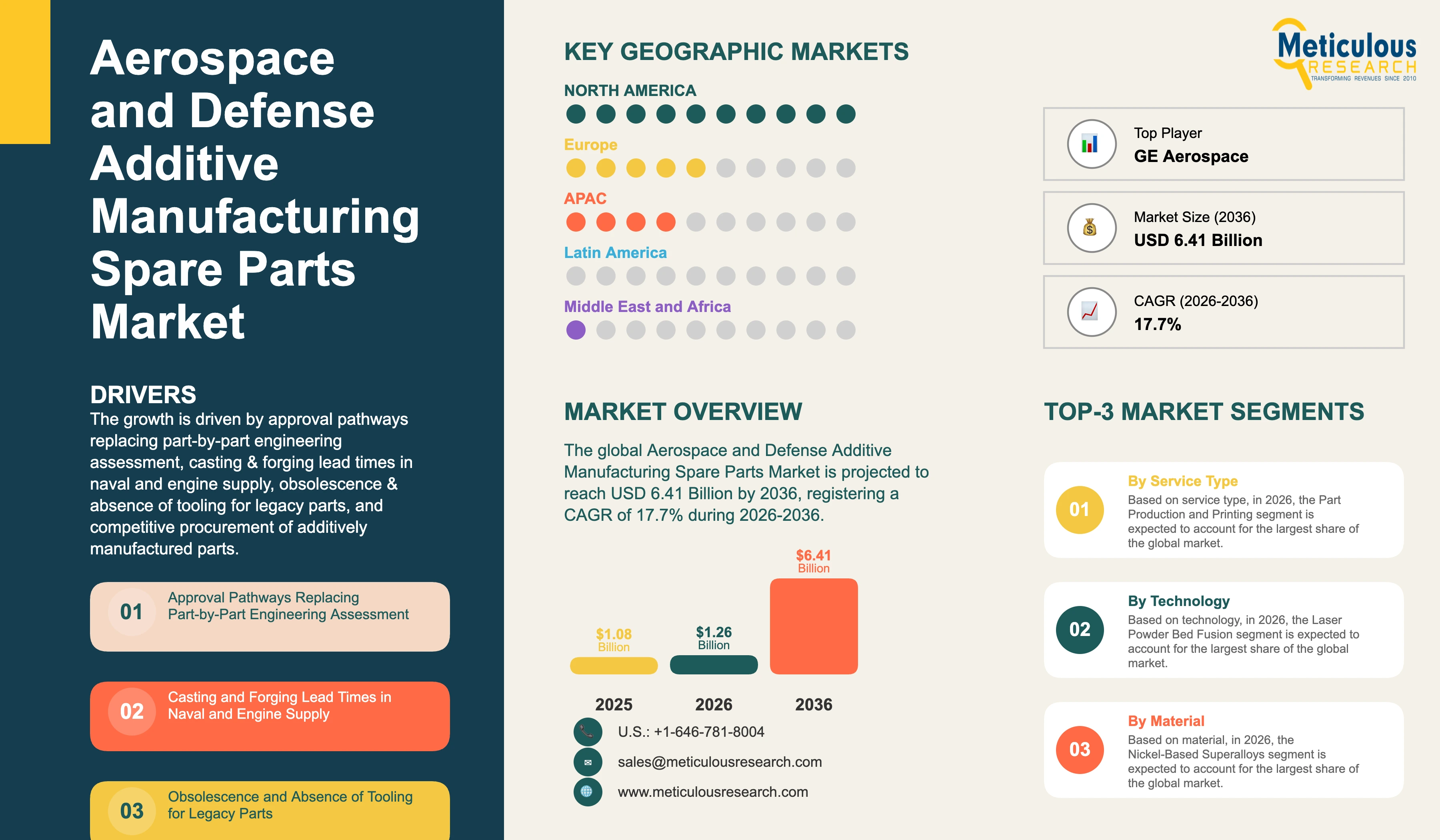
The global Aerospace and Defense Additive Manufacturing Spare Parts Market was valued at USD 1.08 billion in 2025. This market is expected to reach USD 6.41 billion by 2036 from an estimated USD 1.26 billion in 2026, registering a CAGR of 17.7% during the forecast period (2026-2036).
- Published
- Nov 2026
- Pages
- 281
- Format
- PDF + Excel
- Report ID
- MRAD - 1042848
- Base year
- 2025
- 2025 · BASELINE
- $1.08B
- 2036
- $6.41B
- CAGR 2026–2036
- 17.7%
2025 baseline · 2026–2036 forecast at 17.7% CAGR · hover a bar for the value
Key highlights
The global Aerospace and Defense Additive Manufacturing Spare Parts Market is projected to reach USD 6.41 billion by 2036, driven by approval pathways replacing part-by-part engineering assessment, casting and forging lead times in naval and engine supply, obsolescence and absence of tooling for legacy parts, and competitive procurement of additively manufactured parts.
North America is expected to account for the largest market share in 2026 and is also projected to register the fastest growth during the forecast period, supported by the concentration of defense sustainment demand and depot and shipyard capacity in the region together with the approval documents and procurement mechanisms that allow printed parts to be bought and installed.
By service type, Part Production and Printing are expected to account for the largest market share, whereas Digital Part File Creation and Digital Inventory Management are projected to witness the fastest growth through 2036.
By technology, Laser Powder Bed Fusion are expected to account for the largest market share, whereas Binder Jetting are projected to witness the fastest growth through 2036.
By material, Nickel-Based Superalloys are expected to account for the largest market share, whereas Copper and Copper-Nickel Alloys are projected to witness the fastest growth through 2036.
The United States Navy approved Project Peculiar Document 802-8436658 in August 2026, creating a repeatable pathway to replace legacy cast and wrought metal parts with printed metallic parts and authorizing immediate operational use across submarine design, construction, overhaul and repair.
The document removes part-by-part engineering assessments, manual drawing changes and repeated first-article testing for each substitution, while retaining Level I material control and submarine safety system requirements and adding part tracking and non-destructive inspection.
Technical requirements were released on 11 August 2026 and are searchable through the Defense Logistics Agency Quick Search Portal and the Navy Digital Sea Resource Portal, and printed metal components already operate aboard USS Washington and USS Nevada.
The pathway supports the national objective of delivering one Columbia-class and two Virginia-class submarines a year, against which casting and forging lead times are the binding constraint.
The Defense Logistics Agency awarded its first competitive contract for additively manufactured parts on 18 November 2024, covering almost 1,300 F-15 pylon bumpers, where earlier purchases of printed parts had been sole-source.
That part was placed on contract within six months, and the customer supplied a technical data package containing three dimensional drawings, print files and quality assurance requirements.
Printing parameters on that contract are set and approved by service engineers rather than by the vendor, and service engineers decide whether a printed part meets conventional standards.
The Navy opened an additive manufacturing center of excellence at Danville, Virginia on 5 October 2022 within the state Center for Manufacturing Advancement, with three bays devoted to additive manufacturing and an adjacent training center planned to train about 1,000 defense manufacturing workers a year.
Training at that site covers welding, machining, metrology and additive manufacturing together, which reflects that a printed spare reaches a platform only after post-processing, machining and measurement.
Report summary
| Particulars | Details |
|---|---|
| Forecast Period | 2026-2036 |
| Base Year | 2025 |
| Estimated Year | 2026 |
| CAGR (Value) | 17.7% |
| Format | PDF, Excel & Cloud Portal · 281 pages |
| CAGR (Volume) | 15.1% |
| Market Size (Value) in 2026 | USD 1.26 billion |
| Market Size (Value) in 2036 | USD 6.41 billion |
| Market Size (Volume) in 2026 | 2.85 million parts |
| Market Size (Volume) in 2036 | 11.60 million parts |
| Average Selling Price, 2026 | USD 442 per part |
| Average Selling Price, 2036 | USD 553 per part |
| Segments Covered | By Service Type: Part Production and Printing, Post-Processing, Heat Treatment and Machining, Inspection, Qualification and Certification, Part Screening and Candidate Identification, Digital Part File Creation and Digital Inventory Management. By Technology: Laser Powder Bed Fusion, Directed Energy Deposition and Cold Spray, Binder Jetting, Polymer Extrusion and Fused Deposition, Other Additive Processes. By Material: Nickel-Based Superalloys, Titanium Alloys, Stainless and Specialty Steels, Aluminum Alloys, Copper and Copper-Nickel Alloys, Polymers and Composites. By Application: Engines and Propulsion Accessories, Military Fixed-Wing Aircraft, Military Rotorcraft, Naval Vessels and Submarines, Ground Vehicles, Ground Support and Test Equipment, Commercial Aviation Sustainment. |
| Countries Covered | U.S.; Canada; Germany; France; U.K.; Italy; China; Japan; India; South Korea; Mexico; Brazil |
| Key Companies | GE Aerospace, Stratasys Ltd., 3D Systems Corporation, Nikon Corporation, Safran S.A., Materialise NV, and Sintavia, LLC |
Report overview
Segments covered: service type, technology, material, application.
The growth of this market is mainly driven by approval pathways that replace part-by-part engineering assessment, casting and forging lead times in naval and engine supply, obsolescence and the absence of tooling for legacy parts, competitive procurement of additively manufactured parts, and aircraft and vessel availability pressure. However, factors such as technical data package ownership and availability, the qualification burden on high-consequence applications where material control and safety system requirements remain in force, unit cost against conventional production at volume, and qualified operator and inspection capacity are expected to restrain the growth of this market to some extent.
The Additive Spares Production Services Market comprises services that produce replacement parts for aerospace and defense sustainment using additive manufacturing, measured at the point of sale by service providers with volume expressed as parts delivered. The market covers part screening and candidate identification, digital part file creation and digital inventory management, part production and printing, post-processing, heat treatment and machining, and inspection, qualification and certification, delivered through laser powder bed fusion, directed energy deposition and cold spray, binder jetting, polymer extrusion and fused deposition and other processes, in nickel-based superalloys, titanium alloys, stainless and specialty steels, aluminum alloys, copper and copper-nickel alloys and polymers and composites, applied to engines and propulsion accessories, military fixed-wing aircraft, rotorcraft, naval vessels and submarines, ground vehicles, ground support and test equipment and commercial aviation sustainment. Additive equipment and powder sales, parts produced for original build rather than for sustainment, conventional spares manufacture, and repair processes that restore an existing part without producing a replacement fall outside the scope.
Approval rather than printing capability has governed this market, and that constraint has just been lifted in its largest segment. The United States Navy approved Project Peculiar Document 802-8436658 in August 2026, with technical requirements released on 11 August 2026, creating a repeatable pathway to replace legacy cast and wrought metal parts with printed metallic parts and authorizing immediate operational use across submarine design, construction, overhaul and repair. The previous route required part-by-part engineering assessments, manual drawing changes and repeated first-article testing for every substitution.
Quality requirements were retained rather than relaxed, which is what makes the pathway usable on safety-critical work. Level I material control and submarine safety system requirements remain in force and part tracking and non-destructive inspection were added, so the document removes duplicated approvals rather than the engineering standard behind them. Naval Vessels and Submarines is projected to be the fastest-growing application in this market at 23.2%, and printed metal components already operate aboard USS Washington and USS Nevada.
Procurement mechanics changed on the aviation side at about the same time. The Defense Logistics Agency awarded its first competitive contract for additively manufactured parts on 18 November 2024, covering almost 1,300 F-15 pylon bumpers against earlier purchases that had been sole-source, and that part was placed on contract within six months. Competition requires a technical data package the buyer can issue, in that case three dimensional drawings, print files and quality assurance requirements, which is why data availability rather than printing capacity determines how much of the spares catalog is addressable.
Control of the process has moved to the customer in the same step. Printing parameters on that contract are set and approved by service engineers rather than by the vendor, and service engineers decide whether a printed part meets conventional standards. A provider competing on that basis is selling capacity and compliance against a specified parameter set rather than selling its own process knowledge, which changes where margin sits in this market.
Value per part moves less than volume because the catalog broadens as it grows. Volume grows at 15.1% against value at 17.7% and average realized value rises from USD 442 per part in 2026 to USD 553 in 2036, as a mix shift toward qualified metal parts in nickel, titanium and copper-nickel offsets falling unit cost on polymer and high-volume metal work. Digital Part File Creation and Digital Inventory Management is projected to be the fastest-growing service type at 22.4%, since a qualified file can be printed repeatedly while a printed part is consumed once.
North America is expected to account for the largest share of this market in 2026, supported by the approval documents and procurement mechanisms that allow printed parts to be bought and installed, the concentration of depot, shipyard and service provider capacity, and government investment in production and training capability.
Europe is projected to be the fastest-growing region in this market at 18.4%. Germany grows at 19.0% as defense budget increases are applied to fleet availability alongside new equipment, while France, the United Kingdom and Italy carry the combat aircraft, rotorcraft, submarine and engine fleets that generate sustainment demand, alongside commercial aviation maintenance capacity in the same facilities. European operators sustain platforms whose original suppliers sit in several countries, so a qualified replacement produced without returning to the original manufacturer addresses a problem that spans national programs.
The Middle East & Africa region is projected to grow at 16.0%, with demand following maintenance of imported platforms where obsolescence and distance from the original supply base make lead time the governing consideration and where sustainment contracts increasingly specify local repair and production capability, delivered through accredited partners holding the qualification and the data. Latin America is projected to grow at 14.0% from the smallest regional base, with Mexico taking a growing share through machining and component capacity performing the post-processing and finishing stages a printed part requires, and Brazilian demand following regional jet and military aircraft sustainment and naval construction.
Some of the key players operating in the aerospace and defense additive manufacturing spare parts market are GE Aerospace, Stratasys Ltd., 3D Systems Corporation, Nikon Corporation, Safran S.A., Materialise NV, and Sintavia, LLC, among others.
Key strategies include building qualified part file libraries that recur with every order, since digital file and inventory services grow at 22.4% against part volume growth of 15.1%; qualifying materials such as copper-nickel where conventional foundry supply is narrow and slow, growing at 21.6%; adding binder jetting capacity matched to casting geometry and casting quantity, growing at 23.8%; placing equipment and qualified personnel inside customer depots and shipyards to remove transportation from delivery time; and holding post-processing and volumetric inspection in house, since customer-owned parameter sets commoditize the printing step itself.
Report infographic
Market dynamics
20 factors across 5 forcesApproval Pathways Replacing Part-by-Part Engineering Assessment
The United States Navy approved Project Peculiar Document 802-8436658 in August 2026, with technical requirements released on 11 August 2026, creating a repeatable pathway to replace legacy cast and wrought metal parts with printed metallic parts and authorizing immediate operational use across submarine design, construction, overhaul and repair. The previous route required part-by-part engineering assessments, manual drawing changes and repeated first-article testing for each substitution. Approval cost rather than print cost had made most candidate parts uneconomic, since the engineering effort to authorize a part could exceed the value of the parts bought. Removing that cost moves a large portion of a spares catalog from theoretically printable to commercially printable, and Naval Vessels and Submarines is projected to grow at 23.2% in this market on that basis.
Casting and Forging Lead Times in Naval and Engine Supply
The pathway approved in August 2026 supports the national objective of delivering one Columbia-class and two Virginia-class submarines a year, against which casting and forging lead times are the binding constraint. A valve body, impeller or housing ordered from a foundry carries pattern, melt and machining time measured in many months, and the same foundries serve new construction and sustainment from one order book. A printed replacement bypasses the pattern and the melt rather than merely moving up a queue, which is why the comparison that matters is availability rather than unit cost. Copper and Copper-Nickel Alloys is projected to grow at 21.6% in this market, reflecting the seawater system components where this substitution has the clearest case.
Obsolescence and Absence of Tooling for Legacy Parts
Platforms in service for decades carry parts whose original suppliers have exited, whose tooling has been scrapped and for which no vendor will build a pattern or die for an isolated order. The procurement question in those cases is not price but whether the part can be obtained at all. Additive production answers that question without tooling, which is why obsolete parts rather than high-volume parts form the initial candidate pool in most sustainment programs. Part Screening and Candidate Identification exists as a distinct service in this market because identifying which parts carry no viable conventional source is itself analytical work performed before any printing is quoted.
Competitive Procurement of Additively Manufactured Parts
The Defense Logistics Agency awarded its first competitive contract for additively manufactured parts on 18 November 2024, covering almost 1,300 F-15 pylon bumpers, where earlier purchases of printed parts had been sole-source either commercially or from government facilities. The part was placed on contract within six months and the buyer supplied a technical data package containing three dimensional drawings, print files and quality assurance requirements. Competition requires the buyer to hold and issue that data, and printing parameters on the contract are set and approved by service engineers rather than by the vendor. Opening printed parts to competitive award widens the supplier base beyond the providers that developed each part, and it moves price formation from negotiation to bid.
Aircraft Availability and Not-Mission-Capable Supply Rates
An aircraft or vessel held out of service awaiting a part carries a cost measured in availability rather than in the price of the part, and that cost falls on the operator rather than on the supply chain. Sustainment organizations therefore value delivery against a requirement date more highly than unit price on the parts that ground platforms. Engines and Propulsion Accessories holds the largest application share of this market in 2026 because engine accessory and hot section hardware combines high consumption with long conventional lead times. Printed spares enter against that availability measure, which is why the business case survives a unit cost above the conventional equivalent.
Table of contents
12 chapters · 144 sections · 281 pages · click to expandSegmental analysis
| Segment | Largest share (2026) | Fastest growth (2026–2036) |
|---|---|---|
| By Service Type | Part Production and Printing | Digital Part File Creation and Digital Inventory Management |
| By Technology | Laser Powder Bed Fusion | Binder Jetting |
| By Material | Nickel-Based Superalloys | Copper and Copper-Nickel Alloys |
| By Application | Engines and Propulsion Accessories | Naval Vessels and Submarines |
| Other segments | Laser Powder Bed Fusion | Digital Part File Creation and Digital Inventory Management |
By Service Type
- Part Production and Printing are expected to account for the largest share of the global Aerospace and Defense Additive Manufacturing Spare Parts Market.
- The large share of this segment is mainly due to the build operation being the element that consumes machine time, powder and energy on every part delivered, and the stage at which a sustainment organization places an order against a requirement date.
- However, Digital Part File Creation and Digital Inventory Management are projected to register the highest CAGR during the forecast period.
- The rapid growth of this segment is attributed to a qualified part file being printable repeatedly at any approved location while a physical spare is consumed once, with approval pathways and resources now published through supply portals rather than held by individual programs.
- Part Production and Printing are expected to account for the largest market share in 2026.
- Binder Jetting are projected to register the highest CAGR during the forecast period, owing to the production of geometries that were previously cast at quantities and unit costs laser powder bed fusion does not reach, which matches the castings that form the larger part of the sustainment candidate pool.
- Copper and Copper-Nickel Alloys are projected to register the highest CAGR during the forecast period, owing to seawater piping, valve and pump components produced conventionally as castings with narrow and slow foundry supply, against a pathway authorizing printed metallic replacements for cast and wrought parts across submarine construction, overhaul and repair.
- Naval Vessels and Submarines are projected to register the highest CAGR during the forecast period, owing to the approval pathway of August 2026 authorizing immediate operational use of printed metallic parts across submarine design, construction, overhaul and repair, against casting and forging lead times that constrain a build objective of one Columbia-class and two Virginia-class submarines a year.
By Technology
- Laser Powder Bed Fusion are expected to account for the largest market share.
- The large share of this segment is mainly due to the qualification record this process holds across aerospace metal parts and the density and mechanical properties it delivers on nickel, titanium and steel components that enter high-consequence applications.
- However, Binder Jetting are projected to register the highest CAGR during the forecast period.
- The rapid growth of this segment is attributed to the production of geometries that were previously cast at quantities and unit costs laser powder bed fusion does not reach, which matches the castings that form the larger part of the sustainment candidate pool.
By Material
- Nickel-Based Superalloys are expected to account for the largest market share.
- The large share of this segment is mainly due to the value of engine hot section and accessory hardware in these alloys together with the consumption rate of parts operating at temperature, which combines high unit value with long conventional lead times.
- However, Copper and Copper-Nickel Alloys are projected to register the highest CAGR during the forecast period.
- The rapid growth of this segment is attributed to seawater piping, valve and pump components produced conventionally as castings with narrow and slow foundry supply, against a pathway authorizing printed metallic replacements for cast and wrought parts across submarine construction, overhaul and repair.
By Application
- Engines and Propulsion Accessories are expected to account for the largest market share.
- The large share of this segment is mainly due to engine accessory and hot section hardware combining high consumption with long conventional lead times, so printed spares enter against an availability measure rather than a unit price comparison.
- However, Naval Vessels and Submarines are projected to register the highest CAGR during the forecast period.
- The rapid growth of this segment is attributed to the approval pathway of August 2026 authorizing immediate operational use of printed metallic parts across submarine design, construction, overhaul and repair, against casting and forging lead times that constrain a build objective of one Columbia-class and two Virginia-class submarines a year.
Other segments
- Digital Part File Creation and Digital Inventory Management are projected to register the highest CAGR during the forecast period, owing to a qualified part file being printable repeatedly at any approved location while a physical spare is consumed once, with approval pathways and resources now published through supply portals rather than held by individual programs.
- Laser Powder Bed Fusion are expected to account for the largest market share in 2026.
- Nickel-Based Superalloys are expected to account for the largest market share in 2026.
- Engines and Propulsion Accessories are expected to account for the largest market share in 2026.
Geographic analysis
North America
Largest shareNorth America is expected to account for the largest share of this market in 2026 and is projected to grow at 17.2%. The approval documents and procurement mechanisms that allow printed parts to be bought and installed originate in the United States, including Project Peculiar Document 802-8436658 approved in August 2026 and the first competitive contract for additively manufactured parts awarded on 18 November 2024 covering almost 1,300 F-15 pylon bumpers. Depot, shipyard and service provider capacity is concentrated in the same market, including the center opened at Danville, Virginia in October 2022 with three bays devoted to additive manufacturing. Canadian demand follows component supply and fleet sustainment within the same programs. Mexico accounts for a growing share through machining and component capacity that performs the post-processing and finishing stages a printed part requires, serving North American sustainment work. Brazilian demand follows regional jet and military aircraft sustainment and naval construction. Regional activity concentrates in post-processing and inspection rather than in printing, so parts are often printed outside the region and finished within it.
Europe
Fastest growthEurope is projected to be the fastest-growing region in this market at 18.4%. Germany grows at 19.0% as defense budget increases are applied to availability of existing fleets alongside new equipment, and European operators sustain aircraft, vehicles and vessels whose original suppliers sit in several countries, so a qualified replacement produced without returning to the original manufacturer addresses a problem that spans national programs. France, the United Kingdom and Italy carry the combat aircraft, rotorcraft, submarine and engine fleets that generate the sustainment demand, alongside commercial aviation maintenance capacity in the same facilities. Europe is projected to register the highest CAGR at 18.4%, as defense budget increases are applied to availability of existing fleets alongside new equipment and operators sustain aircraft, vehicles and vessels whose original suppliers sit in several countries, with Germany growing at 19.0%.
Asia-Pacific
Asia-Pacific is projected to grow at 18.0%. India is projected to be the fastest-growing country in this market at 22.4%, where large legacy fleets of varied origin create obsolescence and tooling gaps that additive production addresses directly, and domestic providers are being qualified against indigenous sustainment programs. China holds the largest regional volume across its own platforms and a broad additive equipment base. Japan is projected to be the slowest-growing country at 13.2%, where fleets are newer and spares supply arrangements with original manufacturers are established, and South Korea follows its aircraft, naval and ground vehicle programs.
Latin America
Latin America is projected to grow at 14.0% from the smallest regional base in this market.
Middle East & Africa
The Middle East & Africa region is projected to grow at 16.0%. Demand follows maintenance of imported platforms, where obsolescence and distance from the original supply base make lead time the governing consideration and where sustainment contracts increasingly specify local repair and production capability. Printed spares enter through accredited partners holding the qualification and the data rather than through local design authority, so the regional contribution sits in production and inspection performed against externally approved parameters.
Competitive landscape
The global Aerospace and Defense Additive Manufacturing Spare Parts Market is fragmented, with competition among original equipment manufacturers with additive production capability, independent additive service providers and equipment suppliers operating service businesses. Market participants compete primarily on qualification records held on customer parts, material and process range available, delivery performance against requirement dates, inspection and post-processing capability in house, and proximity to depots and shipyards.
building qualified part file libraries that recur with every order, qualifying materials such as copper-nickel where conventional supply is narrow and slow, adding binder jetting capacity matched to casting geometry and quantity, placing equipment and personnel inside customer depots and shipyards, and holding post-processing and volumetric inspection in house rather than subcontracting them
The report provides a comprehensive competitive assessment of the leading companies operating in the global Aerospace and Defense Additive Manufacturing Spare Parts Market. The key players profiled in the report include GE Aerospace (U.S.), Stratasys Ltd. (Israel), 3D Systems Corporation (U.S.), Nikon Corporation (Japan), Safran S.A. (France), Materialise NV (Belgium), and Sintavia, LLC (U.S.).
- GE Aerospace
- Stratasys Ltd.
- 3D Systems Corporation
- Nikon Corporation
- Safran S.A.
- Materialise NV
- Sintavia, LLC
Expert perspectives
Approval cost rather than print cost has held this market back, and the Navy document approved in August 2026 is the first instrument to address it at scale. Replacing part-by-part engineering assessments, manual drawing changes and repeated first-article testing with one repeatable pathway moves a large portion of a spares catalog from theoretically printable to commercially printable, and it does so while retaining Level I material control and submarine safety system requirements. Naval Vessels and Submarines grows at 23.2% in this market on that change alone.
A printed part competes against a conventional part at the quantity actually ordered and usually loses above a few thousand units, so the business case in this market rests on obsolescence, absent tooling and lead time rather than on unit price, and it should be read on that basis. Casting and forging lead times constrain a build objective of one Columbia-class and two Virginia-class submarines a year, which is why Copper and Copper-Nickel Alloys grows at 21.6% while the conventional foundry base for those parts stays narrow.
Providers should expect their process knowledge to be commoditized and plan accordingly. On the first competitive contract for printed parts, awarded on 18 November 2024 for almost 1,300 F-15 pylon bumpers, the customer issued the drawings, print files and quality requirements and service engineers set and approved the printing parameters. A customer holding the parameter set can move work between qualified providers, so differentiation shifts to capacity, post-processing, volumetric inspection and delivery against a requirement date, and Digital Part File Creation and Digital Inventory Management grows at 22.4% because the file rather than the part is the asset that recurs.
Customer perspectives
“The parts we print are the ones we cannot buy. No supplier, no tooling, no pattern, and an aircraft sitting on the ramp waiting for one bracket. Nobody asks me whether the printed part is cheaper, they ask when it lands. Where we used to lose time was the paperwork to authorize the substitution, not the printing.”
“Our customers now hand us the parameter set and the data package and tell us to print to it. That removes the argument about whose process is better, and it also means the work can move to whoever has capacity. So we have invested in post-processing and inspection, because that is the part of the job the customer cannot specify away.”
“Castings are what hold us up, and they hold up new construction and overhaul at the same time because it is the same foundries. A printed valve body does not join that queue at all. What we needed was a route that kept the material control and the inspection but stopped making us requalify from scratch for every single part number.”
Frequently asked questions
The global Aerospace and Defense Additive Manufacturing Spare Parts Market is estimated at USD 1.26 billion in 2026.
The market is projected to reach USD 6.41 billion by 2036.
The market is expected to grow at a CAGR of 17.7% during 2026-2036.
Growth is driven by approval pathways that replace part-by-part engineering assessment, casting and forging lead times, obsolescence and the absence of tooling for legacy parts, competitive procurement of printed parts, and aircraft and vessel availability pressure.
The United States Navy approved Project Peculiar Document 802-8436658 in August 2026, creating a repeatable pathway to replace legacy cast and wrought metal parts with printed metallic parts. It removes part-by-part engineering assessments, manual drawing changes and repeated first-article testing, while retaining Level I material control and submarine safety system requirements and adding part tracking and non-destructive inspection.
The Defense Logistics Agency awarded its first competitive contract for additively manufactured parts on 18 November 2024, covering almost 1,300 F-15 pylon bumpers, where earlier purchases had been sole-source. The customer supplied a technical data package, and printing parameters are set and approved by service engineers rather than by the vendor.
The Navy opened an additive manufacturing center of excellence at Danville, Virginia on 5 October 2022, with three bays devoted to additive manufacturing. An adjacent regional training center is planned to train about 1,000 defense manufacturing workers a year across welding, machining, metrology and additive manufacturing.
The principal challenges are technical data package ownership and availability, the qualification burden on high-consequence applications, unit cost against conventional production above a few thousand units, qualified operator availability, and volumetric inspection capacity.
Emerging technologies include binder jetting as a replacement for casting geometries, growing at 23.8%, directed energy deposition and cold spray, laser powder bed fusion, hot isostatic pressing and post-process qualification routes, and digital part file libraries with managed parameter sets.
Project Peculiar Document 802-8436658 provides a repeatable approval pathway while retaining Level I material control and submarine safety system requirements and adding part tracking and non-destructive inspection. Technical data package availability and data rights determine whether a part can be competed, airworthiness and flight clearance approval applies to parts entering aircraft, and part marking, tracking and non-destructive inspection apply to each delivered unit.
Part Production and Printing are expected to account for the largest market share in 2026.
Digital Part File Creation and Digital Inventory Management are projected to register the highest CAGR during the forecast period, owing to a qualified part file being printable repeatedly at any approved location while a physical spare is consumed once.
Laser Powder Bed Fusion are expected to account for the largest market share in 2026.
Binder Jetting are projected to register the highest CAGR during the forecast period, owing to the production of geometries that were previously cast at quantities and unit costs laser powder bed fusion does not reach.
Nickel-Based Superalloys are expected to account for the largest market share in 2026.
Copper and Copper-Nickel Alloys are projected to register the highest CAGR during the forecast period, owing to seawater piping, valve and pump components produced conventionally as castings with narrow and slow foundry supply.
Engines and Propulsion Accessories are expected to account for the largest market share in 2026.
Naval Vessels and Submarines are projected to register the highest CAGR during the forecast period, owing to the approval pathway of August 2026 authorizing immediate operational use of printed metallic parts across submarine design, construction, overhaul and repair.
North America is expected to account for the largest share of this market in 2026, supported by the approval documents and procurement mechanisms that allow printed parts to be bought and installed, the concentration of depot, shipyard and service provider capacity, and government investment in production and training capability.
Europe is projected to register the highest CAGR at 18.4%, as defense budget increases are applied to availability of existing fleets alongside new equipment, with Germany growing at 19.0%.
Europe is projected to be the fastest-growing region in this market at 18.4%, with Germany growing at 19.0%. France, the United Kingdom and Italy carry the combat aircraft, rotorcraft, submarine and engine fleets that generate sustainment demand.
The Middle East & Africa region is projected to grow at 16.0%, with demand following maintenance of imported platforms where lead time is the governing consideration. Latin America is projected to grow at 14.0% from the smallest regional base, with Mexico taking a growing share through post-processing and finishing capacity.
Some of the key players operating in the aerospace and defense additive manufacturing spare parts market are GE Aerospace, Stratasys Ltd., 3D Systems Corporation, Nikon Corporation, Safran S.A., Materialise NV, and Sintavia, LLC, among others.
Key strategies include building qualified part file libraries, qualifying materials such as copper-nickel, adding binder jetting capacity matched to casting geometry and quantity, placing equipment and qualified personnel inside customer depots and shipyards, and holding post-processing and volumetric inspection in house.
Cite this report
Meticulous Research. (2026). Aerospace and Defense Additive Manufacturing Spare Parts Market - Global Opportunity Analysis and Industry Forecast (2026-2036) (Report No. MRAD - 1042848). Meticulous Market Research Pvt. Ltd. https://www.meticulousresearch.com/product/aerospace-and-defense-additive-manufacturing-spare-parts-market-7531