Toxicogenomics Market (2026-2036)
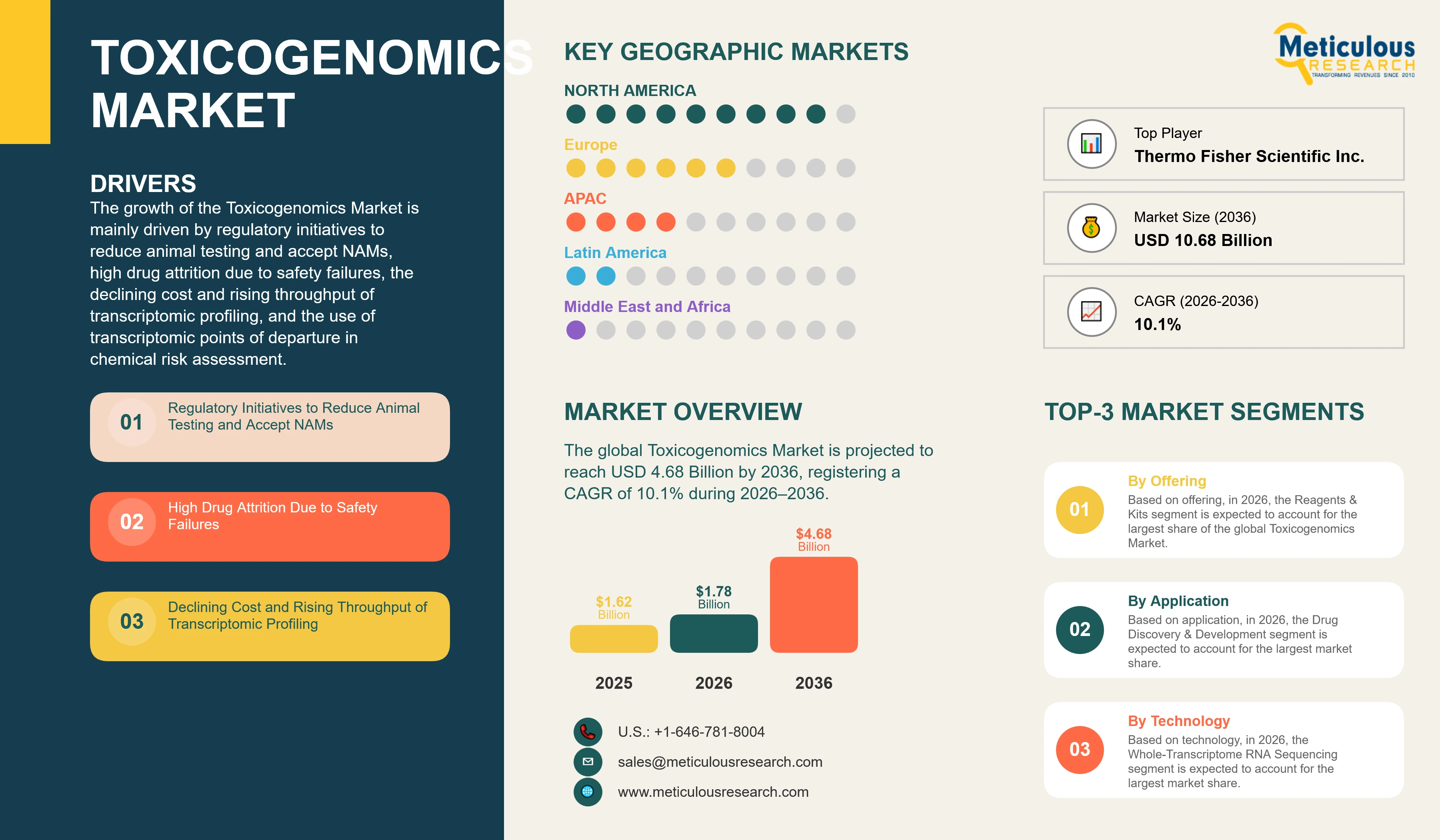
The global Toxicogenomics Market was valued at USD 1.62 billion in 2025. This market is expected to reach USD 4.68 billion by 2036 from an estimated USD 1.78 billion in 2026, registering a CAGR of 10.1% during the forecast period (2026-2036).
- Published
- Oct 2026
- Pages
- 327
- Format
- PDF + Excel
- Report ID
- MRHC - 1042359
- Base year
- 2025
- 2025 · BASELINE
- $1.62B
- 2036
- $4.68B
- CAGR 2026–2036
- 10.1%
2025 baseline · 2026–2036 forecast at 10.1% CAGR · hover a bar for the value
Key highlights
The global Toxicogenomics Market is projected to reach USD 4.68 billion by 2036, driven by regulatory acceptance of NAMs, the need to reduce late-stage safety failures, high-throughput transcriptomics, and the shift to human-relevant in vitro models.
Regulators are moving rapidly toward human-relevant safety testing. In April 2026, the U.S. Food and Drug Administration (FDA) reported that it had met the key first-year goals of its April 2025 Roadmap to Reducing Animal Testing in Preclinical Safety Studies, including draft guidance on reducing nonhuman primate testing for monoclonal antibodies, draft guidance on new approach methodologies (NAMs) published in March 2026 supporting a weight-of-evidence approach using in vitro assays and computational toxicology, a searchable database of alternative methods, and a formal partnership with the National Institutes of Health (NIH) to make human-relevant science the default approach to drug evaluation.
Europe is setting a long-term direction for chemical safety assessment. In June 2026, the European Commission published its roadmap towards phasing out animal testing for chemical safety assessments, covering 15 regulatory domains including industrial and consumer chemicals, pesticides, biocides, pharmaceuticals, and food and feed additives, and noting that more than 15 million animals were used for regulatory testing in the EU between 2015 and 2023, nearly 40% of them for chemical safety assessments.
North America is expected to account for the largest market share in 2026, supported by the concentration of pharmaceutical research, FDA and NIH initiatives, and leading technology and contract research providers, while Asia-Pacific is projected to register the fastest growth during the forecast period.
By technology, Whole-Transcriptome RNA Sequencing is expected to account for the largest market share in 2026, whereas Targeted Transcriptomics is projected to witness the fastest growth through 2036, as high-throughput, low-cost gene expression profiling is applied to large chemical libraries and concentration-response studies.
Report summary
| Particulars | Details |
|---|---|
| Forecast Period | 2026-2036 |
| Base Year | 2025 |
| Estimated Year | 2026 |
| CAGR (Value) | 10.1% |
| Format | PDF, Excel & Cloud Portal · 327 pages |
| Market Size (Value) in 2026 | USD 1.78 Billion |
| Market Size (Value) in 2036 | USD 4.68 Billion |
| Segments Covered | By Offering: Reagents & Kits (Sequencing Library Preparation Kits, Targeted Transcriptomic Assays, Microarray Kits, qPCR Assays & Panels, Sample Preparation Kits), Instruments (Sequencing Systems, Microarray Systems, PCR Systems), Software & Databases, Services (Toxicogenomic Profiling Services, Data Analysis & Interpretation Services). By Technology: Whole-Transcriptome RNA Sequencing, Targeted Transcriptomics, Microarrays, Quantitative PCR, Error-Corrected DNA Sequencing, Other Technologies. By Test System: In Vitro Models (Two-Dimensional Cell Cultures, Three-Dimensional Models & Organoids, Organ-on-Chip Systems), In Vivo Models. By Application: Drug Discovery & Development (Hepatotoxicity, Nephrotoxicity, Cardiotoxicity, Genotoxicity & Carcinogenicity, Other Toxicities), Chemical & Agrochemical Safety Assessment, Cosmetics & Personal Care Safety Assessment, Food Safety & Environmental Toxicology, Other Applications. By End User: Pharmaceutical & Biotechnology Companies, Contract Research Organizations, Chemical, Agrochemical & Cosmetics Companies, Academic, Government & Regulatory Research Institutes. |
| Countries Covered | North America: U.S., Canada. Europe: Germany, U.K., France, Netherlands, Switzerland, Italy, Rest of Europe. Asia-Pacific: China, Japan, India, South Korea, Australia, Rest of Asia-Pacific. Latin America: Brazil, Mexico, Rest of Latin America. Middle East & Africa: Saudi Arabia, UAE, Rest of Middle East & Africa. |
| Key Companies | Thermo Fisher Scientific Inc., Illumina, Inc., QIAGEN N.V., Agilent Technologies, Inc., BioSpyder Technologies, Inc., Charles River Laboratories International, Inc., Laboratory Corporation of America Holdings (Labcorp), Inotiv, Inc., and Eurofins Scientific SE. |
Report overview
Segments covered: offering, technology, application, end user.
The growth of this market is mainly driven by regulatory initiatives to reduce animal testing and accept new approach methodologies in drug and chemical safety assessment, the high attrition of drug candidates due to safety failures and the need for earlier and more predictive toxicity assessment, the declining cost and increasing throughput of sequencing and targeted transcriptomics, and the growing use of transcriptomic points of departure and mechanistic data in chemical risk assessment. In addition, the integration of toxicogenomics with human cell-based models, organoids, and organ-on-chip systems, the application of artificial intelligence (AI) to toxicogenomic data, the development of international reporting frameworks and public toxicogenomic databases, and the growing safety assessment needs of cosmetics, agrochemicals, and industrial chemicals are further supporting the growth of this market.
The Toxicogenomics Market, also referred to as the toxicogenomic testing market, omics-based toxicology market, or genomic toxicology market, comprises the reagents and kits, instruments, software and databases, and services used to measure changes in gene expression and other molecular responses to drugs, chemicals, and environmental agents in order to identify hazards, understand mechanisms of toxicity, and support safety assessment. The market includes whole-transcriptome RNA sequencing; targeted and high-throughput transcriptomics, such as templated oligo sequencing and reduced gene sets; gene expression microarrays; quantitative PCR (qPCR) panels for toxicity biomarkers; error-corrected DNA sequencing for mutagenicity assessment; epigenomic, proteomic, and metabolomic profiling as part of multi-omics toxicology; bioinformatics, benchmark dose modeling, and toxicogenomic databases; and toxicogenomic testing services provided by contract research organizations (CROs). The market ecosystem extends from manufacturers of sequencing, microarray, and PCR platforms and reagents to developers of targeted transcriptomic assays and software, CROs, pharmaceutical and biotechnology companies, chemical, agrochemical, and cosmetics companies, regulatory and government research agencies, and academic institutions.
Toxicogenomics addresses a fundamental problem in safety assessment. Traditional toxicity testing relies largely on animal studies that measure apical endpoints, such as organ damage or tumors, after long exposures, and these studies are expensive, slow, and often poorly predictive of human outcomes. According to the FDA, approximately 90% of drugs that pass animal studies are not approved because of safety or efficacy problems in humans. Toxicogenomic methods measure early molecular changes, often within days of exposure and in human cells, allowing toxic effects to be identified earlier, mechanisms to be understood, and compounds to be ranked by potency.
Regulatory change is the most important force reshaping the market. In April 2026, the U.S. Food and Drug Administration (FDA) reported that it had met the key first-year goals of its April 2025 Roadmap to Reducing Animal Testing in Preclinical Safety Studies, including draft guidance on reducing nonhuman primate testing for monoclonal antibodies, draft guidance on new approach methodologies (NAMs) published in March 2026 supporting a weight-of-evidence approach using in vitro assays and computational toxicology, a searchable database of alternative methods, and a formal partnership with the National Institutes of Health (NIH) to make human-relevant science the default approach to drug evaluation. In September 2026, the FDA announced a direct final rule replacing the terms "animal tests" and "animal studies" with "nonclinical tests" and "nonclinical studies" throughout its regulations, clarifying that non-animal methods can be used where appropriate to test the safety of drugs and biological products, and released a database of 25 use cases in which NAMs have already appeared in FDA review materials. These actions are expected to increase the use of in vitro, in silico, and molecular methods in drug development, and toxicogenomic data are a central part of the weight-of-evidence approach that the FDA is promoting.
Chemical safety assessment is undergoing a similar transition. In June 2026, the European Commission published its roadmap towards phasing out animal testing for chemical safety assessments, covering 15 regulatory domains including industrial and consumer chemicals, pesticides, biocides, pharmaceuticals, and food and feed additives, and noting that more than 15 million animals were used for regulatory testing in the EU between 2015 and 2023, nearly 40% of them for chemical safety assessments. In the U.S., the Environmental Protection Agency (EPA) has developed transcriptomic approaches for deriving points of departure for data-poor chemicals, and the Tox21 program, a collaboration between federal agencies, has generated high-throughput screening and transcriptomic data on thousands of chemicals. The Organisation for Economic Co-operation and Development (OECD) has published an omics reporting framework to support the regulatory use of transcriptomic and metabolomic data.
Technology advances are making toxicogenomics practical at scale. The cost of sequencing has fallen sharply, targeted transcriptomic methods allow thousands of samples to be profiled at low cost directly from cell lysates, and benchmark dose modeling software allows transcriptomic points of departure to be derived from concentration-response data. Human induced pluripotent stem cell-derived cells, three-dimensional organoids, and organ-on-chip systems provide more human-relevant test systems, and AI is being used to predict toxicity from gene expression signatures.
The market includes life science technology companies such as Thermo Fisher Scientific, Illumina, QIAGEN, and Agilent Technologies, which supply sequencing, microarray, PCR, and sample preparation products; developers of targeted transcriptomic platforms such as BioSpyder Technologies; and CROs such as Charles River Laboratories, Labcorp, Inotiv, and Eurofins Scientific, which provide toxicology and toxicogenomic services. These companies compete on the throughput and cost of profiling, data quality and reproducibility, the availability of validated toxicity signatures and reference databases, bioinformatics and interpretation, and regulatory experience.
At the same time, the market faces challenges, including the lack of fully validated and regulatory-accepted toxicogenomic methods for many endpoints, the difficulty of linking molecular changes to adverse outcomes, the complexity of analyzing and interpreting large omics datasets, and differences in study design and data analysis between laboratories. The financial pressure on CROs following reduced biotechnology funding has also affected demand for preclinical services. As a result, companies that combine high-throughput and cost-effective profiling, human-relevant test systems, validated signatures, robust bioinformatics, and support for regulatory submissions are expected to capture the largest share of growth over the forecast period.
Report infographic
Market dynamics
15 factors across 5 forcesRegulatory Initiatives to Reduce Animal Testing and Accept NAMs
Regulatory initiatives to reduce animal testing and accept NAMs are a major factor driving the Toxicogenomics Market, as regulators in the U.S. and Europe are creating pathways for the use of human-relevant, mechanistic data in safety assessment. In April 2026, the U.S. Food and Drug Administration (FDA) reported that it had met the key first-year goals of its April 2025 Roadmap to Reducing Animal Testing in Preclinical Safety Studies, including draft guidance on reducing nonhuman primate testing for monoclonal antibodies, draft guidance on new approach methodologies (NAMs) published in March 2026 supporting a weight-of-evidence approach using in vitro assays and computational toxicology, a searchable database of alternative methods, and a formal partnership with the National Institutes of Health (NIH) to make human-relevant science the default approach to drug evaluation. In September 2026, the FDA announced a direct final rule replacing the terms "animal tests" and "animal studies" with "nonclinical tests" and "nonclinical studies" throughout its regulations, clarifying that non-animal methods can be used where appropriate to test the safety of drugs and biological products, and released a database of 25 use cases in which NAMs have already appeared in FDA review materials.
In Europe, the roadmap published by the European Commission in June 2026 sets out actions to accelerate the development and validation of non-animal methods, use AI and data-driven assessments, and strengthen collaboration across regulatory domains, with a high-level conference planned for 2029 to assess progress. As these policies are implemented, pharmaceutical and chemical companies are expected to invest in toxicogenomic methods to generate data that regulators will accept.
High Drug Attrition Due to Safety Failures
The high attrition of drug candidates due to safety failures is significantly driving market growth. According to the FDA, approximately 90% of drugs that pass animal studies are not approved because of safety or efficacy problems in humans. Safety problems discovered late in development, after significant investment, are a major cost for the pharmaceutical industry. Toxicogenomics allows companies to identify liver, kidney, cardiac, and other toxicities earlier, rank compounds, understand mechanisms, and select safer candidates before costly animal and clinical studies, improving the efficiency of drug development.
Declining Cost and Rising Throughput of Transcriptomic Profiling
The declining cost and rising throughput of transcriptomic profiling are an important driver of demand. Advances in sequencing and targeted transcriptomics allow gene expression to be measured across thousands of samples at a cost that makes concentration-response studies and the screening of large chemical libraries practical. Targeted methods that work directly from cell lysates without RNA extraction further reduce cost and increase throughput, and automation allows high-throughput transcriptomics to be integrated into screening workflows.
Lower costs are expanding toxicogenomics from a specialized mechanistic tool used in selected studies to a routine screening method. Government programs such as Tox21 and the EPA transcriptomics programs have demonstrated high-throughput transcriptomic screening of thousands of chemicals, and pharmaceutical companies are applying similar approaches in early discovery. As costs continue to decline, the number of samples profiled is expected to increase substantially.
Use of Transcriptomic Points of Departure in Chemical Risk Assessment
The use of transcriptomic points of departure in chemical risk assessment supports market growth. Thousands of chemicals in commerce have limited toxicity data, and traditional animal testing of all of them is not feasible. Transcriptomic points of departure, derived by benchmark dose modeling of gene expression changes, have been shown to be broadly consistent with points of departure from traditional studies and can be generated much faster and at lower cost. Regulatory agencies in the U.S., Canada, and Europe are exploring their use for data-poor chemicals, creating demand for toxicogenomic studies and software.
Table of contents
13 chapters · 158 sections · 327 pages · click to expandSegmental analysis
| Segment | Largest share (2026) | Fastest growth (2026–2036) |
|---|---|---|
| By Offering | Reagents & Kits | Software & Databases |
| By Technology | Whole-Transcriptome RNA Sequencing | Targeted Transcriptomics |
| By Test System | In Vivo Models | In Vitro Models |
| By Application | Drug Discovery & Development | Chemical & Agrochemical Safety Assessment |
| By End User | Pharmaceutical & Biotechnology Companies | Contract Research Organizations |
By Offering
- Toxicogenomics Market Analysis by Offering
- Reagents & Kits are further segmented into Sequencing Library Preparation Kits, Targeted Transcriptomic Assays, Microarray Kits, qPCR Assays & Panels, and Sample Preparation Kits; Instruments are further segmented into Sequencing Systems, Microarray Systems, and PCR Systems; and Services are further segmented into Toxicogenomic Profiling Services and Data Analysis & Interpretation Services.
- The Reagents & Kits segment is expected to account for the largest share of the global Toxicogenomics Market.
- The large share of this segment is mainly due to the recurring use of library preparation kits, targeted assays, and sample preparation kits in every toxicogenomic study, the growing number of samples profiled in high-throughput transcriptomic studies, and the wide use of sequencing and qPCR reagents by pharmaceutical companies, CROs, and government laboratories.
- However, the Software & Databases segment is projected to register the highest CAGR during the forecast period.
- The rapid growth of this segment is attributed to the need for bioinformatics, benchmark dose modeling, and interpretation tools to analyze large toxicogenomic datasets, the growing value of curated reference databases for toxicity prediction and read-across, and the application of AI to toxicogenomic data.
- The Services segment is expected to record strong growth, supported by outsourcing of toxicogenomic studies to CROs.
By Technology
- Toxicogenomics Market Analysis by Technology
- Other Technologies include epigenomic, proteomic, and metabolomic profiling.
- The Whole-Transcriptome RNA Sequencing segment is expected to account for the largest share of the market.
- The large share of this segment is mainly due to the comprehensive and unbiased measurement of gene expression provided by RNA sequencing, its widespread adoption in pharmaceutical safety research and mechanistic toxicology, and the declining cost of sequencing, which has led many laboratories to replace microarrays with RNA sequencing.
- However, the Targeted Transcriptomics segment is projected to register the highest CAGR during the forecast period.
- The rapid growth of this segment is attributed to the low cost and high throughput of targeted methods, their ability to work directly from cell lysates, their use in government high-throughput screening programs and concentration-response studies, and the growing demand for transcriptomic points of departure for data-poor chemicals.
- The Error-Corrected DNA Sequencing segment is also expected to grow strongly, supported by its use in mutagenicity assessment.
By Test System
- Toxicogenomics Market Analysis by Test System
- In Vitro Models are further segmented into Two-Dimensional Cell Cultures, Three-Dimensional Models & Organoids, and Organ-on-Chip Systems.
- The In Vivo Models segment is expected to account for the largest share of the market.
- The large share of this segment is mainly due to the continued use of rodent and other animal studies in regulatory toxicology, where toxicogenomic profiling of tissues is used to identify mechanisms and early markers of toxicity, and the large historical reference datasets based on animal studies.
- However, the In Vitro Models segment is projected to register the highest CAGR during the forecast period.
- The rapid growth of this segment is attributed to the regulatory push to reduce animal testing in the U.S. and Europe, the development of human-relevant three-dimensional models, organoids, and organ-on-chip systems, and the suitability of in vitro models for high-throughput transcriptomic screening.
By Application
- Toxicogenomics Market Analysis by Application
- Drug Discovery & Development is further segmented into Hepatotoxicity, Nephrotoxicity, Cardiotoxicity, Genotoxicity & Carcinogenicity, and Other Toxicities.
- The Drug Discovery & Development segment is expected to account for the largest share of the market.
- The large share of this segment is mainly due to the high cost of late-stage safety failures, the use of toxicogenomics by pharmaceutical companies to select safer candidates and understand toxicity mechanisms, and the FDA roadmap to reduce animal testing and promote NAMs in preclinical safety assessment.
- However, the Chemical & Agrochemical Safety Assessment segment is projected to register the highest CAGR during the forecast period.
- The rapid growth of this segment is attributed to the large number of chemicals with limited toxicity data, the use of transcriptomic points of departure in risk assessment, and the European Commission roadmap of June 2026 covering industrial chemicals, pesticides, and biocides, which accounted for a large share of the more than 15 million animals used for regulatory testing in the EU between 2015 and 2023.
By End User
- Toxicogenomics Market Analysis by End User
- The Pharmaceutical & Biotechnology Companies segment is expected to account for the largest share of the market.
- The large share of this segment is mainly due to the extensive use of toxicogenomics in drug discovery and preclinical safety assessment, the significant research budgets of pharmaceutical companies, and their in-house investment in sequencing, bioinformatics, and human-relevant models.
- However, the Contract Research Organizations segment is projected to register the highest CAGR during the forecast period.
- The rapid growth of this segment is attributed to the increasing outsourcing of preclinical safety studies, the development of NAM-based and toxicogenomic service offerings by CROs, and the demand of smaller biotechnology, chemical, and cosmetics companies for specialized toxicogenomic expertise.
Geographic analysis
North America
Largest shareIn 2026, North America is expected to account for the largest share of the global Toxicogenomics Market. The large share of this region is mainly attributed to the concentration of pharmaceutical and biotechnology research, the FDA roadmap to reduce animal testing and its partnership with NIH, government toxicogenomic programs such as Tox21 and EPA transcriptomic research, and the presence of leading technology providers and CROs such as Thermo Fisher Scientific, Illumina, Agilent Technologies, BioSpyder Technologies, Charles River Laboratories, Labcorp, and Inotiv. In September 2026, the FDA announced a direct final rule replacing the terms "animal tests" and "animal studies" with "nonclinical tests" and "nonclinical studies" throughout its regulations, clarifying that non-animal methods can be used where appropriate to test the safety of drugs and biological products, and released a database of 25 use cases in which NAMs have already appeared in FDA review materials.
Europe
Europe is expected to account for a significant share of the market, supported by the European Commission roadmap towards phasing out animal testing for chemical safety assessments, the EU ban on animal testing for cosmetics, strong chemical and agrochemical industries, and research programs on NAMs. In June 2026, the European Commission published its roadmap towards phasing out animal testing for chemical safety assessments, covering 15 regulatory domains including industrial and consumer chemicals, pesticides, biocides, pharmaceuticals, and food and feed additives, and noting that more than 15 million animals were used for regulatory testing in the EU between 2015 and 2023, nearly 40% of them for chemical safety assessments. QIAGEN, headquartered in Germany and the Netherlands, and Eurofins Scientific, headquartered in Luxembourg, are active in the region.
Asia-Pacific
Fastest growthAsia-Pacific is projected to register the highest CAGR during the forecast period. The growth of this region is driven by the rapid growth of pharmaceutical research and CRO capacity in China, India, and South Korea, the long history of toxicogenomic research in Japan, including the Japanese Toxicogenomics Project, growing chemical and cosmetics industries, and the adoption of alternative testing methods by regulators in China, South Korea, and other countries.
Latin America
Latin America and the Middle East & Africa are expected to account for smaller shares of the market. In Latin America, research capacity and alternative testing initiatives in Brazil are expected to support demand, while in the Middle East & Africa, investment in life science research in Gulf countries is expected to support growth.
Competitive landscape
The global Toxicogenomics Market is moderately fragmented, with life science technology companies, developers of targeted transcriptomic platforms and software, and CROs participating across offerings and applications. Market participants compete primarily on the throughput and cost of profiling, data quality and reproducibility, the availability of validated toxicity signatures and reference databases, bioinformatics and interpretation capabilities, human-relevant test systems, and regulatory experience.
Leading companies are developing high-throughput and targeted transcriptomic assays, integrating toxicogenomics with human cell-based models and organ-on-chip systems, building curated databases and AI tools, and expanding NAM-based service offerings. Recent market context includes the FDA report on first-year roadmap progress in April 2026, the European Commission roadmap of June 2026, and the FDA final rule recognizing nonclinical methods in September 2026, which are encouraging technology providers and CROs to strengthen their NAM portfolios.
The report provides a comprehensive competitive assessment of the leading companies operating in the global Toxicogenomics Market. The key players profiled in the report include Thermo Fisher Scientific Inc. (U.S.), Illumina, Inc. (U.S.), QIAGEN N.V. (Netherlands), Agilent Technologies, Inc. (U.S.), BioSpyder Technologies, Inc. (U.S.), Charles River Laboratories International, Inc. (U.S.), Laboratory Corporation of America Holdings (Labcorp) (U.S.), Inotiv, Inc. (U.S.), and Eurofins Scientific SE (Luxembourg).
- Thermo Fisher Scientific Inc.
- Illumina, Inc.
- QIAGEN N.V.
- Agilent Technologies, Inc.
- BioSpyder Technologies, Inc.
- Charles River Laboratories International, Inc.
- Laboratory Corporation of America Holdings · Labcorp
- Inotiv, Inc.
- Eurofins Scientific SE
Expert perspectives
The Toxicogenomics Market is entering a period in which regulatory change is turning toxicogenomics from a research tool into a component of mainstream safety assessment. With the FDA meeting its first-year goals for reducing animal testing, finalizing a rule recognizing nonclinical methods in September 2026, and the European Commission publishing a roadmap to phase out animal testing for chemical safety assessments in June 2026, demand for human-relevant, mechanistic safety data is expected to rise. The binding constraint is shifting from the cost of generating toxicogenomic data to the validation, interpretation, and regulatory acceptance of that data.
Three structural changes are expected to shape competitive positions through 2036. First, high-throughput targeted transcriptomics is expected to make toxicogenomic screening routine, favoring providers with low-cost, scalable assays. Second, the combination of human-relevant models with toxicogenomic readouts is expected to become a core NAM approach, favoring companies that integrate test systems and omics. Third, curated databases, benchmark dose modeling, and AI are becoming key differentiators, as the value of toxicogenomics increasingly lies in interpretation.
For companies planning entry or expansion, the most defensible positions over the forecast period are likely to be found in targeted transcriptomic platforms, toxicogenomic services integrated with organoid and organ-on-chip models, AI-driven toxicity prediction and curated databases, error-corrected sequencing for genotoxicity, and chemical and agrochemical safety assessment in Europe and Asia-Pacific. For established providers, the principal priorities are building regulatory-quality validation evidence, supporting customers in regulatory submissions, and strengthening bioinformatics.
Overall, the market is expected to grow strongly, with reagents and kits, whole-transcriptome RNA sequencing, in vivo models, drug discovery and development, pharmaceutical and biotechnology companies, and North America providing the core of demand and software and databases, targeted transcriptomics, in vitro models, chemical and agrochemical safety assessment, CROs, and Asia-Pacific providing the fastest growth.
Customer perspectives
Insights gathered during primary interviews with pharmaceutical toxicologists, CRO safety assessment leaders, and regulatory scientists operating in this market highlight where procurement priorities are shifting. The following perspectives reflect recurring themes raised across these discussions.
“This reflects the role of toxicogenomics in early candidate selection.”
“This indicates the importance of regulatory-quality services.”
“This points to the value of toxicogenomics for data-poor chemicals.”
Frequently asked questions
The global Toxicogenomics Market is estimated at USD 1.78 billion in 2026.
Cite this report
Meticulous Research. (2026). Toxicogenomics Market - Global Opportunity Analysis And Industry Forecasts (2026-2036) (Report No. MRHC - 1042359). Meticulous Market Research Pvt. Ltd. https://www.meticulousresearch.com/product/toxicogenomics-market-7042