
Thrombectomy Devices Market (2026-2036)
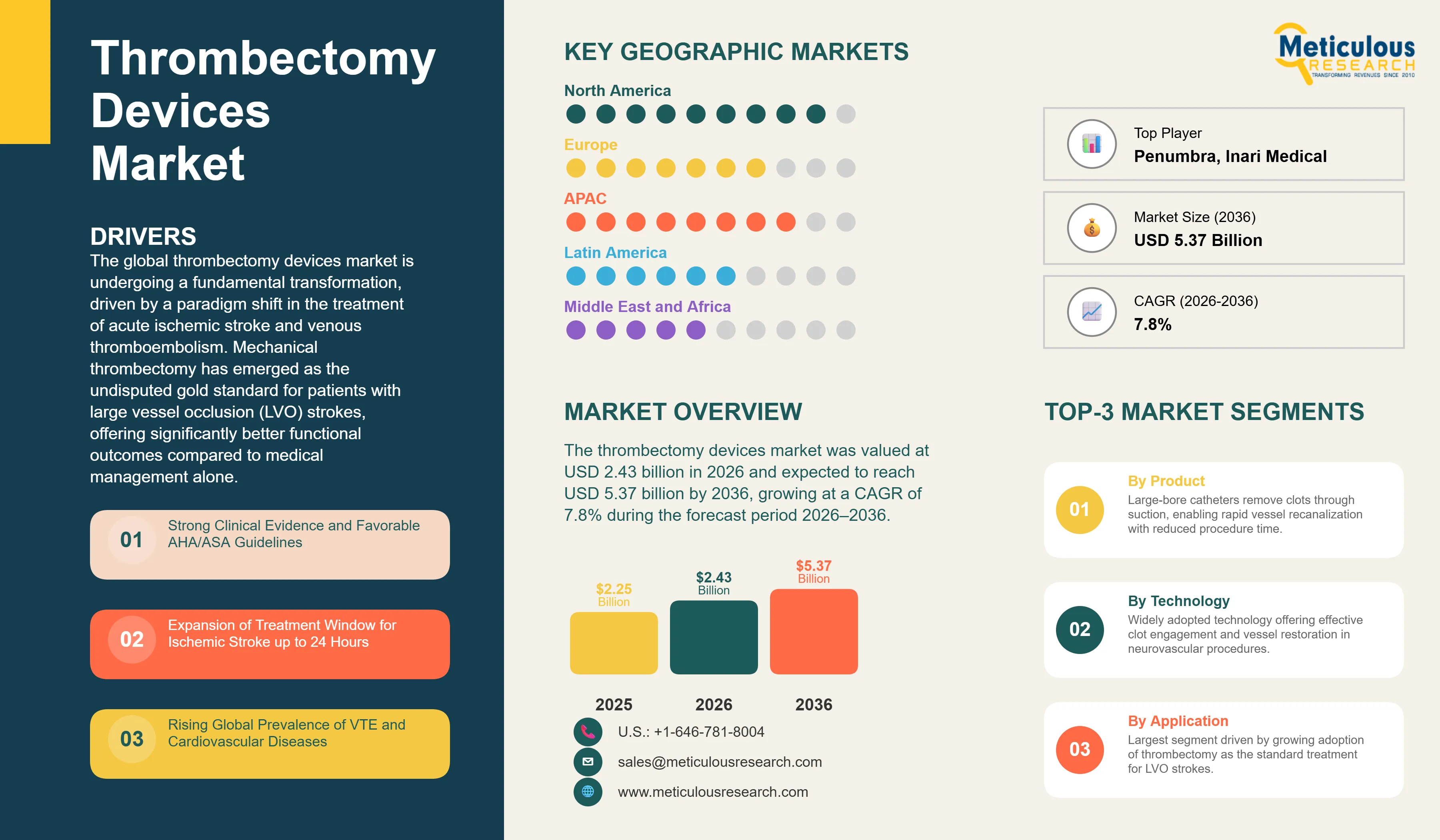
The global thrombectomy devices market was valued at USD 2.43 billion in 2026. This market is expected to reach USD 5.37 billion by 2036, growing at a CAGR of 7.8% during the forecast period 2026–2036.
- Published
- Jun 2026
- Pages
- 287
- Format
- PDF + Excel
- Report ID
- MRHC - 1042012
- Base year
- 2025
- 2026 · ESTIMATED
- $2.43B
- 2036
- $5.37B
- CAGR 2026–2036
- 7.8%
2025 baseline · 2026–2036 forecast at 7.8% CAGR · hover a bar for the value
Key highlights
The global thrombectomy devices market is projected to reach USD 5.37 billion by 2036.
The market is expected to grow at a CAGR of 7.8% during the forecast period 2026–2036.
The global market is estimated at USD 2.43 billion in 2026.
Neurovascular applications (Ischemic Stroke) account for the largest and fastest-growing segment.
The treatment window for mechanical thrombectomy has been extended up to 24 hours post-stroke.
Modern thrombectomy devices achieve successful revascularization in around 80% of cases.
The number of thrombectomy procedures is projected to increase by 8-12% annually through 2030.
Stent Retriever technology remains the gold standard for neurovascular LVO strokes.
North America accounts for approximately 40% of the global market share in 2026.
Report summary
| Particulars | Details |
|---|---|
| Base Year | 2025 |
| Estimated Year | 2026 |
| Forecast Period | 2026–2036 |
| Market Size (2026) | USD 2.43 billion |
| Market Size (2036) | USD 5.37 billion |
| CAGR (2026–2036) | 7.8% |
| Format | PDF, Excel & Cloud Portal · 287 pages |
| Segments Covered | By Product: Aspiration, Mechanical, Ultrasound, Hydrodynamic · By Technology: Stent Retriever, Aspiration, Hybrid · By Application · By End User |
Report overview
Segments covered: product, technology, application, end user.
The global thrombectomy devices market is undergoing a fundamental transformation, driven by a paradigm shift in the treatment of acute ischemic stroke and venous thromboembolism. Mechanical thrombectomy has emerged as the undisputed gold standard for patients with large vessel occlusion (LVO) strokes, offering significantly better functional outcomes compared to medical management alone. The market's expansion is fueled by landmark clinical trials such as DAWN and DEFUSE 3, which have extended the treatment window for mechanical thrombectomy from 6 hours to 24 hours in selected patients. This extension has dramatically increased the eligible patient population, catalyzing a surge in procedure volumes and the establishment of thrombectomy-capable stroke centers worldwide.
The clinical efficacy of thrombectomy is backed by robust data, with modern stent retrievers and aspiration catheters achieving successful revascularization in approximately 82% of cases (meta-analysis of 31 studies). Approximately 15 million people worldwide suffer a stroke each year, with ischemic strokes accounting for ~85–87% of all cases. In the U.S., the lifetime cost of a stroke is estimated at $103,576 per patient (1990 data, adjusted to ~$250,000 today), making the $15,000–$25,000 cost of a thrombectomy procedure highly cost-effective (worth $14,137 per QALY gained) by reducing long-term disability and institutional care requirements. This economic value proposition is a major driver for healthcare systems and payers to expand reimbursement and infrastructure for thrombectomy services.
The market is also witnessing significant expansion in the peripheral vascular segment, particularly for the treatment of deep vein thrombosis (DVT) and pulmonary embolism (PE). New device approvals and favorable clinical data are driving the adoption of mechanical thrombectomy as a first-line therapy for venous thromboembolism, reducing the reliance on thrombolytic drugs and their associated bleeding risks. The competitive landscape is characterized by intense innovation, with leading players like Medtronic, Stryker, and Penumbra constantly refining their portfolios to improve procedural speed, safety, and technical success rates. Strategic consolidation and the development of hybrid technologies that combine aspiration and mechanical retrieval are key trends shaping the future of the market.
Geographically, North America leads the global market, accounting for approximately 40% of total revenue in 2026. This dominance is supported by a mature network of comprehensive stroke centers and favorable reimbursement policies. However, the Asia-Pacific region is projected to witness the fastest growth, driven by a high stroke burden in countries like China and India, increasing healthcare investments, and the expansion of domestic manufacturing capabilities. As global stroke systems of care continue to evolve, the thrombectomy devices market is poised for sustained growth over the next decade, with China at 10.3% CAGR and India at 9.5% CAGR, though the overall market grows at approximately 7% CAGR.
Report infographic
Market dynamics
6 factors across 5 forcesThe primary driver for the thrombectomy
devices market is the strong clinical evidence and favorable guidelines from organizations like the AHA/ASA. Mechanical thrombectomy is now the standard of care for large vessel strokes, leading to its rapid adoption worldwide. The expansion of the treatment window based on advanced imaging has also significantly increased the pool of eligible patients. Furthermore, the rising global prevalence of atrial fibrillation, obesity, and hypertension all major risk factors for stroke and thrombosis is providing a continuous stream of patients requiring these life-saving procedures.
Table of contents
12 chapters · 103 sections · 287 pages · click to expandSegmental analysis
| Segment | Largest share (2026) | Fastest growth (2026–2036) |
|---|---|---|
| By Application | Neurovascular | — |
| By Technology | Stent Retriever | Aspiration Technology |
By Application
- Neurovascular Segment to Lead Growth
- The Neurovascular segment is expected to hold the largest share of the market.
- This dominance is driven by the clear clinical superiority of mechanical thrombectomy for ischemic stroke and its inclusion in international treatment guidelines.
- This segment is also projected to grow at the fastest CAGR as more stroke centers become operational globally.
- The Peripheral Vascular segment is also witnessing significant growth, driven by the increasing use of mechanical thrombectomy for pulmonary embolism and deep vein thrombosis, where it offers a safer alternative to thrombolytic therapy.
By Technology
- Stent Retriever Remains the Gold Standard
- The Stent Retriever segment is expected to hold the largest share of the market.
- Stent retrievers were the first devices to demonstrate clear clinical benefit in randomized trials and remain the primary tool for most neurointerventionalists.
- The Aspiration Technology segment is projected to witness the fastest growth during the forecast period.
- The speed of the procedure and the effectiveness of new, highly flexible, large-bore catheters are driving its rapid adoption across both neuro and peripheral applications.
Geographic analysis
North America
Largest shareNorth America is expected to hold the largest share of the global thrombectomy devices market in 2026, accounting for approximately 40% of the total revenue. This is due to a highly developed network of Comprehensive Stroke Centers, favorable reimbursement for thrombectomy procedures, and a high awareness of stroke symptoms among the general public. Key companies operating in the North American market include Medtronic, Stryker, and Penumbra.
Asia-Pacific
Fastest growthAsia-Pacific is projected to witness the fastest growth during the forecast period. The region faces a massive stroke burden, particularly in China, where stroke is the leading cause of death. Increasing healthcare infrastructure investment, the expansion of stroke centers in Tier 2 and Tier 3 cities, and the rising adoption of advanced medical technologies are the primary growth drivers. Key companies operating in the Asia-Pacific market include Terumo, MicroPort, and major global vendors.
Frequently asked questions
The market is projected to reach USD 5.37 billion by 2036, growing at a CAGR of 7.8% from 2026 to 2036.
Cite this report
Meticulous Research. (2026). Thrombectomy Devices Market - Global Opportunity Analysis and Industry Forecast (2026-2036) (Report No. MRHC - 1042012). Meticulous Market Research Pvt. Ltd. https://www.meticulousresearch.com/product/thrombectomy-devices-market-6695