
Smart Warehousing Market (2026-2036)
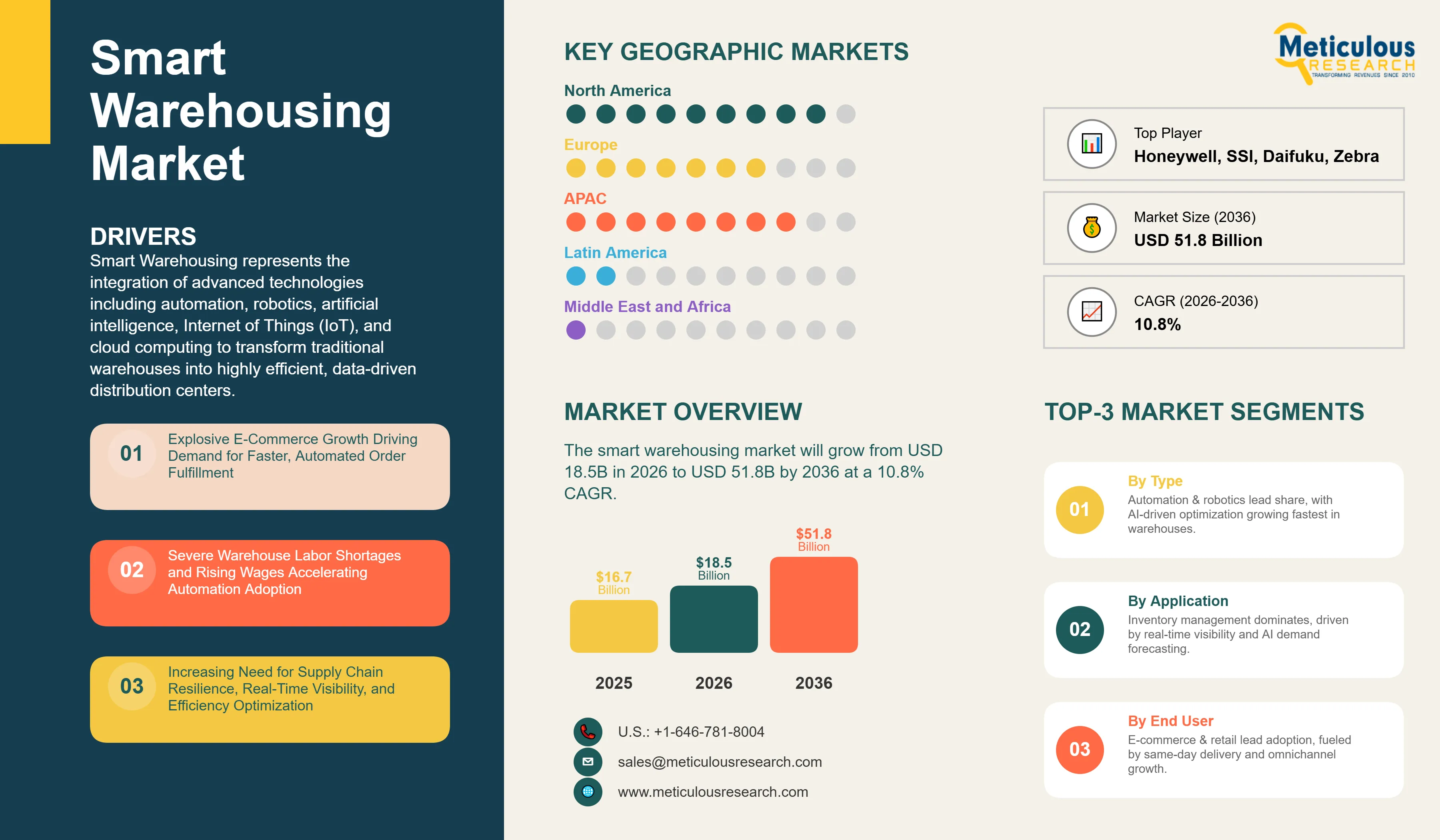
The global smart warehousing market is expected to reach USD 51.8 billion by 2036 from USD 18.5 billion in 2026, at a CAGR of 10.8% from 2026 to 2036.
- Published
- Feb 2026
- Pages
- 291
- Format
- PDF + Excel
- Report ID
- MR-1709
- Base year
- 2025
- 2026 · ESTIMATED
- $18.50B
- 2036
- $51.80B
- CAGR 2026–2036
- 10.8%
2025 baseline · 2026–2036 forecast at 10.8% CAGR · hover a bar for the value
Key highlights
1. In 2026, North America is estimated to account for the largest share of the global smart warehousing market, driven by rapid e-commerce growth, early adoption of warehouse automation by major retailers and 3PL providers, presence of leading technology vendors including Amazon Robotics, Honeywell, and Zebra Technologies, and substantial capital investment in supply chain modernization exceeding $50 billion annually.
2. Asia-Pacific is projected to register the highest CAGR during the forecast period, fueled by massive manufacturing and logistics expansion in China and India, government initiatives supporting Industry 4.0 and smart manufacturing, rapid e-commerce penetration creating fulfillment infrastructure demand, rising labor costs driving automation adoption, and increasing foreign direct investment in modern warehouse facilities.
3. Based on technology, the automation and robotics segment is estimated to hold the largest share of the market in 2026, driven by autonomous mobile robots (AMRs) deployment exceeding 500,000 units globally, automated storage and retrieval systems (AS/RS) reducing picking times by 60-75%, robotic piece-picking systems handling diverse SKUs, and goods-to-person automation eliminating unproductive travel time.
4. Based on component, the hardware segment is expected to witness significant growth during the forecast period, driven by RFID and barcode scanner deployments, IoT sensor networks, autonomous robot installations, automated conveyor systems, and warehouse control system infrastructure supporting complex automation implementations.
5. Based on application, the inventory management segment dominates the market in 2026, representing the most critical warehouse function requiring real-time visibility of stock levels, locations, and movement across millions of SKUs, with AI-powered demand forecasting achieving 90%+ accuracy and preventing stockouts costing retailers $1.1 trillion annually in lost sales.
6. The AI and machine learning segment is expected to grow at a significant CAGR during the forecast period, driven by predictive analytics optimizing inventory placement, machine learning algorithms improving picking route efficiency by 20-30%, computer vision enabling automated quality inspection, and AI-powered demand forecasting reducing excess inventory by 15-25%.
7. The e-commerce and retail end-user segment accounts for the largest share, driven by Amazon operating 1,500+ fulfillment centers globally with extensive robotics deployment, omnichannel retail requiring distributed inventory across stores and warehouses, same-day and next-day delivery expectations necessitating automated fulfillment, and peak season demand surges requiring flexible capacity.
8. The U.S. smart warehousing market is projected to grow at a CAGR of around 10% during the forecast period 2026 to 2036, driven by labor shortages with 490,000 unfilled warehouse positions, rising minimum wages increasing automation ROI, e-commerce sales exceeding $1 trillion annually, and supply chain resilience investments post-pandemic disruptions.
9. China is expected to lead the Asia-Pacific smart warehousing market, driven by government Made in China 2025 initiative promoting automation, JD.com and Alibaba operating highly automated mega-warehouses, rapid logistics network expansion supporting 1 billion+ online shoppers, manufacturing sector automation, and development of domestic robotics and automation technology.
10. In 2026, Germany is projected to account for significant share of the European smart warehousing market, driven by Industry 4.0 leadership in manufacturing and logistics, major automotive and manufacturing sectors requiring sophisticated warehouse operations, strong engineering capabilities in automation technology, and stringent quality and efficiency requirements driving technology adoption.
Report summary
| Particulars | Details |
|---|---|
| Market Size Value in 2026 | USD 18.5 Billion |
| Revenue Forecast in 2036 | USD 51.8 Billion |
| Growth Rate | CAGR of 10.8% from 2026 to 2036 |
| Format | PDF, Excel & Cloud Portal · 291 pages |
| Base Year for Estimation | 2025 |
| Historical Data | 2020-2024 |
| Forecast Period | 2026-2036 |
| Report Coverage | Revenue forecast, company share, competitive landscape, growth factors, and trends |
| Segments Covered | Technology, Component, Application, End-User Industry, Geography |
| Regional Scope | North America, Europe, Asia-Pacific, Latin America, Middle East & Africa |
| Key Companies Profiled | Honeywell International Inc., Zebra Technologies Corporation, Dematic (KION Group), Daifuku Co. Ltd., SSI Schaefer, Swisslog (KUKA AG), Locus Robotics, 6 River Systems (Shopify), GreyOrange, Fetch Robotics (Zebra Technologies), Manhattan Associates, Blue Yonder (Panasonic), Oracle Corporation, SAP SE, Körber AG, and others |
Report overview
Segments covered: technology, component, application, end-user industry.
Smart Warehousing represents the integration of advanced technologies including automation, robotics, artificial intelligence, Internet of Things (IoT), and cloud computing to transform traditional warehouses into highly efficient, data-driven distribution centers. These intelligent facilities employ autonomous mobile robots (AMRs) and automated guided vehicles (AGVs) for material handling, automated storage and retrieval systems (AS/RS) maximizing vertical space utilization, robotic picking and packing systems achieving speeds of 600-1,200 picks per hour, conveyor and sortation systems automating product flow, and collaborative robots (cobots) working alongside human workers for enhanced productivity. IoT sensor networks monitor inventory levels in real-time, track asset locations with centimeter-level accuracy using RFID and Bluetooth Low Energy (BLE) technologies, measure environmental conditions including temperature and humidity for sensitive products, and detect equipment maintenance needs before failures occur through predictive analytics. Artificial intelligence and machine learning algorithms optimize warehouse operations by forecasting demand patterns with 85-95% accuracy, determining optimal inventory placement based on velocity and seasonality, coordinating robot fleet management to prevent congestion and maximize throughput, dynamically routing orders to minimize travel distance and picking time, and continuously learning from operational data to improve efficiency. Warehouse management systems (WMS) integrated with enterprise resource planning (ERP) and transportation management systems (TMS) provide end-to-end visibility across supply chains, while cloud-based platforms enable real-time data access, scalability without infrastructure investment, and seamless integration with e-commerce platforms and marketplaces. Smart warehouses offer transformative benefits including 25-40% reduction in operating costs through labor optimization and space utilization, 99.9% inventory accuracy eliminating stockouts and overstock situations, 2-5x increase in order fulfillment speed meeting same-day and next-day delivery expectations, 50-70% improvement in space utilization through optimized storage density and vertical automation, 30-50% reduction in picking errors through automation and barcode/vision verification, and enhanced worker safety by automating dangerous tasks and reducing repetitive strain injuries. These facilities serve critical functions across diverse industries from e-commerce fulfillment centers handling millions of SKUs and processing 100,000+ daily orders, to retail distribution centers supporting omnichannel operations, third-party logistics (3PL) providers managing multi-client inventories, manufacturing facilities implementing just-in-time inventory, pharmaceutical and healthcare distribution requiring precise temperature control and compliance tracking, and cold chain logistics maintaining product integrity for perishable goods throughout storage and distribution.
Smart Warehousing represents a fundamental transformation of logistics and distribution operations, addressing critical challenges facing modern supply chains including explosive e-commerce growth, labor shortages, rising customer expectations, and cost pressures. Traditional warehouses operating with manual processes, paper-based systems, and forklift-centric material handling face severe limitations including low inventory accuracy (typically 60-80%), slow order fulfillment cycles (24-48 hours for standard orders), high operating costs (labor representing 50-65% of warehouse expenses), limited scalability during demand surges, and workplace safety concerns with injury rates 2-3x higher than other industries. Smart warehouses leverage technology to overcome these limitations, achieving inventory accuracy exceeding 99.9% through RFID and barcode scanning, order fulfillment in 2-4 hours enabling same-day delivery, 25-40% operating cost reduction through automation and optimization, flexible capacity scaling through modular robotics and software, and 50-70% reduction in workplace injuries through automation of dangerous tasks. The global warehouse automation market has experienced explosive growth driven by Amazon's pioneering use of Kiva robots (now Amazon Robotics) demonstrating 20-25% productivity improvement, COVID-19 pandemic highlighting supply chain fragility and accelerating automation adoption, e-commerce penetration reaching 20-30% of total retail in developed markets, labor market tightness with unemployment below 4% in major economies creating recruitment challenges, and technological maturation reducing robotics costs while improving capabilities. Smart warehousing adoption varies significantly by industry and company size, with large e-commerce companies and 3PL providers leading implementation due to high transaction volumes justifying capital investment, automotive and electronics manufacturers requiring precise inventory control for just-in-time production, pharmaceutical and healthcare distributors needing compliance and traceability, and grocery and food distributors implementing cold chain automation. Mid-market adoption is accelerating as robotics-as-a-service (RaaS) models reduce upfront investment, cloud-based WMS eliminate on-premise infrastructure requirements, and modular automation solutions enable phased implementation matching budget constraints.
Report infographic
Market dynamics
12 factors across 4 forcesExplosive E-Commerce Growth and Changing Consumer Expectations
E-commerce sales have grown from $1.3 trillion globally in 2014 to over $5.7 trillion in 2024, representing 20-25% of total retail in developed markets and continuing 15-20% annual growth. This explosion creates unprecedented demand for warehouse capacity and fulfillment speed, with consumers expecting same-day or next-day delivery as standard service. Amazon Prime's two-day (and increasingly same-day) delivery has reset expectations across retail, forcing competitors to invest in fulfillment infrastructure matching these capabilities. Traditional warehouse operations cannot meet these demands, with manual picking and packing processes requiring 24-48 hours for order fulfillment versus 2-4 hours needed for same-day delivery. Smart warehousing technologies including automation, AI optimization, and real-time inventory visibility enable the speed and accuracy required for modern e-commerce, with automated facilities processing 100,000+ daily orders versus 10,000-20,000 for manual operations of similar size.
Severe Labor Shortages and Rising Labor Costs
Warehouse and distribution employment in major economies faces critical shortages, with the United States reporting 490,000 unfilled positions as of 2024, representing 40-50% more openings than applicants. This shortage is driven by demographic shifts with aging workforces, competition from other sectors offering better working conditions, physically demanding nature of warehouse work deterring younger workers, and geographic concentration of warehouses in areas with limited labor pools. Labor costs are rising rapidly, with average warehouse wages increasing 15-25% from 2019-2024 in tight labor markets, and mandatory minimum wage increases in major states (California $16/hour, New York $15/hour) further pressuring costs. Warehouse labor typically represents 50-65% of operating expenses, making these increases unsustainable for many operators. Automation provides compelling ROI, with typical payback periods of 18-24 months for AMR deployments and 2-3 years for comprehensive automation, while eliminating dependency on scarce labor and reducing exposure to wage inflation.
Pressure for Supply Chain Resilience and Operational Efficiency
COVID-19 pandemic exposed supply chain fragility, with warehouse closures, workforce shortages due to illness, and demand volatility creating severe disruptions. Companies experienced stockouts of essential products, order backlogs extending weeks, and inability to scale operations matching demand surges. This highlighted need for resilient, flexible warehouse operations capable of continuing through disruptions and rapidly scaling capacity. Smart warehouses provide this resilience through automation enabling operations with reduced workforce, AI-powered demand forecasting improving inventory positioning, real-time visibility preventing stockouts, and flexible robotics scaling capacity without construction delays. Additionally, competitive pressure and margin compression force continuous efficiency improvement, with smart warehousing delivering 25-40% operating cost reduction, 99.9% inventory accuracy versus 70-80% manual, and 50-70% space utilization improvement through vertical automation and optimized storage density.
Table of contents
12 chapters · 139 sections · 291 pages · click to expandGeographic analysis
North America
Largest shareIn 2026, North America is estimated to account for the largest share of the global smart warehousing market, driven by rapid e-commerce growth, early adoption of warehouse automation by major retailers and 3PL providers, presence of leading technology vendors including Amazon Robotics, Honeywell, and Zebra Technologies, and substantial capital investment in supply chain modernization exceeding $50 billion annually. 2.
Asia-Pacific
Fastest growthAsia-Pacific is projected to register the highest CAGR during the forecast period, fueled by massive manufacturing and logistics expansion in China and India, government initiatives supporting Industry 4.0 and smart manufacturing, rapid e-commerce penetration creating fulfillment infrastructure demand, rising labor costs driving automation adoption, and increasing foreign direct investment in modern warehouse facilities.
Competitive landscape
- Honeywell International Inc.
- Zebra Technologies Corporation
- Dematic (KION Group)
- Daifuku Co. Ltd.
- SSI Schaefer
- Swisslog (KUKA AG)
- Locus Robotics
- 6 River Systems · Shopify
- GreyOrange
Frequently asked questions
The smart warehousing market is expected to grow from USD 18.5 billion in 2026 to USD 51.8 billion by 2036.
Cite this report
Meticulous Research. (2026). Smart Warehousing Market - Global Opportunity Analysis and Industry Forecast (2026-2036) (Report No. MR-1709). Meticulous Market Research Pvt. Ltd. https://www.meticulousresearch.com/product/smart-warehousing-market-6392