
Smart Kitchen Appliances Market (2025-2035)
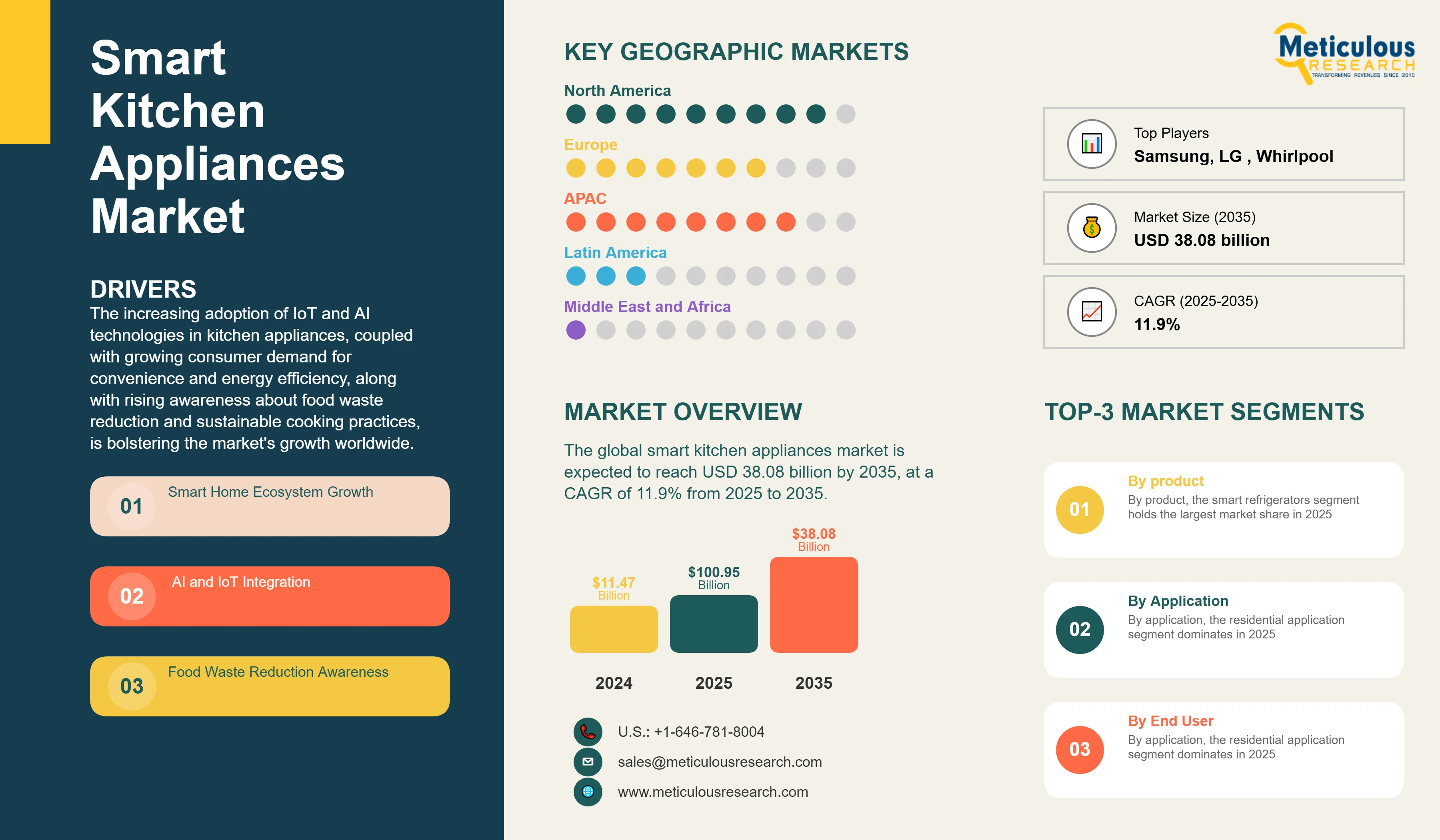
The global smart kitchen appliances market was valued at USD 11.47 billion in 2024. This market is expected to reach USD 38.08 billion by 2035 from USD 12.88 billion in 2025, at a CAGR of 11.9% from 2025 to 2035.
- Published
- Oct 2025
- Pages
- 220
- Format
- PDF + Excel
- Report ID
- MRSE - 1041622
- Base year
- 2024
- 2024 · BASELINE
- $11.47B
- 2035
- $38.08B
- CAGR 2025–2035
- 11.9%
2024 baseline · 2025–2035 forecast at 11.9% CAGR · hover a bar for the value
Key highlights
The global smart kitchen appliances market was valued at USD 11.47 billion in 2024.
This market is expected to reach USD 38.08 billion by 2035 from USD 12.88 billion in 2025, at a CAGR of 11.9% from 2025 to 2035.
The residential application segment holds the largest share of the global smart kitchen appliances market in 2025.
North America commands the largest share of the global smart kitchen appliances market in 2025. The smart kitchen appliance market in this region is growing due to the increasing number of restaurants, pubs, and hotels.
Report summary
| Particulars | Details |
|---|---|
| Report Coverage | Details |
| Market Size by 2035 | USD 38.08 Billion |
| Market Size in 2025 | USD 12.88 Billion |
| Market Size in 2024 | USD 11.47 Billion |
| Market Growth Rate from 2025 to 2035 | CAGR of 11.9% |
| Format | PDF, Excel & Cloud Portal · 220 pages |
| Dominating Region | North America |
| Fastest Growing Region | Asia Pacific |
| Base Year | 2024 |
| Forecast Period | 2025 to 2035 |
| Segments Covered | Product, Technology, Application, Distribution Channel, End User, and Region |
| Regions Covered | North America, Europe, Asia-Pacific, Latin America, and Middle East & Africa |
Report overview
Segments covered: product type, technology, distribution channel, end user, product, application.
The increasing adoption of IoT and AI technologies in kitchen appliances, coupled with growing consumer demand for convenience and energy efficiency, along with rising awareness about food waste reduction and sustainable cooking practices, is bolstering the market's growth worldwide.
In terms of revenue, the global smart kitchen appliances market is valued at USD 12.88 billion in 2025 and is projected to reach USD 38.08 billion by 2035
The market is expected to grow at a CAGR of 11.9% from 2025 to 2035
Asia Pacific is estimated to grow at the fastest CAGR over the forecast period (2025-2035)
By product, the smart refrigerators segment holds the largest market share in 2025
By product, smart cookware & cooktops are projected to register the fastest CAGR from 2025 to 2035
By connectivity, Wi-Fi technology commands the dominant market share in 2025
By application, the residential application segment dominates in 2025
By end user, the commercial segment is expected to witness the fastest CAGR during the forecast period
The smart kitchen appliances market involves designing, developing, manufacturing, and distributing internet-connected kitchen devices that use IoT (Internet of Things), artificial intelligence, and automation to improve cooking efficiency, food management, and user experience. These systems include connected refrigerators with internal cameras and food recognition, AI-powered ovens that adjust cooking settings automatically, voice-controlled dishwashers, robotic cooking systems, smart scales and thermometers, and integrated home automation platforms. Unlike traditional kitchen appliances, smart kitchen devices allow remote control through smartphones, provide maintenance alerts, optimize energy use, suggest recipes based on available ingredients, and work seamlessly with voice assistants like Alexa and Google Home. The overall smart kitchen appliances market is expected to grow due to increased adoption of smart home technologies, rising consumer demand for convenience and time-saving solutions, more awareness about reducing food waste, expanding automation in commercial kitchens, advancements in AI and machine learning, and government support for energy-efficient appliances.
AI is transforming the smart kitchen appliances market by improving convenience, personalization, efficiency, and connectivity. AI-powered appliances, like smart refrigerators, ovens, dishwashers, and cooking machines, now offer more than basic automation. They learn user preferences, track inventory, suggest recipes based on what is available, and automatically adjust cooking times or temperatures for better results. These features help cut down on food waste, save time, and increase energy efficiency with smart energy management.
Key factors driving this growth include more people adopting smart home systems, increasing health awareness where appliances offer dietary tracking and nutritional advice, and rising incomes in developing areas that allow for investment in high-end, AI-integrated appliances. Voice and gesture control make it even easier to interact with these kitchen devices.
Large appliance makers like Samsung, LG, GE, and Xiaomi are investing heavily in AI. They often partner with IoT and cloud service providers to boost their appliances' capabilities. There are still challenges, such as high initial costs, concerns about data privacy, and making sure devices work well together across different smart home platforms. However, these issues are likely to lessen as technology develops and more people adopt it. Overall, AI is turning kitchen appliances from passive tools into smart assistants that support modern lifestyles and evolving consumer needs.
Food waste is a major problem in many households. Smart refrigerators help tackle this issue by tracking food inventory and expiration dates. They reduce spoilage with timely alerts and notifications. These fridges can also suggest recipes based on the ingredients you have, encouraging efficient use of food and cutting down on waste. This supports more sustainable living. Some smart refrigerators now come with internal cameras, allowing users to check their contents remotely while shopping. This helps avoid buying duplicates and reduces waste. Linking with meal planning apps and grocery delivery services creates a system that optimizes food use and minimizes spoilage.
Another major trend driving market growth is the use of robotic cooking systems in commercial kitchens. Labor costs are increasing, and the food service industry is feeling the pressure. Kitchen automation, especially robotics, provides a strong solution to the labor challenges and rising expenses in the food service sector. Companies like Moley Robotics, Chef Robotics, and Miso Robotics are creating AI-powered cooking robots that can prepare thousands of meals each day with consistent quality. These systems cut labor costs by 30-40% while also improving food safety and consistency. Integrating with existing kitchen equipment makes it easier for restaurants and food service operators to adopt these technologies.
The global smart kitchen appliances market was valued at USD 11.47 billion in 2024. This market is expected to reach USD 38.08 billion by 2035 from USD 12.88 billion in 2025, at a CAGR of 11.9% from 2025 to 2035
Asia Pacific is expected to grow at the fastest CAGR from 2025 to 2035. This growth is mainly driven by rapid urbanization, which increases the demand for space-saving, multi-functional smart appliances in smaller urban kitchens.
The rising middle class in China, India, and Southeast Asia expands the market for premium appliances.
Manufacturing capabilities in the region lower production costs, making smart features more affordable for budget-conscious consumers.
Government initiatives for smart cities in Singapore, South Korea, and China encourage the adoption of connected homes.
The smartphone penetration rate, which exceeds 70% in major markets, supports the use of app-controlled appliances.
The cultural focus on fresh food and home cooking in Asian markets matches well with the features of smart refrigerators designed for managing food.
Increased e-commerce access helps boost online appliance sales through virtual demonstrations and reviews.
Report infographic
Market dynamics
8 factors across 3 forcesRising Smart Home Adoption and Connected Living
With over 60% of U.S. consumers using connected home technology, AI-powered appliances are quickly becoming common in smart homes. The growth of smart home ecosystems increases the demand for kitchen appliances that work well with other connected devices, allowing centralized control through a single platform. Compatibility with voice assistants like Alexa, Google Assistant, and Siri enables hands-free operation. This feature is particularly useful during cooking when hands are busy or dirty. The rollout of 5G networks improves connectivity and allows for real-time data processing, enabling advanced features like video streaming from refrigerator cameras. Younger consumers, especially millennials and Gen Z, expect all home appliances to have connected features, which pushes manufacturers to focus on smart capabilities. The COVID-19 pandemic sped up smart home adoption as consumers spent more time cooking at home and looked for technologies to make meal preparation easier.
Table of contents
13 chapters · 126 sections · 220 pages · click to expandSegmental analysis
| Segment | Largest share (2025) | Fastest growth (2025–2035) |
|---|---|---|
| By End User | Why does the Residential | — |
By End User
- The residential application segment holds the largest share of the global smart kitchen appliances market in 2025.
- Individual households represent the largest volume market, with billions of potential customers worldwide looking for convenience and efficiency in daily cooking.
- The shift to remote work has increased the time spent at home, which encourages investment in kitchen upgrades and smart appliances.
- Growing health awareness promotes home cooking over restaurant meals, making smart kitchen appliances important for meal preparation.
- Direct-to-consumer sales channels and e-commerce platforms further help expand the residential market.
Geographic analysis
North America
Largest shareNorth America commands the largest share of the global smart kitchen appliances market in 2025. The smart kitchen appliance market in this region is growing due to the increasing number of restaurants, pubs, and hotels. This market is further driven by the high disposable incomes in this region that make it possible for consumers to buy premium appliances, with the average household income in the U.S. and Canada exceeding $70,000. The early use of smart home technologies has also created a solid foundation for integrating smart kitchens. Major tech companies like Google, Amazon, and Apple play a key role in driving innovation in voice assistants and IoT platforms. The strong retail infrastructure allows consumers to test smart features before making a purchase. Additionally, significant venture capital investment in food tech startups boosts innovation in kitchen automation and robotics. Strict energy efficiency standards and utility rebate programs further encourage the use of smart appliances. North America U.S. By Geography Canada
Europe
Germany United Kingdom France Italy Spain Netherlands Rest of Europe
Asia-Pacific
China Japan India South Korea Australia Southeast Asia Rest of Asia-Pacific
Middle East & Africa
UAE Saudi Arabia South Africa Rest of MEA
Competitive landscape
- —
September 2025 – GE Appliances launched new AI-powered features in its SmartHQ™ consumer app, powered by Google Cloud's generative AI, transforming everyday challenges into simple, guided solutions including personalized recipe creation and appliance care assistance.
- —
August 2025 – Samsung presented an advanced AI Home experience at IFA 2025, showcasing its 2025 Bespoke AI appliance lineup with Voice ID technology that recognizes individual users to provide customized information and accessibility features.
- —
July 2025 – Samsung unveiled its Series 7 Bespoke AI™ Oven featuring AI Pro Cooking technology, an intelligent cooking assistant that optimizes settings to help users prepare healthy meals tailored to dietary needs, with internal camera and recipe customization capabilities.
- —
May 2025 – Samsung Electronics introduced its 4-Door and side-by-side refrigerators equipped with user-friendly 9-inch AI Home screens and 21.5-inch Family Hub screens, designed to improve food management, home control, family communication, and entertainment with enhanced AI Vision Inside technology.
- —
January 2025 – LG Electronics launched the InstaView fridge with MoodUP, enabling customizable colors on fridge doors through LED panels with 190,000 colorways, built-in Bluetooth speakers, and Door-in-Door technology for enhanced personalization and entertainment.
- —
January 2025 – Xiaomi launched its Mijia Cross-Door Refrigerator in China with 513L capacity featuring silver-ion antibacterial technology ensuring 99.99% antibacterial protection, advanced cooling, and smart app connectivity.
Frequently asked questions
The market is expected to increase from USD 12.88 billion in 2025 to USD 38.08 billion by 2035.
Cite this report
Meticulous Research. (2025). Smart Kitchen Appliances Market - Global Opportunity Analysis and Industry Forecast (2025-2035) (Report No. MRSE - 1041622). Meticulous Market Research Pvt. Ltd. https://www.meticulousresearch.com/product/smart-kitchen-appliances-market-6305