Lithium Iron Phosphate (LFP) Batteries Market (2026-2036)
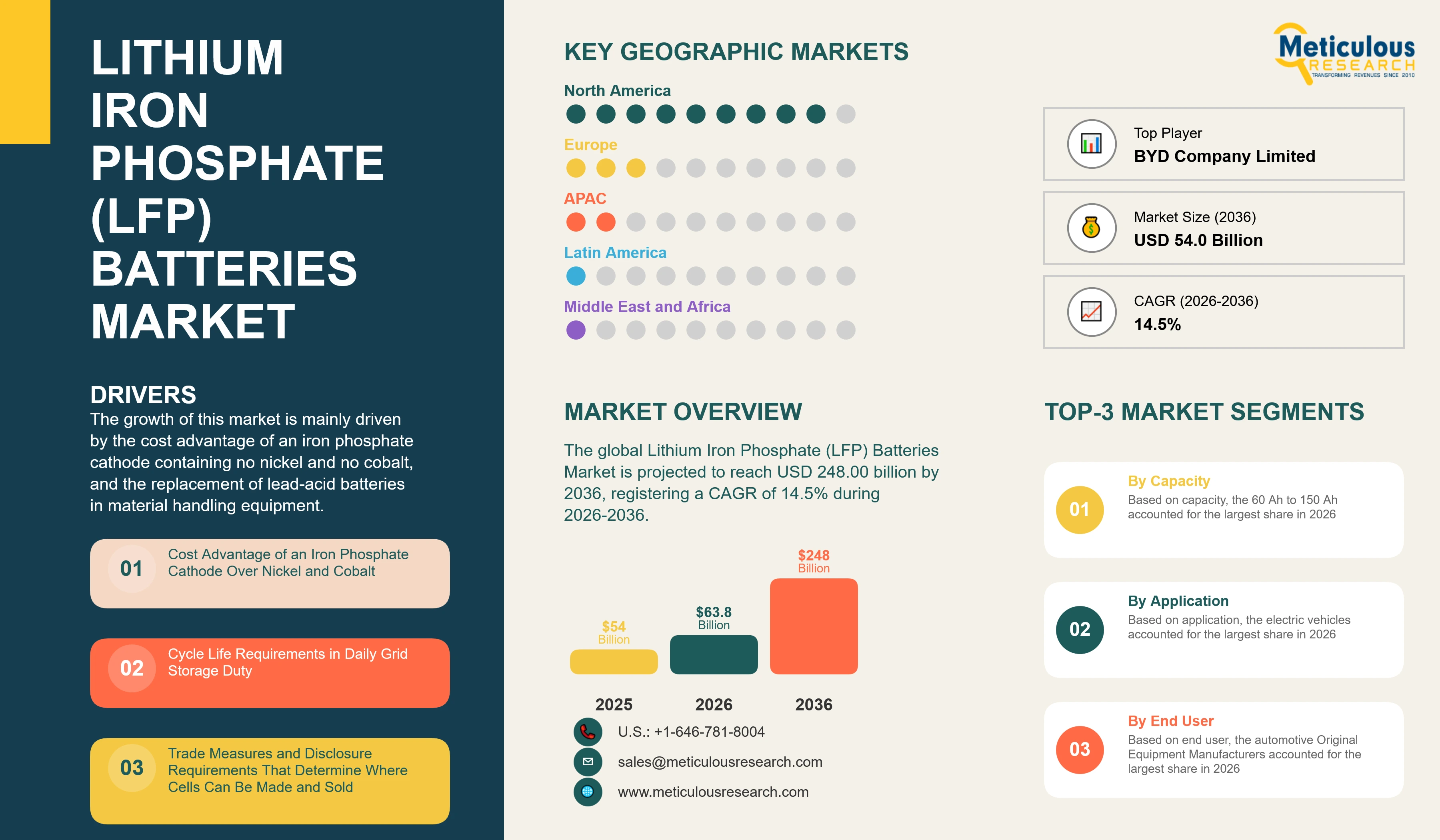
The global Lithium Iron Phosphate (LFP) Batteries Market was valued at USD 54.00 billion in 2025. This market is expected to reach USD 248.00 billion by 2036 from an estimated USD 63.80 billion in 2026, registering a CAGR of 14.5% during the forecast period (2026-2036).
- Published
- Oct 2026
- Pages
- 345
- Format
- PDF + Excel
- Report ID
- MREP - 1042414
- Base year
- 2025
- 2025 · BASELINE
- $54.00B
- 2036
- $248.0B
- CAGR 2026–2036
- 14.5%
2025 baseline · 2026–2036 forecast at 14.5% CAGR · hover a bar for the value
Key highlights
The global Lithium Iron Phosphate (LFP) Batteries Market is valued at USD 63.80 billion in 2026 and is projected to reach USD 248.00 billion by 2036, at a CAGR of 14.5%.
Based on application, the electric vehicles segment is expected to account for the largest share of the market in 2026, while the stationary energy storage segment is projected to register the highest CAGR during the forecast period.
Based on form factor, the prismatic segment is expected to account for the largest share of the market in 2026, while the cylindrical segment is projected to register the highest CAGR during the forecast period.
Based on capacity, the 60 Ah to 150 Ah segment is expected to account for the largest share of the market in 2026, while the above 300 Ah segment is projected to register the highest CAGR during the forecast period.
Based on offering, the cells segment is expected to account for the largest share of the market in 2026, while the modules and packs segment is projected to register the highest CAGR during the forecast period.
Based on end user, the automotive original equipment manufacturers segment is expected to account for the largest share of the market in 2026, while the utilities and independent power producers segment is projected to register the highest CAGR during the forecast period.
Based on geography, Asia-Pacific is expected to account for the largest share of the market in 2026, while North America is projected to register the highest CAGR during the forecast period.
Report summary
| Particulars | Details |
|---|---|
| Base Year | 2025 |
| Estimated Year | 2026 |
| Forecast Period | 2026-2036 |
| Market Size in 2025 | USD 54.00 billion |
| Market Size in 2026 | USD 63.80 billion |
| Market Size by 2036 | USD 248.00 billion |
| CAGR (2026-2036) | 14.5% |
| Format | PDF, Excel & Cloud Portal · 345 pages |
| Largest Segment by Application (2026) | Electric Vehicles |
| Fastest-growing Segment by Application | Stationary Energy Storage |
| Largest Segment by Form Factor (2026) | Prismatic |
| Largest Segment by Capacity (2026) | 60 Ah to 150 Ah |
| Fastest-growing Segment by Capacity | Above 300 Ah |
| Largest Region (2026) | Asia-Pacific |
| Fastest-growing Region | North America |
| Segments Covered | Application, Form Factor, Capacity, Offering, End User, Geography |
| Company Naming Basis | Registered legal entity, with group capability attributed to its owner |
| Number of Companies Profiled | 20, plus other companies |
Report overview
Segments covered: application, form factor, capacity, offering, end user.
The lithium iron phosphate batteries market covers cells, modules and packs using an iron phosphate cathode, together with the cathode active material supplied to cell makers, across prismatic, cylindrical and pouch formats and the electric vehicle, stationary energy storage, consumer, industrial and marine applications that use them. The growth of this market is driven by the cost advantage of iron phosphate over nickel and cobalt cathodes, by the cycle life that makes these cells suitable for daily grid storage duty, by the expansion of utility-scale storage procurement, and by the adoption of iron phosphate cells in entry and mid-range electric vehicles.
Demand is moving from electric vehicles towards stationary energy storage. Electric vehicles account for the larger share of this market in 2026, while storage is growing faster, because a storage system is charged and discharged every day and the long cycle life of an iron phosphate cell matters more in that duty than its lower energy density costs it. Storage buyers also assess a cell differently from vehicle buyers, weighing cycle life, calendar life and warranty terms rather than range and charging speed.
Where a cell and its materials are made has become as important to a buyer as the chemistry itself. Most iron phosphate cathode material and most finished cells are produced in China, and trade measures and disclosure requirements now apply to both. A cell made outside China costs more at present, and the premium is the subject of most supply negotiations in this market.
A lithium iron phosphate cell uses an iron phosphate cathode in place of the nickel, manganese and cobalt cathodes used in other lithium-ion chemistries. The cathode contains no nickel and no cobalt, which lowers the material cost and removes exposure to two of the most volatile inputs in battery manufacturing. The chemistry also holds its capacity across a larger number of charge and discharge cycles and is more stable at high temperature, while storing less energy for a given weight and volume. These properties decide where it is used, favouring applications where cost and cycle life matter more than weight.
Stationary energy storage is the application that suits the chemistry most closely. A grid storage system is charged and discharged daily for fifteen to twenty years, so the number of cycles a cell can deliver determines the value of the asset, and weight is of no consequence in a container standing on the ground. Iron phosphate cells now account for the large majority of new utility-scale storage installed worldwide, and the cells being supplied for that duty have grown steadily larger, with capacities above 300 Ah now common where cells below 150 Ah were standard a few years ago.
Electric vehicles remain the larger application by value in 2026 and have a more mixed relationship with the chemistry. Lower energy density means a shorter range for the same pack weight, which confines iron phosphate to entry and mid-range vehicles in most markets, while pack-level engineering has recovered part of the difference by removing modules and packing cells directly into the pack structure. Vehicle manufacturers have also adopted the chemistry for a commercial reason beyond cost, since a pack with no nickel or cobalt is simpler to source and less exposed to price movement in those metals.
Trade measures now apply to this market at two points in the supply chain. Under the schedule set out in the United States Trade Representative four-year review of Section 301 duties, lithium-ion electric vehicle batteries carry a 25% rate applying from 2024, and lithium-ion non-electric vehicle batteries, natural graphite and permanent magnets carry a 25% rate applying from 2026. Battery parts other than lithium-ion batteries also carry a 25% rate applying from 2024.
Two of those rates matter directly to iron phosphate cells. The 25% rate on lithium-ion non-electric vehicle batteries applying from 2026 falls on the cells used in stationary storage, which is the fastest-growing application in this market, and the 25% rate on natural graphite applying from the same year falls on the anode material used in those cells. A storage developer importing Chinese cells therefore faces a higher landed cost in 2026 than in 2025, and a cell manufacturer outside China that buys Chinese graphite faces a higher input cost at the same time.
The European Union has taken a different approach, through disclosure and due diligence rather than tariffs. Regulation (EU) 2023/1542 sets dated obligations that fall inside the forecast period. The digital battery passport becomes mandatory for electric vehicle batteries on 18 February 2027, and from 18 August 2027 companies placing batteries on the European Union market must hold battery due diligence policies, verified by a notified body and subject to periodic audit. The same regulation requires carbon footprint declarations for certain rechargeable industrial, electric vehicle and light means of transport batteries, and applies minimum recycled content requirements for cobalt, lead, lithium and nickel to industrial, electric vehicle and certain automotive batteries from August 2031.
These requirements affect iron phosphate cells more than the dates alone suggest. The cost advantage of the chemistry rests on a supply chain concentrated in China, where cathode material production and cell manufacturing both draw on an electricity supply with a high carbon intensity, so a carbon footprint declaration records a higher figure for a cell made there than for an equivalent cell made on a lower carbon grid. A battery passport and an audited due diligence policy also require information from every tier of the supply chain, which is more difficult to assemble where the supplier relationship is a purchase rather than a partnership.
Manufacturing outside China is expanding in response, and the economics of it are not yet settled. Plants in North America and Europe are being built under licence from Chinese cell makers or with Chinese equipment and process engineering, because the process knowledge sits there, and the resulting cells cost more than imported equivalents even before the licence fee is counted. A buyer choosing a domestic cell is paying for tariff protection, for compliance with disclosure requirements and for supply security, and the size of that premium determines how quickly capacity outside China fills.
Cathode active material is the part of the supply chain where concentration is highest and least visible to buyers. A cell manufacturer can be located anywhere, while the iron phosphate cathode powder it uses is produced predominantly in China, and a plant built outside China frequently imports the cathode material it consumes. A purchaser assessing the origin of a battery therefore needs to look past the location of the cell plant to the origin of the cathode, and procurement specifications are beginning to ask that question directly.
Cell format has consolidated around large prismatic cells for storage and for most vehicle packs, because a prismatic cell fills a pack volume more completely than a cylindrical cell and requires fewer connections for the same capacity. Cylindrical cells retain a position in smaller packs, in two and three wheeled vehicles and in portable equipment, and they are growing quickly from a smaller base as manufacturers apply the format to iron phosphate chemistry for products where a standard cell size simplifies assembly.
Two conditions qualify the growth rate in this market. Cell prices have fallen steeply as capacity has been added, and revenue growth is therefore slower than growth in gigawatt hours shipped, so a forecast expressed in value understates the increase in volume. The second condition is that the trade measures and disclosure requirements described above are applied by governments and can be changed by them, and a material change in either direction would alter the cost difference between Chinese and non-Chinese cells that much of the capacity now being built depends on.
Report infographic
Market dynamics
21 factors across 5 forcesCost Advantage of an Iron Phosphate Cathode Over Nickel and Cobalt
Material cost is a major factor driving the lithium iron phosphate batteries market. An iron phosphate cathode contains no nickel and no cobalt, which lowers the cost of the most expensive component in a lithium-ion cell and removes exposure to price movement in two metals whose supply is concentrated in a small number of countries. The driver operates on procurement as well as on cost, because a manufacturer sourcing iron and phosphate deals with widely available industrial inputs rather than with mined metals subject to country risk, and it is the main reason vehicle manufacturers have adopted the chemistry for entry and mid-range models. The driver has strengthened as cathode capacity has been added, because the saving is now realised at scale rather than only in theory, and it holds whether or not nickel and cobalt prices rise, since the cathode does not contain them at any price.
Cycle Life Requirements in Daily Grid Storage Duty
Cycle life is driving demand in stationary energy storage, which is the fastest-growing application in this market. A grid storage system is charged and discharged every day across a service life of fifteen to twenty years, so the number of cycles a cell delivers determines the output of the asset over its life, and the lower energy density of an iron phosphate cell carries no penalty in a container standing on the ground. The driver has made iron phosphate the dominant chemistry in new utility-scale storage and has pushed cell capacities above 300 Ah, since a larger cell reduces the number of connections and the assembly labour in a system of a given size. The driver is durable because it rests on the duty the asset performs rather than on an incentive, so it is unaffected by changes in subsidy or tax treatment, and it sets the specification a storage buyer writes rather than merely influencing a preference.
Expansion of Utility-Scale Storage Procurement
Procurement volume is driving demand independently of the cost of cells. Utilities and independent power producers are contracting storage to manage the output of wind and solar generation, to defer network reinforcement and to provide capacity and frequency services, and these contracts are placed in gigawatt hours rather than in units. The driver is supported by storage being procured against a measurable service obligation, which gives the buyer a defined revenue against which to finance the asset, and it is the reason the utilities and independent power producers segment grows faster than any other end user in this market. The driver also changes the scale at which cells are bought, since a project contracted in gigawatt hours commits a manufacturer line for months, which favours suppliers able to guarantee delivery across that period and makes production scheduling part of the commercial offer. Storage procurement is also contracted further ahead than vehicle supply, which gives manufacturers visibility of demand across several quarters.
Pack-Level Engineering That Offsets Lower Energy Density
Pack design is driving adoption in vehicles by reducing the practical effect of lower energy density. Removing modules and packing cells directly into the pack structure recovers volume that was previously taken by module housings and fixings, which narrows the range difference between an iron phosphate pack and a nickel-based pack of the same size. The driver matters because it changes which vehicle segments the chemistry can serve, extending it from the smallest models into mid-range vehicles, and it favours cell formats and sizes designed for structural integration rather than for module assembly. The driver has a limit, because the compensation available from pack design is finite and does not change the energy stored in the cell itself, so the chemistry remains excluded from long-range and performance vehicles however the pack is engineered. Manufacturers are therefore specifying the chemistry by model segment rather than across a full range.
Table of contents
13 chapters · 150 sections · 345 pages · click to expandGeographic analysis
Asia-Pacific
Largest shareIn 2026, Asia-Pacific is expected to account for the largest share of the market. The large share of this region is mainly due to the concentration of cell manufacturing and cathode active material production within it, the scale of electric vehicle production using iron phosphate packs, and domestic storage procurement programmes. The region also supplies cells and cathode material to manufacturers elsewhere, so regional output exceeds regional installation by a wide margin.
North America
Fastest growthHowever, North America is projected to register the highest CAGR during the forecast period. The rapid growth of this region is attributed to utility-scale storage procurement and to cell capacity being built locally, in part because a 25% rate applies from 2026 to imported lithium-ion non-electric vehicle batteries, which narrows the cost difference between an imported cell and one made in the region. Growth is concentrated in stationary storage rather than in vehicles, and the cathode material consumed by new plants is frequently imported.
Europe
Europe occupies a position shaped by disclosure requirements rather than by tariffs. The digital battery passport becomes mandatory for electric vehicle batteries on 18 February 2027 and battery due diligence policies are required from 18 August 2027, which obliges a supplier to produce verified information on carbon footprint and material origin. Demand in the region is therefore weighted towards suppliers able to document their supply chains, and growth depends on how quickly local cell and cathode capacity is established, since much of the current supply arrives from Asia-Pacific.
Latin America
Latin America and the Middle East & Africa remain smaller positions in which demand follows specific projects. Storage procurement in Chile, Brazil and the Gulf states is attached to solar generation and to grid reinforcement programmes, and the cells for these projects are imported. Both regions are therefore best addressed through engineering contractors and system integrators rather than through direct supply, and neither faces the trade measures or disclosure requirements that shape procurement in North America and Europe. Within Latin America, Chile accounts for most of the installed storage capacity, attached to solar generation in the north of the country, while Brazil is growing from a smaller base through distributed and commercial installations.
Middle East & Africa
Across the Middle East and Africa, procurement is concentrated in the Gulf states and in South Africa, in both cases tied to generation projects rather than to standalone storage programmes.
Competitive landscape
The competitive landscape of the lithium iron phosphate batteries market contains four groups of suppliers. Chinese cell manufacturers hold most of the global capacity and supply both domestic and export demand. Korean and Japanese cell manufacturers entered this chemistry later, having built their positions in nickel-based cells, and are adding iron phosphate lines for storage and entry-level vehicle supply. Vehicle manufacturers produce cells for their own use or hold licences to do so. Cathode active material producers supply the powder that cell makers consume and are more concentrated by geography than the cell manufacturers they serve.
Three things determine which suppliers win work in this market. The first is cost per kilowatt hour at scale, since the price level is set by the largest manufacturers operating at full utilisation and a producer without that scale cannot match it. The second is the ability to document carbon footprint and material origin, which decides access to the European market as passport and due diligence obligations take effect. The third is location of production relative to trade measures, which decides the landed cost of a cell in the United States market.
Capacity is concentrated and process knowledge more concentrated still. Most iron phosphate cell capacity and most cathode active material production are located in China, and plants being built in North America and Europe commonly operate under licence from Chinese manufacturers or with Chinese equipment and process engineering. A buyer seeking cells produced outside China is therefore dealing with a short list of plants, several of which depend on Chinese technology and imported cathode material, and the premium attached to those cells is a function of that position.
Key players operating in the global Lithium Iron Phosphate (LFP) Batteries Market are Contemporary Amperex Technology Co., Limited (China), BYD Company Limited (China), EVE Energy Co., Ltd. (China), Gotion High-tech Co., Ltd. (China), CALB Co., Ltd. (China), REPT BATTERO Energy Co., Ltd. (China), Xiamen Hithium Energy Storage Technology Co., Ltd. (China), Sunwoda Electronic Co., Ltd. (China), Guangzhou Great Power Energy & Technology Co., Ltd. (China), LG Energy Solution, Ltd. (South Korea), Samsung SDI Co., Ltd. (South Korea), SK On Co., Ltd. (South Korea), Panasonic Holdings Corporation (Japan), Tesla, Inc. (U.S.), Ford Motor Company (U.S.), American Battery Factory, Inc. (U.S.), Our Next Energy, Inc. (U.S.), Lithium Werks B.V. (Netherlands), Nano One Materials Corp. (Canada), and ICL Group Ltd. (Israel).
Companies are identified at registered legal entity level, and capability held within a group is attributed to the entity that owns it. The companies profiled were verified as active in the manufacture of iron phosphate cells, modules and packs or cathode active material as of October 2026. Producers of nickel, manganese and cobalt cells without an iron phosphate product, lithium, phosphate and graphite miners and refiners, separator, electrolyte and current collector suppliers, battery management system and power conversion suppliers, system integrators assembling purchased cells without manufacturing them, and recyclers without a cell or cathode product were excluded.
- Contemporary Amperex Technology Co., Limited · China
- BYD Company Limited · China
- EVE Energy Co., Ltd. · China
- Gotion High-tech Co., Ltd. · China
- CALB Co., Ltd. · China
- REPT BATTERO Energy Co., Ltd. · China
- Xiamen Hithium Energy Storage Technology Co., Ltd. · China
- Sunwoda Electronic Co., Ltd. · China
- LG Energy Solution, Ltd. · South Korea
- Samsung SDI Co., Ltd. · South Korea
- SK On Co., Ltd. · South Korea
- Panasonic Holdings Corporation · Japan
- Tesla, Inc. (U.S.)
- Ford Motor Company (U.S.)
- American Battery Factory, Inc. (U.S.)
- Our Next Energy, Inc. (U.S.)
- Lithium Werks B.V. · Netherlands
- Nano One Materials Corp. · Canada
- ICL Group Ltd. · Israel
Expert perspectives
The lithium iron phosphate batteries market is usually assessed as a contest between chemistries, and that question is largely settled, since iron phosphate now accounts for the large majority of new utility-scale storage and a growing share of entry and mid-range vehicle packs. The open questions concern location and documentation. Under the United States Trade Representative four-year review schedule, lithium-ion non-electric vehicle batteries and natural graphite both carry a 25% rate applying from 2026, which raises the cost of imported storage cells and of the anode material in them at the same time. Regulation (EU) 2023/1542 makes the digital battery passport mandatory for electric vehicle batteries on 18 February 2027 and requires audited battery due diligence policies from 18 August 2027. The binding constraint is therefore shifting from the cost of the chemistry to where cells and cathode material are made and what can be documented about them.
Three features are expected to shape competitive positions through 2036. First, stationary storage will continue to grow faster than electric vehicles within this market, which moves the customer from a vehicle manufacturer on a platform cycle to a project developer contracting against a service obligation and changes the specifications that decide a sale. Second, cell capacities will continue to rise, with formats above 300 Ah becoming standard in utility-scale systems, which favours manufacturers whose lines and testing capability were built for large formats. Third, cathode active material will remain the most concentrated part of the supply chain, so the origin of a battery will continue to be determined by the cathode rather than by the location of the cell plant. These three features reinforce one another, because a storage buyer specifying a large cell and requiring documented origin is asking for a combination that only a few plants can currently supply.
For companies planning entry or expansion, local cell manufacturing for stationary storage is the clearest opportunity, because the 25% rate applying from 2026 narrows the cost difference between an imported cell and one made in the region, and demand in that application is growing faster than local capacity can serve. Cathode active material production outside China addresses the part of the supply chain that local cell plants have not resolved, and it answers the origin question that procurement specifications are beginning to ask directly. Buyers should establish the origin of the cathode powder rather than accepting the location of the cell plant, and should confirm that a supplier is able to produce the carbon footprint and due diligence information the European requirements call for. Both questions are answerable before a contract is signed and expensive to resolve afterwards.
Two cautions belong in any assessment of this market. The first concerns the relationship between value and volume. Cell prices have fallen steeply as capacity has been added, so revenue grows more slowly than gigawatt hours shipped, and a figure expressed in value understates the increase in volume by a wide margin. The second concerns the durability of the cost difference that new capacity depends on. The tariffs and disclosure requirements described here are applied by governments and can be changed by them, and a material change in either direction would alter the premium that cells made outside China currently command.
Overall, the core of demand through the forecast period will continue to sit in large prismatic cells of 60 Ah to 150 Ah supplied to automotive original equipment manufacturers for entry and mid-range electric vehicles across Asia-Pacific, while the fastest growth will come from stationary energy storage, cells above 300 Ah, cylindrical formats in smaller applications, assembled modules and packs, utility and independent power producer buyers and North American installations.
Customer perspectives
Head of Procurement, Independent Power Producer
This perspective confirms that the chemistry decision is settled in utility-scale storage and that location and landed cost have become the terms of negotiation. It supports the conclusion that the 25% rate applying from 2026 to lithium-ion non-electric vehicle batteries narrows the difference between imported and locally made cells and that this difference is the subject of most supply discussions.
Battery Supply Chain Manager, European Vehicle Manufacturer
This perspective identifies the distinction between the location of a cell plant and the origin of its cathode material, and confirms that European disclosure requirements make the second the operative question. It supports the conclusion that cathode active material is the part of the supply chain that determines the origin of a battery and that procurement specifications are beginning to address it directly.
Operations Director, Warehouse Logistics Operator
This perspective confirms that tolerance of partial charging and long cycle life are the properties that support the replacement of lead-acid batteries in material handling equipment. It supports the conclusion that the industrial and material handling segment holds a steady position based on duty cycle rather than on energy density, in which the weight of the battery is an advantage rather than a penalty.
Frequently asked questions
The market was valued at USD 54.00 billion in 2025 and is estimated at USD 63.80 billion in 2026.
Cite this report
Meticulous Research. (2026). Lithium Iron Phosphate (LFP) Batteries Market - Global Opportunity Analysis and Industry Forecasts (2026-2036) (Report No. MREP - 1042414). Meticulous Market Research Pvt. Ltd. https://www.meticulousresearch.com/product/lithium-iron-phosphate-lfp-batteries-market-7097