Robotic Vacuum Cleaners Market (2024-2031)
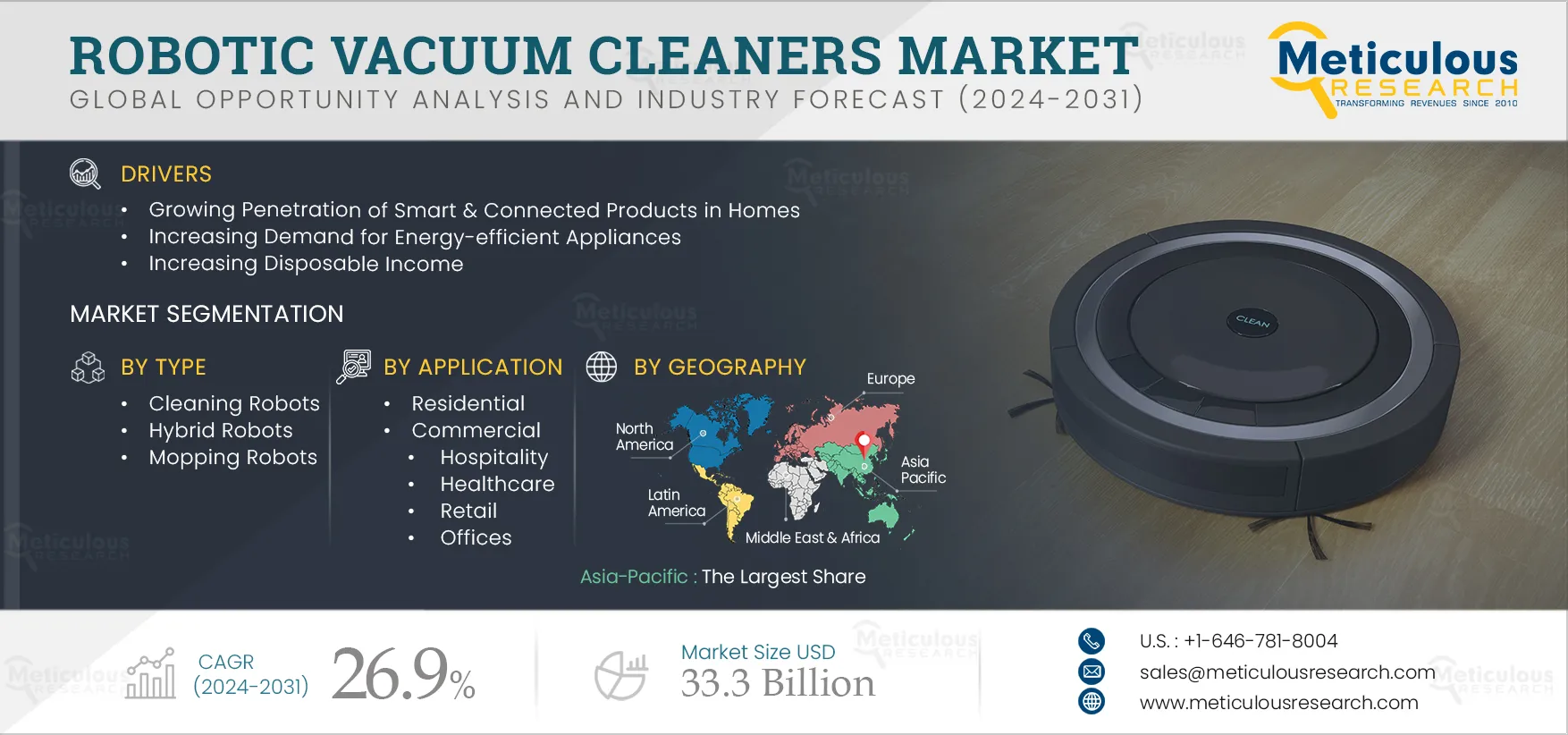
The Robotic Vacuum Cleaners Market is expected to reach $33.3 billion by 2031, at a CAGR of 26.9% from 2024 to 2031.The growth of this market is attributed to the growing penetration of smart & connected products in homes, increasing demand for energy-efficient appliances, and increasing disposable income.
- Published
- Jun 2024
- Pages
- 177
- Format
- PDF + Excel
- Report ID
- MR-487
- Base year
- 2023
- 2031 · FORECAST
- $33.30B
- 2031
- $33.30B
- CAGR 2024–2031
- 26.9%
2023 baseline · 2024–2031 forecast at 26.9% CAGR · hover a bar for the value
Key highlights
By Type: In 2024, the Cleaning Robots Segment to Dominate the Robotic Vacuum Cleaners Market
By Distribution Channel: In 2024, the Online Segment to Dominate the Robotic Vacuum Cleaners Market
By Operation: In 2024, the Self-driven Segment to Dominate the Robotic Vacuum Cleaners Market
By Price Range: In 2024, the USD 201 to USD 500 Segment to Dominate the Robotic Vacuum Cleaners Market
By Application: In 2024, the Self-driven Segment to Dominate the Robotic Vacuum Cleaners Market
Report summary
| Particulars | Details |
|---|---|
| Number of Pages | 177 |
| Format | |
| Forecast Period | 2024–2031 |
| Base Year | 2023 |
| CAGR (Value) | 26.9% |
| Market Size (Value) | USD 33.3 Billion by 2031 |
| Segments Covered | By Type · Cleaning Robots · Hybrid Robots · Mopping Robots · By Distribution Channel · Online · Offline · By Operation · Self-driven · Remote-controlled · By Price Range · Below USD 200 · USD 201 to USD 500 · Above USD 501 · By Application · Residential · Commercial · Hospitality · Healthcare · Retail · Offices · Other Commercial Applications |
| Countries Covered | North America (U.S., Canada), Europe (Germany, U.K., France, Italy, Spain, Russia, Rest of Europe), Asia-Pacific (Japan, China, India, South Korea, Rest of Asia-Pacific), Latin America (Mexico, Brazil, Rest of Latin America), and the Middle East & Africa (UAE, Saudi Arabia, South Africa, Rest of Middle East & Africa) |
| Key Companies | iRobot Corporation (U.S.), ECOVACS Robotics Co., Ltd. (China), Beijing Roborock Technology Co. Ltd. (China), Anker Innovation Technology Co., Ltd. (China), Samsung Electronics Co., Ltd (South Korea), Shenzhen Proscenic Technology Co. Ltd. (China), Neato Robotics, Inc. (U.S.), Cecotec Innovaciones S.L. (Spain), LG Electronics Inc (South Korea), Dyson Limited (U.K.), Panasonic Corporation (Japan), and Sharp Corporation (U.S.) |
Report overview
Segments covered: type, distribution channel, operation, price range, application. Regions: North America, Europe, Asia-Pacific, Latin America, Middle East & Africa.
Moreover, the proliferation of internet-connected and voice-controlled robotic vacuums is expected to offer growth opportunities for the players operating in this market.
Market dynamics
3 factors across 2 forcesGrowing Penetration of Smart & Connected Products in Homes Supports the Growth of Robotic Vacuum Cleaners Market
Recently, smart homes and appliances have become popular. These consist of robotic and automated appliances that make consumers' lives easy. A smart home has its devices interconnected through the internet, which control functions such as security access to the home, temperature, lighting, and home theater.
However, changing lifestyles and busy schedules make it difficult to clean and mop, increasing the need for robotics and smart appliances, including robotic vacuum cleaners. These cleaners are implemented with new advanced features, such as navigation technology, voice control, and remote control. Robotic vacuum cleaners also include an air filter, which makes them safe to use and maintains an eco-friendly environment for the house. The use of smart appliances is changing the lifestyle of consumers by providing comfort and effective work.
Preference for easy-to-use and appropriate appliances is increasing with the rising tech-savvy population. Women's employment is increasing, resulting in more adoption of this technology. Consumers prefer robotic vacuum cleaners over household labor due to high labor charges. These cleaners are more effective and less expensive for consumers. Also, pet owners find robotic vacuum cleaners very useful as they make their cleaning easy, quick, and pet-friendly. Such factors are supporting the growth of the robotic vacuum cleaners market.
Increasing Demand for Energy-efficient Appliances Drives the Growth of Robotic Vacuum Cleaners Market
The demand for energy-efficient appliances is increasing due to various factors such as economic growth, efforts to reduce carbon emissions, and improvement in energy security. Traditional appliances consume more power or energy, which makes it difficult for consumers to use such technologies. Robotic vacuum cleaners use less energy than traditional manual vacuum cleaners.
Robotic vacuum cleaners are designed in such a way that it saves electricity expenses. Once the robot is charged, it can work up to 5 to 6 hours, saving a large amount of energy. Many robotic vacuum cleaners have battery power backups to save energy. Also, the ability of robotic vacuum cleaners to shut down automatically when not working saves energy. Smart homes and smart appliances are energy-efficient as they save energy, and consumers can control appliances' energy usage.
Consumers are widely adopting energy-efficient appliances to reduce power or electricity usage and carbon emissions. Various countries are promoting green initiatives, including green building guidelines or the Energy Conservation Building Code (ECBC). Such initiatives are expected to increase the adoption of energy-efficient appliances in residential buildings, including robotic vacuum cleaners, which are further supporting the market growth.
Table of contents
13 chapters · 111 sections · 177 pages · click to expandSegmental analysis
| Segment | Largest share (2024) | Fastest growth (2024–2031) |
|---|---|---|
| By Type | Cleaning Robots | Hybrid robots |
| By Distribution Channel | Online | — |
| By Operation | Self-driven | Remote-controlled |
| By Price Range | USD 201 to USD 500 | Above USD 501 |
| By Application | Self-driven | — |
By Type
- The Cleaning Robots Segment to Dominate the Robotic Vacuum Cleaners Market
- The cleaning robots segment is expected to account for the largest share of above 48% of the global robotic vacuum cleaners market.
- The large market share of this segment is attributed to the growing demand for smart & connected products, including cleaning robots in homes, the growing importance of improved functionality and performance with no human interference, and the increasing importance of clean and hygienic homes.
- These automatic vacuum cleaners use various technologies, such as online mapping of the home, remote access, and an anti-collision system, to ensure efficient cleaning without any difficulties during the cleaning process.
- However, the hybrid robots segment is projected to register the highest CAGR during the period.
- The segment's growth is attributed to the growing need for Wi-Fi connectivity, advancements in mopping technology, and a growing emphasis on hygiene.
- Hybrid vacuums offer a two-in-one solution, eliminating the need for separate vacuuming and mopping, saving time and effort.
By Distribution Channel
- The Online Segment to Dominate the Robotic Vacuum Cleaners Market
- The online segment is expected to account for a larger share of above 83% of the global robotic vacuum cleaners market.
- The large market share of this segment is attributed to the growth of the e-commerce industry, convenience of shopping from home, availability of a wide range of vacuum cleaners, discounts/lower prices, detailed information for prospective buyers, and comparison of various models/brands.
- On an online platform, companies have the autonomy to display a whole range of products to attract customers with different tastes and needs.
- This enables the buyers to choose from various models after comparing the finish, features, and price of the products on display.
- Moreover, this segment is also projected to register the highest CAGR during the forecast period.
By Operation
- The Self-driven Segment to Dominate the Robotic Vacuum Cleaners Market
- The self-driven segment is expected to account for a larger share of above 68% of the global robotic vacuum cleaners market.
- The large market share of this segment is attributed to the advent of automation and the adoption of AI and IoT in robotic vacuums.
- Innovations in technologies such as sensors, AI, and internet connectivity are supporting the demand for self-driven robotic vacuum cleaners.
- These vacuum cleaners are cost-efficient and clean floors in comparatively less time than remote-controlled cleaners.
- However, the remote-controlled segment is projected to register the highest CAGR during the forecast period.
- The segment's growth is attributed to the increasing demand for AI-enabled vacuum cleaners, key players' increasing strategic developments to offer remote control functionalities through smartphone apps, and technological advancements in home appliances.
- A remote-controlled vacuum cleaner is built with a vacuum cleaner vehicle that helps the cleaner position and move in any direction on the floor.
- It also includes a handheld remote-control device and a transmitter for sending control signals.
By Price Range
- The USD 201 to USD 500 Segment to Dominate the Robotic Vacuum Cleaners Market
- The USD 201 to USD 500 segment is expected to account for the largest share of above 40% of the global robotic vacuum cleaners market.
- The large market share of this segment is attributed to the increasing demand for additional features such as security cameras, advanced sensors to prevent bumping into furniture, advanced mapping and navigation systems, and increasing demand for remote-controlled vacuum cleaners.
- These vacuums are also compatible with Google Assistant and Amazon Alexa to give voice commands while cleaning.
- However, the above USD 501 segment is projected to register the highest CAGR during the forecast period.
- The segment's growth is attributed to the increasing investment in premium appliances, the popularity of smart home appliances, and the increasing demand for high-end vacuums with stronger suction power, better filtration systems, and specialized attachments for deep cleaning, justifying the higher price tag.
By Application
- The Self-driven Segment to Dominate the Robotic Vacuum Cleaners Market
- The residential segment is expected to account for a larger share of above 78% of the global robotic vacuum cleaners market.
- The large market share of this segment is attributed to the busy lifestyle of consumers, technological advancement in home appliances, and increasing awareness of hygiene.
- The residential robotic vacuum market witnessed innovations, such as UV sterilization, spinning brushes, and security cameras for homes, pets, and older adults.
- Companies are integrating new technologies in robotic vacuum cleaners.
- Moreover, this segment is also projected to register the highest CAGR during the forecast period.
Geographic analysis
Asia-Pacific
Largest shareIn 2024, Asia-Pacific is expected to account for the largest share of above 45% of the global robotic vacuum cleaners market. The market growth in Asia-Pacific is driven by the increasing importance of clean and hygienic homes, shifting consumer preference towards purchasing intelligent home appliances, growing adoption of smart & connected products in homes, and the increased availability of technically advanced products. Due to the higher purchasing power of the people in China and South Korea, the demand for automated electronic products is also escalating in the region. Moreover, this region is also projected to record the highest CAGR of above 24% during the forecast period. In 2024, the Asia-Pacific Region to Dominate the Robotic Vacuum Cleaners Market
Competitive landscape
- April 2024
Roborock (China) launched the S8 MaxV Ultra, a technologically advanced robotic cleaner with a built-in voice assistant, in Australia and New Zealand. This cleaner provides a hassle-free cleaning experience for all types of homes.
- March 2023
Samsung India Electronics Pvt. Ltd. launched a Bespoke Jet premium range of vacuum cleaners in India to offer effortless cleaning solutions for indoor living spaces.
- April 2021
IRobot Corporation (U.S.) partnered with NSBE Boston (U.S.) to strengthen the company’s efforts to educate students and create career and professional development opportunities for minorities in STEM.
- iRobot Corporation (U.S.)
- ECOVACS Robotics Co., Ltd. · China
- Beijing Roborock Technology Co. Ltd. · China
- Anker Innovation Technology Co., Ltd. · China
- Samsung Electronics Co., Ltd · South Korea
- Shenzhen Proscenic Technology Co. Ltd. · China
- Neato Robotics, Inc. (U.S.)
- Cecotec Innovaciones S.L · Spain
- LG Electronics Inc · South Korea
- Dyson Limited (U.K.)
- Panasonic Corporation · Japan
- Sharp Corporation (U.S.)
Frequently asked questions
The robotic vacuum cleaners market study focuses on market assessment and opportunity analysis based on sales of robotic vacuum cleaners across different regions, countries, and market segments. It also offers a competitive analysis based on an extensive assessment of the leading players’ product portfolios, geographic presence, and key growth strategies.
Cite this report
Meticulous Research. (2024). Robotic Vacuum Cleaners Market - Global Opportunity Analysis And Industry Forecast (2024-2031) (Report No. MR-487). Meticulous Market Research Pvt. Ltd. https://www.meticulousresearch.com/product/robotic-vacuum-cleaner-market-5181