Remote Cardiac Monitoring Market (2026-2036)
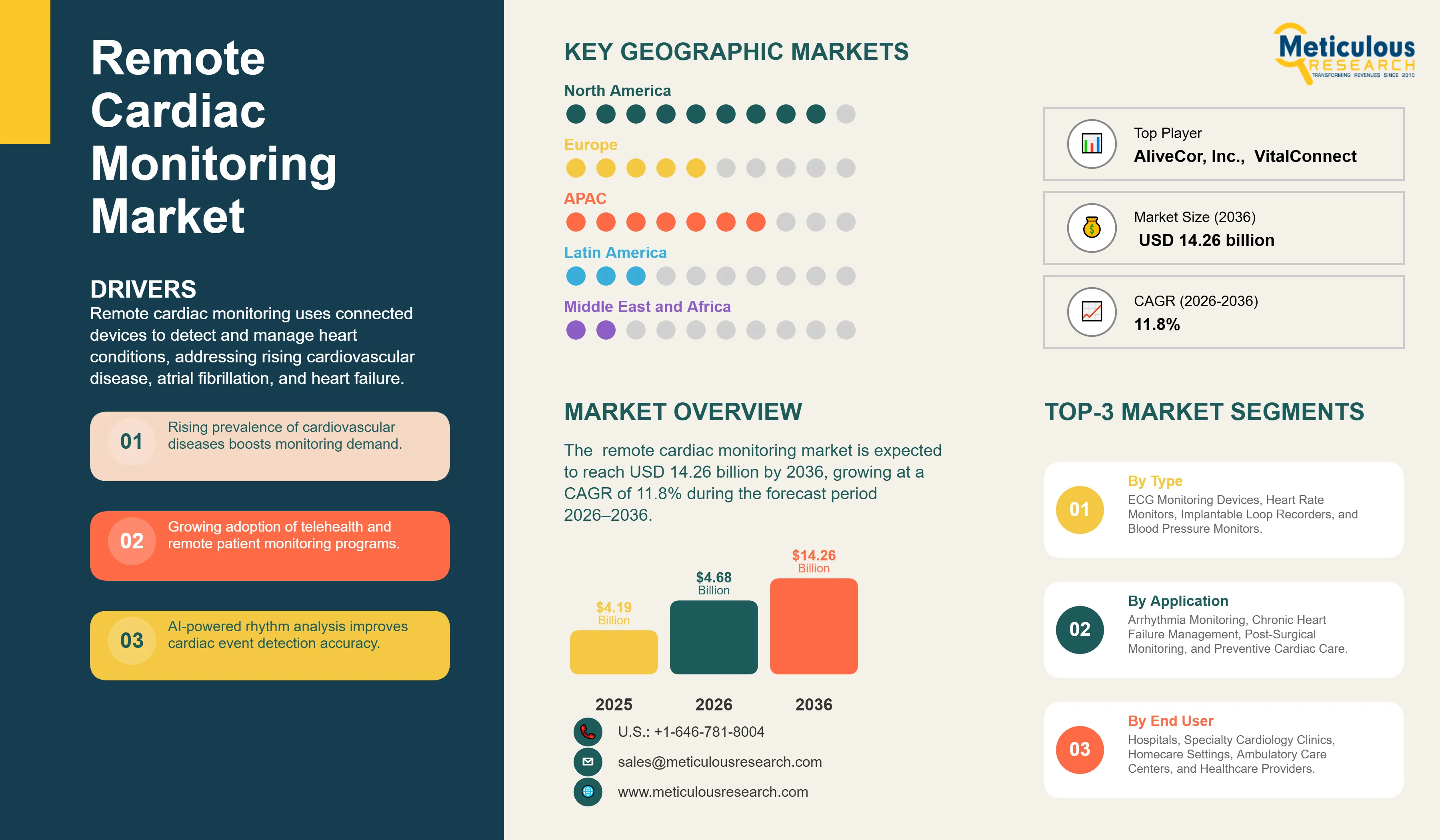
The global remote cardiac monitoring market was valued at USD 4.68 billion in 2026. This market is expected to reach USD 14.26 billion by 2036, growing at a CAGR of 11.8% during the forecast period 2026–2036.
- Published
- Jun 2026
- Pages
- 281
- Format
- PDF + Excel
- Report ID
- MRHC - 1042027
- Base year
- 2025
- 2026 · ESTIMATED
- $4.68B
- 2036
- $14.26B
- CAGR 2026–2036
- 11.8%
2025 baseline · 2026–2036 forecast at 11.8% CAGR · hover a bar for the value
Key highlights
The global remote cardiac monitoring market is projected to reach USD 14.26 billion by 2036.
The market is expected to grow at a CAGR of 11.8% during the forecast period 2026–2036.
The global market is estimated at USD 4.68 million in 2026.
ECG monitoring devices, including MCT and patch-based systems, hold the largest market share.
Remote monitoring tools demonstrate a 3x higher detection rate for asymptomatic AFib than traditional ECGs.
Medicare spending on remote patient monitoring has surged by more than 20x since 2019.
Cardiovascular diseases account for approximately 33% of all global deaths, driving market demand.
North America holds the largest market share, estimated at approximately 42% in 2026.
The homecare setting is the fastest-growing end-user segment for remote cardiac monitoring.
Report summary
| Particulars | Details |
|---|---|
| Base Year | 2025 |
| Estimated Year | 2026 |
| Forecast Period | 2026–2036 |
| Market Size (2026) | USD 4.68 billion |
| Market Size (2036) | USD 14.26 billion |
| CAGR (2026–2036) | 11.8% |
| Format | PDF, Excel & Cloud Portal · 281 pages |
| Segments Covered | By Product Type: ECG Monitors, Heart Rate Monitors, ILRs · By Component: Hardware, Software, Services · By Application · By End User |
| Key Companies | Abbott Laboratories, Boston Scientific Corporation, GE HealthCare, Philips Healthcare, Baxter International, Nihon Kohden Corporation, Biotronik, iRhythm Technologies, BioTelemetry, Bardy Diagnostics, Preventice Solutions, AliveCor, VitalConnect, Cardiac Insight |
Report infographic
Market dynamics
10 factors across 4 forcesThe market's growth is fundamentally anchored
by the convergence of an aging global population, the rising prevalence of chronic cardiac conditions, and the rapid adoption of telehealth services. According to the United Nations, the global population aged 65 years and older is projected to increase from approximately 857 million in 2021 to nearly 1.6 billion by 2050, significantly increasing the incidence of arrhythmias, heart failure, and other age-related cardiovascular disorders. Furthermore, the expansion of remote patient monitoring (RPM) programs has accelerated following the COVID-19 pandemic, as healthcare providers increasingly seek cost-effective solutions that reduce hospital admissions and enable earlier clinical intervention.
Technological innovation is the primary catalyst for market expansion,
particularly the development of medical-grade wearables and non-invasive sensors that offer high patient compliance. Modern remote monitoring platforms now incorporate AI-driven rhythm analysis algorithms capable of filtering massive volumes of continuous data to identify clinically significant events with high precision. These tools have demonstrated a 3x higher detection rate for asymptomatic arrhythmias compared to traditional intermittent clinical ECGs. Furthermore, the integration of remote monitoring data into electronic health records (EHR) is enabling more proactive, data-driven clinical decision-making, reducing the likelihood of emergency hospitalizations and improving long-term patient outcomes. In the United States, Medicare spending on remote patient monitoring has surged by over 20x since 2019, reflecting the rapid mainstreaming of these technologies.
The market is also benefiting from a favorable regulatory and reimbursement landscape,
with organizations like the Centers for Medicare & Medicaid Services (CMS) expanding CPT codes for remote physiologic monitoring. While hospitals and specialty clinics remain the primary gatekeepers for diagnostic monitoring, the homecare setting is witnessing the fastest growth as patients and providers seek more convenient and cost-effective long-term management models. The competitive landscape is characterized by intense innovation among medical technology giants such as Medtronic, Abbott, and Boston Scientific, alongside specialized digital health firms like iRhythm and AliveCor. These companies are increasingly focusing on cloud-native architectures and predictive analytics to provide actionable insights at the point of care.
Geographically,
North America leads the global market. This dominance is driven by the region's advanced healthcare infrastructure, robust reimbursement for remote services, and a high concentration of leading cardiac technology firms. However, the Asia-Pacific region is projected to witness the fastest growth through 2036. Countries like China and India are rapidly modernizing their diagnostic infrastructure to manage their massive patient populations and the increasing burden of CVDs. As remote cardiac monitoring becomes the standard of care for chronic disease management, the market is poised for sustained growth, reaching over USD 14 billion by the end of the forecast period.
The primary driver for the remote
cardiac monitoring market is the rising global prevalence of cardiovascular diseases (CVDs). According to the World Heart Federation (2024), an estimated 20.5 million people died from CVD-related causes in 2021, representing 33% of all global deaths. Furthermore, the rapidly aging global population is significantly increasing the pool of patients at risk for chronic heart failure and arrhythmias. The United Nations (2024) reports that 1 in 6 people worldwide will be over the age of 65 by 2050. Technological advancements in medical-grade wearables and AI-driven rhythm analysis have also made remote monitoring more accessible and reliable, while the expansion of reimbursement codes by payers like CMS is incentivizing providers to adopt these tools in routine clinical workflows.
A major restraint is the concern regarding data security and patient privacy,
as the continuous transmission of sensitive cardiac data over public networks presents significant cybersecurity risks. Furthermore, the high capital investment required for sophisticated mobile cardiac telemetry (MCT) and implantable loop recorder (ILR) systems can be a barrier to adoption, particularly in budget-constrained healthcare settings and emerging markets. The American Heart Association (2025) notes that the projected annual cost of CVDs in the U.S. alone will exceed USD 1.1 trillion by 2035, putting immense pressure on healthcare budgets and potentially limiting the rapid rollout of high-cost remote monitoring technologies.
Table of contents
12 chapters · 107 sections · 281 pages · click to expandSegmental analysis
| Segment | Largest share (2026) | Fastest growth (2026–2036) |
|---|---|---|
| By Product Type | ECG Monitors | Patch-based ECGs and Smart Wearables |
| By Application | Arrhythmia Monitoring | Chronic Heart Failure (CHF) Management |
By Product Type
- ECG Monitors to Hold Largest Share
- The ECG Monitoring Devices segment is expected to hold the largest share of the market.
- This segment includes Holter monitors, patch-based ECGs, and Mobile Cardiac Telemetry (MCT).
- The dominance is driven by the critical role of continuous ECG tracking in the definitive diagnosis of arrhythmias.
- The Patch-based ECGs and Smart Wearables sub-segment is projected to witness the fastest growth, as patients increasingly prefer non-invasive, comfortable monitoring solutions that do not disrupt their daily activities.
By Application
- Arrhythmia Monitoring to Lead
- The Arrhythmia Monitoring segment is expected to hold the largest share of the market.
- Atrial fibrillation (AFib) is the most common cardiac rhythm disorder, affecting millions globally and requiring long-term tracking to manage stroke risk.
- The Chronic Heart Failure (CHF) Management segment is projected to witness the fastest growth during the forecast period, as healthcare systems focus on reducing costly hospital readmissions through proactive fluid status and vital sign tracking.
Geographic analysis
North America
Largest shareNorth America is expected to hold the largest share of the global remote cardiac monitoring market in 2026, accounting for approximately 42% of total revenue. This dominance is due to the region's advanced healthcare infrastructure, favorable reimbursement policies for remote monitoring services, and the presence of major industry players like Medtronic and Abbott. The high prevalence of CVDs in the U.S. also drives significant demand for remote monitoring solutions.
Asia-Pacific
Fastest growthAsia-Pacific is projected to witness the fastest growth during the forecast period. The region is rapidly modernizing its healthcare infrastructure and adopting digital health solutions to manage its massive and aging patient populations. The rising burden of cardiovascular diseases in countries like China and India is the primary growth driver. Key companies operating in the Asia-Pacific market include major global vendors and emerging local medical technology firms.
Competitive landscape
- Abbott Laboratories
- Boston Scientific Corporation
- GE HealthCare
- Philips Healthcare
- Baxter International · Hillrom
- Nihon Kohden Corporation
- Biotronik
- iRhythm Technologies
- BioTelemetry · Philips
- Bardy Diagnostics · Baxter
- Preventice Solutions · Boston Scientific
- AliveCor
- VitalConnect
- Cardiac Insight
Frequently asked questions
The market is projected to reach USD 14,260.4 million by 2036, growing at a CAGR of 11.8% from 2026 to 2036.
Cite this report
Meticulous Research. (2026). Remote Cardiac Monitoring Market - Global Opportunity Analysis and Industry Forecast (2026-2036) (Report No. MRHC - 1042027). Meticulous Market Research Pvt. Ltd. https://www.meticulousresearch.com/product/remote-cardiac-monitoring-market-6710