Plant-based Milk Market (2024-2031)
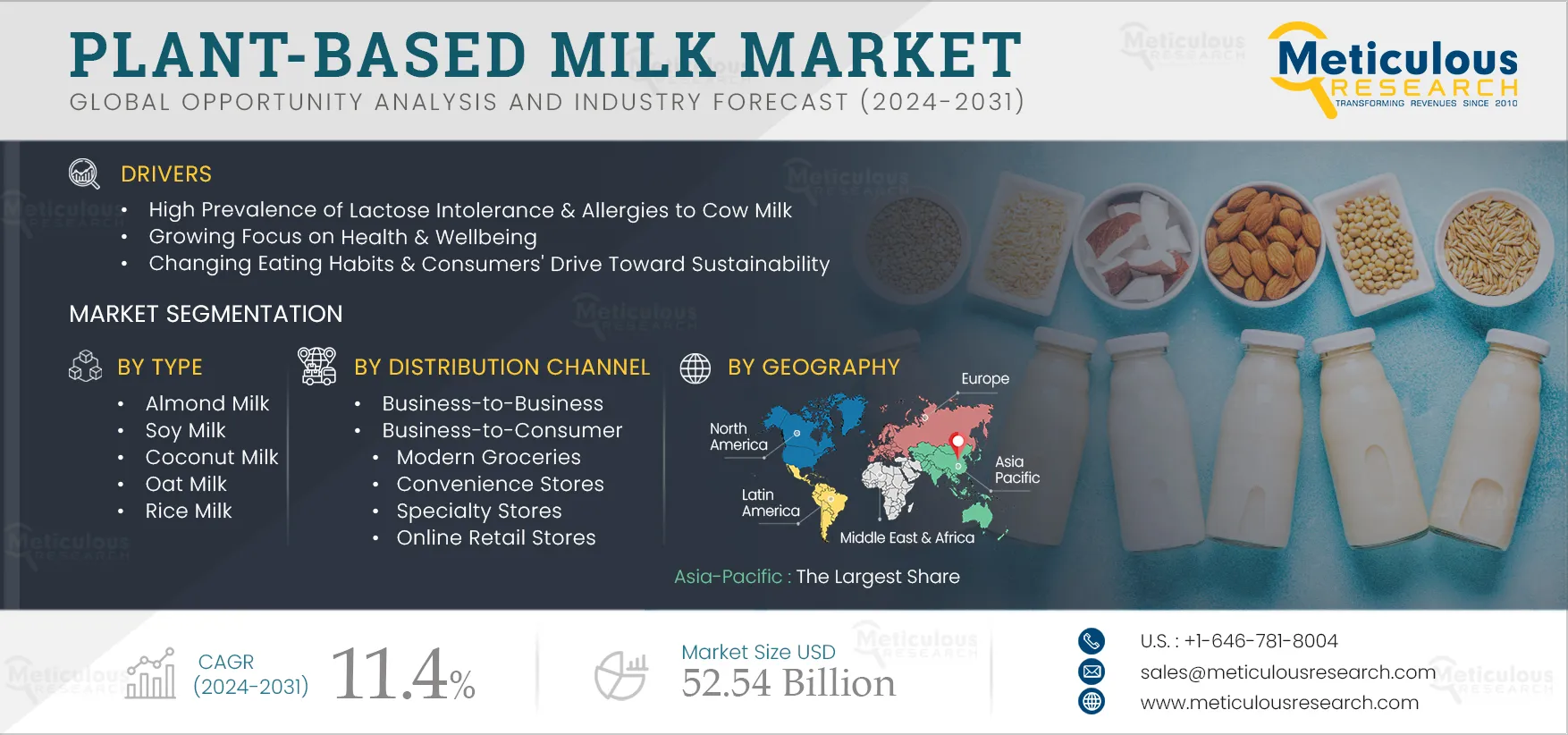
The Plant-based Milk Market was valued at $21.96 billion in 2023. This market is expected to reach $52.54 billion by 2031, from an estimated $24.7 billion in 2024, at a CAGR of 11.4% during the forecast period 2024-2031. Plant-based Milk Market Size & Forecast In terms of volume, this market is projected
- Published
- Jan 2024
- Pages
- 233
- Format
- PDF + Excel
- Report ID
- MRFB - 104618
- Base year
- 2023
- 2023 · BASELINE
- $21.96B
- 2031
- $52.54B
- CAGR 2024–2031
- 11.4%
2023 baseline · 2024–2031 forecast at 11.4% CAGR · hover a bar for the value
Key highlights
By Type: In 2024, the Almond Milk Segment to Dominate the Plant-based Milk Market
By Formulation: In 2024, the Unflavored Segment to Dominate the Plant-based Milk Market
By Distribution Channel: In 2024, the Business-To-Business (B2B) Segment to Dominate the Plant-based Milk Market
Report summary
| Particulars | Details |
|---|---|
| Number of Pages | 233 |
| Format | |
| Forecast Period | 2024–2031 |
| Base Year | 2023 |
| CAGR (Value) | 11.4% |
| Market Size (Value) | USD 52.54 Billion by 2031 |
| CAGR (Volume) | 9.2% |
| Market Size (Volume) | 18.26 Billion Liters by 2031 |
| Segments Covered | By Type · Almond Milk · Soy Milk · Coconut Milk · Oat Milk · Rice Milk · Other Plant-based Milks · By Formulation · Unflavored · Flavored · By Distribution Channel · Business-to-Business · Business-to-Consumer · Modern Groceries · Convenience Stores · Specialty Stores · Online Retail Stores · Other B2C Distribution Channels |
| Countries Covered | North America (U.S., Canada), Europe (Germany, U.K., Spain, Italy, France, Netherlands, Sweden, Belgium, Austria, Denmark, Poland, Portugal, Rest of Europe), Asia-Pacific (China, India, Japan, Australia, Thailand, South Korea, Rest of Asia-Pacific), Latin America (Brazil, Mexico, Argentina, Rest of Latin America), and Middle East & Africa |
| Key Companies | Hain Celestial Group, Inc. (U.S.), SunOpta Inc. (Canada), Sanitarium Health and Wellbeing Company (Australia), Axiom Foods, Inc. (U.S.), Earth's Own Food Company, Inc. (Canada), Sunrise Soya Foods (Canada), Campbell Soup Company (U.S.), Danone S.A. (France), Plamil Foods Ltd. (U.K.), Sahmyook Foods (South Korea), Nestlé S.A. (Switzerland), Natura Foods (Canada), Blue Diamond Growers (U.S.), and Oatly Group AB (Sweden). |
Report overview
Segments covered: type, formulation, distribution channel. Regions: North America, Europe, Asia-Pacific, Latin America.
In terms of volume, this market is projected to reach 18.26 billion Liters by 2031, at a CAGR of 9.2% during the forecast period of 2024–2031. The growth of the plant-based milk market is driven by the high prevalence of lactose intolerance & allergies to cow milk, the growing focus on health & well-being, changing eating habits & consumers’ drive toward sustainability, and increasing investments & government support for plant-based industries. However, the high preference for animal-based milk products and the growing consumption of soy-free & gluten-free products restrain the growth of this market.
Emerging economies in Asia-Pacific and Latin America are expected to generate market growth opportunities. However, the fluctuating raw material prices are a major challenge for market stakeholders.
Report infographic
Market dynamics
3 factors across 2 forcesHigh Prevalence of Lactose Intolerance & Allergies to Cow Milk
Lactose intolerance is the inability of the body to digest lactose, the sugar present in milk. Lactose intolerance can be symptomatic or asymptomatic. In symptomatic populations, lactose intolerance can lead to diarrhea and stomach pain. According to the National Institutes of Health (NIH), lactose intolerance among adults is most common in East Asians, affecting 70–100% of the population. Encyclopedia Britannica adds that the condition affects 75 to 90% of Native American, African, Asian, Mediterranean, and Jewish populations. Only about 5% of Northern and Central Europeans have lactose intolerance.
With the high prevalence of lactose intolerance and allergies to cow milk, many consumers across the globe are switching to vegan diets, reducing milk consumption in some parts of the world. For instance, according to the United States Department of Agriculture (USDA) Economic Research Service (ERS) Food Availability (Per Capita) Data System, daily per capita fluid milk consumption in the U.S. has decreased over each of the past seven decades. The daily per capita fluid milk consumption in the U.S. decreased to 0.49 cups in 2019 from 0.62 cups, 0.69 cups, and 0.78 cups in 2010, 2000, and 1990, respectively. With the increasing prevalence of lactose intolerance and allergies to cow milk, most dairy consumers have started preferring dairy alternatives made from plant-based sources, which, in turn, is driving the growth of the plant-based milk market.
Growing Focus on Health & Wellbeing
Factors such as rapid urbanization, lifestyle changes, industrialization, economic development, health & wellness trends, and the rising awareness about health issues caused by the long-term use of animal milk have created immense growth opportunities for the manufacturers of plant-based milk globally.
A large share of the global population is struggling with weight management, cardiovascular diseases, and allergies. Moreover, there are other concerns related to animal milk, such as acne & dermatological problems and exposure to contaminants like hormones, pesticide residues, mycotoxins, metals, and antibiotics that can lead to allergies and poor health. Plant-based milks typically have a lower content of saturated fat and cholesterol compared to full-fat animal milk. They can, therefore, help control cardiovascular diseases by reducing blood pressure and cholesterol.
Plant-based dairy alternatives can be a solution for many of these health concerns and also provide nutrition. Plant-based milks are nutritionally adequate for everyone, from pregnant women to children to athletes. These products can reduce health issues, such as heart disease, Type 2 diabetes, hypertension, certain types of cancer, and obesity. Dairy alternative-based diets are high in fiber and provide all the necessary nutrients. Therefore, the growing focus on health & well-being is driving the demand for plant-based milk products.
Table of contents
11 chapters · 158 sections · 233 pages · click to expandSegmental analysis
| Segment | Largest share (2024) | Fastest growth (2024–2031) |
|---|---|---|
| By Type | Almond Milk | Oat milk |
| By Formulation | Unflavored | Flavored |
| By Distribution Channel | Business-To-Business (B2B) | — |
By Type
- The Almond Milk Segment to Dominate the Plant-based Milk Market
- The almond milk segment is expected to account for the largest share of 59.9% of the global plant-based milk market.
- The large market share of this segment is mainly attributed to factors such as the increasing number of consumers switching to nut-based lactose-free milk, changing taste preferences, and increasing health & environmental concerns.
- Almond milk is entirely plant-based, making it a suitable choice for individuals following vegan or vegetarian diets.
- The production of almond milk generally has a lower environmental impact compared to dairy milk, as it requires less water and produces fewer greenhouse gas emissions.
- However, the oat milk segment is projected to witness the highest growth rate of 12.7% during the forecast period of 2024–2031.
- Oat milk contains vitamins and minerals, including vitamin B2 (riboflavin), vitamin B3 (niacin), phosphorus, and manganese, which contribute to overall health.
- Oat milk is often fortified with essential nutrients like calcium, vitamin D, and vitamin B12, providing similar nutritional benefits to cow's milk.
- The growth of this segment is mainly driven by consumers’ increasing preference for soy-free, low-fat, and gluten-free products; the high nutritional properties of oat milk; and rising awareness about the health benefits of oats.
By Formulation
- The Unflavored Segment to Dominate the Plant-based Milk Market
- The unflavored segment is expected to account for the larger share of 64.4% of the global plant-based milk market.
- The large market share of this segment is mainly attributed to factors such as the increased consumer demand for naturally dairy-free & sugar-free products and the clean taste and smooth texture of unflavored dairy-free products, which allow for their seamless incorporation into various food and beverage recipes.
- However, the flavored segment is projected to register the highest CAGR of 13.6% during the forecast period of 2024–2031.
- The rapid growth of this segment is mainly driven by the increasing demand for ready-to-drink beverages and changing consumer taste preferences.
By Distribution Channel
- The Business-To-Business (B2B) Segment to Dominate the Plant-based Milk Market
- The business-to-consumer (B2C) segment is expected to account for the larger share of 67.4% of the global plant-based milk market.
- The large market share of this segment is attributed to the increased retail sales of plant-based milk in supermarkets & hypermarkets, increased shelf space for plant-based products in modern groceries, growing preference for shopping from brick-and-mortar grocers due to easy access & availability and increasing consumer acceptance for vegan & vegetarian dairy alternatives, especially plant-based milk.
Geographic analysis
Asia-Pacific
Largest shareIn 2024, Asia-Pacific is expected to account for the largest share of 49.7% of the global plant-based milk market, followed by Europe and North America. Asia-Pacific plant-based milk market is estimated to be worth USD 28.07 billion in 2024. The large share of this market is mainly attributed to consumers’ rising awareness about the benefits of protein-rich foods, increasing health consciousness, the growing adoption of advanced technologies in the F&B industry, and the region’s large vegan & vegetarian population base. Moreover, this region is slated to register the highest CAGR of 12.6% during the forecast period of 2024–2031, mainly due to the region’s increasing vegan & flexitarian populations, the rising popularity of Western diets, and increasing investments in the plant-based milk industry. Asia-Pacific Dominates the Overall Plant-based Milk Market, Also Leads in Growth
Competitive landscape
- March 2024
Oatly Group AB (Sweden) partnered with Barry’s (U.S.), a boutique fitness brand, to launch its Unsweetened Oatmilk in fitness studios across the U.S.
- July 2023
Sahmyook Foods (South Korea) launched Light Sahmyook Soy Milk C, which mixes the savory taste of the existing Samyuk Soymilk A with the sweet taste of the sweet Samyuk Soymilk B.
- October 2023
Oatly Group AB (Sweden), in collaboration with Coffee Fellows (Germany), made its Oatly Barista available in 275 locations of Coffee Fellows across Germany, Austria, Belgium, Luxembourg, and the Netherlands.
- March 2023
Nestlé S.A. (Switzerland) launched a plant-based milk alternative by combining oats and fava, which has 5g of protein per serving and all the amino acids.
- Hain Celestial Group, Inc. (U.S.)
- SunOpta Inc. · Canada
- Sanitarium Health and Wellbeing Company · Australia
- Axiom Foods, Inc. (U.S.)
- Earth's Own Food Company, Inc. · Canada
- Sunrise Soya Foods · Canada
- Campbell Soup Company (U.S.)
- Danone S.A. · France
- Plamil Foods Ltd. (U.K.)
- Sahmyook Foods · South Korea
- Nestlé S.A. · Switzerland
- Natura Foods · Canada
- Blue Diamond Growers (U.S.)
- Oatly Group AB · Sweden
Frequently asked questions
Plant-based milk, a milk alternative, is dairy-free, protein-rich milk derived from plant-based sources, such as almonds, soy, coconut, oats, and rice. It is a sustainable and environmentally friendly milk alternative for the globally increasing vegan, lactose intolerant, and flexitarian populations. It addresses issues related to animal welfare, resource efficiency, and climate change.
This report provides detailed market insights and market sizes & forecasts for the plant-based milk market in terms of value (by type, formulation, distribution channel, and geography) & volume (by type and geography). Each segment provides the market sizes & forecasts for five key geographies (North America, Europe, Asia-Pacific, Latin America, and the Middle East & Africa) along with key regional countries.
Cite this report
Meticulous Research. (2024). Plant-based Milk Market - Global Opportunity Analysis and Industry Forecast (2024-2031) (Report No. MRFB - 104618). Meticulous Market Research Pvt. Ltd. https://www.meticulousresearch.com/product/plant-based-milk-market-5304