Organic Spirulina Market (2025-2035)
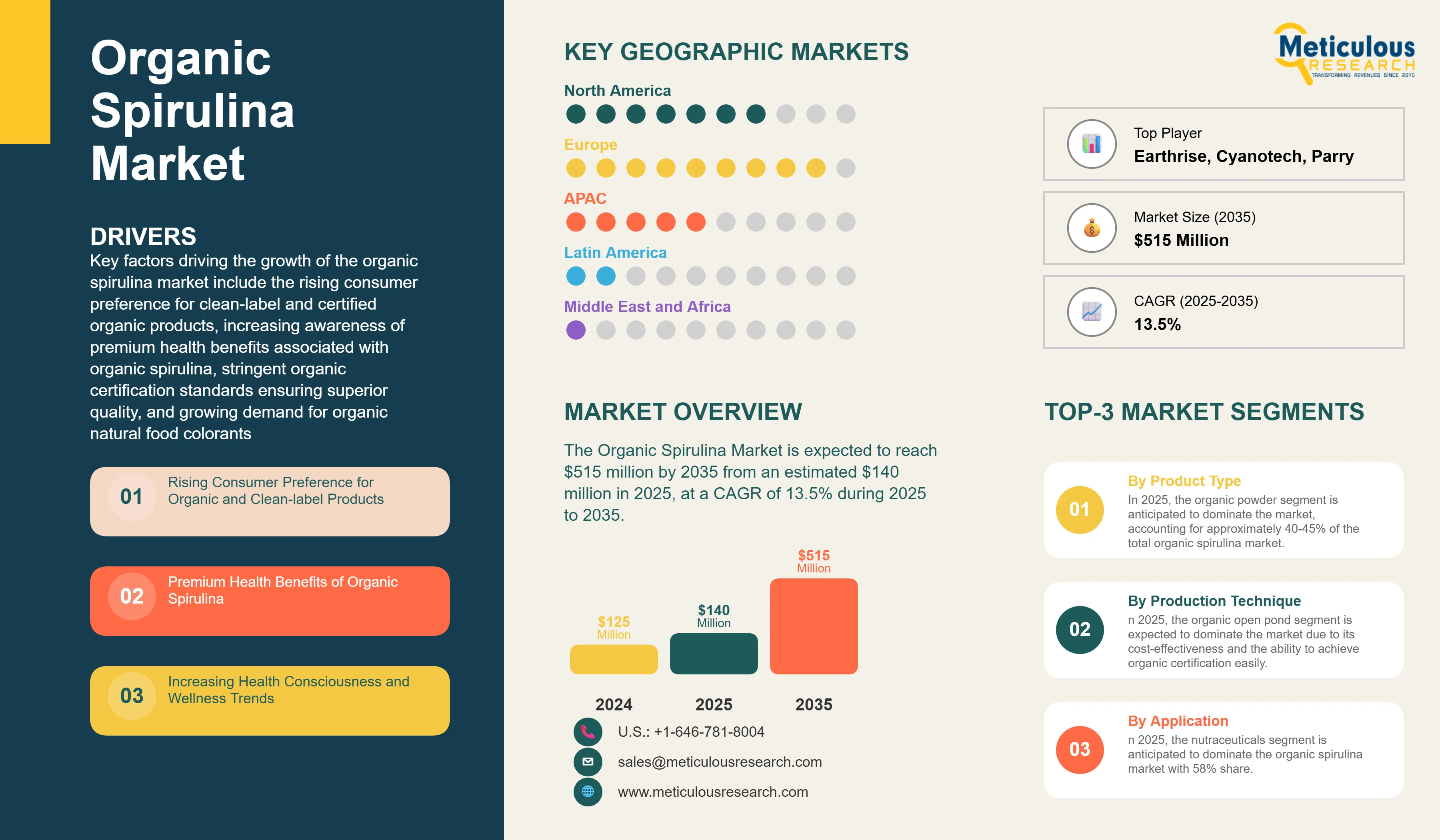
The Organic Spirulina Market was valued at $125 million in 2024. This market is expected to reach $515 million by 2035 from an estimated $140 million in 2025, at a CAGR of 13.5% during the forecast period of 2025 to 2035. Executive Summary Key factors driving the growth of the organic spirulina market
- Published
- Jun 2025
- Pages
- 145
- Format
- PDF + Excel
- Report ID
- MR-1511
- Base year
- 2024
- 2024 · BASELINE
- $125.0M
- 2035
- $515.0M
- CAGR 2025–2035
- 13.5%
2024 baseline · 2025–2035 forecast at 13.5% CAGR · hover a bar for the value
Key highlights
The Organic Spirulina Market was valued at $125 million in 2024.
This market is expected to reach $515 million by 2035 from an estimated $140 million in 2025, at a CAGR of 13.5% during the forecast period of 2025 to 2035.
In 2025, Europe is anticipated to account for the major share of around 45% of the organic spirulina market, reflecting the region's well-established organic food culture, stringent organic regulations, and high consumer awareness about organic products.
North America follows as the second-largest market, driven by the USDA Organic certification program, high health consciousness among consumers, and the presence of leading organic spirulina brands.
Asia-Pacific is emerging as the fastest-growing region for organic spirulina, with a projected CAGR of 16.4% during 2025-2035, driven by increasing organic awareness in countries like Japan, Australia, and urban areas of China and India, rising disposable incomes, and growing health consciousness among the middle class.
Report summary
| Particulars | Details |
|---|---|
| Number of Pages | 145 |
| Forecast Period | 2025–2035 |
| Base Year | 2024 |
| CAGR (Value) | 13.5% |
| Format | PDF, Excel & Cloud Portal · 145 pages |
| Market Size 2024 | USD 125 million |
| Market Size 2025 | USD 140 million |
| Market Size 2035 | USD 515 million |
| Segments Covered | By Product Type, Production Technique, Distribution Channel, Application |
| Countries Covered | North America (U.S., Canada), Europe (Germany, France, U.K., Italy, Netherlands, Spain, Denmark, Sweden, and Rest of Europe), Asia-Pacific (Japan, Australia, India, China, Thailand, and Rest of Asia-Pacific), Latin America (Brazil, Mexico, Argentina, and Rest of Latin America), and the Middle East & Africa (South Africa, UAE, Egypt, and Rest of Middle East & Africa) |
Report overview
Segments covered: product type, production technique, distribution channel, application. Regions: North America, Europe, Asia-Pacific, Latin America, Middle East & Africa.
Key factors driving the growth of the organic spirulina market include the rising consumer preference for clean-label and certified organic products, increasing awareness of premium health benefits associated with organic spirulina, stringent organic certification standards ensuring superior quality, growing demand for organic natural food colorants, expanding organic nutraceuticals industry, and rising willingness to pay premium prices for sustainable and environmentally-friendly products. However, this growth is restrained by higher production costs and premium pricing, limited organic certified production capacity, complex organic certification processes, and lower yields compared to conventional spirulina cultivation.
Additionally, untapped markets in developing regions with growing organic awareness, development of innovative organic product formulations, expansion of direct-to-consumer organic sales channels, integration with the broader organic food ecosystem, and rising demand for organic aquaculture applications are poised to offer significant growth opportunities for market players. The adoption of sustainable packaging for organic products and vertical integration in organic supply chains are emerging as notable trends in this market.
Report infographic
Market dynamics
4 factors across 1 forceRising Consumer Preference for Organic and Clean-Label Products
The demand for organic spirulina is experiencing unprecedented growth due to increasing consumer awareness about the benefits of organic products and the growing preference for clean-label ingredients. Modern consumers are increasingly concerned about synthetic additives, pesticide residues, and chemical contaminants in their food and supplements, driving them toward certified organic alternatives. The organic spirulina market benefits from this trend as consumers seek products that are free from synthetic fertilizers, pesticides, and genetic modifications.
The adverse effects of synthetic additives, coupled with a rise in health consciousness and a preference for environmentally friendly products, are driving this trend. Organic spirulina, being produced without synthetic inputs and under strict organic certification standards, appeals to health-conscious consumers who prioritize product purity and safety. This preference is particularly strong among millennials and Gen Z consumers who are willing to pay premium prices for products that align with their health and environmental values.
The clean-label movement has gained significant momentum in recent years, with consumers demanding transparency in product ingredients and production methods. Organic spirulina, with its simple ingredient profile and certified organic status, perfectly aligns with these consumer expectations, driving its adoption across various applications.
Premium Health Benefits and Superior Nutritional Profile
Organic spirulina offers enhanced health benefits compared to conventional spirulina due to its purer cultivation environment and absence of synthetic contaminants. The organic production process, which prohibits the use of synthetic fertilizers and chemicals, results in a cleaner product with potentially higher bioavailability of nutrients. Research suggests that organic spirulina may contain higher levels of certain antioxidants and beneficial compounds due to the stress-response mechanisms activated in organic cultivation environments.
Spirulina is regarded as a nutritional powerhouse due to its high protein content, which includes all eight essential amino acids in balanced proportions. It is also rich in beta-carotene, vitamin E, and iron. Organic spirulina maintains these nutritional benefits while providing additional assurance of purity and safety, making it particularly attractive to health-conscious consumers, athletes, and individuals with dietary restrictions.
The growing body of research supporting spirulina's health benefits, combined with the premium positioning of organic variants, has led to increased adoption among consumers seeking natural alternatives to synthetic supplements and functional foods.
Expanding Organic Nutraceuticals Industry
In recent decades, the use of dietary supplements, including vitamins, minerals, and nutritional and herbal supplements, has been on the rise. This trend was further accelerated during the COVID-19 pandemic, with a notable increase in supplement sales. The organic segment of the nutraceuticals industry is experiencing even faster growth as consumers increasingly prioritize natural and certified organic ingredients in their health and wellness routines.
The organic nutraceuticals market is being driven by an aging population with heightened health awareness, increased focus on preventive healthcare, and growing consumer education about the benefits of organic supplements. Organic spirulina, being recognized as a complete superfood with multiple health benefits, is positioned to capture a significant share of this growing market.
Furthermore, healthcare professionals and nutritionists are increasingly recommending organic supplements due to their perceived safety and efficacy advantages, further driving the demand for organic spirulina products.
Market Segmentation Analysis
Table of contents
13 chapters · 181 sections · 145 pages · click to expandGeographic analysis
Europe
Largest shareIn 2025, Europe is anticipated to account for the major share of around 45% of the organic spirulina market, reflecting the region's well-established organic food culture, stringent organic regulations, and high consumer awareness about organic products. The market in Europe is slated to record a strong CAGR of 13.2% during the forecast period of 2025–2035. This growth is fueled by the shift towards natural colorants, an increased emphasis on preventive health measures, a rising consumption of functional foods, and a growing demand for environmentally sustainable products. For organic spirulina specifically, Europe's leadership is further strengthened by the EU's comprehensive organic certification framework, high consumer purchasing power, and strong demand for premium organic products.
North America
North America follows as the second-largest market, driven by the USDA Organic certification program, high health consciousness among consumers, and the presence of leading organic spirulina brands. The region's strong e-commerce infrastructure and direct-to-consumer organic brands contribute significantly to market growth.
Asia-Pacific
Fastest growthAsia-Pacific is emerging as the fastest-growing region for organic spirulina, with a projected CAGR of 16.4% during 2025-2035, driven by increasing organic awareness in countries like Japan, Australia, and urban areas of China and India, rising disposable incomes, and growing health consciousness among the middle class.
Competitive landscape
The organic spirulina market is characterized by a mix of specialized organic producers, conventional spirulina manufacturers with organic divisions, and premium health and wellness brands. Leading players in the global organic spirulina market include Earthrise Nutritionals LLC, Cyanotech Corporation, Parry Nutraceuticals, Algosource SA, Allmicroalgae Natural Products S.A., Sea & Sun Organic GmbH, Far East Bio-Tec Co., Ltd., Organic Spirulina India Pvt. Ltd., Australian Organic Spirulina Co., Pond Technologies Inc., Algae Health Sciences, DIC Corporation, and Hydrolina Biotech among others. These companies are focusing on strategies such as organic certification expansion, premium product development, sustainable packaging initiatives, direct-to-consumer marketing, and partnerships with organic food manufacturers to strengthen their market position.
- Earthrise Nutritionals LLC
- Cyanotech Corporation
- Parry Nutraceuticals
- Algosource SA
- Allmicroalgae Natural Products S.A.
- Sea & Sun Organic GmbH
- Far East Bio-Tec Co., Ltd.
- Organic Spirulina India Pvt. Ltd.
- Australian Organic Spirulina Co.
- Pond Technologies Inc.
- Algae Health Sciences
- DIC Corporation
- Hydrolina Biotech
Frequently asked questions
The organic spirulina market is projected to reach USD 515 million by 2035 from USD 140 million in 2025, at a CAGR of 13.5% during the forecast period.
Cite this report
Meticulous Research. (2025). Organic Spirulina Market - Global Opportunity Analysis and Industry Forecast (2025–2035) (Report No. MR-1511). Meticulous Market Research Pvt. Ltd. https://www.meticulousresearch.com/product/organic-spirulina-market-6194