Resources
About Us

Operating Room Integration Market Size, Share & Trends Analysis by Component, Device Type, Application, End User, and Geography - Global Opportunity Analysis and Industry Forecast (2026-2036)
Report ID: MRHC - 1042044 Pages: 287 Jun-2026 Formats*: PDF Category: Healthcare Delivery: 24 to 72 Hours Download Free Sample Report
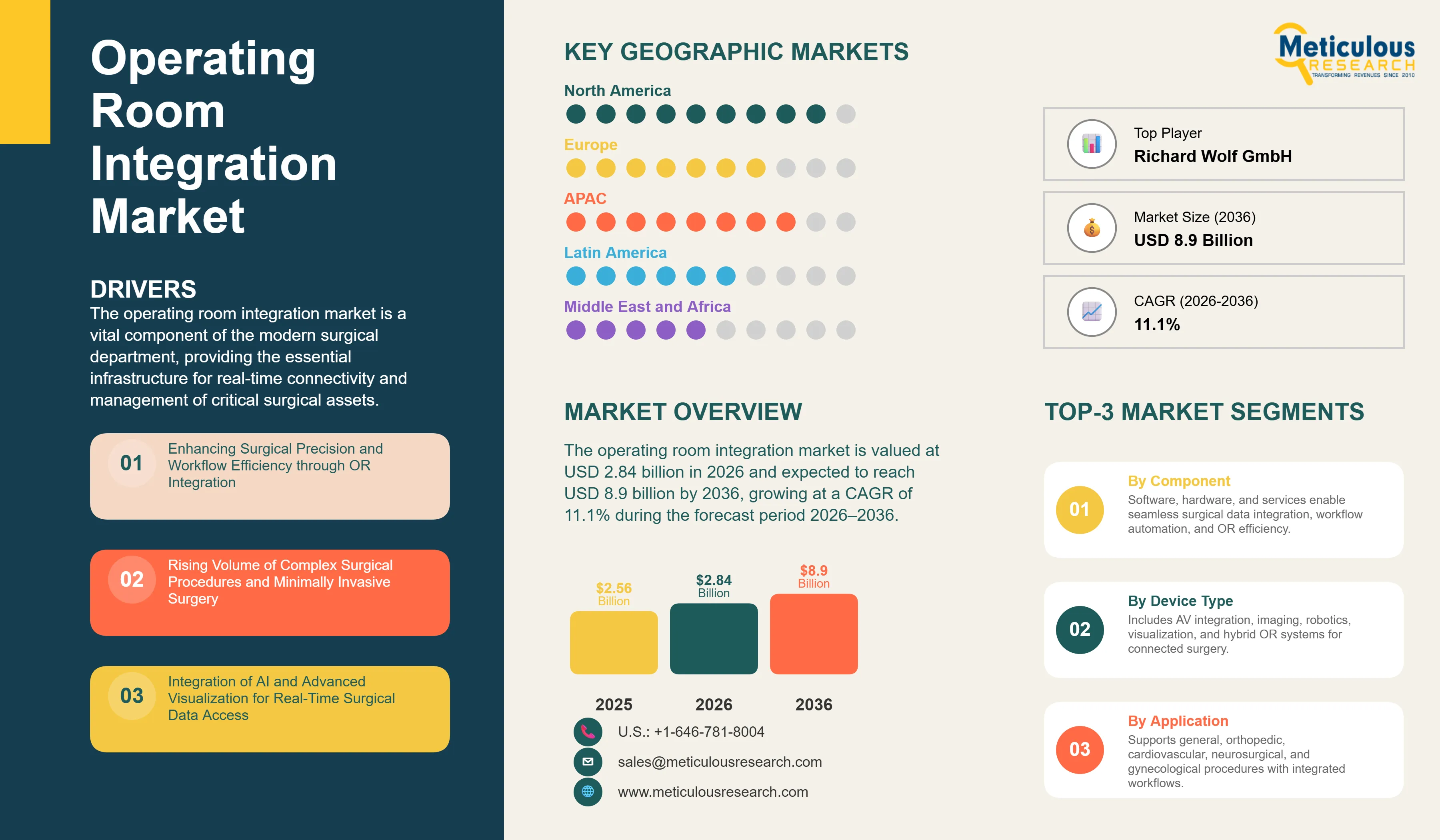
The global operating room integration market is valued at USD 2.84 billion in 2026. This market is expected to reach USD 8.9 billion by 2036, growing at a CAGR of 11.1% during the forecast period 2026–2036.
 Click here to: Get Free Sample Pages of this Report
The global operating room integration market is a vital component of the modern surgical department, providing the essential infrastructure for real-time connectivity and management of critical surgical assets. OR integration solutions, including audio-video integration, surgical device connectivity, and data management platforms, enable surgical teams to maintain institutional integrity and clinical productivity. As of 2026, the market is undergoing a significant transformation, driven by the global imperative to address the rising complexity of surgical procedures and the increasing demand for minimally invasive interventions. According to industry reports, integrated operating rooms are essential for reducing surgical errors and improving patient outcomes.
The transition toward integrated and AI-powered surgical workflow platforms is essential for improving clinical efficiency and surgical throughput in the healthcare industry. Modern OR integration solutions leverage advanced sensors and AI-driven analytics to provide a unified view of the surgical environment, ensuring that stakeholders have immediate access to actionable insights. As healthcare systems transition toward value-based care models, the demand for integration solutions that can demonstrably reduce procedure times and improve resource utilization is expected to surge.
Drivers: Enhancing Surgical Precision and Workflow Efficiency through Advanced OR Integration
The primary driver for the operating room integration market is the escalating global cost of healthcare and the increasing volume of complex surgical procedures, which necessitates a more efficient and data-driven approach to surgical management. According to the AHA, surgical throughput and resource underutilization account for significant annual losses in hospital capital budgets. This massive financial burden is driving the adoption of integrated surgical suites to manage the high volume of procedures and clinical documentation. Furthermore, the shift toward minimally invasive surgery (MIS) and the increasing demand for real-time surgical data access are significant drivers. Government initiatives promoting the adoption of connected health solutions and the exchange of health information are compelling healthcare organizations to invest in OR integration solutions that can seamlessly integrate with broader healthcare IT ecosystems.
Restraints: High Implementation Costs and Technical Integration Challenges
Market growth is restrained by the high cost of implementing comprehensive operating room integration solutions and the technical challenges of achieving seamless data interoperability across disparate surgical device platforms and legacy IT systems. For many mid-sized hospitals, the initial capital investment and ongoing maintenance costs of a facility-wide integrated surgical suite can be a significant barrier. Additionally, the lack of standardized data protocols between different surgical device providers often leads to data silos, making it difficult to achieve a truly unified surgical record. Concerns regarding data privacy and cybersecurity in centralized information hubs also act as deterrents to market expansion. Furthermore, the significant organizational change management and specialized training required for successful implementation can lead to slower adoption rates.
Opportunities: Advancing AI-Driven Surgical Analytics and Hybrid Operating Rooms
The integration of artificial intelligence (AI) and machine learning (ML) into operating room integration platforms offers substantial growth opportunities. AI-powered tools can analyze complex surgical data and clinical evidence to identify potential workflow bottlenecks, facilitating more precise surgical intervention. By 2026, AI-driven predictive analytics are being used to forecast surgical demand and optimize procedure scheduling, enabling proactive resource distribution and improving patient safety. Furthermore, the shift toward hybrid operating rooms provides healthcare organizations with superior surgical capabilities, combining advanced imaging with traditional surgical environments. This integration facilitates real-time data sharing among diverse surgical specialists, supporting multi-disciplinary collaboration, which is particularly beneficial for complex interventions.
Evolution toward Holistic and AI-Powered Surgical Care Orchestration
A defining trend in 2026 is the evolution of OR integration from standalone visualization and device-control systems into AI-enabled surgical care orchestration platforms. Modern integrated ORs increasingly consolidate data from imaging systems, electronic health records, surgical devices, and robotics platforms to create a unified intraoperative environment that supports clinical decision-making and workflow optimization. The growing need for such platforms is reinforced by rising surgical volumes globally, with an estimated 313 million surgical procedures performed annually worldwide, placing increasing pressure on hospitals to improve operating room efficiency and care coordination. AI-enabled workflow management, automated documentation, and real-time performance analytics are gaining adoption as healthcare providers seek to reduce procedural variability, improve patient safety, and optimize OR utilization.
Integration of Advanced Visualization and Robotic Surgery Platforms
The integration of advanced visualization and robotic surgery platforms is becoming a central component of next-generation OR integration solutions. Hospitals are increasingly connecting robotic systems, 4K/3D visualization technologies, imaging modalities, and surgical data management platforms within a single workflow ecosystem to improve procedural precision and clinical efficiency. The trend is supported by continued growth in robotic-assisted surgery; for example, approximately 2.68 million procedures were performed using da Vinci systems in 2024, representing 17% year-over-year growth, while the global installed base exceeded 9,500 robotic systems. As robotic-assisted procedures expand across general surgery, urology, gynecology, orthopedics, and cardiovascular applications, demand for integrated OR platforms capable of managing real-time imaging, video routing, device interoperability, and procedural data is expected to accelerate.
Analysis by Component
Software
Based on component, the software segment is expected to hold the largest share in 2026. This dominance is driven by the increasing demand for advanced surgical data management and AI-powered workflow orchestration platforms. Integrated software provides a centralized 'source of truth' for surgical data and device status, enabling more efficient regional surgical flow coordination. Key sub-segments include surgical data management software, which manages patient and procedural records, and AI-powered workflow orchestration platforms, which optimize procedure scheduling and resource allocation. Real-time visualization dashboards are also essential for providing surgical teams with immediate access to critical procedural data.
Hardware and Services
The hardware segment remains vital, providing the physical infrastructure for data collection and visualization. This includes high-resolution displays and monitors, surgical cameras and lights, and integration gateways that facilitate connectivity between disparate surgical devices. Simultaneously, the services segment—including strategic consulting, custom implementation, and post-deployment support—is growing in importance as healthcare organizations seek expert guidance for organizational change management and technical integration. As OR integration solutions become more complex, the need for comprehensive maintenance and support services is becoming a critical success factor for hospitals.
Analysis by Device Type
Based on device type, the audio-video integration systems segment is expected to account for the largest share in 2026, reflecting the critical need for seamless communication and high-definition visualization in complex surgical procedures. Surgical imaging integration systems are also significant, providing the infrastructure for real-time surgical data access and interoperability. The integration of robotic surgery systems and advanced visualization tools (4K/3D) is projected to witness the fastest growth, as hospitals prioritize minimally invasive interventions and automated surgical workflows. Hybrid operating room integration systems are also gaining traction, combining advanced imaging with traditional surgical environments for complex interventions.
Geographic Analysis: Regional Growth and Digital Health Adoption
North America is expected to dominate the global operating room integration market in 2026, accounting for approximately 46.5% of total revenue. The region's leadership is driven by the widespread adoption of advanced surgical technologies, strong penetration of electronic health records and hospital information systems, and continued investments in hybrid operating rooms across large hospital networks and academic medical centers. The United States remains the largest market due to high procedural volumes, increasing adoption of robotic-assisted surgery, and growing demand for integrated surgical workflows that enhance operating room efficiency, clinical documentation, and patient safety. Furthermore, the presence of leading OR integration vendors and a well-established healthcare technology ecosystem continues to support market growth across North America.
Asia Pacific is projected to register the fastest growth during the forecast period. Growth is being driven by expanding healthcare infrastructure, rising surgical procedure volumes, increasing investments in advanced operating room technologies, and ongoing hospital modernization initiatives across China, India, Japan, and Southeast Asia. Government-led healthcare digitization programs, growing adoption of minimally invasive and robotic-assisted surgeries, and the development of new tertiary-care and specialty hospitals are accelerating demand for integrated operating room solutions. As healthcare providers increasingly prioritize workflow efficiency, interoperability, and data-driven surgical management, the region is expected to offer significant growth opportunities for both global and regional market participants.
The competitive landscape of the global operating room integration market is characterized by intense innovation and strategic consolidations as vendors seek to provide end-to-end clinical care orchestration platforms. Leading players are differentiating themselves through the sophistication of their AI engines and their ability to provide seamless integration with robotic systems and other clinical management platforms. Strategic acquisitions of niche sensor and analytics companies are a common trend as vendors seek to enhance their diagnostic capabilities. The market is also seeing increased collaboration between integration vendors and healthcare providers to ensure seamless surgical monitoring across the care continuum.
Key players operating in the global market include Stryker Corporation (U.S.), Steris plc (U.S.), Karl Storz SE & Co. KG (Germany), Olympus Corporation (Japan), Getinge AB (Sweden), Smith & Nephew plc (U.K.), Richard Wolf GmbH (Germany), Brainlab AG (Germany), Eizo Corporation (Japan), Barco NV (Belgium), Arthrex, Inc. (U.S.), and various emerging technology providers specializing in AI-driven surgical analytics and advanced visualization tools.
The market is projected to reach USD 8.9 billion by 2036, growing at a CAGR of 11.1% from 2026 to 2036.
Hospitals report a significant reduction in procedure times and an improvement in surgical workflow efficiency and patient safety.
The Artificial Intelligence & Machine Learning (AI/ML) and Robotic Surgery Integration segments are expected to grow the fastest.
Around 50% of new revenue is driven by software, with a strong shift toward AI-powered workflow orchestration.
North America holds the largest share, estimated at 46.5% in 2026, driven by high adoption of MIS and robotic systems.
AI enables the prediction of surgical demand and optimizes procedure scheduling, improving resource distribution and patient safety.
The pressure to reduce surgical errors and procedure times is driving the demand for integrated platforms to manage high volumes.
Hospitals and clinics are the primary adopters, managing the highest volumes of diverse integrated surgical suites.
These systems provide the continuous, data-driven surgical management necessary to improve clinical outcomes and reduce the total cost of care.
The top 5 players are Stryker, Steris, Karl Storz, Olympus, and Getinge.























Published Date: Jun-2024
Published Date: Jul-2026
Published Date: Jul-2026
Please enter your corporate email id here to view sample report.
Subscribe to get the latest industry updates


