
Microcontroller (MCU) Market (2025-2035)
The global microcontroller (MCU) market is expected to reach USD 95.01 billion by 2035 from USD 35.53 billion in 2025, at a CAGR of 9.8% from 2025 to 2035.
- Published
- Dec 2025
- Pages
- 246
- Format
- PDF + Excel
- Report ID
- MRSE - 1041630
- Base year
- 2024
- 2025 · ESTIMATED
- $35.53B
- 2035
- $95.01B
- CAGR 2025–2035
- 9.8%
2024 baseline · 2025–2035 forecast at 9.8% CAGR · hover a bar for the value
Key highlights
The global microcontroller (MCU) market is expected to reach USD 95.01 billion by 2035 from USD 35.53 billion in 2025, at a CAGR of 9.8% from 2025 to 2035.
In 2025, the Asia-Pacific region commands the largest share of the global microcontroller market. This is mainly attributed to its robust electronics manufacturing capabilities, the presence of major semiconductor foundries such as TSMC, rapid industrialization, and growing automotive production.
The North American region is expected to grow significantly during the forecast period due to growing demand for IoT devices, smart homes, advanced automotive electronics, and aerospace and defense applications.
Europe is a major market driven by its solid car sector, especially in Germany, as well as rising industrial automation and smart grid deployments.
Report summary
| Particulars | Details |
|---|---|
| Market Size Value in 2025 | USD 35.53 Billion |
| Revenue Forecast in 2035 | USD 95.01 Billion |
| Growth Rate (CAGR) | 9.8% from 2025 to 2035 |
| Format | PDF, Excel & Cloud Portal · 246 pages |
| Base Year for Estimation | 2024 |
| Historical Data | 2023–2024 |
| Forecast Period | 2025–2035 |
| Quantitative Units | Revenue in USD Billion and CAGR from 2025 to 2035 |
| Report Coverage | Revenue forecast, company ranking, competitive landscape, growth factors, and trends |
| Segments Covered | Product Type, Architecture, Application, Memory Type, Region |
| Regional Scope | North America, Europe, Asia-Pacific, Latin America, Middle East & Africa |
| Countries Covered | U.S., Canada, Germany, U.K., France, Italy, Spain, China, Japan, South Korea, India, Taiwan, Brazil, Mexico, Saudi Arabia, UAE, South Africa |
| Key Companies Profiled | NXP Semiconductors N.V., Renesas Electronics Corporation, Microchip Technology Inc., STMicroelectronics N.V., Infineon Technologies AG, Texas Instruments Incorporated, Analog Devices Inc., Silicon Laboratories Inc., Toshiba Electronic Devices & Storage Corporation, ROHM Co. Ltd., Cypress Semiconductor Corporation (Infineon), Maxim Integrated (Analog Devices), ON Semiconductor Corporation, Nuvoton Technology Corporation, Holtek Semiconductor Inc., Espressif Systems (Shanghai) Co. Ltd., Nordic Semiconductor ASA, MediaTek Inc., Samsung Electronics Co. Ltd., Fujitsu Limited |
Report overview
Segments covered: product type, architecture, application.
An MCU is a small integrated circuit device designed to control certain functions in embedded systems. In other words, it acts like the "brain" of electronic gadgets, and it embodies a processor core, along with memory and programmable input/output peripherals, all on one chip. The ability of a microcontroller to be embedded into almost anything has enabled the building of a wide range of automated products and systems, from house appliances and cars to medical devices, industrial machines, consumer electronics, and IoT devices.
In 2025, Asia-Pacific accounts for the largest share of the global microcontroller market, driven by robust electronics manufacturing capabilities, rapid industrialization, and the presence of major semiconductor foundries like TSMC.
North America is projected to register a significant CAGR during the forecast period, fueled by growing demand for IoT devices, smart homes, and advanced automotive electronics.
Based on product type, the 32-bit microcontroller segment holds the largest share of the market in 2025, driven by increasing demand for higher processing power in automotive, industrial automation, and IoT applications.
Based on architecture, the ARM segment dominates the market in 2025, owing to its widespread adoption in consumer electronics, automotive systems, and IoT devices due to superior power efficiency and processing capabilities.
Based on application, the automotive segment is expected to witness the highest growth rate during the forecast period, driven by increasing adoption of electric vehicles, advanced driver assistance systems (ADAS), and in-vehicle infotainment systems.
Based on application, the consumer electronics & telecom segment accounts for the largest share of the market in 2025, fueled by growing demand for smartphones, wearables, smart home devices, and 5G infrastructure.
The industrial segment is expected to grow at a significant CAGR during the forecast period, driven by increasing adoption of Industry 4.0, smart manufacturing, and industrial automation systems.
The U.S. microcontroller market is projected to grow at a CAGR of around 10% during the forecast period 2025 to 2035.
China is expected to lead the Asia-Pacific microcontroller market, driven by massive electronics manufacturing capabilities and government initiatives like "Made in China 2025."
In 2025, Germany is projected to account for the largest share of the European microcontroller market, driven by its strong automotive industry and presence of leading semiconductor manufacturers.
Microcontrollers are essentially the basic elements that make an embedded system functional, allowing for the implementation of control and intelligence in a wide range of electronic devices and systems. This small integrated circuit incorporates processing capability, memory, and input/output interfaces on one chip and is integral to modern electronics, from simple household appliances through to complex automotive systems and industrial machinery.
Several technological trends are transforming the microcontroller market, from the proliferation of IoT devices to the electrification and automation of vehicles, Industry 4.0 and smart manufacturing, and the increasing demand for smart consumer electronics. Because of the growing complexity of electronic systems and rising requirements for real-time processing, continuous connectivity, and energy efficiency, microcontrollers have become a critically important product segment across nearly all industry sectors.
The microcontroller market is going through a paradigm change towards increased processing capabilities and higher integration. The 32-bit microcontrollers segment is continuously witnessing significant growth since applications require further computational power, more memory, and advanced connectivities. ARM-based architectures have become the de facto standard for many applications due to their optimal balance of performance and power efficiency.
The integration of AI and ML capabilities at the edge is transforming MCU applications. AI-enabled MCUs, developed by manufacturers, can perform real-time inference tasks locally for several applications: smart devices, predictive maintenance, autonomous systems, and voice recognition-all of them without cloud connectivity.
Automotive remains one of the most dynamic growth areas, driven by unprecedented demand for sophisticated microcontrollers, driven by the growth of electric vehicles and autonomous driving technologies. The current designs feature hundreds of MCUs employed in everything from battery management systems and powertrain control to ADAS, infotainment, and body electronics.
The integration of AI and ML at the edge in MCU applications is transforming the landscape. With advanced AI-enabled microcontrollers capable of executing real-time inference tasks locally, vendors are building solutions for smart devices, predictive maintenance, autonomous systems, and voice recognition-all without cloud connectivity.
The automotive sector is one of the most dynamic growth areas, driven by electric vehicles and autonomous driving technologies that require sophisticated MCUs in unparalleled numbers. Present-day vehicles feature hundreds of MCUs powering everything from the battery management systems and powertrain control to advanced ADAS, infotainment, and body electronics.
The automotive industry has represented one of the largest and fastest-growing application segments for microcontrollers. Newer vehicles have increasingly come to feature an expanding range of electronic systems, ranging from ADAS and in-vehicle infotainment to telematics, powertrain control, and body electronics. The recent, rapid expansion in EVs has accelerated the demand for MCUs in battery management systems, motor control, onboard chargers, and DC-DC converters. According to the International Energy Agency, China's EV production reached 12.4 million in 2024, accounting for over 70% of global EV production and thereby creating large demand for automotive-grade microcontrollers.
The growth of Internet of Things applications in consumer, industrial, and enterprise domains gives great impetus to the demand for microcontrollers. Connected devices, ranging from smartphones and wearables to smart home appliances, industrial sensors, and smart meters, require MCUs with rich connectivity options, low power consumption, and powerful processing features. During recent years, the number of connected IoT devices has grown rapidly, reaching 18.8 billion in 2024, with forecasts showing around 40 billion devices by 2030, making huge demands on efficient IoT microcontrollers.
Integration of AI and machine learning capabilities into microcontrollers is a key growth opportunity. AI-enabled MCUs can run real-time inference jobs at the edge locally, which would enable applications like voice recognition, predictive maintenance, anomaly detection, and image processing-all independent of any cloud connectivity. This trend toward edge AI is driving the development of more powerful microcontrollers with dedicated neural processing units and hardware accelerators.
The initiative on Industry 4.0 and smart manufacturing further opens opportunities for a greater scale for MCU adoption. Industrial automation systems need robust MCUs for process control, robotics, PLCs, HMIs, and wireless sensor networks. Government initiatives on smart manufacturing and digitization in major economies are very likely to push the demand for industrial-grade microcontrollers.
Report infographic
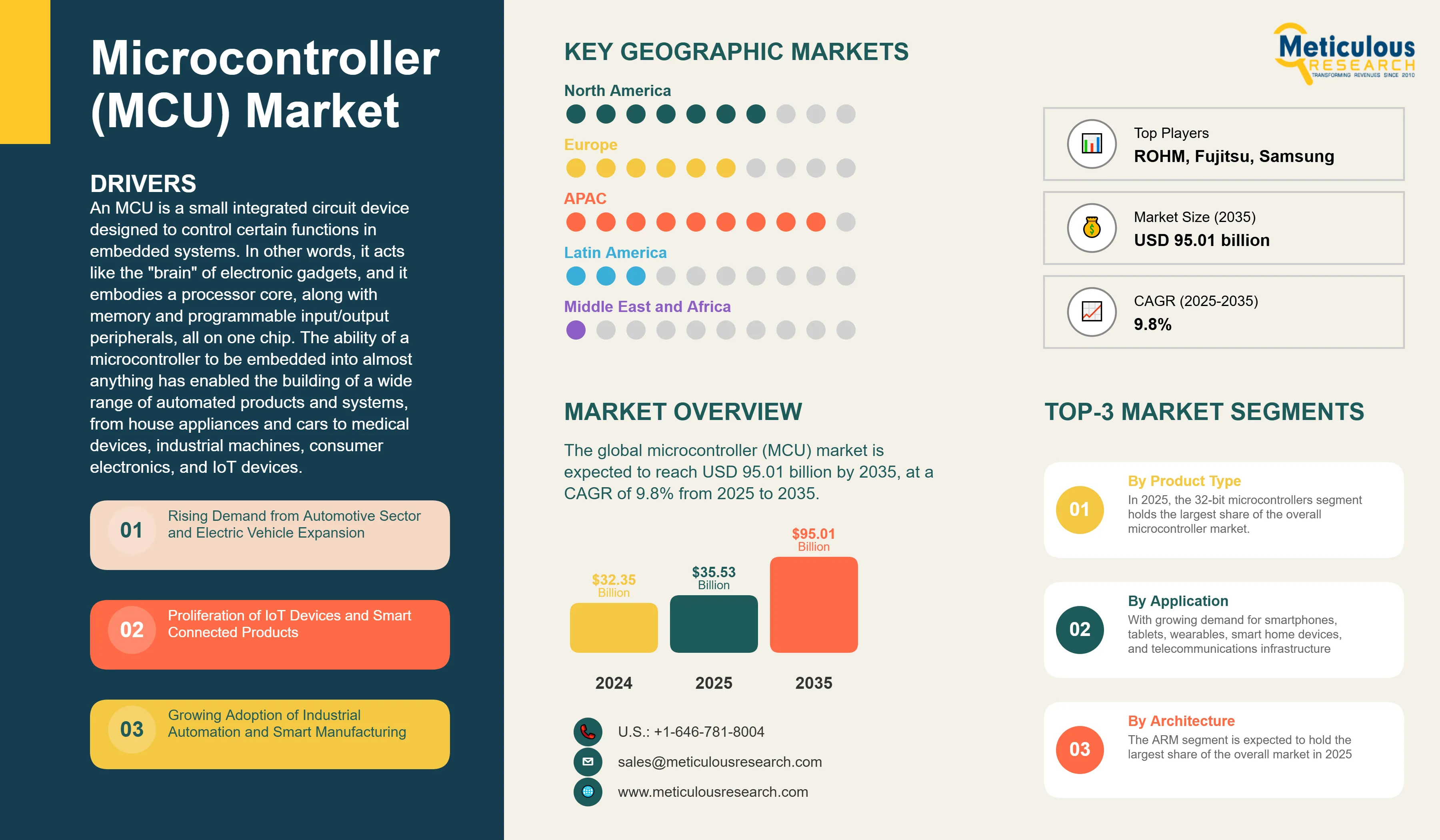
Table of contents
13 chapters · 157 sections · 246 pages · click to expandGeographic analysis
Asia-Pacific
Largest shareIn 2025, the Asia-Pacific region commands the largest share of the global microcontroller market. This is mainly attributed to its robust electronics manufacturing capabilities, the presence of major semiconductor foundries such as TSMC, rapid industrialization, and growing automotive production. Supported by government initiatives aimed at boosting domestic semiconductor manufacturing, China will continue to lead the regional market, with its position as the world's leading hub for electronics manufacturing and EV production.
North America
The North American region is expected to grow significantly during the forecast period due to growing demand for IoT devices, smart homes, advanced automotive electronics, and aerospace and defense applications. The presence of major MCU manufacturers in this region, including Texas Instruments, Microchip Technology, and Analog Devices, propels innovation and market development.
Europe
Europe is a major market driven by its solid car sector, especially in Germany, as well as rising industrial automation and smart grid deployments. Most of the key semiconductor players like Infineon Technologies, STMicroelectronics, and NXP Semiconductors have large operations in the region.
Competitive landscape
- NXP Semiconductors N.V. · Netherlands
- Renesas Electronics Corporation · Japan
- Microchip Technology Inc. (U.S.)
- STMicroelectronics N.V. · Switzerland
- Infineon Technologies AG · Germany
- Texas Instruments Incorporated (U.S.)
- Analog Devices Inc. (U.S.)
- Silicon Laboratories Inc. (U.S.)
- Toshiba Electronic Devices & Storage Corporation · Japan
- ROHM Co. Ltd. · Japan
- ON Semiconductor Corporation (U.S.)
- Nuvoton Technology Corporation · Taiwan
- Holtek Semiconductor Inc. · Taiwan
- Espressif Systems (Shanghai) Co. Ltd. · China
- Nordic Semiconductor ASA · Norway
- MediaTek Inc. · Taiwan
- Samsung Electronics Co. Ltd. · South Korea
- Fujitsu Limited · Japan
Frequently asked questions
The microcontroller market is expected to grow from USD 35.53 billion in 2025 to USD 95.01 billion by 2035.
Cite this report
Meticulous Research. (2025). Microcontroller (MCU) Market - Global Opportunity Analysis and Industry Forecast (2025-2035) (Report No. MRSE - 1041630). Meticulous Market Research Pvt. Ltd. https://www.meticulousresearch.com/product/microcontroller-market-6313