Microarray Analysis Market (2026-2036)
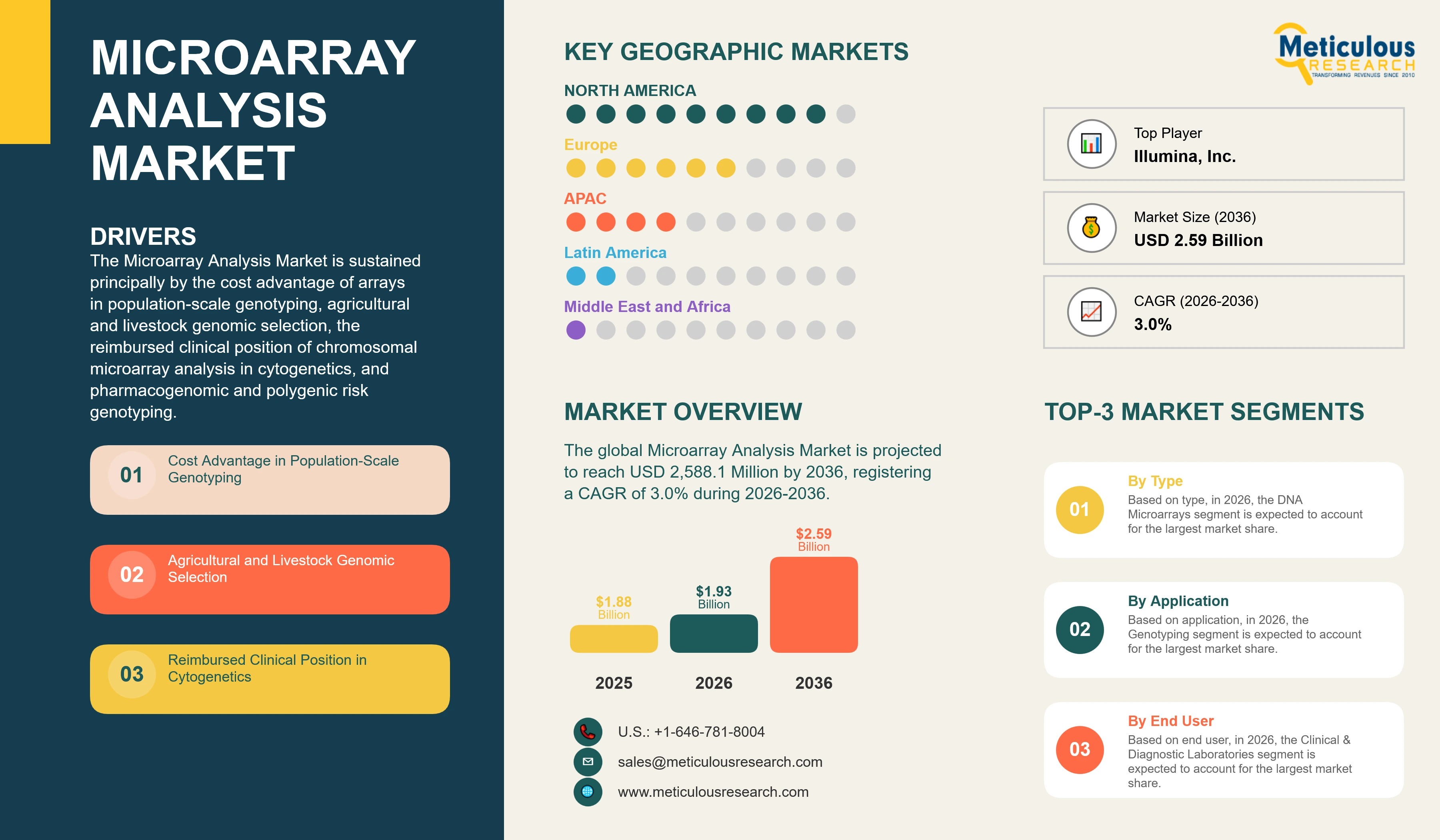
The global Microarray Analysis Market was valued at USD 1,882.4 million in 2025. This market is expected to reach USD 2,588.1 million by 2036 from an estimated USD 1,926.3 million in 2026, registering a CAGR of 3.0% during the forecast period (2026-2036).
- Published
- Oct 2026
- Pages
- 327
- Format
- PDF + Excel
- Report ID
- MRHC - 1042371
- Base year
- 2025
- 2025 · BASELINE
- $1.88B
- 2036
- $2.59B
- CAGR 2026–2036
- 3.0%
2025 baseline · 2026–2036 forecast at 3.0% CAGR · hover a bar for the value
Key highlights
The global Microarray Analysis Market is projected to reach USD 2, 588.1 million by 2036 at a modest CAGR, sustained by population genotyping, agrigenomics, pharmacogenomics, and clinical cytogenetics rather than by broad research adoption.
Array demand is uneven rather than uniformly declining. In the second quarter of 2026, Illumina, Inc. reported microarrays and other revenue of USD 105 million, up 21% as reported but down 4% on a rest-of-world organic basis, against sequencing consumables revenue of USD 775 million in the same quarter, illustrating both the scale of array activity relative to sequencing and the uneven trajectory of array demand.
Population genotyping remains the anchor application. In the U.K., Our Future Health has genotyped 755,000 of its more than 2.02 million recruited participants using a genotyping array covering 686,416 variants, from which 159,587,100 imputed variants were generated, with the first array release in December 2023, the first imputed genotype release in December 2025, and the first genetic ancestry release in May 2026.
Agricultural genotyping is a commercially significant application. In March 2026, Neogen Corporation announced the sale of its global genomics business, operating under the GeneSeek brand and including the Igenity and GGP array-based livestock genotyping portfolios, to Zoetis Inc. for USD 160 million, with the business having generated approximately USD 90 million in sales in fiscal 2025.
North America is expected to account for the largest market share in 2026, supported by clinical cytogenetics volumes, agricultural genotyping, and research activity, while Asia-Pacific is projected to register the fastest growth during the forecast period.
By application, Genotyping is expected to account for the largest market share in 2026 and is also projected to witness the fastest growth through 2036, reflecting the concentration of remaining array value in population, agricultural, and pharmacogenomic genotyping rather than in expression profiling.
Report summary
| Particulars | Details |
|---|---|
| Forecast Period | 2026-2036 |
| Base Year | 2025 |
| Estimated Year | 2026 |
| CAGR (Value) | 3.0% |
| Format | PDF, Excel & Cloud Portal · 327 pages |
| Market Size (Value) in 2026 | USD 1,926.3 Million |
| Market Size (Value) in 2036 | USD 2,588.1 Million |
| Segments Covered | By Product: Consumables (Arrays & Chips, Reagents & Kits), Instruments (Scanners & Imaging Systems, Hybridisation, Washing & Automation Systems), Software & Services. By Type: DNA Microarrays (Genotyping Arrays, Copy Number & Cytogenetic Arrays, Methylation Arrays, Expression Arrays), Protein & Antibody Microarrays, Tissue & Cell Microarrays, Other Microarrays. By Application: Genotyping (Population & Biobank Genotyping, Pharmacogenomic Genotyping, Polygenic Risk & Research Genotyping), Cytogenetics & Copy Number Analysis, Gene Expression Profiling, Agrigenomics & Animal Breeding, Proteomic & Biomarker Profiling, Other Applications. By End User: Academic & Research Institutes, Biobanks & Population Genomics Programmes, Clinical & Diagnostic Laboratories, Agricultural & Animal Breeding Organizations, Pharmaceutical & Biotechnology Companies. |
| Countries Covered | North America: U.S., Canada. Europe: U.K., Germany, France, Netherlands, Nordic Countries, Rest of Europe. Asia-Pacific: China, Japan, India, South Korea, Australia, Rest of Asia-Pacific. Latin America: Brazil, Argentina, Mexico, Rest of Latin America. Middle East & Africa: Saudi Arabia, UAE, South Africa, Rest of Middle East & Africa. |
| Key Companies | Illumina, Inc., Thermo Fisher Scientific Inc., Agilent Technologies, Inc., Revvity, Inc., Bio-Rad Laboratories, Inc., Zoetis Inc. (GeneSeek), Eurofins Scientific SE, RayBiotech Life, Inc., Sengenics Corporation LLC, and Merck KGaA. |
Report overview
Segments covered: product, type, application, end user.
The growth of this market is driven principally by applications in which arrays retain a decisive cost and throughput advantage over sequencing, most notably population-scale genotyping for biobanks and national cohort programmes, array-based genotyping in livestock and crop breeding, pharmacogenomic genotyping, and chromosomal microarray analysis in prenatal and paediatric cytogenetics, where the test remains the covered standard in several payer policies. In addition, the continued development of array content for diverse ancestries and polygenic risk applications, the use of arrays as an affordable first-tier test ahead of selective sequencing, and the installed base of array instrumentation in clinical cytogenetics and agricultural genotyping laboratories support demand. Growth is nonetheless modest, because next-generation sequencing has displaced arrays in gene expression profiling and in much of discovery research, and this report forecasts a mature market growing slowly rather than an expanding one.
The Microarray Analysis Market, also referred to as the biochip market, array-based analysis market, or microarray technology market, comprises the consumables, instruments, software, and services used to perform parallel analysis of many biological targets immobilised in an ordered pattern on a solid support. The market includes DNA microarrays for genotyping, copy number analysis, methylation analysis, and gene expression profiling; protein and antibody microarrays for proteomic profiling, biomarker screening, and autoantibody detection; tissue and cell microarrays for pathology and histological screening; and other array formats including carbohydrate and small-molecule arrays. The market covers array consumables, which account for most recurring spending, scanners, hybridisation ovens, washing stations and automated array handling systems, analysis and interpretation software, and array-based genotyping and profiling services. The market ecosystem extends from array and instrument manufacturers and service providers to biobanks and national cohort programmes, clinical cytogenetics and molecular pathology laboratories, agricultural breeding organizations, pharmaceutical companies, and academic researchers.
Any credible assessment of this market must begin with the fact that next-generation sequencing has displaced microarrays from most of the applications in which arrays were once standard. Gene expression profiling has largely moved to RNA sequencing, which measures transcripts without the need for predefined probes and detects novel transcripts and splice variants that an array cannot. Discovery research has followed. The market that remains is therefore not a general-purpose research technology but a set of specific applications in which the economics or the regulatory position still favour arrays, and understanding which applications those are is the central analytical question for this market.
Population-scale genotyping is the largest of these applications and the most robust. Genotyping a known set of common variants on an array costs a fraction of sequencing a genome, and when combined with imputation against a reference panel it yields tens of millions of variant calls from a few hundred thousand directly measured positions. In the U.K., Our Future Health has genotyped 755,000 of its more than 2.02 million recruited participants using a genotyping array covering 686,416 variants, from which 159,587,100 imputed variants were generated, with the first array release in December 2023, the first imputed genotype release in December 2025, and the first genetic ancestry release in May 2026. That ratio, roughly 160 million imputed variants from fewer than 700,000 measured, is the economic argument for arrays in population cohorts, and it is why biobanks continue to genotype at scale rather than sequence.
Array content continues to be developed for this purpose. Thermo Fisher Scientific has extended its Axiom array portfolio for population-scale studies and pharmacogenomic research, including biobank-oriented arrays and the PangenomiX array designed to support population-scale disease studies and pharmacogenomics across diverse ancestries, reflecting continued investment in array content for large cohort genotyping. Investment in arrays designed for diverse ancestries and for pharmacogenomic content indicates that suppliers regard population genotyping as a durable rather than a declining application, and the growth of polygenic risk research, which depends on common variant genotyping across very large cohorts, reinforces that position.
Agricultural genotyping is the second substantial application and is commercially significant out of proportion to its visibility. In March 2026, Neogen Corporation announced the sale of its global genomics business, operating under the GeneSeek brand and including the Igenity and GGP array-based livestock genotyping portfolios, to Zoetis Inc. for USD 160 million, with the business having generated approximately USD 90 million in sales in fiscal 2025. Livestock genomic selection requires genotyping very large numbers of animals at low cost per sample, with no requirement to discover novel variation, which is precisely the case arrays serve best. The acquisition of an array-based livestock genotyping business generating approximately USD 90 million in annual sales by a major animal health company demonstrates that this application is regarded as strategically valuable rather than legacy.
Clinical cytogenetics sustains a protected position for arrays through payer policy. A payer medical policy revised in March 2026 provides coverage for chromosomal microarray analysis in invasive prenatal diagnosis, in fetuses with major structural abnormalities on ultrasound, in intrauterine fetal demise or stillbirth at 20 weeks or more, and after two or more miscarriages at 20 weeks or less, stating that the test can typically replace fetal karyotype, while declining to cover routine whole-genome or whole-exome sequencing for prenatal diagnosis outside clinical trials until sufficient peer-reviewed data and validation studies are published. Chromosomal microarray analysis detects copy number variation across the genome at a resolution far exceeding karyotype, is supported by extensive validation and professional guidance, and in several coverage policies is the reimbursed prenatal test while sequencing is not. This gives arrays a defended clinical application that is insulated from technology substitution for as long as the coverage position holds.
The commercial picture at the suppliers reflects this mixed position. In the second quarter of 2026, Illumina, Inc. reported microarrays and other revenue of USD 105 million, up 21% as reported but down 4% on a rest-of-world organic basis, against sequencing consumables revenue of USD 775 million in the same quarter, illustrating both the scale of array activity relative to sequencing and the uneven trajectory of array demand. Array revenue at the largest supplier is roughly one-seventh of sequencing consumable revenue and is not growing organically, which is consistent with a technology serving specific durable applications rather than expanding into new ones. Protein and tissue arrays occupy smaller niches, with protein arrays used in autoantibody and biomarker screening and tissue microarrays in pathology research, both facing competition from multiplexed immunoassay and spatial profiling methods.
The market includes Illumina and Thermo Fisher Scientific, which supply most genotyping and expression array capacity, Agilent Technologies, which supplies cytogenetics and expression arrays, Revvity and Bio-Rad Laboratories in selected formats, protein array providers including RayBiotech and Sengenics, tissue microarray and pathology suppliers including TissueArray and BioChain, and array-based genotyping service providers including Eurofins Scientific and, in agricultural genotyping, the GeneSeek business acquired by Zoetis. Participants compete on cost per sample, array content and ancestry coverage, call rate and data quality, throughput and automation, regulatory status for clinical use, and the quality of analysis software and imputation support.
At the same time, the market faces substantial and structural challenges, including continuing displacement by sequencing as sequencing costs fall, the inability of arrays to detect variants not represented on the array, which limits their use where novel variation matters, the gradual encroachment of low-pass whole-genome sequencing into population genotyping as an imputation alternative, the long-term risk that clinical coverage policies shift toward sequencing, and consolidation of the supplier base. As a result, participants that concentrate on applications where cost per sample is decisive, maintain content relevant to diverse populations and to pharmacogenomic and polygenic applications, and hold defended clinical positions are expected to retain the largest share of a market that is growing only slowly.
Report infographic
Market dynamics
15 factors across 5 forcesCost Advantage in Population-Scale Genotyping
The cost advantage of arrays in population-scale genotyping is the principal factor sustaining the Microarray Analysis Market. Genotyping a predefined set of common variants costs a small fraction of sequencing a genome, and imputation against reference panels converts a few hundred thousand measured genotypes into tens of millions of inferred variant calls suitable for association analysis. In the U.K., Our Future Health has genotyped 755,000 of its more than 2.02 million recruited participants using a genotyping array covering 686,416 variants, from which 159,587,100 imputed variants were generated, with the first array release in December 2023, the first imputed genotype release in December 2025, and the first genetic ancestry release in May 2026.
For a cohort programme recruiting millions of participants, this difference determines what is affordable. A programme can genotype an order of magnitude more participants than it could sequence for the same budget, and for genome-wide association and polygenic risk research, statistical power depends more on the number of participants than on the completeness of variant ascertainment in any individual. This logic has not changed with falling sequencing costs, because array costs have fallen alongside them.
Agricultural and Livestock Genomic Selection
Agricultural and livestock genomic selection is significantly driving array demand. Breeding programmes genotype very large numbers of animals and plants to estimate breeding values, verify parentage, and screen for genetic defects and traits, and these applications require low cost per sample across known markers rather than discovery of novel variation. In March 2026, Neogen Corporation announced the sale of its global genomics business, operating under the GeneSeek brand and including the Igenity and GGP array-based livestock genotyping portfolios, to Zoetis Inc. for USD 160 million, with the business having generated approximately USD 90 million in sales in fiscal 2025. The valuation placed on an array-based livestock genotyping business by a major animal health company indicates that this application is treated as a strategic asset.
Reimbursed Clinical Position in Cytogenetics
The reimbursed clinical position of chromosomal microarray analysis in cytogenetics is an important driver of demand. A payer medical policy revised in March 2026 provides coverage for chromosomal microarray analysis in invasive prenatal diagnosis, in fetuses with major structural abnormalities on ultrasound, in intrauterine fetal demise or stillbirth at 20 weeks or more, and after two or more miscarriages at 20 weeks or less, stating that the test can typically replace fetal karyotype, while declining to cover routine whole-genome or whole-exome sequencing for prenatal diagnosis outside clinical trials until sufficient peer-reviewed data and validation studies are published. Arrays detect copy number variation genome-wide at resolution far beyond karyotype, are supported by extensive validation and professional guidance, and in several payer policies remain the covered prenatal and paediatric test while exome and genome sequencing are excluded outside clinical trials.
This coverage position is commercially significant because it is independent of technical merit. Where a payer covers an array and declines to cover sequencing for the same indication, laboratories will continue to perform arrays regardless of what sequencing could in principle deliver, which gives this application a stability the research applications of arrays never had.
Pharmacogenomic and Polygenic Risk Genotyping
Pharmacogenomic and polygenic risk genotyping supports market growth. Pharmacogenomic testing interrogates a defined set of variants in genes affecting drug metabolism and response, which is an array-appropriate problem, and preemptive pharmacogenomic programmes genotyping large populations once for lifetime use favour the lowest cost per sample. Thermo Fisher Scientific has extended its Axiom array portfolio for population-scale studies and pharmacogenomic research, including biobank-oriented arrays and the PangenomiX array designed to support population-scale disease studies and pharmacogenomics across diverse ancestries, reflecting continued investment in array content for large cohort genotyping. Polygenic risk scoring likewise depends on genotyping common variants across very large cohorts, which is the application arrays serve most economically.
Table of contents
12 chapters · 146 sections · 327 pages · click to expandSegmental analysis
| Segment | Largest share (2026) | Fastest growth (2026–2036) |
|---|---|---|
| By Product | Consumables | Software & Services |
| By Type | DNA Microarrays | DNA Microarrays |
| By Application | Genotyping | Genotyping |
| By End User | Clinical & Diagnostic Laboratories | Biobanks & Population Genomics Programmes |
By Product
- Microarray Analysis Market Analysis by Product
- Consumables are further segmented into Arrays & Chips and Reagents & Kits, while Instruments are further segmented into Scanners & Imaging Systems and Hybridisation, Washing & Automation Systems.
- The Consumables segment is expected to account for the largest share of the global Microarray Analysis Market.
- The large share of this segment is mainly due to the consumption of an array for every sample processed, the large installed base of array instrumentation in cytogenetics, agricultural genotyping, and biobank laboratories, and the concentration of array spending in high-volume genotyping applications where consumable cost per sample is the principal purchasing consideration.
- However, the Software & Services segment is projected to register the highest CAGR during the forecast period, from a small base.
- The growth of this segment is attributed to the outsourcing of array genotyping to service providers by agricultural breeding organizations and cohort programmes that do not operate their own laboratories, and to demand for analysis, imputation, and interpretation support, which has become a greater proportion of the value delivered as array hardware has commoditised.
- The Instruments segment is expected to grow slowly, reflecting a largely installed base with limited new placement.
By Type
- Microarray Analysis Market Analysis by Type
- DNA Microarrays are further segmented into Genotyping Arrays, Copy Number & Cytogenetic Arrays, Methylation Arrays, and Expression Arrays.
- Other Microarrays include carbohydrate and small-molecule arrays.
- The DNA Microarrays segment is expected to account for the largest share of the market and is also projected to register the highest CAGR during the forecast period.
- This is mainly due to the concentration of remaining array demand in genotyping for population cohorts, agriculture, and pharmacogenomics, and in copy number and cytogenetic analysis, which together represent the applications in which arrays retain either a decisive cost advantage or a reimbursed clinical position.
- The Protein & Antibody Microarrays segment is expected to grow modestly, supported by autoantibody profiling, biomarker screening, and immune response characterization, while facing competition from multiplexed bead-based immunoassay and proximity-based proteomic platforms.
- The Tissue & Cell Microarrays segment is expected to grow slowly, retaining a role in pathology research and antibody validation while spatial profiling methods address questions tissue arrays cannot.
By Application
- Microarray Analysis Market Analysis by Application
- Genotyping is further segmented into Population & Biobank Genotyping, Pharmacogenomic Genotyping, and Polygenic Risk & Research Genotyping.
- Other Applications include methylation analysis and drug discovery screening.
- The Genotyping segment is expected to account for the largest share of the market and is also projected to register the highest CAGR during the forecast period.
- This is mainly due to the economics of array genotyping with imputation in population cohorts, demonstrated by the generation of 159,587,100 imputed variants from a 686,416-variant array in the Our Future Health programme, the growth of national cohort programmes outside established markets, and the suitability of arrays to pharmacogenomic and polygenic applications.
- The Cytogenetics & Copy Number Analysis segment is expected to account for a substantial and stable share, protected by payer coverage of chromosomal microarray analysis in prenatal and paediatric indications.
- The Agrigenomics & Animal Breeding segment is expected to grow steadily, supported by genomic selection programmes and expansion into additional species, while the Gene Expression Profiling segment is expected to decline as RNA sequencing continues to displace expression arrays.
By End User
- Microarray Analysis Market Analysis by End User
- The Clinical & Diagnostic Laboratories segment is expected to account for the largest share of the market.
- The large share of this segment is mainly due to the volume of chromosomal microarray analysis performed in prenatal, paediatric, and oncology cytogenetics, the reimbursed status of these tests, and the established installed base of array platforms and validated workflows in cytogenetics laboratories.
- However, the Biobanks & Population Genomics Programmes segment is projected to register the highest CAGR during the forecast period.
- The rapid growth of this segment is attributed to the continuing recruitment and genotyping activity of established programmes, the establishment of national cohort programmes in Asia-Pacific and the Middle East, and the decisive cost advantage of array genotyping with imputation at the scale these programmes operate.
Geographic analysis
North America
Largest shareIn 2026, North America is expected to account for the largest share of the global Microarray Analysis Market. The large share of this region is mainly attributed to the volume of chromosomal microarray analysis performed in clinical cytogenetics under established coverage policies, the scale of agricultural genotyping in dairy, beef, swine, and poultry breeding, substantial research activity, and the presence of the principal array suppliers including Illumina, Thermo Fisher Scientific, and Agilent Technologies. A payer medical policy revised in March 2026 provides coverage for chromosomal microarray analysis in invasive prenatal diagnosis, in fetuses with major structural abnormalities on ultrasound, in intrauterine fetal demise or stillbirth at 20 weeks or more, and after two or more miscarriages at 20 weeks or less, stating that the test can typically replace fetal karyotype, while declining to cover routine whole-genome or whole-exome sequencing for prenatal diagnosis outside clinical trials until sufficient peer-reviewed data and validation studies are published.
Europe
Europe is expected to account for a significant share of the market, supported by large biobank and cohort programmes that genotype at scale, established clinical cytogenetics services, and agricultural breeding organizations using genomic selection. In the U.K., Our Future Health has genotyped 755,000 of its more than 2.02 million recruited participants using a genotyping array covering 686,416 variants, from which 159,587,100 imputed variants were generated, with the first array release in December 2023, the first imputed genotype release in December 2025, and the first genetic ancestry release in May 2026. The region is among the most array-intensive in population genotyping terms relative to its population.
Asia-Pacific
Fastest growthAsia-Pacific is projected to register the highest CAGR during the forecast period. The growth of this region is driven by the establishment of national population genomics programmes in China, Japan, India, and Southeast Asia, for which array genotyping is the affordable approach at national scale, the expansion of livestock and crop genotyping as agricultural production intensifies, the growth of clinical cytogenetics capacity, and the availability of array content designed for non-European ancestries, which earlier arrays served poorly.
Latin America
Latin America and the Middle East & Africa are expected to account for smaller shares of the market. In Latin America, cattle and poultry genotyping in Brazil and Argentina is expected to support demand, while in the Middle East, national genome programmes and clinical genetics capacity in Gulf countries, where consanguinity-associated conditions are prevalent, are expected to support growth.
Competitive landscape
The global Microarray Analysis Market is concentrated, with two suppliers accounting for most genotyping and expression array capacity and the remainder of the market divided among cytogenetics array suppliers, protein and tissue array specialists, and genotyping service providers. The supplier base has consolidated considerably, and for the largest participants arrays now represent a minor line alongside substantially larger sequencing businesses. Participants compete on cost per sample, array content and ancestry coverage, call rate and data quality, throughput and automation, regulatory status for clinical use, and analysis and imputation support.
Activity is focused on content rather than platform innovation, with suppliers developing arrays for diverse ancestries, pharmacogenomic and polygenic applications, and additional agricultural species, while defending reimbursed clinical positions. Recent developments include the sale by Neogen of its array-based GeneSeek livestock genotyping business, including the Igenity and GGP portfolios, to Zoetis for USD 160 million in March 2026, and the extension of array content for population-scale and pharmacogenomic research by Thermo Fisher Scientific.
The report provides a comprehensive competitive assessment of the leading companies operating in the global Microarray Analysis Market. The key players profiled in the report include Illumina, Inc. (U.S.), Thermo Fisher Scientific Inc. (U.S.), Agilent Technologies, Inc. (U.S.), Revvity, Inc. (U.S.), Bio-Rad Laboratories, Inc. (U.S.), Zoetis Inc. (GeneSeek) (U.S.), Eurofins Scientific SE (Luxembourg), RayBiotech Life, Inc. (U.S.), Sengenics Corporation LLC (Singapore), and Merck KGaA (Germany).
- Illumina, Inc.
- Thermo Fisher Scientific Inc.
- Agilent Technologies, Inc.
- Revvity, Inc.
- Bio-Rad Laboratories, Inc.
- Zoetis Inc. (GeneSeek)
- Eurofins Scientific SE
- RayBiotech Life, Inc.
- Sengenics Corporation LLC
- Merck KGaA
Expert perspectives
The Microarray Analysis Market requires an honest premise, which is that this is a mature technology that sequencing has displaced from most of the applications it once dominated. What remains is not a general research platform but four specific positions: population genotyping, where imputation makes a 686,416-variant array yield 159 million variant calls at a cost sequencing cannot match; agricultural genomic selection, where cost per animal is the only variable that matters; clinical cytogenetics, where payer coverage protects the array and excludes sequencing; and pharmacogenomic and polygenic genotyping, where the variants of interest are known and common. The binding constraint is not whether arrays work but how long each of these four positions holds.
Three structural changes are expected to shape the market through 2036. First, the balance between array genotyping and low-pass whole-genome sequencing in population cohorts is the single most consequential uncertainty, since parity on cost per sample would remove the principal argument for arrays in their largest application. Second, clinical coverage policy rather than clinical evidence will determine how long cytogenetics volumes hold, and those policies are reviewed periodically. Third, growth in new geographies depends on content designed for non-European ancestries, which suppliers are now developing.
For companies planning entry or expansion, the realistic positions over the forecast period are in array content for diverse populations and national cohort programmes outside established markets, agricultural genotyping in under-penetrated species and regions, genotyping services for organizations without laboratories, and imputation and analysis support, where value has migrated as array hardware has commoditised. Entry into expression arrays or general research applications is not advisable. For established suppliers, the priority is defending the four remaining positions rather than seeking new ones.
Overall, the market is expected to grow slowly and to remain mature throughout the forecast period, with consumables, DNA microarrays, genotyping applications, and clinical and diagnostic laboratories in North America providing the core of demand, and software and services, population and biobank genotyping, and Asia-Pacific providing what growth there is.
Customer perspectives
Insights gathered during primary interviews with biobank laboratory directors, clinical cytogeneticists, and animal breeding genomics managers highlight where priorities lie. The following perspectives reflect recurring themes raised across these discussions.
“This reflects the cost arithmetic sustaining population arrays.”
“This indicates coverage rather than capability as the determinant.”
“This points to agrigenomics as a durably array-appropriate application.”
Frequently asked questions
The global Microarray Analysis Market is estimated at USD 1,926.3 million in 2026.
Cite this report
Meticulous Research. (2026). Microarray Analysis Market - Global Opportunity Analysis And Industry Forecasts (2026-2036) (Report No. MRHC - 1042371). Meticulous Market Research Pvt. Ltd. https://www.meticulousresearch.com/product/microarray-analysis-market-7054