Fuel Cell Market (2026-2036)
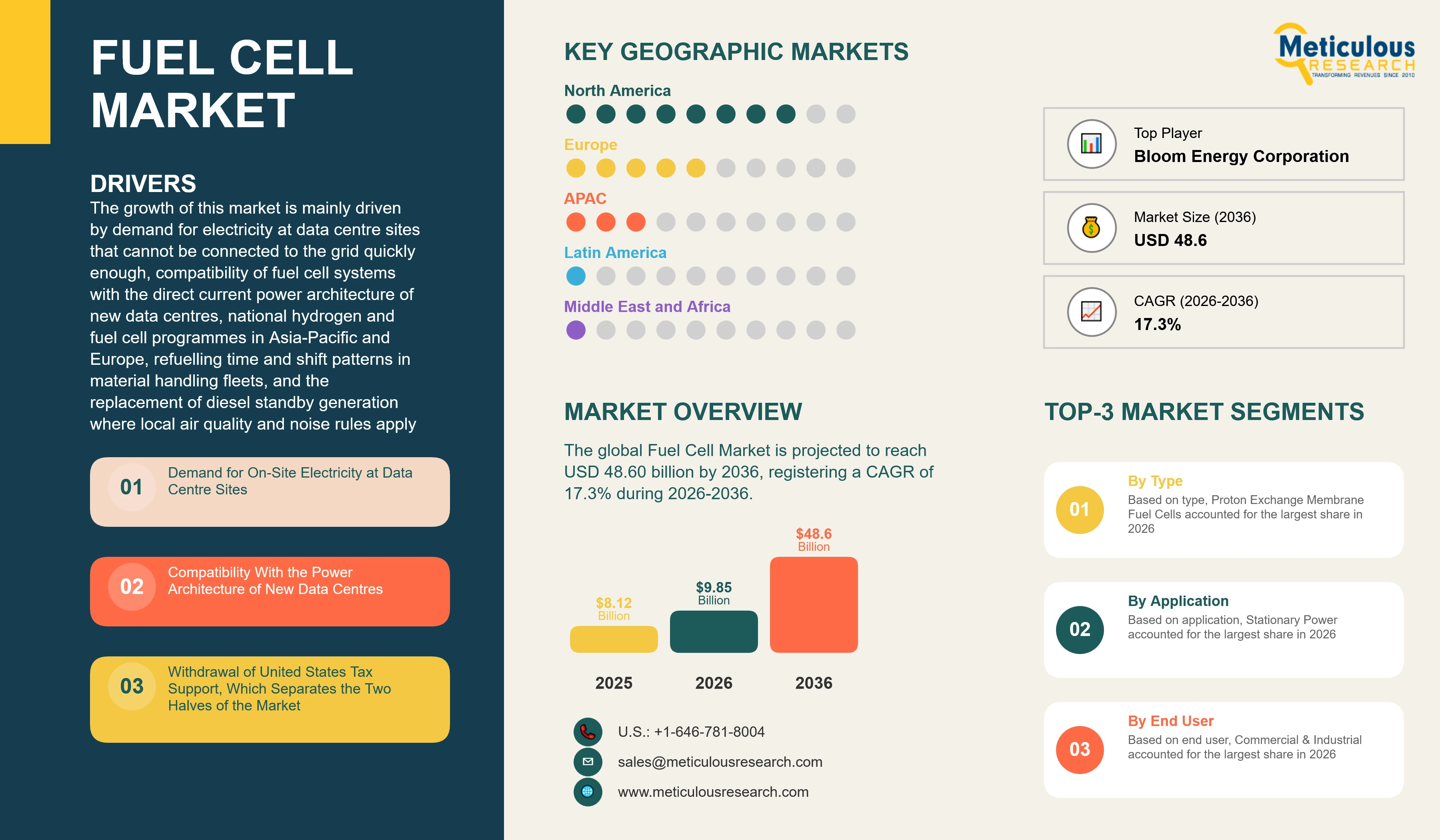
The global Fuel Cell Market was valued at USD 8.12 billion in 2025. This market is expected to reach USD 48.60 billion by 2036 from an estimated USD 9.85 billion in 2026, registering a CAGR of 17.3% during the forecast period (2026-2036).
- Published
- Oct 2026
- Pages
- 347
- Format
- PDF + Excel
- Report ID
- MREP - 1042410
- Base year
- 2025
- 2025 · BASELINE
- $8.12B
- 2036
- $48.60B
- CAGR 2026–2036
- 17.3%
2025 baseline · 2026–2036 forecast at 17.3% CAGR · hover a bar for the value
Key highlights
The global Fuel Cell Market is valued at USD 9.85 billion in 2026 and is projected to reach USD 48.60 billion by 2036, at a CAGR of 17.3%.
Based on type, the proton exchange membrane fuel cell segment is expected to account for the largest share of the market in 2026, while the solid oxide fuel cell segment is projected to register the highest CAGR during the forecast period.
Based on application, the stationary power segment is expected to account for the largest share of the market in 2026, and is also projected to register the highest growth rate during the forecast period.
Based on fuel, the natural gas segment is expected to account for the largest share of the market in 2026, while the biogas and renewable natural gas segment is projected to register the highest CAGR during the forecast period.
Based on power output, the 100 kW to 1 MW segment is expected to account for the largest share of the market in 2026, while the above 1 MW segment is projected to register the highest CAGR during the forecast period.
Based on end user, the commercial and industrial segment is expected to account for the largest share of the market in 2026, while the data centres and information technology segment is projected to register the highest CAGR during the forecast period.
Based on geography, Asia-Pacific is expected to account for the largest share of the market in 2026, while North America is projected to register the highest CAGR during the forecast period.
Report summary
| Particulars | Details |
|---|---|
| Base Year | 2025 |
| Estimated Year | 2026 |
| Forecast Period | 2026-2036 |
| Market Size in 2025 | USD 8.12 billion |
| Market Size in 2026 | USD 9.85 billion |
| Market Size by 2036 | USD 48.60 billion |
| CAGR (2026-2036) | 17.3% |
| Format | PDF, Excel & Cloud Portal · 347 pages |
| Largest Segment by Type (2026) | Proton Exchange Membrane Fuel Cells |
| Fastest-growing Segment by Type | Solid Oxide Fuel Cells |
| Largest Segment by Application (2026) | Stationary Power |
| Largest Segment by Fuel (2026) | Natural Gas |
| Fastest-growing Segment by End User | Data Centres & Information Technology |
| Largest Region (2026) | Asia-Pacific |
| Fastest-growing Region | North America |
| Segments Covered | Type, Application, Fuel, Power Output, End User, Geography |
| Company Naming Basis | Registered legal entity, with group capability attributed to its owner |
| Number of Companies Profiled | 20, plus other companies |
Report overview
Segments covered: type, application, fuel, power output, end user.
The fuel cell market covers systems that generate electricity through an electrochemical reaction rather than combustion, across proton exchange membrane, solid oxide, phosphoric acid, molten carbonate and other cell types, supplied for stationary power, transportation and portable applications and operated on natural gas, hydrogen, methanol and biogas. The growth of this market is driven by demand for electricity at data centre sites that cannot be connected to the grid quickly enough, by national hydrogen programmes in Asia-Pacific and Europe, by the replacement of diesel generation where local air quality rules apply, and by the use of fuel cells in material handling fleets where refuelling time matters more than fuel cost.
Demand in this market divides between stationary power and transport applications, and the two are growing at different rates. Stationary power is growing quickly, because data centre operators need electricity on site within months rather than years and fuel cells running on natural gas can be installed in that time. Transport demand is growing more slowly, because hydrogen refuelling infrastructure remains limited and because the United States has withdrawn the tax credits that supported vehicle purchases.
Most fuel cells sold for stationary power currently run on natural gas or biogas rather than on hydrogen. Customers buy them for the speed and reliability of the installation rather than for a carbon saving. Hydrogen remains the long-term fuel for this market and the systems being installed are built to convert to it, while current sales are made on grid timing and site constraints.
A fuel cell converts fuel into electricity through an electrochemical reaction, which means it has no combustion step and few moving parts. It therefore runs quietly, emits little at the point of use, and holds its efficiency at part load where an engine loses it. These properties decide where fuel cells are bought. They are chosen where electricity is needed on a site that cannot easily be connected to the grid, where local air quality or noise rules restrict engines, or where a vehicle must be refuelled quickly and run for a long shift.
The strongest demand at present comes from data centres, and recent contracts show the scale of it. Bloom Energy announced on 13 April 2026 that Oracle intends to purchase up to 2.8 GW of its solid oxide fuel cell systems under a master services agreement, of which an initial 1.2 GW has been contracted with deployment under way and continuing into 2027. The systems are installed on site as distributed generation rather than drawing on the grid, and the company stated that a previous installation for the same customer was delivered in 55 days against an anticipated 90-day schedule. Bloom Energy also stated that its platform is aligned to emerging standards such as 800 V direct current and is built for denser artificial intelligence workloads, and that the systems provide rapid load-following support that traditional grids were not designed to deliver.
Installation time is the main reason for this demand. A data centre operator waiting for a grid connection measures the delay in years, so a plant that can be installed in under two months allows a site to open that could not otherwise be built. The decision is made on timing and site constraints rather than on the cost of electricity, which is why the orders are large and relatively insensitive to price. The reference to 800 V direct current reflects the same requirement, because the equipment is designed to connect directly into the power system that new artificial intelligence sites are adopting.
Transport and residential demand have moved in the opposite direction following recent changes to United States tax law. The One Big Beautiful Bill Act changed the United States tax treatment of hydrogen and clean vehicles. The section 45V clean hydrogen production credit is terminated for facilities that do not begin construction before 1 January 2028, where the previous schedule allowed construction to begin before 1 January 2033, which brings the cut-off forward by five years. The section 30D clean vehicle credit is terminated for vehicles acquired after 30 September 2025 and the section 45W commercial clean vehicle credit is terminated for qualifying commercial clean vehicles acquired after the same date, in both cases around seven years earlier than the previous schedule. The section 25D residential credit, which covers residential fuel cell systems, ends for systems placed in service after 31 December 2025, while leased residential fuel cell property remains able to claim the section 48E credit until that credit expires.
The effect on hydrogen transport is direct. A buyer of a fuel cell truck or bus in the United States lost the purchase credit for vehicles acquired after 30 September 2025, and a producer of the hydrogen that would fuel it now has until the end of 2027 to begin construction in order to claim the production credit. The two changes work together, because vehicle demand and fuel supply depend on each other, and removing support from both at once leaves each waiting for the other. Hydrogen mobility in the United States is therefore expected to grow from a small base over the forecast period rather than to scale within it.
Residential fuel cells have been affected by the same legislation. The section 25D credit ended for systems placed in service after 31 December 2025, which removes the support that made a home system affordable, although leased residential property retains access to the section 48E credit for the time being. The residential segment of this market is consequently expected to depend on Japan, where domestic fuel cell systems have an established base and a different support structure, rather than on North America.
Grid connection delay accounts for most of the growth in this market. Operators are buying these systems because the alternative is a site that cannot open, rather than because fuel cells are clean, quiet or efficient, although they are all three. Demand is therefore firm while interconnection queues remain long and exposed if those queues shorten, since a utility that reduces its connection timeline removes the reason for the purchase. Suppliers are responding by selling on reliability and load following alongside speed, because those reasons remain valid once grid access improves.
Fuel choice separates this market more clearly than cell technology does. A stationary system running on natural gas is sold on availability and speed, competes with a gas turbine or an engine, and is bought by a site developer. A system running on hydrogen is sold on emissions, competes with a battery or a grid connection, and depends on a fuel supply chain that is still being built. The same manufacturer often supplies both, so the fuel a system runs on describes the business more accurately than the product name does.
Transport demand is concentrated in applications where batteries are least suitable rather than spread across the vehicle market. Material handling is the clearest example, because a forklift refuelled in minutes allows a warehouse to run three shifts, and the fuel is consumed inside a single site where one refuelling point serves the whole fleet. Buses and regional trucks follow the same pattern where routes return to a depot. Passenger cars remain the most difficult application, because a driver refuelling in public needs a station network that does not exist in most markets, and the loss of the United States purchase credit has widened that gap.
Supply is concentrated among a smaller number of companies than the market appears to contain. Solid oxide systems for large stationary sites come from a few manufacturers, proton exchange membrane stacks for vehicles come from a similarly small group, and several of the large industrial names in this market supply components or operate through joint ventures rather than selling complete systems. A buyer placing an order of several hundred megawatts therefore has a short list of suppliers, and delivery capacity rather than product specification usually determines how quickly an order can be filled.
Two conditions qualify the growth rate in this market. The largest orders are concentrated among a small number of customers in a single application, and the data centre demand supporting them rests on a grid connection problem that utilities are under pressure to resolve. If interconnection timelines shorten materially, the market returns to competing on the cost of electricity, where a fuel cell running on natural gas is more expensive than a grid connection in most regions. The forecast in this report assumes queues remain long through the first half of the period and ease gradually in the second.
Report infographic
Market dynamics
21 factors across 5 forcesDemand for On-Site Electricity at Data Centre Sites
Data centre power demand is a major factor driving the fuel cell market, because operators need electricity at a site before a grid connection can be delivered. Bloom Energy announced on 13 April 2026 that Oracle intends to purchase up to 2.8 GW of its solid oxide fuel cell systems under a master services agreement, of which an initial 1.2 GW has been contracted with deployment under way and continuing into 2027. The systems are installed on site as distributed generation rather than drawing on the grid, and the company stated that a previous installation for the same customer was delivered in 55 days against an anticipated 90-day schedule. Installation time is the reason for the order, since an operator waiting years for an interconnection is able to open a site in under two months instead. The decision is made on timing and site constraints rather than on the cost of electricity, which is why these orders are large and relatively insensitive to price, and why they are placed by site developers rather than by energy buyers. The driver also favours suppliers able to commit to a delivery date, because the value of the installation falls away if it arrives late.
Compatibility With the Power Architecture of New Data Centres
Equipment design is reinforcing the same demand. Bloom Energy also stated that its platform is aligned to emerging standards such as 800 V direct current and is built for denser artificial intelligence workloads, and that the systems provide rapid load-following support that traditional grids were not designed to deliver. A fuel cell that connects into the direct current architecture a site is already adopting avoids a conversion stage, and load following matters because artificial intelligence workloads change power draw quickly and in large steps. This driver raises the value of the installation beyond the supply of electricity, because the system is contributing to the stability of the site as well as to its capacity, and it gives suppliers a reason to sell on performance rather than only on delivery speed. The driver is likely to outlast the current shortage of grid capacity, since a system built into the electrical design of a site is harder to remove than one parked beside it.
National Hydrogen and Fuel Cell Programmes in Asia-Pacific and Europe
Government programmes outside the United States are driving demand on a different basis. Several Asia-Pacific countries operate support schemes that oblige or encourage utilities to procure fuel cell capacity, and domestic fuel cell systems have an established installed base in Japan with a support structure of their own. European programmes fund hydrogen production and refuelling alongside vehicle purchase. The driver matters because it is not affected by the United States tax changes, and it is the main reason Asia-Pacific holds the largest share of this market while North America grows fastest. The driver also supports cell types that have little presence elsewhere, since phosphoric acid and molten carbonate systems remain in use where these programmes have run for many years.
Refuelling Time and Shift Patterns in Material Handling Fleets
Material handling is driving the most settled part of transportation demand. A fuel cell forklift refuels in minutes, which allows a warehouse to run three shifts without the battery changing and charging that a comparable electric fleet requires, and the fuel is consumed inside a single site where one refuelling point serves the whole fleet. This driver avoids the obstacle that limits other transport applications, because the operator controls the refuelling infrastructure and does not depend on a public network, and it explains why this application has grown steadily while public hydrogen refuelling has not. The driver extends to buses, refuse vehicles and regional distribution trucks on the same reasoning, because each returns to a depot where the operator is able to install and control the refuelling point.
Table of contents
13 chapters · 153 sections · 347 pages · click to expandGeographic analysis
Asia-Pacific
Largest shareIn 2026, Asia-Pacific is expected to account for the largest share of the market. The large share of this region is mainly due to utility procurement programmes that oblige or encourage the purchase of fuel cell capacity, an established base of domestic fuel cell systems in Japan with support arrangements of its own, and the manufacturing of cells, stacks and complete systems within the region. Demand in Asia-Pacific is supported by government programmes rather than by site constraints, which gives it a steadier profile than demand elsewhere.
North America
Fastest growthHowever, North America is projected to register the highest CAGR during the forecast period. The rapid growth of this region is attributed to data centre construction and to grid connection delays that leave operators unable to open sites on the timetable they need, which is the condition the largest orders in this market are meeting. Growth in the region is concentrated in large stationary installations and is weighted towards natural gas, while the hydrogen transport and residential parts of the market have lost the tax support that underpinned them.
Europe
Europe occupies a position shaped by hydrogen policy rather than by data centre demand. Programmes across the region fund hydrogen production, refuelling and vehicle purchase together, which supports transport applications more evenly than in North America, and industrial sites use fuel cells where air quality rules restrict engines. Growth in the region depends on the pace at which hydrogen supply arrives, since much of the equipment being specified is intended to run on it, and that makes the European path slower but less dependent on a single application.
Latin America
Latin America and the Middle East & Africa remain smaller positions in which demand follows specific projects rather than general adoption. Installations in both regions are concentrated in industrial sites, mining operations and new developments where grid supply is unreliable or absent, and in the Gulf states in hydrogen production projects aimed at export rather than at local fuel cell use. Both regions are therefore best addressed through project developers and engineering contractors rather than through a direct sales presence within the forecast period. Within Latin America, Brazil and Chile account for most of the activity, in both cases tied to mining and industrial sites rather than to urban power supply, and across the Middle East and Africa the installations that proceed are generally part of a larger engineering contract rather than a separate equipment purchase.
Competitive landscape
The competitive landscape of the fuel cell market contains four groups of suppliers. Dedicated fuel cell manufacturers supply complete systems and hold the large stationary orders. Vehicle manufacturers develop fuel cell systems for their own vehicles and in some cases sell stacks to others. Diversified industrial and power equipment groups supply fuel cells alongside engines, turbines and electrical equipment. Cell and stack specialists supply the core components to system builders rather than selling to end users, and several of the larger industrial names in this market operate through joint ventures rather than through wholly owned product lines.
Three things decide which suppliers win work in this market. The first is manufacturing and commissioning capacity, because the largest orders are limited by how quickly systems can be delivered rather than by their specification, and a committed delivery date is often the deciding term. The second is the ability to run on the fuel the customer actually has, which at present means natural gas and biogas for stationary sites and depot-supplied hydrogen for fleets. The third is a credible path to hydrogen conversion, because a customer installing equipment with a long service life wants to know it will not be stranded by a later change of fuel.
Supply is concentrated. Large solid oxide systems for stationary sites come from a small number of manufacturers, proton exchange membrane stacks for vehicles come from a similarly small group, and a buyer placing an order measured in hundreds of megawatts is dealing with a short list of suppliers able to deliver at that scale. Concentration of this kind gives the leading suppliers pricing strength while demand is strong, and it also means a delay at one manufacturer affects projects that have no alternative source.
Key players operating in the global Fuel Cell Market are Bloom Energy Corporation (U.S.), Plug Power Inc. (U.S.), Panasonic Holdings Corporation (Japan), Toyota Motor Corporation (Japan), Hyundai Motor Company (South Korea), Doosan Fuel Cell Co., Ltd. (South Korea), Ballard Power Systems Inc. (Canada), Cummins Inc. (U.S.), Robert Bosch GmbH (Germany), FuelCell Energy, Inc. (U.S.), Mitsubishi Heavy Industries, Ltd. (Japan), Toshiba Corporation (Japan), Honda Motor Co., Ltd. (Japan), Weichai Power Co., Ltd. (China), Beijing SinoHytec Co., Ltd. (China), Ceres Power Holdings plc (U.K.), SFC Energy AG (Germany), PowerCell Sweden AB (Sweden), Nedstack Fuel Cell Technology BV (Netherlands), and Elcogen AS (Estonia).
Companies are identified at registered legal entity level, and capability held within a group is attributed to the entity that owns it. The companies profiled were verified as active in the supply of fuel cells, fuel cell systems, stacks or cells as of October 2026. Suppliers of electrolysers without a fuel cell product, hydrogen producers and distributors, refuelling station builders, balance of plant and component suppliers without a cell or stack product, engineering contractors installing equipment they do not manufacture, and companies whose fuel cell operations have ceased or entered insolvency proceedings were excluded.
- Bloom Energy Corporation (U.S.)
- Plug Power Inc. (U.S.)
- Panasonic Holdings Corporation · Japan
- Toyota Motor Corporation · Japan
- Hyundai Motor Company · South Korea
- Doosan Fuel Cell Co., Ltd. · South Korea
- Ballard Power Systems Inc. · Canada
- Cummins Inc. (U.S.)
- Robert Bosch GmbH · Germany
- FuelCell Energy, Inc. (U.S.)
- Mitsubishi Heavy Industries, Ltd. · Japan
- Toshiba Corporation · Japan
- Honda Motor Co., Ltd. · Japan
- Weichai Power Co., Ltd. · China
- Beijing SinoHytec Co., Ltd. · China
- Ceres Power Holdings plc (U.K.)
- SFC Energy AG · Germany
- PowerCell Sweden AB · Sweden
- Nedstack Fuel Cell Technology BV · Netherlands
- Elcogen AS · Estonia
Expert perspectives
The fuel cell market is usually assessed as a single hydrogen market, and demand within it is moving in two directions. Bloom Energy announced on 13 April 2026 that Oracle intends to purchase up to 2.8 GW of solid oxide fuel cell systems, with 1.2 GW already contracted, installed on site rather than through the grid, following a previous installation delivered in 55 days against a 90-day schedule. At the same time, the One Big Beautiful Bill Act terminated the section 30D and section 45W vehicle credits for vehicles acquired after 30 September 2025, ended the section 25D residential credit for systems placed in service after 31 December 2025, and brought the section 45V hydrogen production credit forward so that construction must begin before 1 January 2028 rather than 1 January 2033. The binding constraint is therefore shifting from the cost of the technology to the availability of a grid connection on one side and the availability of fuel and support on the other.
Three features are expected to shape competitive positions through 2036. First, stationary demand will continue to be decided on how quickly a site can be powered rather than on emissions, which keeps natural gas as the main fuel in this market for much of the period. Second, equipment will continue to be designed into the electrical architecture of data centres rather than parked beside them, which deepens the relationship with the customer and makes a supplier harder to replace. Third, hydrogen transport will continue to concentrate in depot-based and single-site fleets, because those operators control their own refuelling and do not wait for a public network.
For companies planning entry or expansion, manufacturing and commissioning capacity is worth more at present than product differentiation. The largest orders are limited by delivery rather than by specification, and a supplier able to commit to a date wins work that a better system without capacity will not. The second route is the replacement of diesel standby generation at sites subject to air quality and noise limits, where the comparison is against a permit refusal rather than against a cheaper source of electricity, and that supports a price the same equipment could not command elsewhere. Buyers should establish which fuel the system will run on during its first ten years, since that determines both the operating cost and the carbon position.
Two cautions belong in any assessment of this market. The first concerns the reason for the growth. Data centre operators are buying because a site cannot be connected quickly, and utilities are under pressure to shorten interconnection timelines, so a material improvement in grid access would move the purchase back onto the cost of electricity, where a fuel cell running on natural gas is more expensive than a grid connection in most regions. The second concerns concentration. The largest commitments come from a small number of customers in one application, capacity built for those orders is difficult to redeploy, and a change in the construction plans of a single customer moves a full year of deliveries.
Overall, the core of demand through the forecast period will continue to sit in proton exchange membrane and solid oxide systems supplied for stationary power on natural gas to commercial and industrial sites across Asia-Pacific, while the fastest growth will come from solid oxide systems above 1 MW, biogas and renewable natural gas as the fuel, data centre and information technology buyers and North American installations, while demand through the early years of the period continues to be met on natural gas and decided on how quickly a site can be connected.
Customer perspectives
Director of Site Development, Data Centre Operator
This perspective confirms that stationary purchases are decided on how quickly a site can be powered rather than on emissions, and that natural gas is the fuel in most of these installations. It supports the conclusion that the buyer is a site development function rather than an energy or sustainability function, and that a committed delivery date is the deciding term.
Fleet Engineering Manager, Regional Distribution Operator
This perspective identifies refuelling availability and the withdrawal of purchase support as the two factors limiting hydrogen transport demand. It supports the conclusion that transportation growth concentrates in depot-based fleets where the operator controls refuelling, and that the loss of the United States vehicle credits has delayed decisions rather than redirected them.
Head of Energy, Multi-Site Manufacturer
This perspective confirms that local air quality and noise conditions create demand that is not price sensitive in the usual sense. It supports the conclusion that replacement of diesel standby generation is a distinct opportunity in which the comparison is made against a permit refusal, and that this supports a price the same equipment could not command on cost grounds.
Frequently asked questions
The market was valued at USD 8.12 billion in 2025 and is estimated at USD 9.85 billion in 2026.
Cite this report
Meticulous Research. (2026). Fuel Cell Market - Global Opportunity Analysis and Industry Forecasts (2026-2036) (Report No. MREP - 1042410). Meticulous Market Research Pvt. Ltd. https://www.meticulousresearch.com/product/fuel-cell-market-7093