Resources
About Us

Kidney Stone Management Devices Market Size, Share & Trends Analysis by Product Type, Procedure Type, End User, and Geography - Global Opportunity Analysis and Industry Forecast (2026-2036)
Report ID: MRHC - 1042081 Pages: 289 Jun-2026 Formats*: PDF Category: Healthcare Delivery: 24 to 72 Hours Download Free Sample Report
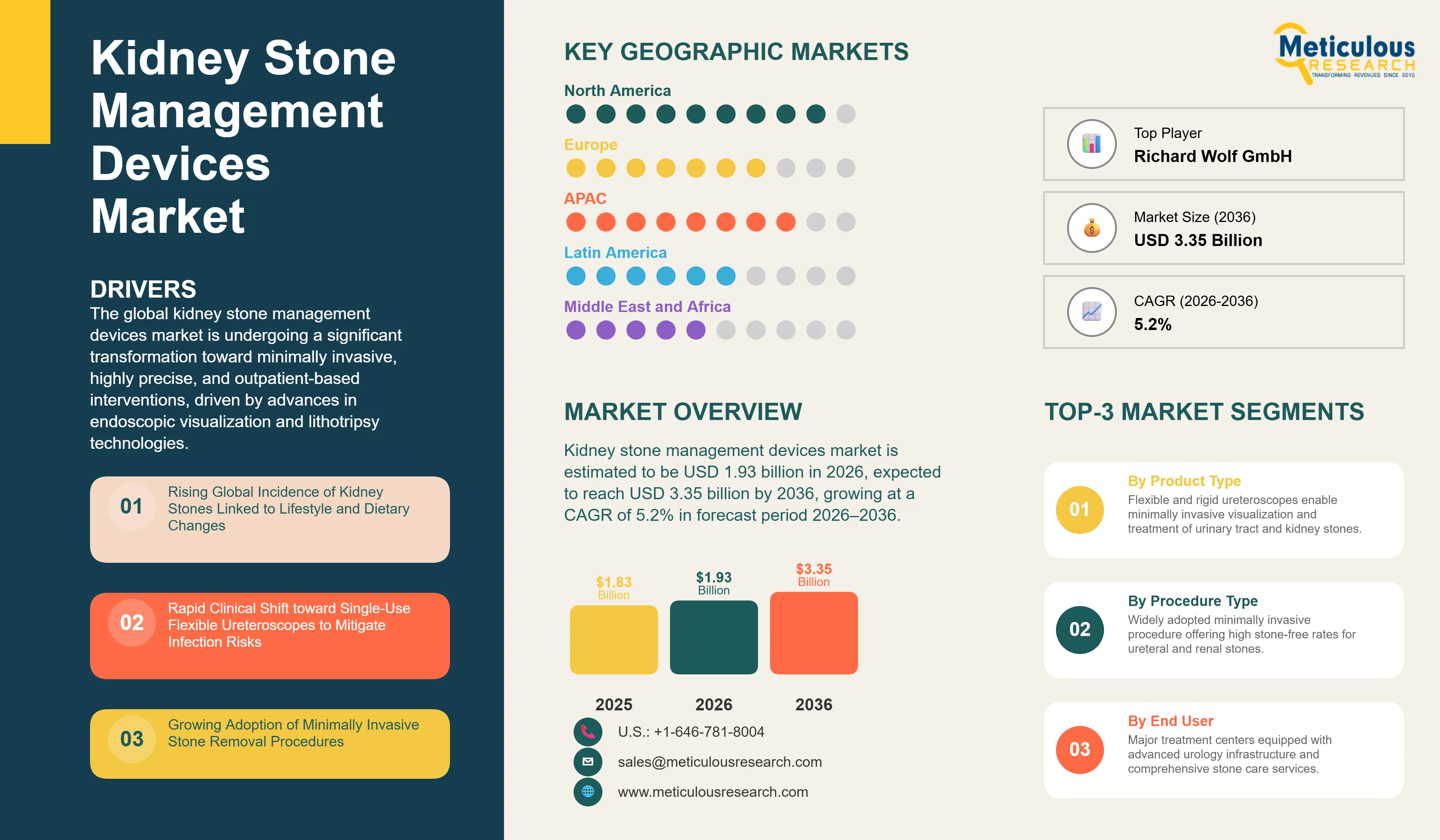
The global kidney stone management devices market is estimated to be USD 1.93 billion in 2026. This market is expected to reach USD 3.35 billion by 2036, growing at a CAGR of 5.2% during the forecast period 2026–2036.
 Click here to: Get Free Sample Pages of this Report
The global kidney stone management devices market is undergoing a significant transformation toward minimally invasive, highly precise, and outpatient-based interventions, driven by advances in endoscopic visualization and lithotripsy technologies. Urolithiasis remains a major global healthcare burden, with kidney stones affecting approximately 11% of men and 6% of women in the United States during their lifetime, according to the U.S. National Institute of Diabetes and Digestive and Kidney Diseases (NIDDK). The growing prevalence of obesity, diabetes, dehydration, and dietary risk factors such as high sodium and animal protein intake continues to contribute to rising stone incidence worldwide.
Market growth is being driven by the increasing adoption of minimally invasive procedures, particularly ureteroscopy (URS) and laser lithotripsy, which offer superior stone clearance, reduced morbidity, and faster recovery compared with traditional surgical approaches. Clinical recommendations from leading organizations such as the American Urological Association and the European Association of Urology increasingly support ureteroscopic and laser-based interventions for a broad range of urinary stone indications, reinforcing the shift away from more invasive treatment modalities.
Technological innovation remains a key market catalyst. The emergence of single-use flexible ureteroscopes is improving procedural efficiency by eliminating reprocessing requirements and reducing cross-contamination risks, while next-generation laser platforms, particularly thulium fiber laser (TFL) systems, are enabling faster stone dusting, improved fragmentation efficiency, and enhanced surgical precision. Simultaneously, advancements in digital imaging, high-definition endoscopy, and intraoperative visualization are improving clinical outcomes and procedural consistency across hospitals and ambulatory surgical centers.
As healthcare systems continue to prioritize value-based care and same-day treatment pathways, the adoption of disposable endoscopic devices and advanced lithotripsy technologies is expected to accelerate. Furthermore, the integration of artificial intelligence-enabled imaging analysis and surgical planning tools is anticipated to enhance diagnostic accuracy and procedural decision-making, supporting sustained growth in the global kidney stone management devices market over the forecast period.
Drivers: Increasing Global Prevalence of Urolithiasis and the Rapid Adoption of Single-Use Endoscopic Technologies
The growth of the global kidney stone management devices market is primarily driven by the rising incidence of kidney stones worldwide and the transformative shift toward disposable surgical technologies.
Rising Global Incidence of Kidney Stones Linked to Lifestyle and Dietary Changes
A major driver for the market is the increasing global prevalence of urolithiasis, which is closely linked to modern dietary habits, rising obesity rates, and insufficient hydration. As urban lifestyles become more prevalent, the intake of processed foods high in sodium and protein has grown, significantly increasing the risk of stone formation. This demographic and lifestyle shift is creating a consistent and expanding patient pool for kidney stone management devices. The growing awareness among patients and healthcare providers about the long-term complications of untreated stones is also driving a higher volume of diagnostic consultations and subsequent surgical interventions.
Rapid Clinical Shift toward Single-Use Flexible Ureteroscopes to Mitigate Infection Risks
The market is significantly driven by the rapid adoption of single-use (disposable) flexible ureteroscopes. These devices eliminate the need for complex and time-consuming reprocessing, thereby reducing the risk of cross-contamination and hospital-acquired infections. For healthcare facilities, disposable scopes offer a predictable cost-per-procedure and eliminate the high maintenance and repair costs associated with reusable scopes. The improved accessibility and consistent performance of modern single-use scopes are encouraging their widespread use, particularly in ambulatory surgical centers and community hospitals, which is a fundamental driver for market expansion.
Restraints: High Costs of Advanced Laser Systems and Potential Clinical Complications of Invasive Procedures
Despite their clinical benefits, the adoption of advanced kidney stone management devices is hindered by significant capital investment requirements and the inherent risks of surgical intervention.
High Capital Investment and Operational Costs for Advanced Lithotripsy Systems
A major restraint for the market is the high capital investment required for advanced lithotripsy systems, particularly high-power thulium fiber lasers and advanced shock wave lithotripters. These technologies involve significant upfront costs for equipment, as well as ongoing expenses for specialized disposables, maintenance, and clinical training. For smaller hospitals and clinics, especially in emerging markets, these financial barriers can be prohibitive. This can limit the availability of the most advanced stone management treatments to larger, well-funded medical centers, impacting overall market penetration and patient access to the latest technologies.
Inherent Clinical Risks and Potential Complications Associated with Invasive Stone Procedures
The global kidney stone management devices market is also impacted by the inherent clinical risks and potential complications associated with invasive stone procedures. While minimally invasive, procedures like ureteroscopy and PCNL still carry risks of ureteral injury, infection, and bleeding. Furthermore, the possibility of incomplete stone clearance and the need for secondary procedures can deter some patients from seeking surgical intervention. These clinical concerns, combined with the stringent regulatory requirements for new urological devices, remain significant hurdles for manufacturers and can restrain the rapid adoption of new stone management technologies.
Opportunities: Integration of Thulium Fiber Laser Technology and the Expansion of Outpatient Urological Care
Future growth opportunities in the kidney stone management devices market are centered on the adoption of next-generation laser technologies and the migration of procedures to ambulatory settings.
Increasing Clinical Adoption of Thulium Fiber Laser (TFL) for Superior Fragmentation
There is a significant opportunity for market growth driven by the increasing clinical adoption of thulium fiber laser (TFL) technology. TFL offers superior stone fragmentation and dusting capabilities compared to traditional holmium lasers, allowing for faster procedures and higher stone-free rates. The ability to use smaller laser fibers and operate with higher safety profiles makes TFL highly attractive for modern urological practices. Manufacturers that focus on developing and promoting TFL-based lithotripsy systems are well-positioned to capitalize on the ongoing technology replacement cycle in the urology market.
Significant Migration of Stone Procedures to Ambulatory Surgical Centers (ASCs)
The ongoing migration of kidney stone procedures from hospital operating rooms to ambulatory surgical centers (ASCs) represents a major opportunity. ASCs offer a more efficient and cost-effective setting for minimally invasive procedures like ureteroscopy. The availability of high-performance single-use ureteroscopes and portable laser systems has enabled ASCs to provide high-quality care with faster patient turnaround times. Manufacturers that can offer comprehensive solutions optimized for the ASC environment, including flexible procurement models for disposables, are likely to lead the next phase of market expansion.
Accelerating Transition toward Single-Use Flexible Ureteroscopes in Urological Practice
A prominent trend in 2026 is the accelerating transition toward single-use flexible ureteroscopes, driven by increasing procedure volumes and growing emphasis on infection prevention and operational efficiency. According to the U.S. National Institute of Diabetes and Digestive and Kidney Diseases (NIDDK), kidney stones affect approximately 11% of men and 6% of women in the United States, contributing to a substantial and recurring procedural burden on healthcare systems. Single-use ureteroscopes eliminate reprocessing requirements, reduce repair-related downtime, and mitigate the risk of cross-contamination associated with reusable endoscopes. The trend is particularly pronounced in ambulatory surgical centers (ASCs) and high-volume stone treatment centers seeking faster patient turnover and predictable device performance. Continuous improvements in digital imaging, scope deflection, and ergonomics have further narrowed the performance gap between disposable and reusable platforms, accelerating adoption across both developed and emerging healthcare markets.
Integration of Artificial Intelligence for Enhanced Stone Detection and Treatment Planning
The kidney stone management devices market is increasingly embracing artificial intelligence (AI) to improve diagnostic accuracy and procedural planning. The widespread use of computed tomography (CT), which the American Urological Association identifies as the most accurate imaging modality for urinary stone evaluation, has created a growing opportunity for AI-assisted image analysis. Advanced algorithms are being developed to automatically detect stones, estimate stone burden, predict composition, and assess treatment complexity using CT and ultrasound datasets. These capabilities enable clinicians to select optimal treatment approaches, including ureteroscopy, extracorporeal shock wave lithotripsy (ESWL), or laser lithotripsy, while improving procedural planning and resource utilization. As healthcare providers increasingly prioritize precision medicine and outcome-based care, AI-driven decision support tools are expected to enhance stone-free rates, reduce procedure times, and improve consistency in kidney stone management.
Analysis by Product Type
Based on product type, the ureteroscopes segment is expected to hold the largest share of the global kidney stone management devices market in 2026. This leadership is substantiated by the widespread clinical adoption of ureteroscopy (URS) as a primary treatment for both ureteral and renal stones. The shift toward single-use flexible ureteroscopes has further accelerated this segment's dominance by improving procedural efficiency and accessibility. However, the lithotripsy devices segment is projected to register the highest CAGR during the forecast period. The rapid clinical transition from traditional Holmium:YAG to next-generation Thulium Fiber Laser (TFL) technology is driving significant equipment sales and driving the growth of this segment.
Analysis by Procedure Type
By procedure type, ureteroscopy (URS) is expected to hold the largest share in 2026. Ureteroscopy is the leading procedure type as it offers high stone-free rates (SFR) for stones of various sizes and locations. Its versatility and the continuous improvement in scope technology have made it the preferred choice for modern urological management. However, the laser lithotripsy segment is projected to grow at the fastest CAGR during the forecast period. The integration of advanced thulium fiber lasers into standard workflows, which enhances fragmentation efficiency and reduces the need for stone retrieval, is driving the rapid expansion of this procedure segment.
Analysis by End User
By end user, the hospitals & specialty clinics segment is expected to hold the largest share in 2026. Hospitals lead the market as they provide the comprehensive infrastructure and specialized equipment required for a full range of kidney stone treatments. However, the ambulatory surgical centers (ASCs) segment is projected to register the highest CAGR during the forecast period. The ongoing shift toward minimally invasive, outpatient kidney stone procedures, enabled by the availability of high-performance disposable scopes and portable laser systems, is accelerating the migration of treatments to these outpatient facilities.
Geographic Analysis: North America's Market Dominance and Asia-Pacific's Rapid Clinical Expansion
Largest Share: North America
North America is expected to dominate the global kidney stone management devices market in 2026, accounting for approximately 42% of total revenue. The region's leadership is driven by the high prevalence of kidney stone disease, with the U.S. National Institute of Diabetes and Digestive and Kidney Diseases reporting lifetime kidney stone occurrence in approximately 11% of men and 6% of women. Strong adoption of minimally invasive treatment modalities, including flexible ureteroscopy, laser lithotripsy, and single-use ureteroscopes, coupled with a highly developed healthcare infrastructure and favorable reimbursement environment, further supports market growth. The region also benefits from early adoption of advanced technologies such as thulium fiber laser (TFL) systems and the presence of leading industry participants, including Boston Scientific Corporation, Cook Medical LLC, Olympus Corporation, Karl Storz SE & Co. KG, BD, and Teleflex Incorporated.
Fastest Growing: Asia-Pacific
The Asia-Pacific region is projected to witness the fastest growth in the global kidney stone management devices market, with a CAGR of 6.8% during the forecast period. This rapid expansion is driven by the increasing incidence of urolithiasis associated with urbanization, expanding healthcare infrastructure, and rising medical tourism. Governments in countries like China and India are also increasing investments in medical technology, facilitating the adoption of advanced kidney stone management devices. Key companies operating in the Asia Pacific market are Olympus Corporation, Karl Storz SE & Co. KG, and Richard Wolf GmbH.
The global kidney stone management devices market is characterized by intense competition among established medical technology giants and specialized urology firms. Competition is primarily focused on enhancing the image quality and ergonomics of flexible ureteroscopes and improving the stone fragmentation efficiency of laser systems. Key players are investing heavily in R&D to develop next-generation thulium fiber lasers and high-performance single-use scopes to capture the growing outpatient market. Strategic developments often involve acquisitions of specialized laser technology firms and partnerships with leading urological clinics to validate new treatment protocols. Furthermore, there is a growing focus on providing integrated digital solutions that combine visualization, lithotripsy control, and AI-driven diagnostics. Manufacturers are also increasingly focusing on cost-effective procurement models for disposables and comprehensive clinical training programs to support the successful implementation of their technologies in diverse healthcare settings, which is critical for maintaining market leadership in this rapidly evolving field.
Boston Scientific Corporation, Olympus Corporation, Karl Storz SE & Co. KG, Richard Wolf GmbH, Cook Medical LLC (Cook Group), Coloplast A/S, Dornier MedTech GmbH, EDAP TMS S.A., DirexGroup, Lumenis Be Ltd. (Lumenis), Becton, Dickinson and Company (BD), Storz Medical AG, Convergent Laser Technologies, Allengers Medical Systems Ltd., Symmetry Surgical Inc., Medtronic plc, Teleflex Incorporated, UroViu Corporation, Ambu A/S, Pusen Medical Technology Co., Ltd.
The global market is estimated at USD 1.93 billion in 2026, with a projected growth to USD 3.35 billion by 2036, at a CAGR of 5.2%.
Primary drivers include the rising global incidence of kidney stones and the rapid clinical shift toward single-use flexible ureteroscopes.
Major restraints include the high capital costs of advanced laser systems and the inherent clinical risks associated with invasive stone procedures.
Opportunities lie in the increasing adoption of thulium fiber laser (TFL) technology and the significant migration of procedures to ambulatory surgical centers (ASCs).
Lithotripsy devices, particularly those based on thulium fiber laser technology, are projected to grow at the fastest CAGR.
Hospitals & specialty clinics are expected to hold the largest share as the primary setting for comprehensive kidney stone treatments.
North America is expected to dominate the market due to high prevalence, advanced healthcare infrastructure, and early technology adoption.
Asia-Pacific is projected to witness the fastest growth, fueled by increasing stone incidence and expanding healthcare infrastructure.
Key trends include the accelerating transition toward disposable endoscopy and the integration of AI for enhanced stone detection and planning.
























Published Date: Jun-2026
Published Date: Jun-2026
Published Date: Jan-2025
Published Date: Jun-2024
Please enter your corporate email id here to view sample report.
Subscribe to get the latest industry updates


