IoT Antenna Market (2026-2036)
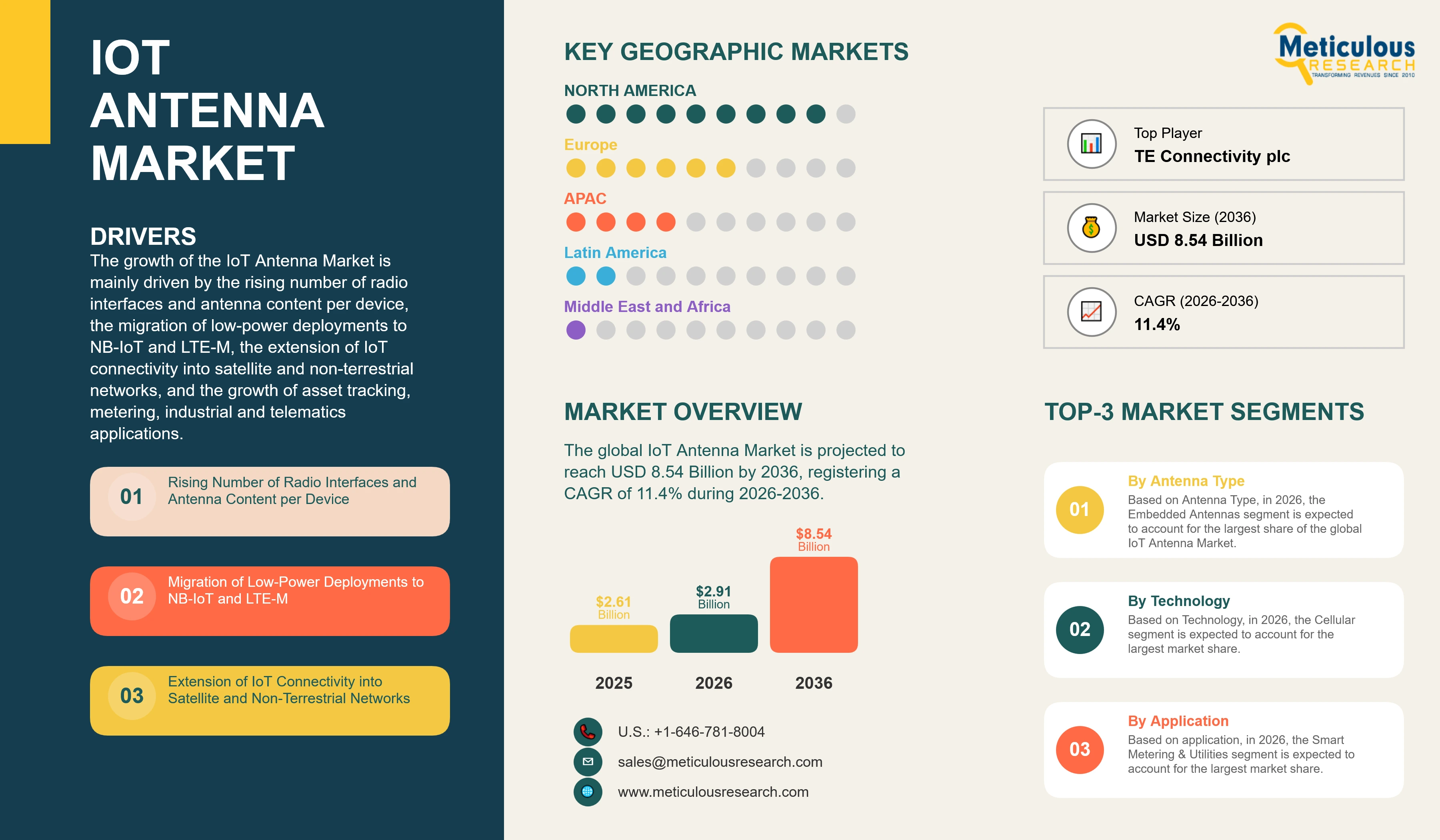
The global IoT Antenna Market was valued at USD 2.61 billion in 2025. This market is expected to reach USD 8.54 billion by 2036 from an estimated USD 2.91 billion in 2026, registering a CAGR of 11.4% during the forecast period (2026-2036).
- Published
- Oct 2026
- Pages
- 378
- Format
- PDF + Excel
- Report ID
- MRICT - 1042373
- Base year
- 2025
- 2025 · BASELINE
- $2.61B
- 2036
- $8.54B
- CAGR 2026–2036
- 11.4%
2025 baseline · 2026–2036 forecast at 11.4% CAGR · hover a bar for the value
Key highlights
The global IoT Antenna Market is projected to reach USD 8.54 billion by 2036, driven by rising antenna content per device, NB-IoT and LTE-M migration, satellite connectivity in terrestrial devices, and growth in tracking, metering and industrial applications.
Connectivity component demand is expanding rapidly. In the third quarter of fiscal 2026, ended 26 June 2026, TE Connectivity reported net sales of USD 5.16 billion, up 14% reported and 12% organically, with Industrial Solutions sales of USD 2.58 billion, up 21.9% reported and 21.0% organically, including growth of 16.3% in automation and connected living, and record orders of USD 5.7 billion, up 27%, with double-digit order growth in all businesses.
Interconnect demand and order books are at records. In the second quarter of 2026, Amphenol Corporation reported net sales of USD 8,758.1 million, up 55% in U.S. dollars and 30% organically, with orders of USD 10.7 billion and a book-to-bill ratio of 1.23 to 1, and guided to third-quarter sales of USD 9.3 billion to USD 9.4 billion.
Satellite connectivity is entering mainstream device design. Normative 3GPP work on non-terrestrial networks began in December 2019 under Release 17 and has continued with enhancements through Releases 18, 19 and 20, covering NR-NTN for broadband and reliable services and IoT-NTN based on NB-IoT and eMTC for massive machine-type communication, across approximately 1 GHz to 30 GHz with dedicated S, L, Ka and Ku bands.
Asia-Pacific is expected to account for the largest market share in 2026, supported by device and module manufacturing concentration, while the Middle East & Africa is projected to register the fastest growth during the forecast period.
Report summary
| Particulars | Details |
|---|---|
| Forecast Period | 2026-2036 |
| Base Year | 2025 |
| Estimated Year | 2026 |
| CAGR (Value) | 11.4% |
| Format | PDF, Excel & Cloud Portal · 378 pages |
| Market Size (Value) in 2026 | USD 2.91 Billion |
| Market Size (Value) in 2036 | USD 8.54 Billion |
| Segments Covered | By Antenna Type: Embedded Antennas (Chip & Surface-Mount Ceramic, Flexible Printed Circuit, Printed Circuit Board Trace, Stamped Metal), External Antennas (Terminal-Mount & Whip, Magnetic & Adhesive Mount, Puck & Through-Hole, Panel & Directional), Combination Antennas. By Technology: Cellular (4G LTE, LTE-M & NB-IoT, 5G Sub-6 GHz, 5G RedCap, 5G mmWave), Wi-Fi & Bluetooth (2.4 GHz, Dual-Band 2.4/5 GHz, 6 GHz Wi-Fi 6E & Wi-Fi 7), GNSS (Single-Band, Multi-Band), LPWAN, Satellite & Non-Terrestrial Networks, Other Technologies (NFC & RFID, Ultra-Wideband). By Frequency Band: Sub-1 GHz, 1-3 GHz, 3-6 GHz, Above 6 GHz. By Application: Asset Tracking & Logistics, Smart Metering & Utilities, Industrial IoT & Automation, Automotive & Telematics, Smart Home & Building, Healthcare & Wearables, Agriculture & Environmental Monitoring, Other Applications. |
| Countries Covered | Asia-Pacific: China, Japan, South Korea, Taiwan, India, Singapore, Malaysia, Vietnam, Rest of Asia-Pacific. North America: U.S., Canada. Europe: Germany, U.K., France, Italy, Spain, Ireland, Netherlands, Rest of Europe. Latin America: Brazil, Mexico, Rest of Latin America. Middle East & Africa: Saudi Arabia, UAE, Rest of Middle East & Africa. |
| Key Companies | TE Connectivity plc, Amphenol Corporation, Molex, LLC, Murata Manufacturing Co., Ltd., Taoglas Group Holdings Limited, Kyocera AVX Components Corporation, Yageo Corporation, Abracon LLC, Antenova Limited, Ignion S.L., Johanson Technology, Inc., Ezurio, 2J Antennas s.r.o., Mobile Mark, Inc., Panorama Antennas Ltd., Unictron Technologies Corporation, and Siglink Technology Co., Ltd. |
Report overview
Segments covered: antenna type, technology, frequency band, application.
The growth of this market is mainly driven by the rising number of radio interfaces carried in each connected device, which increases antenna content per unit rather than only unit volumes; the migration of low-power wide-area deployments from legacy cellular technologies to NB-IoT and LTE-M as operators retire second and third generation networks; the addition of satellite connectivity to terrestrial IoT devices through non-terrestrial network standards, which requires additional antenna elements and new frequency bands; and the growth of asset tracking, smart metering, industrial automation and telematics applications that depend on reliable radio performance in constrained enclosures. In addition, the tightening of radio equipment certification and cybersecurity requirements, the adoption of Wi-Fi 6E and Wi-Fi 7 in the 6 GHz band, the growth of multi-band GNSS for precise positioning, and the shift of device makers toward pre-certified antenna components and design support services are further supporting the growth of this market.
The IoT Antenna Market, also referred to as the antennas for IoT market, embedded antenna market, or connected device antenna market, comprises the antenna components and assemblies designed into devices that connect to networks for machine-to-machine and internet of things applications. The market includes embedded antennas mounted inside the device enclosure, such as chip and surface-mount ceramic antennas, flexible printed circuit antennas, printed circuit board trace antennas and stamped metal antennas; external antennas attached to or mounted on the device or its installation, such as terminal-mount and whip antennas, magnetic and adhesive mount antennas, puck and through-hole antennas and panel antennas; and combination antennas that house several radio and positioning elements in a single housing. The market ecosystem extends from antenna designers and manufacturers to radio module makers, device original equipment manufacturers, contract manufacturers, test and certification laboratories, network operators and the regulators whose spectrum allocations and equipment requirements determine what an antenna must support.
The economics of this market are driven less by device unit growth than by antenna content per device. A connected device that once carried a single cellular antenna now commonly carries a cellular antenna, a positioning antenna, a short-range antenna for commissioning or local connectivity, and in many designs a second cellular element for diversity. Each additional radio interface adds an antenna, and each additional band an antenna must cover makes that antenna harder to design and more valuable. This is why antenna revenue grows faster than connected device shipments and why the design support that accompanies the component has become part of what is purchased.
Component demand across connectivity markets has been strong. In the third quarter of fiscal 2026, ended 26 June 2026, TE Connectivity reported net sales of USD 5.16 billion, up 14% reported and 12% organically, with Industrial Solutions sales of USD 2.58 billion, up 21.9% reported and 21.0% organically, including growth of 16.3% in automation and connected living, and record orders of USD 5.7 billion, up 27%, with double-digit order growth in all businesses. Growth of 16.3% in automation and connected living, within an industrial segment growing 21.0% organically, indicates that demand for connectivity components in connected and automated applications is expanding well ahead of general industrial production. In the second quarter of 2026, Amphenol Corporation reported net sales of USD 8,758.1 million, up 55% in U.S. dollars and 30% organically, with orders of USD 10.7 billion and a book-to-bill ratio of 1.23 to 1, and guided to third-quarter sales of USD 9.3 billion to USD 9.4 billion. A book-to-bill ratio of 1.23 to 1 indicates that orders are being placed ahead of shipments across the interconnect industry.
The most significant technical change affecting antenna design is the extension of cellular standards into satellite. Normative 3GPP work on non-terrestrial networks began in December 2019 under Release 17 and has continued with enhancements through Releases 18, 19 and 20, covering NR-NTN for broadband and reliable services and IoT-NTN based on NB-IoT and eMTC for massive machine-type communication, across approximately 1 GHz to 30 GHz with dedicated S, L, Ka and Ku bands. IoT-NTN is built on NB-IoT and eMTC, which means the same low-power device categories used in terrestrial metering and tracking are being specified to operate over satellite, and supporting both requires either a wider-band antenna or an additional element in bands the device did not previously use.
Commercial activity confirms that this is no longer a standards exercise. According to a Global Mobile Suppliers Association summary published in September 2025, 170 mobile and satellite operator partnerships had been publicly announced across 80 countries and territories as at August 2025, with 34 operators in 25 markets having launched commercial services. Where an asset tracker or a remote sensor is expected to maintain connectivity outside terrestrial coverage, the antenna must deliver performance in satellite bands with a link budget far less forgiving than a terrestrial one, which raises the engineering content and the price of the antenna.
Regulation is simultaneously raising the cost of getting a radio product to market. The cybersecurity requirements of Commission Delegated Regulation (EU) 2022/30 under the Radio Equipment Directive became applicable on 1 August 2025, requiring internet-connected radio equipment placed on the European Union market to meet network protection, personal data protection and fraud prevention essential requirements. Together with national equipment authorisation regimes, this has increased the testing and documentation burden on every device containing a radio, and because antenna performance determines radiated emissions and receiver sensitivity, the antenna is central to whether a device passes. Device makers have responded by favouring pre-certified antenna components supplied with reference designs, measured performance data and design support, which shifts value from the physical part toward the engineering service attached to it.
Spectrum policy continues to add bands rather than replace them. The opening of the 6 GHz band for Wi-Fi 6E and Wi-Fi 7, the continued use of sub-1 GHz industrial, scientific and medical bands for long-range low-power links, the allocation of mid-band spectrum for fifth generation networks and the addition of satellite bands through non-terrestrial networks all coexist, and devices increasingly need to operate across several of them. The consequence for antenna suppliers is that multi-band and multi-protocol designs, which command the highest prices and require the most design support, are becoming the standard requirement rather than the exception.
The market includes connectivity and interconnect groups such as TE Connectivity and Amphenol, passive component manufacturers including Murata Manufacturing, Kyocera AVX, Yageo through Pulse Electronics, Johanson Technology and Abracon, connector and electronics groups including Molex, and antenna specialists including Taoglas, Antenova, Ignion, 2J Antennas, Mobile Mark, Panorama Antennas, Unictron Technologies and Siglink Technology, alongside Ezurio in wireless modules and antennas. Participants compete on radiated performance in realistic enclosures, band and protocol coverage, size and integration flexibility, availability of reference designs and measured data, certification support, supply continuity and lead time, and total cost including the engineering effort a customer must expend to achieve performance.
At the same time, the market faces challenges, including the compression of antenna volume as devices shrink while band requirements expand, the dependence of achieved performance on the customer device design rather than on the component alone, price pressure from commoditised single-band parts and low-cost regional suppliers, the engineering cost of supporting customers through design and certification, and exposure to raw material and manufacturing cost volatility. As a result, suppliers that combine multi-band and multi-protocol design capability, credible measured performance data, strong certification and design support, and reliable supply at scale are expected to capture the largest share of growth over the forecast period.
Report infographic
Market dynamics
15 factors across 5 forcesRising Number of Radio Interfaces and Antenna Content per Device
The rising number of radio interfaces carried in each connected device is a major factor driving the IoT Antenna Market, as it increases antenna content per unit independently of device volumes. A tracking device typically combines a cellular radio for backhaul, a positioning receiver, and a short-range radio for configuration or local data transfer, and each of those requires its own antenna or a shared element designed to cover all of their bands. Antenna revenue therefore rises faster than connected device shipments, and the design difficulty rises faster still.
Component demand reflects this. In the third quarter of fiscal 2026, ended 26 June 2026, TE Connectivity reported net sales of USD 5.16 billion, up 14% reported and 12% organically, with Industrial Solutions sales of USD 2.58 billion, up 21.9% reported and 21.0% organically, including growth of 16.3% in automation and connected living, and record orders of USD 5.7 billion, up 27%, with double-digit order growth in all businesses. Growth of 16.3% in automation and connected living within an industrial segment growing 21.0% organically indicates that connectivity content in connected applications is expanding ahead of underlying equipment production, which is the condition under which antenna suppliers gain content share.
Migration of Low-Power Deployments to NB-IoT and LTE-M
The migration of low-power wide-area deployments from legacy cellular technologies to NB-IoT and LTE-M is significantly driving market growth. As operators retire second and third generation networks, the large installed base of metering, alarm, telematics and industrial monitoring devices built for those technologies must be replaced with devices supporting the newer low-power categories, and each replacement is a new antenna design rather than a like-for-like substitution because the band plans and performance requirements differ.
The effect is concentrated and time-bound, which makes it commercially significant. Utility metering, building systems and fleet telematics are deployed in large homogeneous populations, so a migration decision converts into a large single antenna requirement with a defined specification, and because these devices operate for a decade or more on battery power, antenna efficiency is a primary design criterion rather than a secondary one.
Extension of IoT Connectivity into Satellite and Non-Terrestrial Networks
The extension of IoT connectivity into satellite and non-terrestrial networks is an important driver of both volume and value. Normative 3GPP work on non-terrestrial networks began in December 2019 under Release 17 and has continued with enhancements through Releases 18, 19 and 20, covering NR-NTN for broadband and reliable services and IoT-NTN based on NB-IoT and eMTC for massive machine-type communication, across approximately 1 GHz to 30 GHz with dedicated S, L, Ka and Ku bands. Because IoT-NTN is specified on the same NB-IoT and eMTC foundations used in terrestrial low-power devices, device makers can extend existing product lines into satellite coverage, and doing so requires antenna support in bands the device did not previously use.
Commercial momentum is established. According to a Global Mobile Suppliers Association summary published in September 2025, 170 mobile and satellite operator partnerships had been publicly announced across 80 countries and territories as at August 2025, with 34 operators in 25 markets having launched commercial services. Satellite link budgets are far less forgiving than terrestrial ones, so achieving usable performance places unusually high demands on antenna efficiency, gain pattern and placement, which raises the engineering content and therefore the value of the antenna in these designs.
Growth of Asset Tracking, Metering, Industrial and Telematics Applications
The growth of asset tracking, smart metering, industrial automation and telematics applications supports market growth and favours higher-value antenna products. These applications place devices in metal enclosures, underground chambers, moving vehicles and industrial environments where radio conditions are poor, and performance under those conditions cannot be achieved with a commodity part. Buyers in these segments specify measured efficiency and radiation patterns, require design support to integrate the antenna into a constrained enclosure, and purchase in volumes that justify custom development.
Order patterns across the interconnect industry indicate the strength of underlying demand. In the second quarter of 2026, Amphenol Corporation reported net sales of USD 8,758.1 million, up 55% in U.S. dollars and 30% organically, with orders of USD 10.7 billion and a book-to-bill ratio of 1.23 to 1, and guided to third-quarter sales of USD 9.3 billion to USD 9.4 billion. Orders of USD 10.7 billion against sales of USD 8.76 billion, a book-to-bill ratio of 1.23 to 1, indicate that customers across industrial, automotive and communications applications are committing to future deliveries rather than drawing down inventory.
Table of contents
12 chapters · 175 sections · 378 pages · click to expandSegmental analysis
| Segment | Largest share (2026) | Fastest growth (2026–2036) |
|---|---|---|
| By Antenna Type | Embedded Antennas | Combination Antennas |
| By Technology | Cellular | Satellite & Non-Terrestrial Networks |
| By Frequency Band | 1-3 GHz | Above 6 GHz |
| By Application | Smart Metering & Utilities | Asset Tracking & Logistics |
By Antenna Type
- IoT Antenna Market Analysis by Antenna Type
- Embedded Antennas are further segmented into Chip & Surface-Mount Ceramic Antennas, Flexible Printed Circuit Antennas, Printed Circuit Board Trace Antennas, and Stamped Metal Antennas.
- External Antennas are further segmented into Terminal-Mount & Whip Antennas, Magnetic & Adhesive Mount Antennas, Puck & Through-Hole Antennas, and Panel & Directional Antennas.
- The Embedded Antennas segment is expected to account for the largest share of the global IoT Antenna Market.
- The large share of this segment is mainly due to the preference of device makers for antennas contained within the enclosure in consumer, smart home, metering, wearable and tracking products, the suitability of chip and flexible printed circuit antennas for automated assembly, and the volume of devices in which an external antenna is not acceptable for cost, durability or appearance reasons.
- However, the Combination Antennas segment is projected to register the highest CAGR during the forecast period.
- The rapid growth of this segment is attributed to the rising number of radio interfaces per device, which makes separate parts impractical in the available space, to the requirement for managed isolation between cellular, positioning and short-range elements, and to the addition of satellite bands, which increases the number of elements a single assembly must accommodate.
By Technology
- IoT Antenna Market Analysis by Technology
- Cellular is further segmented into 4G LTE, LTE-M & NB-IoT, 5G Sub-6 GHz, 5G RedCap, and 5G mmWave.
- Wi-Fi & Bluetooth is further segmented into 2.4 GHz, Dual-Band 2.4/5 GHz, and 6 GHz Wi-Fi 6E & Wi-Fi 7.
- GNSS is further segmented into Single-Band and Multi-Band.
- Other Technologies include NFC & RFID and Ultra-Wideband.
- The Cellular segment is expected to account for the largest share of the market.
- The large share of this segment is mainly due to the use of cellular connectivity as the primary wide-area link in metering, tracking, telematics and industrial monitoring devices, the breadth of bands a cellular antenna must cover, and the ongoing replacement of devices built for retired second and third generation networks with devices supporting LTE-M and NB-IoT.
- However, the Satellite & Non-Terrestrial Networks segment is projected to register the highest CAGR during the forecast period.
- The rapid growth of this segment is attributed to the specification of IoT-NTN on NB-IoT and eMTC foundations within 3GPP Releases 17 through 20, the launch of commercial direct-to-device services by operators in 25 markets as at August 2025, and the demanding link budgets that require higher-performing and therefore higher-value antennas.
By Frequency Band
- IoT Antenna Market Analysis by Frequency Band
- The 1-3 GHz segment is expected to account for the largest share of the market.
- The large share of this segment is mainly due to the concentration of cellular bands, positioning frequencies and 2.4 GHz short-range protocols in this range, which makes it the range nearly every connected device must cover, and often the range in which a single antenna is required to operate across multiple protocols.
- However, the Above 6 GHz segment is projected to register the highest CAGR during the forecast period.
- The rapid growth of this segment is attributed to the opening of the 6 GHz band for Wi-Fi 6E and Wi-Fi 7, the use of millimetre wave spectrum in fixed wireless and high-capacity industrial applications, and the inclusion of Ka and Ku bands in non-terrestrial network standards covering approximately 1 GHz to 30 GHz.
- The Sub-1 GHz segment is expected to grow steadily, supported by long-range low-power links in metering and agriculture.
By Application
- IoT Antenna Market Analysis by Application
- Other Applications include retail and payment devices and smart city infrastructure.
- The Smart Metering & Utilities segment is expected to account for the largest share of the global IoT Antenna Market.
- The large share of this segment is mainly due to the scale of electricity, gas, water and heat metering deployments, the homogeneity of those populations, which converts a single design decision into very large antenna volumes, and the replacement cycle created by the retirement of legacy cellular networks on which existing meters depend.
- However, the Asset Tracking & Logistics segment is projected to register the highest CAGR during the forecast period.
- The rapid growth of this segment is attributed to the combination of cellular, positioning and short-range connectivity in a single constrained device, the extension of tracking into locations without terrestrial coverage through satellite connectivity, and the premium placed on antenna efficiency in devices that must operate for years on a battery.
Geographic analysis
Asia-Pacific
Largest shareIn 2026, Asia-Pacific is expected to account for the largest share of the global IoT Antenna Market. The large share of this region is mainly attributed to the concentration of connected device, module and consumer electronics manufacturing in China, Taiwan, South Korea, Japan and Southeast Asia, the presence of leading passive component and antenna manufacturers including Murata Manufacturing, Kyocera AVX, Yageo, Unictron Technologies and Siglink Technology, the scale of smart metering and smart city deployments in China and India, and the position of the region as the point at which antennas are designed into devices regardless of where those devices are ultimately sold.
North America
North America is expected to account for a significant share of the market, supported by demand from asset tracking, fleet telematics, industrial automation and utility metering, early adoption of satellite direct-to-device services, and the presence of leading suppliers including TE Connectivity, Amphenol, Molex, Abracon, Johanson Technology, Mobile Mark and 2J Antennas. In the second quarter of 2026, Amphenol Corporation reported net sales of USD 8,758.1 million, up 55% in U.S. dollars and 30% organically, with orders of USD 10.7 billion and a book-to-bill ratio of 1.23 to 1, and guided to third-quarter sales of USD 9.3 billion to USD 9.4 billion.
Europe
Europe is expected to account for a substantial share of the market, supported by smart metering mandates, industrial automation and automotive telematics demand, and the presence of antenna specialists including Taoglas, Antenova, Ignion, Panorama Antennas and Ezurio. Regulatory requirements in the region directly influence antenna selection. The cybersecurity requirements of Commission Delegated Regulation (EU) 2022/30 under the Radio Equipment Directive became applicable on 1 August 2025, requiring internet-connected radio equipment placed on the European Union market to meet network protection, personal data protection and fraud prevention essential requirements.
Middle East & Africa
Fastest growthThe Middle East & Africa is projected to register the highest CAGR during the forecast period. The growth of this region is driven by smart city and utility infrastructure programmes in Saudi Arabia and the United Arab Emirates, the deployment of connected monitoring in oil, gas and water infrastructure, and the suitability of satellite-enabled IoT for applications in areas without terrestrial coverage.
Latin America
Latin America is expected to grow steadily, supported by utility metering modernisation, fleet telematics and agricultural monitoring in Brazil and Mexico.
Competitive landscape
The global IoT Antenna Market is fragmented, with large connectivity and passive component groups holding leading positions in high-volume standard products alongside antenna specialists that compete on design capability, custom development and applications support, and regional manufacturers competing primarily on price in commoditised categories. Market participants compete on radiated performance in realistic enclosures, band and protocol coverage, size and integration flexibility, availability of reference designs and measured data, certification support, supply continuity and lead time, and total cost including the engineering effort a customer must expend to achieve performance.
Leading companies are developing multi-band and combination antennas that consolidate cellular, positioning and short-range elements, extending portfolios into satellite and non-terrestrial network bands, expanding applications engineering and measurement capability to support customer integration and certification, building portfolios for 6 GHz Wi-Fi and mid-band private networks, and strengthening supply continuity commitments for industrial and automotive customers. Recent market context includes net sales growth of 14% with record orders of USD 5.7 billion, up 27%, at TE Connectivity in the third quarter of fiscal 2026, including growth of 16.3% in automation and connected living, and organic sales growth of 30% with a book-to-bill ratio of 1.23 to 1 at Amphenol in the second quarter of 2026.
The report provides a comprehensive competitive assessment of the leading companies operating in the global IoT Antenna Market. The key players profiled in the report include TE Connectivity plc (Switzerland), Amphenol Corporation (U.S.), Molex, LLC (U.S.), Murata Manufacturing Co., Ltd. (Japan), Taoglas Group Holdings Limited (Ireland), Kyocera AVX Components Corporation (U.S.), Yageo Corporation (Taiwan), Abracon LLC (U.S.), Antenova Limited (U.K.), Ignion S.L. (Spain), Johanson Technology, Inc. (U.S.), Ezurio (U.S.), 2J Antennas s.r.o. (Slovakia), Mobile Mark, Inc. (U.S.), Panorama Antennas Ltd. (U.K.), Unictron Technologies Corporation (Taiwan), and Siglink Technology Co., Ltd. (China).
- TE Connectivity plc
- Amphenol Corporation
- Molex, LLC
- Murata Manufacturing Co., Ltd.
- Taoglas Group Holdings Limited
- Kyocera AVX Components Corporation
- Yageo Corporation
- Abracon LLC
- Antenova Limited
- Ignion S.L
- Johanson Technology, Inc.
- Ezurio
- 2J Antennas s.r.o
- Mobile Mark, Inc.
- Panorama Antennas Ltd.
- Unictron Technologies Corporation
- Siglink Technology Co., Ltd
Expert perspectives
The IoT Antenna Market is best understood as a content market rather than a unit market. Antenna revenue is rising faster than connected device shipments because each device now carries more radio interfaces and each antenna must cover more bands, and the evidence from connectivity suppliers is consistent with that reading, with growth of 16.3% in automation and connected living at TE Connectivity within an industrial segment growing 21.0% organically, and an industry book-to-bill ratio of 1.23 to 1 at Amphenol. The binding constraint is shifting from component cost to integration capability, because the performance a customer achieves depends on the device design as much as on the part, and a supplier that cannot guide that integration cannot sell the higher-value products.
Three structural changes are expected to shape competitive positions through 2036. First, the extension of IoT standards into satellite through IoT-NTN is expected to add antenna elements and new frequency bands to products that already exist, creating a replacement requirement across a large installed base rather than a new niche. Second, the retirement of legacy cellular networks is expected to force a concentrated migration of metering, telematics and monitoring devices to LTE-M and NB-IoT, converting homogeneous installed populations into large single-specification antenna requirements. Third, the certification and cybersecurity burden on radio equipment is expected to continue favouring components supplied with measured data, reference designs and pre-compliance support over equivalent parts sold on price.
For companies planning entry or expansion, the most defensible positions over the forecast period are likely to be found in combination antennas consolidating multiple radios, satellite-capable antennas for terrestrial device platforms, multi-band GNSS for precise positioning, antennas qualified for industrial private networks and 6 GHz Wi-Fi, and certification-ready components supplied with design services. For established suppliers, the principal priorities are expanding applications engineering and measurement capability, defending price through engineering content rather than volume in commoditised categories, and offering the supply continuity that industrial and automotive customers require.
Overall, the market is expected to grow steadily, with embedded antennas, cellular technology, the 1 to 3 GHz band, smart metering applications and Asia-Pacific providing the core of demand, and combination antennas, satellite and non-terrestrial network technology, frequencies above 6 GHz, asset tracking applications and the Middle East & Africa providing the fastest growth.
Customer perspectives
Insights gathered during primary interviews with device hardware leads, radio frequency design engineers, and procurement managers highlight where priorities are shifting. The following perspectives reflect recurring themes raised across these discussions.
“This reflects integration support rather than component price as the purchasing basis.”
“This indicates how migration converts into concentrated antenna requirements.”
“This points to supply continuity as a qualification requirement.”
Frequently asked questions
The global IoT Antenna Market is estimated at USD 2.91 billion in 2026.
Cite this report
Meticulous Research. (2026). IoT Antenna Market - Global Opportunity Analysis and Industry Forecast (2026-2036) (Report No. MRICT - 1042373). Meticulous Market Research Pvt. Ltd. https://www.meticulousresearch.com/product/iot-antenna-market-7056