
Infusion Pumps Market (2025-2032)
The Infusion Pumps Market is projected to reach $25.9 billion by 2032, at a CAGR of 8.3% from 2025 to 2032.
- Published
- Jan 2025
- Pages
- 230
- Format
- PDF + Excel
- Report ID
- MRHC - 104272
- Base year
- 2024
- 2032 · FORECAST
- $25.90B
- 2032
- $25.90B
- CAGR 2025–2032
- 8.3%
2024 baseline · 2025–2032 forecast at 8.3% CAGR · hover a bar for the value
Key highlights
The Infusion Pumps Market is projected to reach $25.9 billion by 2032, at a CAGR of 8.3% from 2025 to 2032.
The infusion pump accessories/consumables segment is expected to account for the largest share of the infusion pumps market.
The multi-channel infusion pumps segment is expected to account for the largest share of the segment owing to factors such as rising demand for technologically advanced infusion pumps, precise & multiple drug delivery in case of chronic diseases, and rising awareness and demand for advanced infusion pumps in home healthcare.
The oncology segment is expected to account for the largest share of the infusion pumps market due to the increasing prevalence of cancer and rising demand for controlled dispensing of drugs in the body for chemotherapy.
The hospitals & clinics segment is expected to account for the largest share of the infusion pumps market.
The increasing focus of government bodies of Asia-Pacific countries such as China, India, Singapore, and South Korea on the healthcare sector in terms of increased investment for the adoption of advanced technology, rising investments in better healthcare infrastructure, and the increasing awareness and literacy among the population.
Report summary
| Particulars | Details |
|---|---|
| Base Year | 2024 |
| Estimated Year | 2025 |
| Forecast Period | 2025–2032 |
| Market Size (2032) | USD 25.90 billion |
| CAGR (2025–2032) | 8.3% |
| Format | PDF, Excel & Cloud Portal · 230 pages |
| Segments Covered | By Type: Volumetric, Syringe, Insulin, Ambulatory [Disposable, Chemo] Implantable · By Channel: Single, Multi) Application (Oncology, Pain, Diabetes, Hematology, Pediatrics) End User (Hospital, Ambulatory Care |
| Key Companies | Becton, Dickinson and Company (BD), B. Braun SE, Baxter International Inc. (U.S.), Fresenius SE&Co. KGaA, ICU Medical, Inc. (U.S.), Medtronic plc, MOOG Inc. (U.S.), Terumo Corporation, F. Hoffmann-LA Roche Ltd, Insulet Corporation (U.S.) |
Report overview
Segments covered: type, channel.
Infusion pumps enable healthcare providers to provide easy and seamless delivery of fluids into the patient’s body without frequently being in contact with them. These solutions help healthcare professionals streamline patient medications in a controlled way, reducing the chances of errors or overdose. Moreover, advanced infusion pumps give patients the accessibility to carry out their daily tasks with ease while being on medications. Additionally, the COVID-19 pandemic triggered several end users' adoption of infusion pumps, such as hospitals, clinics, and ambulatory centers, due to their ability to provide medications to patients without contact with them.
The growth of this market is driven by the increasing demand and adoption of patient engagement solutions, efforts to enhance patient-centric care by end users, growing industry consolidation through partnerships and collaborations, government initiatives and regulatory upgradation, rising healthcare expenditure, and rising prevalence of chronic diseases coupled with the increasing geriatric population. However, patient data privacy and safety concerns may restrain the growth of this market.
Furthermore, the growing adoption of wearable and mobile-based digital healthcare solutions and emerging economies are expected to offer significant growth opportunities for players in this market. However, the lack of digital literacy, the high cost associated with deploying healthcare IT solutions, and the lack of skilled IT personnel in the healthcare industry are challenging the growth of infusion pump market.
The prevalence of chronic diseases and conditions such as cancer, diabetes, and heart disease is rising globally. According to the WHO, 41 million people die from chronic diseases each year, accounting for around 74% of all deaths globally. Growth in the geriatric population and social behaviors such as tobacco and alcohol use, physical inactivity, and unhealthy diets are major factors driving a steady increase in the number of people suffering from chronic diseases. According to the International Diabetes Federation, the global prevalence of diabetes is estimated to increase from 10.5% of the global population in 2021 to 11.3% in 2032.
Also, chronic diseases are often associated with the elderly population due to the declining bodily functions and immunity among this population segment. Aging is associated with progressive deterioration in the structure and functioning of organs. The elderly population is more prone to various chronic diseases. According to World Population Prospects, the population aged 65 and above is growing more rapidly than other age groups.
In 2019, 703 million people were in the age group of 65 years and above globally. This number is projected to reach 1.5 billion by 2050. This remarkable growth in the elderly population is driven by declining fertility rates and improvements in longevity. Infusion pumps are commonly used to manage diabetes, particularly for individuals with type 1 diabetes. Insulin pumps deliver a continuous supply of insulin, mimicking the function of the pancreas. This helps regulate blood sugar levels and allows for flexibility in insulin dosing. Insulin pump can also be programmed to deliver bolus doses before meals.
Furthermore, non-communicable diseases (NCDs), such as cancer, cardiovascular disease, diabetes, and mental illness, are becoming more prevalent. NCDs currently account for 70% of all deaths globally, with the majority recorded in low- & middle-income countries. The International Agency for Research on Cancer (IARC) estimates that globally, 1 in 5 people develop cancer during their lifetime, and 1 in 8 men and 1 in 11 women lose their lives. As per WHO estimates, the global prevalence of new cancer cases is expected to increase from 19.2 million in 2020 to 24.5 in 2032, while the global mortality from cancer is expected to increase from 9.9 million in 2020 to 12.9 million in 2032. Many cancer patients receive chemotherapy and other medications through infusion pumps. These pumps provide a steady and controlled infusion of chemotherapy drugs, reducing the risk of side effects and ensuring the patient receives the prescribed treatment regimen.
The overall scenario indicates that the rising prevalence of chronic diseases, coupled with the increasing geriatric population, is expected to increase the patient pool demanding highly innovative solutions during their diagnosis journey, further driving the growth of the infusion pumps market. Infusion pumps offer several advantages in managing chronic diseases, including precise dosing, reduced risk of human error, and the ability to customize infusion rates and schedules based on individual patient needs.
Report infographic
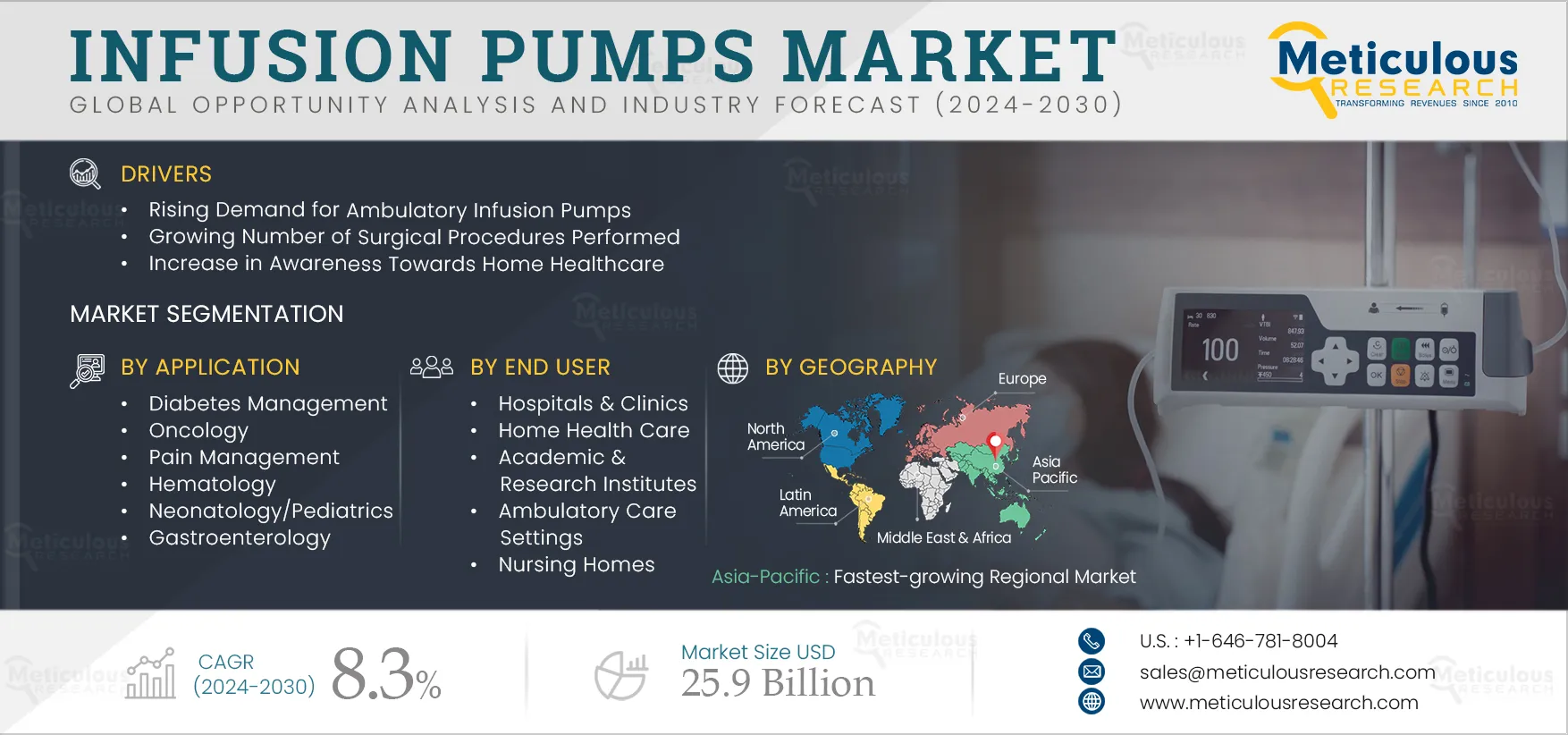
Market dynamics
1 factors across 1 forceIncrease in Awareness of Home Healthcare is Expected to Drive the Market
The emergence of home healthcare has enabled patients to receive hospital-like care in their homes. Infusion pumps are often used in home healthcare settings to manage chronic diseases. Patients can receive necessary treatments and medications at home, improving their quality of life and reducing hospital stays. These advantages of home care have led many countries, such as the U.S., U.K., Canada, Australia, and Israel, to implement government policies that encourage homecare health services. For instance, every regional and metropolitan hospital in Victoria, Australia, has a hospital-at-home program, and nearly 6% of all hospital bed-days are provided that way. (Source: Commonwealth Fund). Furthermore, home care is widely adopted for specific conditions such as deep venous thrombosis (DVT) and acute cellulitis.
As per the Johns Hopkins Model, the cost of at-home care was 32% less than hospital care (USD 5,081 VS. USD 7,480), and the length of stay of the patients was also reduced by nearly one-third (3.2 days VS. 4.9 days). Additionally, the home care setting was found to be more convenient for family members and patients than those offered usual hospital care.
Nearly 5.6 million children in the U.S. receive nearly 5.1 hours of medical care at home, which saves approximately USD 36 billion annually (Source: Everyday Health, Inc.). These factors have led to the increased adoption of home healthcare as a cost-effective alternative to hospital healthcare services. Additionally, the reduced need for rehospitalization, expensive & unnecessary testing, and shorter treatment times are among the major factors propelling the adoption of home-based health care in developed and developing countries.
Table of contents
12 chapters · 106 sections · 230 pages · click to expandSegmental analysis
| Segment | Largest share (2025) | Fastest growth (2025–2032) |
|---|---|---|
| By Product Types Studied in This Report | Infusion pump accessories/consumables | — |
| By Channels Studied in This Report | Multi-channel infusion pumps | — |
| By Applications Studied in This Report | Oncology | — |
| By End Users Studied in This Report | Hospitals & Clinics | — |
| By Type | — | — |
| By Channel | — | — |
| By Application | — | — |
| By End User | — | — |
| By Geography | — | — |
By Product Types Studied in This Report
- The infusion pump accessories/consumables segment is expected to account for the largest share of the infusion pumps market.
- Recurrent use and repeat purchase of accessories/consumables for infusion therapy support the high share of this segment.
By Channels Studied in This Report
- The multi-channel infusion pumps segment is expected to account for the largest share of the segment owing to factors such as rising demand for technologically advanced infusion pumps, precise & multiple drug delivery in case of chronic diseases, and rising awareness and demand for advanced infusion pumps in home healthcare.
By Applications Studied in This Report
- The oncology segment is expected to account for the largest share of the infusion pumps market due to the increasing prevalence of cancer and rising demand for controlled dispensing of drugs in the body for chemotherapy.
- Additionally, portable infusion pumps can enable patients to receive chemotherapy in their homes, triggering the segment's growth.
By End Users Studied in This Report
- The hospitals & clinics segment is expected to account for the largest share of the infusion pumps market.
- Factors such as the large volume of patients served by hospitals, the top line serving a large volume of patients, and increasing patient pool are some factors that account for the largest market share.
By Type
- Devices Devices by Type, Volumetric Infusion Pumps
- Devices Devices by Type, Volumetric Infusion Pumps
- Syringe Infusion Pumps
- Insulin Infusion Pumps
By Channel
- Infusion Pumps Market Size & Trend Analysis, by Channel
- Single Channel Infusion Pumps
- Multi-channel Infusion Pumps
By Application
- Infusion Pumps Market Size & Trend Analysis, by Application
- Diabetes Management
- Oncology
- Pain Management
- Hematology
- Neonatology/Pediatrics
- Gastroenterology
By End User
- Infusion Pumps Market Size & Trend Analysis, by End User
- Hospitals & Clinics
- Home Health Care
- Academic & Research Institutes
- Ambulatory Care Settings
- Nursing Homes
By Geography
- Infusion Pumps Market Size & Trend Analysis, by Geography
- North America U.S.
- Canada
- Germany
- France
- Italy
- U.K.
- Spain
- Rest of Europe (RoE)
- China
- Japan
- India
- Rest of Asia-Pacific
- Brazil
- Mexico
- Rest of Latin America
Geographic analysis
Asia-Pacific
Fastest growthThe increasing focus of government bodies of Asia-Pacific countries such as China, India, Singapore, and South Korea on the healthcare sector in terms of increased investment for the adoption of advanced technology, rising investments in better healthcare infrastructure, and the increasing awareness and literacy among the population. Furthermore, the growing presence of key companies is boosting the growth of this regional market. Asia-Pacific: Fastest-growing Regional Market
Competitive landscape
- Becton
- Dickinson and Company (BD)
- B. Braun SE · Germany
- Baxter International Inc. (U.S.)
- Fresenius SE&Co. KGaA · Germany
- ICU Medical, Inc. (U.S.)
- Medtronic plc · Ireland
- MOOG Inc. (U.S.)
- Terumo Corporation · Japan
- F. Hoffmann-LA Roche Ltd · Switzerland
- Insulet Corporation (U.S.)
Frequently asked questions
The Infusion Pumps Market focuses on devices that deliver fluids and medications into patients' bodies in controlled amounts, enhancing treatment precision and reducing risks of medication errors.
Cite this report
Meticulous Research. (2025). Infusion Pumps Market - Global Opportunity Analysis and Industry Forecast (2025-2032) (Report No. MRHC - 104272). Meticulous Market Research Pvt. Ltd. https://www.meticulousresearch.com/product/infusion-pumps-market-4973