Hospital Command Center Market (2026-2036)
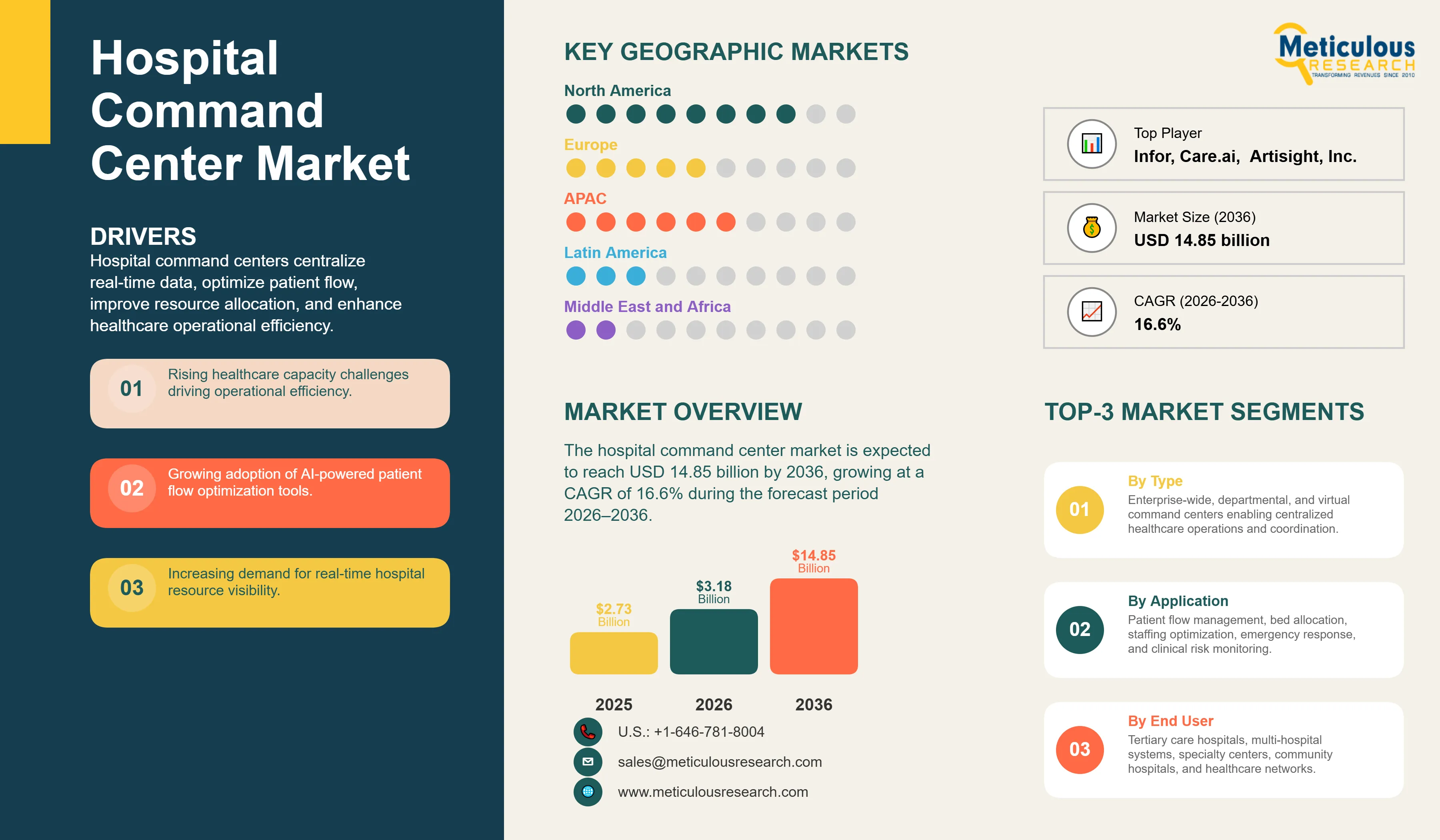
The global hospital command center market is estimated to be USD 3.18 billion in 2026. This market is expected to reach USD 14.85 billion by 2036, growing at a CAGR of 16.6% during the forecast period 2026–2036.
- Published
- Jun 2026
- Pages
- 267
- Format
- PDF + Excel
- Report ID
- MRHC - 1042042
- Base year
- 2025
- 2026 · ESTIMATED
- $3.18B
- 2036
- $14.85B
- CAGR 2026–2036
- 16.6%
2025 baseline · 2026–2036 forecast at 16.6% CAGR · hover a bar for the value
Key highlights
The global hospital command center market is projected to reach USD 14.85 billion by 2036, growing at a CAGR of 16.6% during the forecast period 2026–2036.
North America is expected to dominate the global market in 2026, driven by the presence of large-scale integrated delivery networks (IDNs) and high adoption of advanced healthcare IT solutions, with hospitals in the region spending over $30 billion annually on technology and cybersecurity infrastructure as of 2025 (Source: AHA).
Asia Pacific is projected to witness the fastest growth, fueled by rapid investments in 'Smart Hospital' infrastructure and government-led digital health transformation initiatives across China, India, and Australia.
By solution type, the enterprise-wide command center segment is expected to hold the largest share in 2026, as multi-facility health systems seek a centralized 'source of truth' for regional patient flow and capacity management.
By technology, the artificial intelligence and machine learning (AI/ML) segment is expected to account for the largest share in 2026, with AI-driven staffing models shown to reduce nurse overtime by an average of 12% (Source: HIMSS).
By deployment mode, the cloud-based segment is expected to dominate the market in 2026, accounting for approximately 80% of new installations due to superior scalability and support for multi-facility integration.
By application, the patient flow and capacity management segment is expected to hold the largest share in 2026, reflecting the primary operational focus on reducing length of stay (LOS) and optimizing bed utilization.
By end user, the tertiary care centers and multi-hospital systems segment is expected to account for the largest share in 2026.
Key players operating in the global market include GE HealthCare Technologies Inc., Koninklijke Philips N.V., Siemens Healthineers AG, Oracle Health (Cerner), and TeleTracking Technologies, Inc.
Report summary
| Particulars | Details |
|---|---|
| Base Year | 2025 |
| Estimated Year | 2026 |
| Forecast Period | 2026–2036 |
| Market Size (2026) | USD 3.18 billion |
| Market Size (2036) | USD 14.85 billion |
| CAGR (2026–2036) | 16.6% |
| Format | PDF, Excel & Cloud Portal · 267 pages |
| Segments Covered | By Solution Type · By Technology · By Application · By End User |
| Key Companies | GE HealthCare Technologies Inc. (U.S.), Koninklijke Philips N.V., Siemens Healthineers AG, Oracle Corporation (Oracle Health/Cerner) (U.S.), Microsoft Corporation (U.S.), Salesforce, Inc. (U.S.), GetWellNetwork, Inc. (U.S.), TeleTracking Technologies, Inc. (U.S.), McKesson Corporation (U.S.), NVIDIA Corporation (U.S.), Health Catalyst, Inc. (U.S.), Infor (U.S.), Stryker Corporation (U.S.), Care.ai (U.S.), Artisight, Inc. (U.S.), Qventus, Inc. (U.S.), LeanTaaS, Inc. (U.S.), Wolters Kluwer, Ascom Holding AG |
Report infographic
Transition to Autonomous and Self-Healing Operational Logistics
A defining trend in 2026 is the evolution of command centers from decision-support tools into autonomous orchestration hubs. Advanced platforms are increasingly capable of 'self-healing' operational logistics, where AI engines automatically trigger housekeeping requests or adjust discharge planning tasks based on predicted inpatient census. This automation reduces the cognitive load on staff, allowing them to focus on high-acuity clinical triage. The integration of generative AI is further accelerating this trend by automating the generation of clinical summaries, ensuring that stakeholders have immediate access to actionable insights.
Ambient Clinical Intelligence for Virtual Nursing and Patient Safety
The convergence of ambient intelligence and computer vision is revolutionizing the scope of hospital command centers. By integrating data from AI-enabled sensors, command centers can monitor patient safety milestones—such as fall prevention and hand hygiene—without physical room entries. This 'virtual nursing' capability is becoming a standard feature in high-end command hubs, particularly in regions facing severe nursing shortages. The ability to provide 24/7 situational awareness over high-risk patients significantly reduces hospital-acquired conditions (HACs) and improves clinical outcomes.
Analysis by Solution Type
Based on solution type, the enterprise-wide command center segment is expected to hold the largest share in 2026. This dominance is driven by the consolidation of hospitals into large integrated delivery networks (IDNs) that require a centralized 'source of truth' to manage regional patient flow. However, the virtual and satellite command center segment is projected to register the highest CAGR during the forecast period. This growth is fueled by the expansion of 'hospital-at-home' programs, where remote monitoring hubs coordinate care for patients outside traditional hospital walls, thereby increasing system capacity without physical bed expansion.
Market dynamics
3 factors across 3 forcesAddressing the Global Healthcare Capacity Crisis
The growth of the overall market is being driven by the critical need to optimize patient throughput and the rising use of predictive analytics to manage chronic emergency department (ED) boarding. Recent industry data indicate that hospitals are caring for sicker, more complex patients, with inpatient volumes rising by about 5.3% in 2025 while total expenses increased by 7.5% (AHA, based on Strata Decision Technology benchmarks). At the same time, the WHO projects a global shortfall of up to 10 million health workers by 2030, pushing health systems to explore AI‑enabled staffing and workforce optimization models. Hospital command centers have shown measurable impact, with reported reductions of 43 minutes in ambulance dispatch times and 3.5 hours in bed‑allocation delays for ED patients (NHS/BMJ Informatics)
Table of contents
13 chapters · 134 sections · 267 pages · click to expandSegmental analysis
| Segment | Largest share (2026) | Fastest growth (2026–2036) |
|---|---|---|
| By Technology | AI/ML | AI/ML |
By Technology
- The AI/ML segment is expected to account for the largest share in 2026.
- AI engines are foundational to modern command centers, enabling the prediction of patient census and discharge readiness.
- The AI/ML segment is also projected to register the highest CAGR, as health systems increasingly adopt autonomous operational modules.
- The integration of IoT and RTLS technology remains a critical secondary segment, providing the real-time location data of equipment and staff necessary for precise operational coordination.
Geographic analysis
North America
Largest shareNorth America is expected to dominate the global hospital command center market in 2026. The region's dominance is supported by a mature healthcare IT landscape and the widespread adoption of centralized operational models by large IDNs like AdventHealth and Providence Swedish. These systems have reported serving thousands of additional patients annually through optimized bed orchestration. The Presence of leading vendors and significant investment in digital health infrastructure continue to drive the market in the U.S. and Canada.
Asia-Pacific
Fastest growthThe Asia Pacific region is projected to witness the fastest growth during the forecast period. This is driven by rapid healthcare infrastructure expansion and 'Smart Hospital' initiatives across China, India, and Australia. For example, major private healthcare providers in India are standardizing on centralized command center models to manage large patient volumes across multi-facility networks. The increasing adoption of cloud-based platforms and the digital transformation of public health agencies in the region are creating substantial opportunities for global and local technology integrators. The key companies operating in the Asia Pacific market are GE HealthCare, Philips, Siemens Healthineers, and various local technology integrators.
Competitive landscape
The competitive landscape of the global hospital command center market is characterized by intense innovation and strategic acquisitions as vendors seek to provide end-to-end operational orchestration platforms. Leading players are differentiating themselves through the sophistication of their AI engines and their ability to provide demonstrated ROI in terms of length-of-stay reduction. Strategic moves, such as the integration of patient communication and throughput modules into unified ecosystems, are redefining vendor positioning in the June 2026 landscape.
Key players operating in the global hospital command center market include GE HealthCare Technologies Inc. (U.S.), Koninklijke Philips N.V. (Netherlands), Siemens Healthineers AG (Germany), Oracle Corporation (Oracle Health/Cerner) (U.S.), Microsoft Corporation (U.S.), Salesforce, Inc. (U.S.), GetWellNetwork, Inc. (U.S.), TeleTracking Technologies, Inc. (U.S.), McKesson Corporation (U.S.), NVIDIA Corporation (U.S.), symplr (U.S.), Health Catalyst, Inc. (U.S.), Infor (U.S.), Stryker Corporation (U.S.), Care.ai (U.S.), Artisight, Inc. (U.S.), Qventus, Inc. (U.S.), LeanTaaS, Inc. (U.S.), Wolters Kluwer (Netherlands), and Ascom Holding AG (Switzerland).
- GE HealthCare Technologies Inc. (U.S.)
- Koninklijke Philips N.V. · Netherlands
- Siemens Healthineers AG · Germany
- Oracle Corporation (Oracle Health/Cerner) (U.S.)
- Microsoft Corporation (U.S.)
- Salesforce, Inc. (U.S.)
- GetWellNetwork, Inc. (U.S.)
- TeleTracking Technologies, Inc. (U.S.)
- McKesson Corporation (U.S.)
- NVIDIA Corporation (U.S.)
- Health Catalyst, Inc. (U.S.)
- Infor (U.S.)
- Stryker Corporation (U.S.)
- Care.ai (U.S.)
- Artisight, Inc. (U.S.)
- Qventus, Inc. (U.S.)
- LeanTaaS, Inc. (U.S.)
- Wolters Kluwer · Netherlands
- Ascom Holding AG · Switzerland
Frequently asked questions
The market is projected to reach USD 14.85 billion by 2036, growing at a CAGR of 16.6% from 2026 to 2036.
Cite this report
Meticulous Research. (2026). Hospital Command Center Market - Global Opportunity Analysis and Industry Forecast (2026-2036) (Report No. MRHC - 1042042). Meticulous Market Research Pvt. Ltd. https://www.meticulousresearch.com/product/hospital-command-center-market-6725