
Healthcare Artificial Intelligence Market (2024-2031)
The Healthcare Artificial Intelligence Market to reach $176.4 billion by 2031 at a CAGR of 31.3% during the forecast period 2024–2031. Healthcare Artificial Intelligence Market Size & Forecast The growth of the healthcare artificial intelligence market is driven by the growing demand for personalized
- Published
- Apr 2024
- Pages
- 230
- Format
- PDF + Excel
- Report ID
- MRICT - 104139
- Base year
- 2022
- 2031 · FORECAST
- $176.4B
- 2031
- $176.4B
- CAGR 2024–2031
- 31.3%
2022–2023 baseline · 2024–2031 forecast at 31.3% CAGR · hover a bar for the value
Key highlights
The Healthcare Artificial Intelligence Market to reach $176.4 billion by 2031 at a CAGR of 31.3% during the forecast period 2024–2031.
The hospital workflow management segment is projected to register the highest CAGR during the forecast period.
The hospitals & diagnostic centers segment is projected to register the highest CAGR during the forecast period.
However, the Asia-Pacific market is projected to register the highest CAGR during the forecast period. The significant use of big data in the healthcare sector, the growing need for coordination between healthcare workforce & patients, the rise in adoption of precision medicine, the growing prevalence of diseases and remarkable growth in venture capital investments, and the rising technological innovation are expected to support the growth of this market.
In 2024, North America is expected to account for the largest share of the market in the global healthcare artificial intelligence market.
Report summary
| Particulars | Details |
|---|---|
| Number of Pages | 230 |
| Format | |
| Forecast Period | 2024-2031 |
| Base Year | 2022 |
| CAGR | 31.3% |
| Estimated Market Size (Value) | $176.4 billion by 2031 |
| Segments Covered | By Offering · Software · Services · Installation & Integration · Support & Maintenance · Hardware · By Technology · Natural Language Processing · Context-aware Processing · Machine Learning · Querying Method · By Application · Drug Discovery · Hospital Workflow Management · Patient Data & Risk Analytics · Medical Imaging & Diagnosis · Patient Management · Precision Medicine · Other Applications · By End User · Hospitals & Diagnostic Centers · Pharmaceutical & Biotechnology Companies · Healthcare Payers · Patients · Other End Users |
| Countries Covered | North America (U.S., Canada), Europe (Germany, France, U.K., Italy, Spain, RoE), Asia-Pacific (China, Japan, India, Singapore, South Korea, RoAPAC), Latin America, and the Middle East & Africa. |
| Key Companies | NVIDIA Corporation (U.S.), Google LLC (U.S.) (A Subsidiary of Alphabet Inc.), Intel Corporation (U.S.), International Business Machines Corporation (U.S.), Microsoft Corporation (U.S.), GE HealthCare Technologies Inc. (U.S.), Amazon.com, Inc. (U.S.), Verint Systems Inc. (U.S.), General Vision, Inc. (U.S.), Siemens Healthineers AG (Germany), CloudMedx Inc. (U.S.), AltexSoft Inc. (U.S.), IQVIA Holdings Inc. (U.S.), Welltok, Inc. . (U.S.), and iCarbonX (China). |
Report overview
Segments covered: offering, technology, application, end user. Regions: North America, Europe, Asia-Pacific.
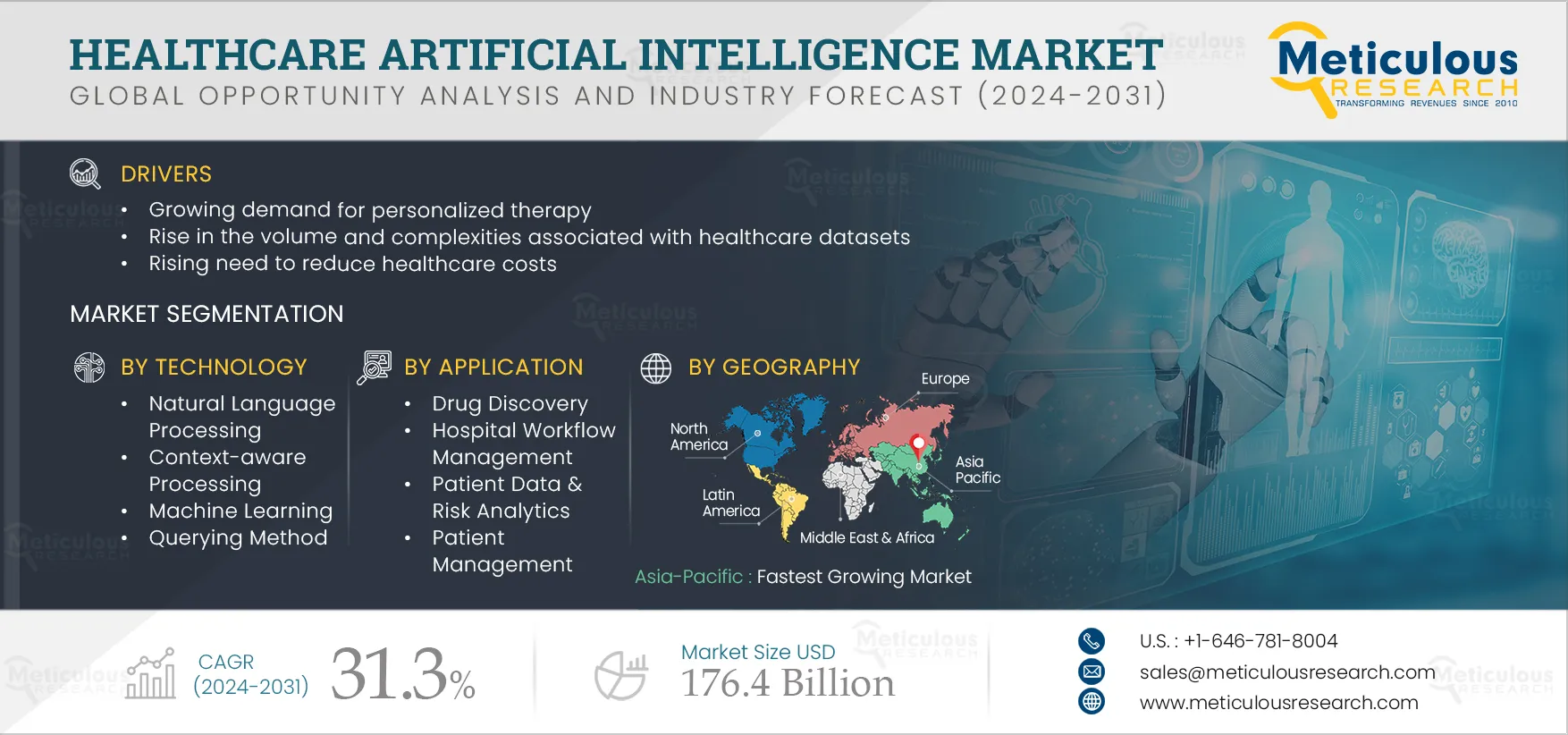
The growth of the healthcare artificial intelligence market is driven by the growing demand for personalized therapy, the rise in the volume and complexities associated with healthcare datasets, and the rising need to reduce healthcare costs. However, reluctance to adopt AI technologies due to a lack of trust restrains the growth of this market. Moreover, the growing potential of AI-based tools in the treatment of chronic and infectious diseases and the rising incorporation of AI in clinical trials to accelerate new drug launches are expected to generate market growth opportunities. However, discrepancies arising due to upgrades and human barriers to AI adoption are major challenges for market stakeholders. Additionally, growing AI-based clinical decision support systems (CDSS) to identify patient risk are prominent trends in this market.
Report infographic
Market dynamics
1 factors across 1 forceGrowing Demand for Personalized Therapy
Personalized therapy is an emerging practice of medicine that uses an individual's genetic profile to guide decisions made regarding the prevention, diagnosis, and treatment of disease. Personalized therapy is revolutionizing the healthcare industry, and the integration of artificial intelligence (AI) is fueling this transformation. AI technologies have significantly advanced ability to analyze vast amounts of complex data, leading to improved diagnosis and treatment outcomes. AI algorithms can process extensive patient data, including genetic information, medical records, and lifestyle factors, to create personalized treatment plans. By analyzing patterns and correlations within this data, AI can identify hidden insights and predict individual treatment responses with unprecedented accuracy.
However, with the growing adoption of AI in personalized therapy various companies are providing the solution for individuals to more effective treatment and better outcomes. For instance, in October 2021, Fujitsu Limited (Japan) partnered with Aichi Cancer Center (Japan) to develop an AI system to offer patients personalized cancer treatment. The new solution enables efficient and precise search of information in medical databases, contributing to a significant reduction of time required for physicians to plan individualized medical treatment for cancer patients. Such growing developments help to increase the demand for personalized therapy using AI which helps to increase the growth of this market during the forecast period.
Table of contents
12 chapters · 105 sections · 230 pages · click to expandSegmental analysis
| Segment | Largest share (2024) | Fastest growth (2024–2031) |
|---|---|---|
| By Offering | — | Services |
| By Technology | — | Natural language processing |
| By Application | — | Hospital workflow management |
| By End User | — | Hospitals & diagnostic centers |
By Offering
- The global healthcare artificial intelligence market is segmented into software, hardware, and services.
- The services segment is projected to register the highest CAGR during the forecast period.
- The rising use of AI services for personalized medication guidance and 24/7 support, the increasing need to analyze data to identify potential health issues, the rising adoption of AI services to help reduce human error, assist medical professionals and staff, and the growing incorporation of AI services in clinical trials to accelerate new drug launches are expected to support the growth of this segment.
By Technology
- The global healthcare artificial intelligence market is segmented into machine learning, natural language processing, context-aware processing, and querying method.
- The natural language processing segment is projected to register the highest CAGR during the forecast period.
- The increasing need to predict the risk of any health-related complication at an early stage, the increasing use of efficient back-end coding to optimize billing procedures, the growing ability to collect large amounts of data and handle big data, and the rising need to organize physician documentation are expected to support the growth of this segment.
By Application
- The hospital workflow management segment is projected to register the highest CAGR during the forecast period.
- The increasing use of AI in hospitals to improve patient experience and to provide better care to their patient, the growing amount of healthcare data generated to manage medical records and assemble and evaluate patient data generated in the hospitals, the growing adoption to automate tasks, improve patient care coordination, reduce costs, and the increasing use of chatbots for customer service engagement are expected to support the growth of this segment.
By End User
- The hospitals & diagnostic centers segment is projected to register the highest CAGR during the forecast period.
- The growing adoption of AI to improve accuracy, reduce costs, and save time compared to traditional diagnostic methods, the rising use of AI for automating routine tasks such as maintaining records, data entry, and scan analysis, and the growing need to improve the speed and accuracy of patient visits, leading to faster and more personalized care are expected to support the growth of this segment.
Geographic analysis
Asia-Pacific
Fastest growthHowever, the Asia-Pacific market is projected to register the highest CAGR during the forecast period. The significant use of big data in the healthcare sector, the growing need for coordination between healthcare workforce & patients, the rise in adoption of precision medicine, the growing prevalence of diseases and remarkable growth in venture capital investments, and the rising technological innovation are expected to support the growth of this market. Asia-Pacific: Fastest Growing Market
North America
Largest shareIn 2024, North America is expected to account for the largest share of the market in the global healthcare artificial intelligence market.
Competitive landscape
The report includes a competitive landscape based on an extensive assessment of the key growth strategies adopted by leading market participants in the last 3–4 years. The key players operating in the healthcare artificial intelligence market are NVIDIA Corporation (U.S.), Google LLC (U.S.) (A Subsidiary of Alphabet Inc.), Intel Corporation (U.S.), International Business Machines Corporation (U.S.), Microsoft Corporation (U.S.), GE HealthCare Technologies Inc. (U.S.), Amazon.com, Inc. (U.S.), Verint Systems Inc. (U.S.), General Vision, Inc. (U.S.), Siemens Healthineers AG (Germany), CloudMedx Inc. (U.S.), AltexSoft Inc. (U.S.), IQVIA Holdings Inc. (U.S.), Welltok, Inc. (U.S.), and iCarbonX (China).
- NVIDIA Corporation (U.S.)
- Intel Corporation (U.S.)
- International Business Machines Corporation (U.S.)
- Microsoft Corporation (U.S.)
- GE HealthCare Technologies Inc. (U.S.)
- Amazon.com, Inc. (U.S.)
- Verint Systems Inc. (U.S.)
- General Vision, Inc. (U.S.)
- Siemens Healthineers AG · Germany
- CloudMedx Inc. (U.S.)
- AltexSoft Inc. (U.S.)
- IQVIA Holdings Inc. (U.S.)
- Welltok, Inc. . (U.S.)
- iCarbonX · China
Frequently asked questions
The global healthcare artificial intelligence market is projected to reach $176.4 Billion by 2031, at a CAGR of 31.3% during the forecast period.
Cite this report
Meticulous Research. (2024). Healthcare Artificial Intelligence Market - Global Opportunity Analysis and Industry Forecast (2024-2031) (Report No. MRICT - 104139). Meticulous Market Research Pvt. Ltd. https://www.meticulousresearch.com/product/healthcare-artificial-intelligence-market-4937