Green Building Materials Market (2025-2032)
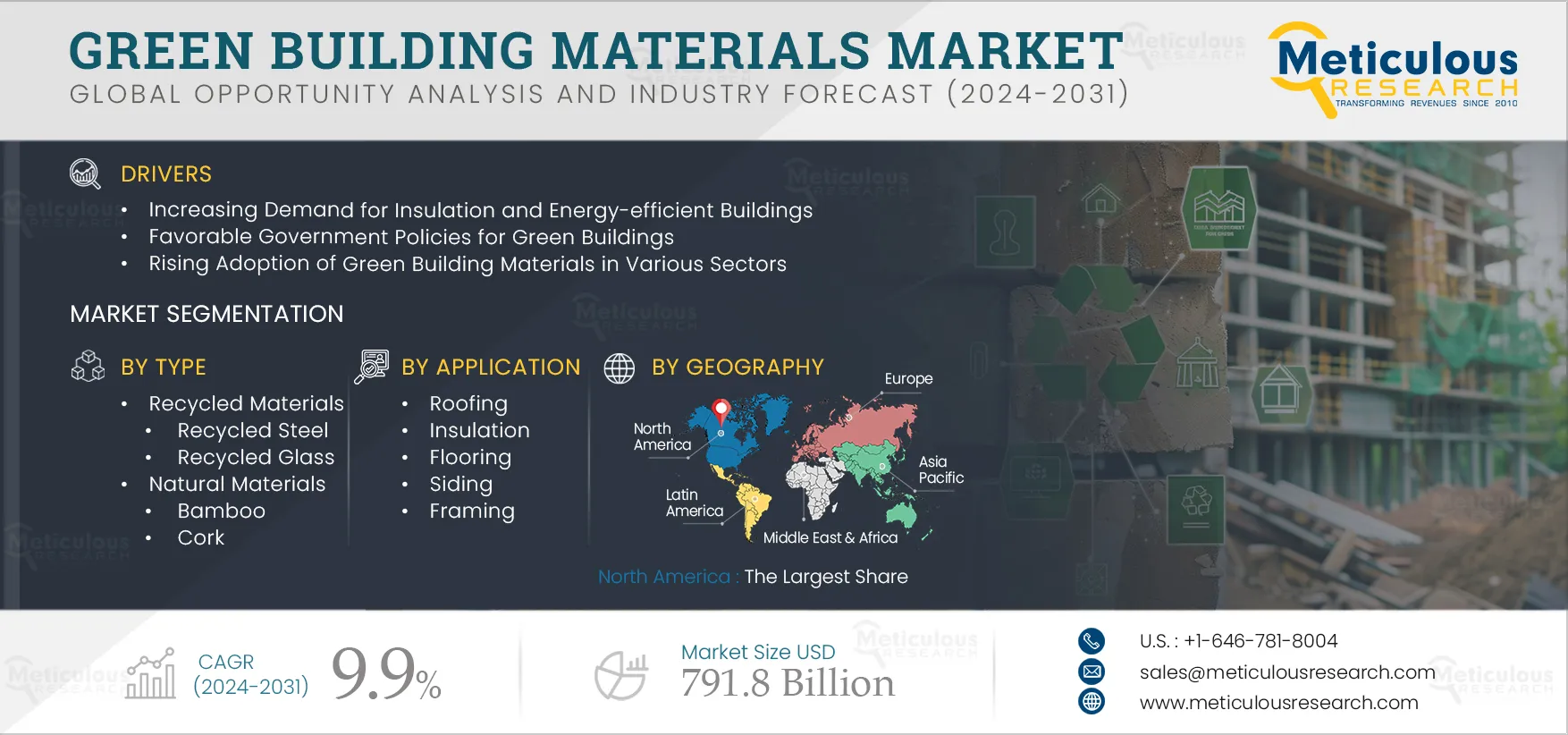
The Green Building Materials Market is expected to reach $791.8 billion by 2032, at a CAGR of 9.9% from 2025 to 2032. Green Building Materials Market Size & Forecast The market for green building materials is expected to grow primarily because of several factors, including the growing need for energy-efficient
- Published
- Feb 2025
- Pages
- 250
- Format
- PDF + Excel
- Report ID
- MRCHM - 1041302
- Base year
- 2024
- 2032 · FORECAST
- $791.8B
- 2032
- $791.8B
- CAGR 2025–2032
- 9.9%
2024 baseline · 2025–2032 forecast at 9.9% CAGR · hover a bar for the value
Key highlights
By Type: The Recycled Materials Segment to Dominate the Green Building Materials Market in 2025
By Product: The Exterior Products Segment to Dominate the Green Building Materials Market in 2025
By Application: The Roofing is Segment to Dominate the Green Building Materials Market in 2025
By Sector: The Residential Segment to Dominate the Green Building Materials Market in 2025
Report summary
| Particulars | Details |
|---|---|
| Number of Pages | 250 |
| Format | |
| Forecast Period | 2025–2032 |
| Base Year | 2024 |
| CAGR (Value) | 9.9% |
| Market Size (Value) | $791.8 Billion by 2032 |
| Segments Covered | By Type · Recycled Materials · Recycled Steel · Recycled Glass · Recycled Plastic · Other Recycled Materials · Natural Materials · Bamboo · Cork · Straw Bales · Timber · Other Natural Materials · Other Materials · By Product · Exterior Products · Interior Products · Solar Products · Other Products · By Application · Roofing · Insulation · Flooring · Siding · Framing · Other Applications · By Sector · Residential · Commercial · Offices · Retail Spaces · Hotels · Educational Institutes · Other Commercial Sectors · Other Sectors |
| Countries Covered | North America (U.S. and Canada), Europe (Germany, U.K., France, Italy, Spain, Switzerland, Poland, and Rest of Europe), Asia-Pacific (China, India, Japan, South Korea, Singapore, South Korea, Australia & New Zealand, and Rest of Asia-Pacific), Latin America (Brazil, Mexico, Rest of Latin America) and the Middle East & Africa (UAE, Israel, Rest of Middle East & Africa) |
| Key Companies Profiled | DuPont de Nemours, Inc. (U.S.), Holcim Group (Switzerland), Interface Inc. (U.S.), Kingspan Group plc (Ireland), Owens Corning (U.S.), PPG Industries, Inc. (U.S.), Sika AG (Switzerland), Bauder Ltd. (U.K.), Amvic Inc. (Canada), Binderholz GmbH (Germany), Alumasc Group Plc (U.K.), BASF SE (Germany), CertainTeed, LLC. (U.S.), Forbo International SA (Switzerland), and LG Hausys Ltd (South Korea) |
Report overview
Segments covered: type, product, application, sector. Regions: North America, Europe, Asia-Pacific, Latin America.
The market for green building materials is expected to grow primarily because of several factors, including the growing need for energy-efficient buildings and insulation, the growing acceptance of green building materials across different industries, and government laws that support green construction practices. Furthermore, the players operating in this market would have growth opportunities owing to the growing emphasis on environmental sustainability.
Report infographic
Market dynamics
3 factors across 2 forcesFavorable Government Policies for Green Buildings Driving Market Growth
As governments globally increasingly focus on sustainability and climate action, several rising policies and trends in green building are emerging. These policies are aimed at accelerating the transition towards more sustainable, energy-efficient, and environmentally friendly buildings. Some of the government policies for green buildings are as follows:
- In March 2025, the Department of Energy (DOE) (U.S.) announced an investment of USD 6 billion for 33 projects across more than 20 states to decarbonize energy-intensive industries, reduce industrial greenhouse gas emissions, support well-paying union jobs, and boost industrial communities.
- In 2025, policies and announced an investment of USD 73.5 million in programs such as the ENERGY STAR Portfolio Manager platform to support the implementation of local initiatives, including benchmarking, labeling, and disclosure policies, and building performance standards to further reduce emissions and lower energy bills.
These rising policies reflect a growing recognition of the need for more sustainable buildings. Thus, government initiatives encouraging the adoption of green building materials are driving the growth of this market.
Increasing Demand for Insulation and Energy-efficient Buildings Driving Market Growth
There is a demand for more sustainable building approaches as a result of growing awareness of climate change and the need to minimize carbon footprints. Utility bills are reduced by the substantial reduction in energy use for heating and cooling that comes from insulation and energy-efficient buildings. The entire living and working environment is improved by proper insulation, which additionally preserves appropriate indoor temperatures and improves indoor air quality. To encourage energy efficiency and sustainability, several governments are enacting stronger construction rules and providing incentives for green building methods. Because technology is constantly evolving, it is essential to the robotics market because it increases the productivity, capability, adaptability, and efficiency of robots. This method preserves the caliber of the job while conserving time and resources. Overall, the rising need for insulation and energy-efficient green buildings is driven by conserving energy, reducing environmental impact, improving occupant health and comfort, complying with regulations, and achieving economic benefits.
Table of contents
12 chapters · 122 sections · 250 pages · click to expandSegmental analysis
| Segment | Largest share (2025) | Fastest growth (2025–2032) |
|---|---|---|
| By Type | Recycled Materials | — |
| By Product | Exterior Products | — |
| By Application | Roofing | — |
| By Sector | Residential | — |
By Type
- The recycled materials segment is expected to account for the largest share of over 54.0% of the green building materials market.
- This segment’s large market share is attributed to the growing adoption of recycled materials in various sectors, the surge in demand for sustainable building materials, and promising government policies that encourage the use of recycled materials.
- In addition, the benefits associated with recycled materials, such as waste reduction, resource conservation, and lower carbon footprints, contribute to the growth of this market.
- Moreover, this segment is expected to grow at a higher CAGR during the forecast period.
By Product
- The exterior products segment is expected to account for the largest share of over 43.0% of the green building materials market.
- The rising demand for energy-efficient buildings and insulation, the growing popularity of exterior products that improve indoor air quality, the growing adoption of innovative and sustainable exterior products, and the growing consumer awareness of environmental issues are all factors contributing to this segment's large market share.
- Furthermore, the advantages of external items include lower heating and cooling costs, greater home comfort, better air quality, environmental sustainability, and energy efficiency.
- Moreover, this segment is expected to grow at a higher CAGR during the forecast period.
By Application
- The Roofing is Segment to Dominate the Green Building Materials Market in 2025
- The roofing segment is expected to account for the largest share of over 40.0% of the green building materials market.
- This segment’s large market share is attributed to the rising development of cool roofs, green roofs, and building-integrated photovoltaics (BIPV), the surge in demand for sustainable roofing materials to reduce carbon footprints, and the rising adoption of green roofs to improve indoor air quality.
- In addition, the benefits associated with the roofing segment, such as extended roof lifespan, lower surface temperature, reduced carbon footprint, and improved air quality, further support the growth of this segment.
- Moreover, this segment is expected to register the highest CAGR during the forecast period.
By Sector
- The Residential Segment to Dominate the Green Building Materials Market in 2025
- The residential segment is expected to account for the larger share of over 42.0% of the green building materials market.
- This segment's large market share is attributed to the rising incentives such as tax credits, rebates, and grants for using green building materials, the rising shift towards more sustainable living practices, the rising demand for advanced insulation and energy-efficient solutions, and the growing need for the development of high-performance insulation, smart windows, and sustainable composites.
- Furthermore, increasing environmental awareness, regulatory support, and technological innovations are expected to support the growth of this segment.
Geographic analysis
North America
Largest shareIn 2025, North America is expected to account for the largest share of over 35.0% of the green building materials market. The presence of prominent green building materials players contributes to the large market share of this region. In addition, the increasing emphasis on environmental sustainability, the growing adoption of green building materials in the residential sector, and the rising adoption of green building materials in various sectors drive the demand for green building materials in the region. Additionally, several leading key players are investing in green building materials. For instance, in November 2021, CertainTeed, LLC. (U.S.), a leading manufacturer of sustainable building materials, announced an investment of more than USD 400 million to expand its production capacity at four key manufacturing locations in the United States. North America to Dominate the Green Building Materials Market
Asia-Pacific
Fastest growthHowever, Asia-Pacific is expected to register the highest CAGR of 11.0% during the forecast period. This region's rapid growth is mainly driven by factors such as the surge in demand for sustainable building materials, favorable government policies for green buildings, and rising awareness about the benefits and availability of green building materials.
Competitive landscape
- January 2025
Holcim Group (Switzerland) partnered with Greentown Labs (U.S.) to accelerate open innovation for the decarbonization of the built environment.
- September 2024
Holcim Group (Switzerland) opened its innovation hub to showcase its sustainable building solutions and serve as a co-creation lab to accelerate low-carbon, circular, and energy-efficient building worldwide.
- DuPont de Nemours, Inc. (U.S.)
- Holcim Group · Switzerland
- Interface Inc. (U.S.)
- Kingspan Group plc · Ireland
- Owens Corning (U.S.)
- PPG Industries, Inc. (U.S.)
- Sika AG · Switzerland
- Bauder Ltd. (U.K.)
- Amvic Inc. · Canada
- Binderholz GmbH · Germany
- Alumasc Group Plc (U.K.)
- BASF SE · Germany
- CertainTeed, LLC. (U.S.)
- Forbo International SA · Switzerland
- LG Hausys Ltd · South Korea
Frequently asked questions
The green building materials market study focuses on market assessment and opportunity analysis based on the sales of green building materials products across various countries, regions, and market segments. The study includes a competitive analysis based on an extensive assessment of the leading players’ product portfolios, geographic presence, and key growth strategies adopted in the last three to four years.
Cite this report
Meticulous Research. (2025). Green Building Materials Market - Global Opportunity Analysis and Industry Forecast (2025-2032) (Report No. MRCHM - 1041302). Meticulous Market Research Pvt. Ltd. https://www.meticulousresearch.com/product/green-building-materials-market-5985