Genomics Data Storage and Management Market (2026-2036)
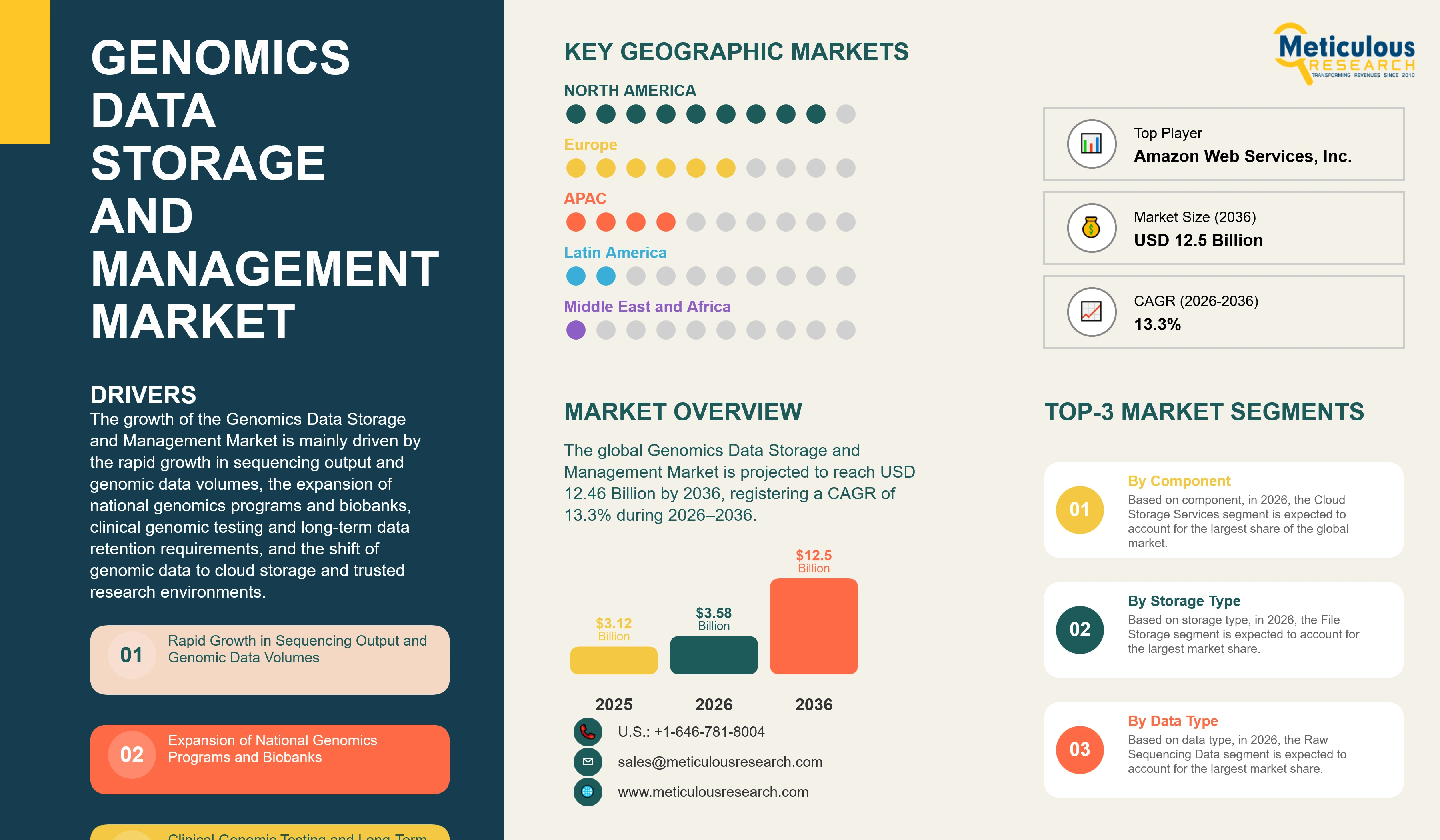
The global Genomics Data Storage and Management Market was valued at USD 3.12 billion in 2025. This market is expected to reach USD 12.46 billion by 2036 from an estimated USD 3.58 billion in 2026, registering a CAGR of 13.3% during the forecast period (2026-2036).
- Published
- Oct 2026
- Pages
- 317
- Format
- PDF + Excel
- Report ID
- MRHC - 1042357
- Base year
- 2025
- 2025 · BASELINE
- $3.12B
- 2036
- $12.46B
- CAGR 2026–2036
- 13.3%
2025 baseline · 2026–2036 forecast at 13.3% CAGR · hover a bar for the value
Key highlights
The global Genomics Data Storage and Management Market is projected to reach USD 12.46 billion by 2036, driven by rising sequencing output, national genomics programs, clinical genomics retention requirements, cloud adoption, and multi-omic data growth.
Population-scale genomic datasets are now stored and accessed in the cloud. In June 2026, the All of Us Research Program of the U.S. National Institutes of Health (NIH) expanded its dataset to more than 747,000 participants, including 535,000 whole-genome sequences linked to nearly 482,000 electronic health records and more than 1.3 billion genetic variants, all stored and accessed in the cloud through its Researcher Workbench.
Compression and data management are becoming central to controlling storage costs. In June 2026, Illumina, Inc. reported that DRAGEN ORA lossless compression, available in DRAGEN v4.5, makes sequencing data files up to five times smaller than compressed FASTQ files, saving laboratories approximately USD 900 in storage costs per NovaSeq X 25B flow cell and reducing storage costs by up to 80%.
North America is expected to account for the largest market share in 2026, supported by large genomics programs, sequencing centers, clinical genomic testing, and the presence of leading cloud and storage providers, while Asia-Pacific is projected to register the fastest growth during the forecast period.
By component, Cloud Storage Services are expected to account for the largest market share in 2026, whereas Data Management Software is projected to witness the fastest growth through 2036, as organizations adopt compression, tiering, lifecycle management, and metadata cataloging to control costs and make data ready for analysis and AI.
Report summary
| Particulars | Details |
|---|---|
| Forecast Period | 2026-2036 |
| Base Year | 2025 |
| Estimated Year | 2026 |
| CAGR (Value) | 13.3% |
| Format | PDF, Excel & Cloud Portal · 317 pages |
| Market Size (Value) in 2026 | USD 3.58 Billion |
| Market Size (Value) in 2036 | USD 12.46 Billion |
| Segments Covered | By Component: Cloud Storage Services, Storage Hardware (All-Flash & Hybrid Storage Systems, Parallel File Systems & Scale-Out NAS, Object Storage Systems, Tape & Archival Systems), Data Management Software (Compression & Encoding Software, Data Orchestration, Tiering & Lifecycle Management Software, Metadata Management & Cataloging Software, Backup & Disaster Recovery Software), Professional & Managed Services. By Storage Type: File Storage, Object Storage, Block Storage, Archival Storage. By Deployment Mode: Cloud-Based, Hybrid, On-Premise. By Data Type: Raw Sequencing Data, Aligned & Variant Data, Multi-Omics, Single-Cell & Spatial Data, Associated Clinical & Phenotypic Data. By End User: Academic & Research Institutes, Pharmaceutical & Biotechnology Companies, Hospitals & Clinical Laboratories, Government Agencies & National Genomics Programs, Other End Users. |
| Countries Covered | North America: U.S., Canada. Europe: U.K., Germany, France, Netherlands, Switzerland, Nordic Countries, Rest of Europe. Asia-Pacific: China, Japan, South Korea, India, Singapore, Australia, Rest of Asia-Pacific. Latin America: Brazil, Mexico, Rest of Latin America. Middle East & Africa: Saudi Arabia, UAE, Qatar, Rest of Middle East & Africa. |
| Key Companies | Amazon Web Services, Inc., Google LLC (Google Cloud), Microsoft Corporation, Dell Technologies Inc., NetApp, Inc., IBM Corporation, Hewlett Packard Enterprise Company, Pure Storage, Inc., DataDirect Networks, Inc. (DDN), WEKA (WekaIO, Inc.), and Illumina, Inc. |
Report overview
Segments covered: component, storage type, deployment, data type, end user.
The growth of this market is mainly driven by the rapid growth in sequencing output and the resulting volume of raw, aligned, and variant data, the expansion of national genomics programs, biobanks, and newborn and population sequencing that require long-term storage and controlled access, the growth of clinical genomic testing with long data retention requirements, and the shift of genomic data to cloud storage and trusted research environments. In addition, the adoption of long-read, single-cell, spatial, and multi-omic technologies that generate larger and more complex datasets, the use of genomic data for artificial intelligence (AI) model training, the adoption of genomic data compression and lifecycle management to control costs, and data sovereignty and security requirements are further supporting the growth of this market.
The Genomics Data Storage and Management Market, also referred to as the genomic data storage market, sequencing data storage market, or genomic data infrastructure market, comprises the cloud storage services, storage hardware, data management software, and professional and managed services used to store, protect, organize, archive, and provide access to genomic and multi-omic data. The market includes cloud object, file, and archival storage services and genomics-specific cloud storage; on-premise storage systems, including all-flash and hybrid arrays, parallel file systems, scale-out network-attached storage, object storage, and tape libraries; genomic data compression and encoding software; data management, orchestration, tiering, and lifecycle management software; metadata management and data cataloging; backup, archiving, and disaster recovery; and design, migration, and managed storage services. The market covers raw sequencing data, such as base call and FASTQ files, aligned data, such as BAM and CRAM files, variant data, and multi-omic, single-cell, and spatial data. The market ecosystem extends from cloud providers, storage hardware manufacturers, and data management software developers to sequencing centers, genome institutes, national genomics programs and biobanks, hospitals and clinical laboratories, pharmaceutical and biotechnology companies, and academic research institutions.
Genomic data are among the largest and fastest-growing categories of scientific data. A single human whole genome sequenced at standard coverage generates roughly 100 gigabytes or more of raw data, and high-throughput sequencers can generate many terabytes of data per run. Programs sequencing hundreds of thousands of genomes, and research projects using long-read, single-cell, and spatial technologies, generate petabytes of data that must be stored securely, often for decades, and kept accessible for reanalysis. Storage and data management have therefore become a significant part of the cost and complexity of genomics.
National programs and biobanks are major sources of demand. In June 2026, the All of Us Research Program of the U.S. National Institutes of Health (NIH) expanded its dataset to more than 747,000 participants, including 535,000 whole-genome sequences linked to nearly 482,000 electronic health records and more than 1.3 billion genetic variants, all stored and accessed in the cloud through its Researcher Workbench. UK Biobank holds all of its data on its cloud-based Research Analysis Platform (UKB-RAP), and its planned releases for 2027 include long-read whole-genome sequencing with epigenetic data for up to 50,000 participants, proteomic data covering 5,300 proteins for 150,000 participants, and single-cell RNA sequencing data, each adding large new data volumes to be stored and managed. In the U.K., Genomics England is sequencing the genomes of up to 100,000 newborns in its Generation Study and, in 2026, is adding long-read whole-genome sequencing for at least 2,000 samples under its Babies in Focus program, a contract valued at an estimated GBP 4.2 million, creating long-term data storage and retention needs for longitudinal genomic data. These programs require storage that is secure, scalable, and accessible to approved researchers, and they increasingly hold data in the cloud or in trusted research environments rather than distributing copies.
Public data repositories and research funders are also moving to the cloud. The Sequence Read Archive (SRA) of the NIH, the largest public repository of raw sequencing data, has been made fully available in the cloud on Google Cloud and Amazon Web Services (AWS) through the NIH STRIDES Initiative, which provides researchers with access to commercial cloud storage and computing. Cloud storage allows researchers to analyze large datasets where they are stored, avoiding costly and slow data transfer, and cloud providers offer genomics-specific storage and analysis services. At the same time, many sequencing centers, hospitals, and national programs continue to operate high-performance on-premise storage for active analysis, data sovereignty, and cost control, and hybrid architectures are becoming common.
Cost control is a growing priority. Storing large volumes of raw data indefinitely is expensive, and organizations are adopting compression, tiered storage that moves inactive data to lower-cost archival tiers, and policies on which data to retain. In June 2026, Illumina, Inc. reported that DRAGEN ORA lossless compression, available in DRAGEN v4.5, makes sequencing data files up to five times smaller than compressed FASTQ files, saving laboratories approximately USD 900 in storage costs per NovaSeq X 25B flow cell and reducing storage costs by up to 80%. Data management software that tracks data, metadata, and provenance across locations is also becoming essential for reproducibility, compliance, and AI.
The market includes cloud providers such as Amazon Web Services, Google Cloud, and Microsoft Azure; storage hardware and software companies such as Dell Technologies, NetApp, IBM, Hewlett Packard Enterprise, Pure Storage, DataDirect Networks (DDN), and WEKA; and Illumina, which offers genomic data compression and cloud data management. These companies compete on performance for genomic pipelines, scalability, cost per terabyte, data protection and security, compliance with health data regulations, support for hybrid and multi-cloud deployment, and integration with genomic analysis workflows.
At the same time, the market faces challenges, including the high and growing cost of long-term storage and cloud data egress, data privacy and security requirements and differences in data protection laws between countries, data sovereignty requirements that restrict where data can be stored, the complexity of managing data across multiple locations and formats, and uncertainty about which data should be retained over the long term. As a result, companies that combine scalable and cost-efficient storage, compression and lifecycle management, strong security and compliance, hybrid and sovereign deployment options, and integration with genomic workflows are expected to capture the largest share of growth over the forecast period.
Report infographic
Market dynamics
15 factors across 5 forcesRapid Growth in Sequencing Output and Genomic Data Volumes
The rapid growth in sequencing output and genomic data volumes is a major factor driving the Genomics Data Storage and Management Market, as every genome, exome, and transcriptome sequenced creates data that must be stored, protected, and managed. High-throughput sequencers can produce many terabytes of data per run, sequencing costs have fallen substantially, and laboratories are sequencing more samples and using deeper coverage. In addition, newer technologies, such as long-read sequencing, single-cell sequencing, and spatial transcriptomics, generate larger files per sample than standard short-read sequencing.
As data volumes grow, storage requirements rise faster than the number of samples, because raw, intermediate, and processed data are often stored together and kept for reanalysis. UK Biobank holds all of its data on its cloud-based Research Analysis Platform (UKB-RAP), and its planned releases for 2027 include long-read whole-genome sequencing with epigenetic data for up to 50,000 participants, proteomic data covering 5,300 proteins for 150,000 participants, and single-cell RNA sequencing data, each adding large new data volumes to be stored and managed. This growth creates sustained demand for storage capacity, compression, and data management.
Expansion of National Genomics Programs and Biobanks
The expansion of national genomics programs and biobanks is significantly driving market growth. In June 2026, the All of Us Research Program of the U.S. National Institutes of Health (NIH) expanded its dataset to more than 747,000 participants, including 535,000 whole-genome sequences linked to nearly 482,000 electronic health records and more than 1.3 billion genetic variants, all stored and accessed in the cloud through its Researcher Workbench. In the U.K., Genomics England is sequencing the genomes of up to 100,000 newborns in its Generation Study and, in 2026, is adding long-read whole-genome sequencing for at least 2,000 samples under its Babies in Focus program, a contract valued at an estimated GBP 4.2 million, creating long-term data storage and retention needs for longitudinal genomic data. Programs in Europe, the Middle East, and Asia-Pacific are sequencing large populations, and these programs must store data securely for decades, provide controlled access to researchers, and link genomic data with health records, creating demand for large-scale, secure storage and data management.
Clinical Genomic Testing and Long-Term Data Retention Requirements
The growth of clinical genomic testing and long-term data retention requirements is an important driver of demand. Clinical laboratories performing tumor profiling, hereditary disease testing, rare disease diagnosis, and prenatal and newborn testing must retain data and records for periods set by laboratory regulations and health record rules, and genomic data are increasingly retained so that they can be reanalyzed as knowledge improves. Hospitals adopting clinical whole-genome sequencing and newborn genome sequencing face significant storage needs for data that may be relevant over a patient lifetime.
Clinical data must also be stored with strong security, access controls, and audit trails to comply with health privacy regulations, such as the Health Insurance Portability and Accountability Act (HIPAA) in the U.S. and the General Data Protection Regulation (GDPR) in Europe. These requirements favor storage and data management solutions designed for regulated health data.
Shift of Genomic Data to Cloud Storage and Trusted Research Environments
The shift of genomic data to cloud storage and trusted research environments supports market growth. The Sequence Read Archive (SRA) of the NIH, the largest public repository of raw sequencing data, has been made fully available in the cloud on Google Cloud and Amazon Web Services (AWS) through the NIH STRIDES Initiative, which provides researchers with access to commercial cloud storage and computing. Biobanks such as UK Biobank and programs such as All of Us hold data in the cloud and allow researchers to analyze it in place. Cloud storage offers scalability, durability, and integration with computing and analysis services, and it is increasingly the default for new genomic data collections.
Table of contents
13 chapters · 150 sections · 317 pages · click to expandSegmental analysis
| Segment | Largest share (2026) | Fastest growth (2026–2036) |
|---|---|---|
| By Component | Cloud Storage Services | Data Management Software |
| By Storage Type | File Storage | Object Storage |
| By Deployment Mode | Cloud-Based | Hybrid |
| By Data Type | Raw Sequencing Data | Multi-Omics, Single-Cell & Spatial Data |
| By End User | Academic & Research Institutes | Hospitals & Clinical Laboratories |
By Component
- Genomics Data Storage and Management Market Analysis by Component
- Storage Hardware is further segmented into All-Flash & Hybrid Storage Systems, Parallel File Systems & Scale-Out NAS, Object Storage Systems, and Tape & Archival Systems, while Data Management Software is further segmented into Compression & Encoding Software, Data Orchestration, Tiering & Lifecycle Management Software, Metadata Management & Cataloging Software, and Backup & Disaster Recovery Software.
- The Cloud Storage Services segment is expected to account for the largest share of the global Genomics Data Storage and Management Market.
- The large share of this segment is mainly due to the adoption of cloud storage by biobanks, national programs, and public repositories, such as UK Biobank, All of Us, and the SRA, the recurring nature of cloud storage revenue, which grows with data volume, and the use of cloud storage by pharmaceutical companies and research institutions to analyze large datasets.
- However, the Data Management Software segment is projected to register the highest CAGR during the forecast period.
- The rapid growth of this segment is attributed to the need to control storage costs through compression and tiering, the complexity of managing data across hybrid and multi-cloud environments, and the growing importance of metadata and cataloging for reproducibility, compliance, and AI.
- The Professional & Managed Services segment is also expected to grow strongly, supported by data migration and the outsourcing of storage operations.
By Storage Type
- Genomics Data Storage and Management Market Analysis by Storage Type
- The File Storage segment is expected to account for the largest share of the market.
- The large share of this segment is mainly due to the use of high-performance parallel file systems and scale-out network-attached storage in sequencing centers, genome institutes, and research computing environments, where genomic analysis pipelines require fast, shared access to large files.
- However, the Object Storage segment is projected to register the highest CAGR during the forecast period.
- The rapid growth of this segment is attributed to the scalability and durability of object storage for large genomic datasets, its role as the main storage model in the cloud, its use as a lower-cost tier for long-term retention, and the growing support for object storage in genomic analysis tools.
By Deployment Mode
- Genomics Data Storage and Management Market Analysis by Deployment Mode
- The Cloud-Based segment is expected to account for the largest share of the market.
- The large share of this segment is mainly due to the adoption of cloud storage by biobanks, national programs, public repositories, and pharmaceutical companies, the scalability of cloud storage for rapidly growing datasets, and the integration of cloud storage with computing and analysis services.
- However, the Hybrid segment is projected to register the highest CAGR during the forecast period.
- The rapid growth of this segment is attributed to data sovereignty requirements, the need of sequencing centers and hospitals to combine high-performance on-premise storage with cloud scalability and archiving, and the adoption of multi-cloud data management.
- The On-Premise segment is expected to remain important for sequencing centers and clinical laboratories.
By Data Type
- Genomics Data Storage and Management Market Analysis by Data Type
- The Raw Sequencing Data segment is expected to account for the largest share of the market.
- The large share of this segment is mainly due to the large size of base call and FASTQ files compared with processed data, the retention of raw data for reanalysis, quality control, and regulatory purposes, and the rapid growth of sequencing output.
- However, the Multi-Omics, Single-Cell & Spatial Data segment is projected to register the highest CAGR during the forecast period.
- The rapid growth of this segment is attributed to the adoption of single-cell, spatial, long-read, and proteomic technologies in research, biobanks, and drug discovery, and the large and complex data generated by these technologies, such as the long-read, proteomic, and single-cell data planned by UK Biobank for 2027.
By End User
- Genomics Data Storage and Management Market Analysis by End User
- Academic & Research Institutes include sequencing centers and genome institutes, while Other End Users include agrigenomics and animal genomics organizations.
- The Academic & Research Institutes segment is expected to account for the largest share of the market.
- The large share of this segment is mainly due to the large volume of sequencing performed by genome institutes, sequencing centers, and university research groups, their operation of large-scale storage infrastructure, and their use of public repositories and cloud resources for research data.
- However, the Hospitals & Clinical Laboratories segment is projected to register the highest CAGR during the forecast period.
- The rapid growth of this segment is attributed to the adoption of clinical whole-genome sequencing, newborn genome sequencing programs, long-term data retention requirements, and the need for secure, compliant storage for clinical genomic data.
Geographic analysis
North America
Largest shareIn 2026, North America is expected to account for the largest share of the global Genomics Data Storage and Management Market. The large share of this region is mainly attributed to the large volume of sequencing performed by genome centers, pharmaceutical companies, and clinical laboratories, major programs and repositories such as All of Us and the SRA, and the presence of leading cloud and storage providers such as AWS, Google Cloud, Microsoft, Dell Technologies, NetApp, IBM, Hewlett Packard Enterprise, Pure Storage, DDN, and WEKA. The Sequence Read Archive (SRA) of the NIH, the largest public repository of raw sequencing data, has been made fully available in the cloud on Google Cloud and Amazon Web Services (AWS) through the NIH STRIDES Initiative, which provides researchers with access to commercial cloud storage and computing.
Europe
Europe is expected to account for a significant share of the market, supported by large biobanks and national programs, such as UK Biobank, Genomics England, and the 1+ Million Genomes initiative, strong data protection requirements that favor in-region and sovereign storage, and major research institutes. In the U.K., Genomics England is sequencing the genomes of up to 100,000 newborns in its Generation Study and, in 2026, is adding long-read whole-genome sequencing for at least 2,000 samples under its Babies in Focus program, a contract valued at an estimated GBP 4.2 million, creating long-term data storage and retention needs for longitudinal genomic data.
Asia-Pacific
Fastest growthAsia-Pacific is projected to register the highest CAGR during the forecast period. The growth of this region is driven by the rapid growth of sequencing capacity in China, national genomics programs in Japan, South Korea, Singapore, India, and Australia, data localization requirements that create demand for in-country storage, and the expansion of cloud regions by global and regional providers.
Latin America
Latin America and the Middle East & Africa are expected to account for smaller shares of the market.
Middle East & Africa
In the Middle East, national genome programs in Saudi Arabia, the UAE, and Qatar are creating demand for large-scale, sovereign genomic data storage, while in Latin America, genomic research and clinical testing in Brazil and Mexico are expected to support growth.
Competitive landscape
The global Genomics Data Storage and Management Market is moderately consolidated, with large cloud providers and enterprise storage companies accounting for a significant share, alongside high-performance storage specialists and genomic data management and compression providers. Market participants compete primarily on performance for genomic pipelines, scalability, cost per terabyte, data protection and security, compliance with health data regulations, support for hybrid and multi-cloud deployment, and integration with genomic analysis workflows.
Leading companies are developing high-performance storage for AI and genomics workloads, expanding cloud regions and sovereign cloud services, offering genomics-specific cloud storage and analysis services, developing compression and lifecycle management tools, and partnering with sequencing companies, biobanks, and national programs. Recent examples include the DRAGEN ORA compression savings reported by Illumina in June 2026, the expansion of the All of Us cloud dataset in June 2026, and the planned 2027 multi-omic data releases of UK Biobank on its cloud platform.
The report provides a comprehensive competitive assessment of the leading companies operating in the global Genomics Data Storage and Management Market. The key players profiled in the report include Amazon Web Services, Inc. (U.S.), Google LLC (Google Cloud) (U.S.), Microsoft Corporation (U.S.), Dell Technologies Inc. (U.S.), NetApp, Inc. (U.S.), IBM Corporation (U.S.), Hewlett Packard Enterprise Company (U.S.), Pure Storage, Inc. (U.S.), DataDirect Networks, Inc. (DDN) (U.S.), WEKA (WekaIO, Inc.) (U.S.), and Illumina, Inc. (U.S.).
- Amazon Web Services, Inc.
- Google LLC · Google Cloud
- Microsoft Corporation
- Dell Technologies Inc.
- NetApp, Inc.
- IBM Corporation
- Hewlett Packard Enterprise Company
- Pure Storage, Inc.
- DataDirect Networks, Inc. (DDN)
- WEKA (WekaIO, Inc.)
- Illumina, Inc
Expert perspectives
The Genomics Data Storage and Management Market is growing because genomic data are accumulating faster than organizations can comfortably store and manage them. With All of Us holding 535,000 whole genomes in the cloud, UK Biobank planning long-read, proteomic, and single-cell releases in 2027, and newborn and population sequencing programs creating data that must be retained for decades, storage has become a strategic issue rather than a background cost. The binding constraint is shifting from storage capacity to the cost, governance, and usability of data over its full lifecycle.
Three structural changes are expected to shape competitive positions through 2036. First, cloud and object storage are expected to become the default for long-term genomic data, while high-performance on-premise storage remains important for active analysis and sovereignty, favoring providers with strong hybrid offerings. Second, compression, tiering, and lifecycle management are expected to become essential for cost control, favoring providers of genomics-specific data management. Third, AI is expected to increase demand for high-performance, well-cataloged data infrastructure.
For companies planning entry or expansion, the most defensible positions over the forecast period are likely to be found in genomic data compression and lifecycle management, sovereign and hybrid storage for national programs, AI-ready high-performance storage for genomics, and secure storage for clinical genomics in hospitals. For established providers, the principal priorities are reducing the total cost of storage, supporting compliance with health data regulations, and integrating storage with genomic analysis workflows.
Overall, the market is expected to grow strongly, with cloud storage services, file storage, cloud-based deployment, raw sequencing data, academic and research institutes, and North America providing the core of demand and data management software, object storage, hybrid deployment, multi-omics, single-cell and spatial data, hospitals and clinical laboratories, and Asia-Pacific providing the fastest growth.
Customer perspectives
Insights gathered during primary interviews with research computing managers, clinical genomics directors, and national genomics program leaders operating in this market highlight where procurement priorities are shifting. The following perspectives reflect recurring themes raised across these discussions.
“This reflects the importance of cost control in genomic storage.”
“This indicates the demand for compliant long-term clinical storage.”
“This points to the importance of sovereign and hybrid storage.”
Frequently asked questions
The global Genomics Data Storage and Management Market is estimated at USD 3.58 billion in 2026.
Cite this report
Meticulous Research. (2026). Genomics Data Storage and Management Market - Global Opportunity Analysis And Industry Forecasts (2026-2036) (Report No. MRHC - 1042357). Meticulous Market Research Pvt. Ltd. https://www.meticulousresearch.com/product/genomics-data-storage-and-management-market-7040