Genomic Data Platforms Market (2026-2036)
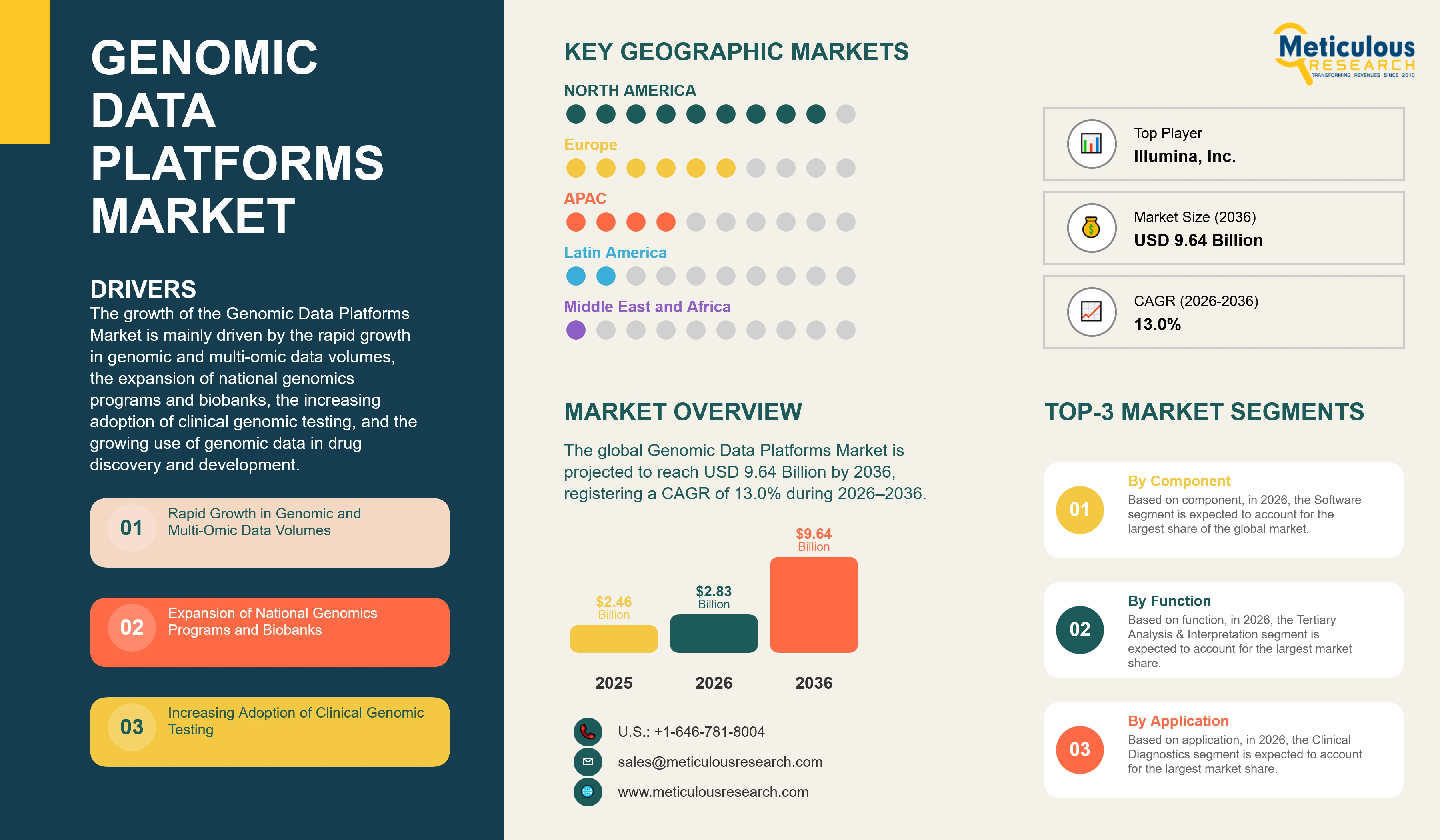
The global Genomic Data Platforms Market was valued at USD 2.46 billion in 2025. This market is expected to reach USD 9.64 billion by 2036 from an estimated USD 2.83 billion in 2026, registering a CAGR of 13.0% during the forecast period (2026-2036).
- Published
- Oct 2026
- Pages
- 299
- Format
- PDF + Excel
- Report ID
- MRHC - 1042356
- Base year
- 2025
- 2025 · BASELINE
- $2.46B
- 2036
- $9.64B
- CAGR 2026–2036
- 13.0%
2025 baseline · 2026–2036 forecast at 13.0% CAGR · hover a bar for the value
Key highlights
The global Genomic Data Platforms Market is projected to reach USD 9.64 billion by 2036, driven by growing genomic data volumes, national genomics programs, clinical genomics, pharmaceutical data use, and AI-driven multi-omic analysis.
Population-scale genomic datasets are increasingly accessed through cloud platforms. In June 2026, the All of Us Research Program of the U.S. National Institutes of Health (NIH) expanded its dataset to more than 747,000 participants, including 535,000 whole-genome sequences linked to nearly 482,000 electronic health records and more than 1.3 billion genetic variants, all made available to approved researchers through its cloud-based Researcher Workbench.
Pharmaceutical demand for genomic data and insights is expanding. In the second quarter of 2026, Illumina, Inc. reported revenue of USD 1.16 billion, up 9.5% year over year, and highlighted the expansion of BioInsight, its data and insights business for pharmaceutical customers combining sequencing, compute, and artificial intelligence (AI), whose first initiative, the Billion Cell Atlas, has six partners and has delivered more than 300 million cells.
North America is expected to account for the largest market share in 2026, supported by large genomics programs, clinical genomic testing, pharmaceutical research, and the presence of leading platform and cloud providers, while Asia-Pacific is projected to register the fastest growth during the forecast period.
By function, Tertiary Analysis & Interpretation is expected to account for the largest market share in 2026, whereas Multi-Omics Integration & AI Analytics is projected to witness the fastest growth through 2036, as pharmaceutical companies and research institutions combine genomic, transcriptomic, proteomic, and clinical data to discover targets and biomarkers.
Report summary
| Particulars | Details |
|---|---|
| Forecast Period | 2026-2036 |
| Base Year | 2025 |
| Estimated Year | 2026 |
| CAGR (Value) | 13.0% |
| Format | PDF, Excel & Cloud Portal · 299 pages |
| Market Size (Value) in 2026 | USD 2.83 Billion |
| Market Size (Value) in 2036 | USD 9.64 Billion |
| Segments Covered | By Component: Software (Subscription & Software-as-a-Service, Perpetual Licenses), Services (Implementation & Integration Services, Bioinformatics & Data Analysis Services, Managed Services). By Function: Data Storage & Management, Secondary Analysis, Tertiary Analysis & Interpretation, Data Sharing & Federated Collaboration, Multi-Omics Integration & AI Analytics. By Deployment Mode: Cloud-Based, Hybrid, On-Premise. By Application: Clinical Diagnostics (Oncology, Rare & Inherited Diseases, Reproductive Health, Other Clinical Applications), Drug Discovery & Development, Population Genomics & Biobanking, Academic & Translational Research, Other Applications. By End User: Hospitals & Clinical Laboratories, Pharmaceutical & Biotechnology Companies, Academic & Research Institutes, Government Agencies & National Genomics Programs. |
| Countries Covered | North America: U.S., Canada. Europe: U.K., Germany, France, Netherlands, Switzerland, Nordic Countries, Rest of Europe. Asia-Pacific: China, Japan, South Korea, India, Singapore, Australia, Rest of Asia-Pacific. Latin America: Brazil, Mexico, Rest of Latin America. Middle East & Africa: Saudi Arabia, UAE, Qatar, Rest of Middle East & Africa. |
| Key Companies | Illumina, Inc., QIAGEN N.V., DNAnexus, Inc., Velsera, Inc., Lifebit Biotech Ltd, SOPHiA GENETICS SA, Amazon Web Services, Inc., and Google LLC (Google Cloud). |
Report overview
Segments covered: component, function, deployment, application, end user.
The growth of this market is mainly driven by the rapid growth in the volume of genomic and multi-omic data generated by sequencing, the expansion of national genomics programs and biobanks that provide data to researchers through cloud-based platforms, the increasing adoption of genomic testing in clinical care for oncology, rare diseases, and reproductive health, which requires scalable analysis and interpretation, and the growing use of genomic data by pharmaceutical companies for target discovery and drug development. In addition, the shift to cloud-based and federated trusted research environments, the application of artificial intelligence (AI) and machine learning to genomic and multi-omic data, regulatory frameworks enabling secure secondary use of health data, and the integration of genomic data with electronic health records are further supporting the growth of this market.
The Genomic Data Platforms Market, also referred to as the genomic data management and analysis platforms market, genomics informatics platforms market, or genomic data science platforms market, comprises the software platforms and related services used to store, manage, process, analyze, interpret, share, and integrate genomic and multi-omic data for clinical care, research, and drug development. The market includes genomic data storage and management platforms; secondary analysis platforms for read alignment and variant calling, including hardware-accelerated pipelines; tertiary analysis and clinical interpretation platforms for variant annotation, classification, and reporting; trusted research environments and federated data-sharing platforms that allow controlled access to sensitive genomic data; and multi-omics integration and AI analytics platforms. These platforms are delivered through public cloud, hybrid, and on-premise deployments, together with implementation, bioinformatics, and managed services. The market ecosystem extends from genomic platform developers, sequencing companies, and cloud providers to hospitals and clinical laboratories, pharmaceutical and biotechnology companies, national genomics programs and biobanks, and academic research institutions.
The volume of genomic data is growing rapidly. A single human whole genome generates tens to more than a hundred gigabytes of raw data, and national programs, biobanks, and clinical laboratories now hold hundreds of thousands to millions of genomes, together with transcriptomic, proteomic, single-cell, and spatial data. Managing, analyzing, and sharing these data requires scalable computing, secure storage, standardized pipelines, and governance that traditional on-premise systems in individual institutions cannot easily provide. Genomic data platforms address these needs, and their importance grows with each increase in sequencing output.
National genomics programs and biobanks are major users and drivers of platforms. In June 2026, the All of Us Research Program of the U.S. National Institutes of Health (NIH) expanded its dataset to more than 747,000 participants, including 535,000 whole-genome sequences linked to nearly 482,000 electronic health records and more than 1.3 billion genetic variants, all made available to approved researchers through its cloud-based Researcher Workbench. UK Biobank makes all of its data available only through its cloud-based UK Biobank Research Analysis Platform (UKB-RAP), and its planned releases for 2027 include long-read whole-genome sequencing with epigenetic data for up to 50,000 participants, proteomic data covering 5,300 proteins for 150,000 participants, and single-cell RNA sequencing data, which will add substantially to the genomic and multi-omic data already held on the platform. These programs increasingly follow a model in which researchers bring their analyses to the data in a secure cloud environment rather than downloading data, a model that requires trusted research environment platforms and creates recurring demand for computing and analysis.
Cross-border and national data infrastructures are expanding. In Europe, the 1+ Million Genomes initiative, signed by 27 countries, is building the Genomic Data Infrastructure, a decentralized infrastructure for cross-border access to genomic and clinical data that is aligned with the European Health Data Space, with a roadmap targeting operational infrastructure in 15 countries by 2026 and the Genome of Europe project generating a reference dataset of at least 100,000 whole genomes. The European Health Data Space Regulation, which entered into force in 2025, establishes a framework for the secondary use of health data, including genomic data, through health data access bodies, and is expected to increase demand for secure data platforms. National genomic medicine programs in the U.K., the Middle East, and Asia-Pacific are building similar infrastructures.
Clinical genomics and pharmaceutical research are the main commercial markets. Hospitals and clinical laboratories use interpretation platforms to analyze tumor, hereditary, rare disease, and reproductive genomic tests and generate clinical reports, while pharmaceutical companies use genomic data platforms to analyze biobank and real-world data, identify drug targets, and stratify patients for clinical trials. In the second quarter of 2026, Illumina, Inc. reported revenue of USD 1.16 billion, up 9.5% year over year, and highlighted the expansion of BioInsight, its data and insights business for pharmaceutical customers combining sequencing, compute, and artificial intelligence (AI), whose first initiative, the Billion Cell Atlas, has six partners and has delivered more than 300 million cells.
The market includes sequencing and life science companies such as Illumina and QIAGEN, which offer secondary analysis, interpretation, and data platforms; specialized genomic data platform companies such as DNAnexus, Velsera, Lifebit, and SOPHiA GENETICS; and cloud providers such as Amazon Web Services (AWS) and Google Cloud, which offer genomics-specific services. These companies compete on scalability and performance, security, compliance, and governance, support for federated and multi-cloud deployment, the quality of clinical interpretation and knowledge bases, multi-omic and AI capabilities, and relationships with national programs, laboratories, and pharmaceutical companies.
At the same time, the market faces challenges, including data privacy and security concerns and differences in data protection laws between countries, the lack of interoperability between platforms and data formats, the high cost of storing and computing on very large datasets, shortages of bioinformatics expertise, and the need for clinical interpretation platforms to meet regulatory and quality requirements. As a result, companies that combine scalable and secure cloud and federated infrastructure, strong governance and compliance, high-quality interpretation, multi-omic and AI analytics, and interoperability with clinical and research systems are expected to capture the largest share of growth over the forecast period.
Report infographic
Market dynamics
15 factors across 5 forcesRapid Growth in Genomic and Multi-Omic Data Volumes
The rapid growth in genomic and multi-omic data volumes is a major factor driving the Genomic Data Platforms Market, as each increase in sequencing output creates more data to store, analyze, and interpret. Sequencing costs have fallen substantially, high-throughput sequencers allow laboratories to generate many thousands of genomes per year, and research is expanding into long-read sequencing, single-cell, spatial, and proteomic data. UK Biobank makes all of its data available only through its cloud-based UK Biobank Research Analysis Platform (UKB-RAP), and its planned releases for 2027 include long-read whole-genome sequencing with epigenetic data for up to 50,000 participants, proteomic data covering 5,300 proteins for 150,000 participants, and single-cell RNA sequencing data, which will add substantially to the genomic and multi-omic data already held on the platform.
As datasets grow from thousands to hundreds of thousands and millions of samples, organizations can no longer manage them with local servers and ad hoc pipelines. Scalable platforms that automate processing, manage data and metadata, and support analysis at population scale become essential, creating sustained demand for platforms and associated cloud computing.
Expansion of National Genomics Programs and Biobanks
The expansion of national genomics programs and biobanks is significantly driving market growth. In June 2026, the All of Us Research Program of the U.S. National Institutes of Health (NIH) expanded its dataset to more than 747,000 participants, including 535,000 whole-genome sequences linked to nearly 482,000 electronic health records and more than 1.3 billion genetic variants, all made available to approved researchers through its cloud-based Researcher Workbench. In Europe, the 1+ Million Genomes initiative, signed by 27 countries, is building the Genomic Data Infrastructure, a decentralized infrastructure for cross-border access to genomic and clinical data that is aligned with the European Health Data Space, with a roadmap targeting operational infrastructure in 15 countries by 2026 and the Genome of Europe project generating a reference dataset of at least 100,000 whole genomes. Governments in the U.K., Europe, the Middle East, and Asia-Pacific are investing in genomic medicine and population genomics programs, and these programs require platforms for data processing, secure storage, controlled researcher access, and integration with health records.
Increasing Adoption of Clinical Genomic Testing
The increasing adoption of clinical genomic testing is an important driver of demand. Tumor profiling, hereditary cancer testing, rare disease diagnosis, prenatal and carrier screening, and pharmacogenomic testing are expanding in clinical practice, and each test requires analysis, variant interpretation, and reporting. Clinical laboratories use interpretation platforms with curated knowledge bases to classify variants consistently and efficiently, and the growth of decentralized testing in hospitals is increasing demand for platforms that allow laboratories to run genomic tests without extensive in-house bioinformatics.
Clinical genomics also requires platforms that meet quality and regulatory requirements, integrate with laboratory information systems and electronic health records, and support the reanalysis of data as knowledge improves. As genomic testing becomes part of routine care for more conditions, demand for clinical-grade interpretation and data management platforms is expected to grow steadily.
Growing Use of Genomic Data in Drug Discovery and Development
The growing use of genomic data in drug discovery and development supports market growth. Drug targets with genetic evidence are more likely to succeed in clinical development, and pharmaceutical companies are investing in access to biobank, population, and real-world genomic data to identify and validate targets, understand disease mechanisms, and stratify patients. In the second quarter of 2026, Illumina, Inc. reported revenue of USD 1.16 billion, up 9.5% year over year, and highlighted the expansion of BioInsight, its data and insights business for pharmaceutical customers combining sequencing, compute, and artificial intelligence (AI), whose first initiative, the Billion Cell Atlas, has six partners and has delivered more than 300 million cells. Pharmaceutical companies use genomic data platforms to analyze these large datasets securely, often in collaboration with biobanks and data providers.
Table of contents
13 chapters · 148 sections · 299 pages · click to expandSegmental analysis
| Segment | Largest share (2026) | Fastest growth (2026–2036) |
|---|---|---|
| By Component | Software | Services |
| By Function | Tertiary Analysis & Interpretation | Multi-Omics Integration & AI Analytics |
| By Deployment Mode | Cloud-Based | Hybrid |
| By Application | Clinical Diagnostics | Drug Discovery & Development |
| By End User | Hospitals & Clinical Laboratories | Pharmaceutical & Biotechnology Companies |
By Component
- Genomic Data Platforms Market Analysis by Component
- Software is further segmented into Subscription & Software-as-a-Service and Perpetual Licenses, while Services are further segmented into Implementation & Integration Services, Bioinformatics & Data Analysis Services, and Managed Services.
- The Software segment is expected to account for the largest share of the global Genomic Data Platforms Market.
- The large share of this segment is mainly due to the broad adoption of genomic analysis, interpretation, and data management software by clinical laboratories, pharmaceutical companies, and research institutions, the recurring nature of subscription and usage-based revenue, and the use of platforms by national programs and biobanks to provide data access to researchers.
- However, the Services segment is projected to register the highest CAGR during the forecast period.
- The rapid growth of this segment is attributed to the shortage of in-house bioinformatics expertise, the complexity of implementing platforms for national programs and health systems, and the growing demand for managed and data analysis services from pharmaceutical companies and hospitals.
By Function
- Genomic Data Platforms Market Analysis by Function
- The Tertiary Analysis & Interpretation segment is expected to account for the largest share of the market.
- The large share of this segment is mainly due to the large volume of clinical genomic tests in oncology, hereditary disease, rare disease, and reproductive health that require variant annotation, classification, and reporting, the value of curated knowledge bases, and the use of interpretation platforms by clinical laboratories and hospitals.
- However, the Multi-Omics Integration & AI Analytics segment is projected to register the highest CAGR during the forecast period.
- The rapid growth of this segment is attributed to the growth of transcriptomic, proteomic, single-cell, and spatial data, the use of AI and foundation models for target discovery and variant interpretation, and investment by pharmaceutical companies in data-driven drug discovery, such as the BioInsight business of Illumina.
- The Data Sharing & Federated Collaboration segment is also expected to grow strongly, supported by national programs and the Genomic Data Infrastructure in Europe.
By Deployment Mode
- Genomic Data Platforms Market Analysis by Deployment Mode
- The Cloud-Based segment is expected to account for the largest share of the market.
- The large share of this segment is mainly due to the scalability and flexibility of cloud computing for large genomic datasets, the adoption of cloud platforms by biobanks and national programs such as UK Biobank and All of Us, and the availability of genomics-specific services from cloud providers.
- However, the Hybrid segment is projected to register the highest CAGR during the forecast period.
- The rapid growth of this segment is attributed to data sovereignty and privacy requirements that keep data within national or institutional boundaries, the adoption of federated analysis across multiple locations, and the need of hospitals and national programs to combine local infrastructure with cloud scalability.
By Application
- Genomic Data Platforms Market Analysis by Application
- Clinical Diagnostics is further segmented into Oncology, Rare & Inherited Diseases, Reproductive Health, and Other Clinical Applications.
- Other Applications include agrigenomics and pathogen genomics.
- The Clinical Diagnostics segment is expected to account for the largest share of the market.
- The large share of this segment is mainly due to the high volume of clinical genomic tests requiring analysis and interpretation, the expansion of tumor profiling and rare disease testing, and the adoption of interpretation platforms by clinical laboratories and hospitals to manage testing efficiently and consistently.
- However, the Drug Discovery & Development segment is projected to register the highest CAGR during the forecast period.
- The rapid growth of this segment is attributed to the use of genetic evidence to select and validate drug targets, pharmaceutical investment in access to biobank and real-world genomic data, the use of multi-omic and AI platforms for target and biomarker discovery, and the growth of genomic data and insights businesses serving pharmaceutical companies.
By End User
- Genomic Data Platforms Market Analysis by End User
- The Hospitals & Clinical Laboratories segment is expected to account for the largest share of the market.
- The large share of this segment is mainly due to the growth of clinical genomic testing, the use of interpretation and data management platforms by reference and hospital laboratories, and the growing adoption of in-house genomic testing by hospitals.
- However, the Pharmaceutical & Biotechnology Companies segment is projected to register the highest CAGR during the forecast period.
- The rapid growth of this segment is attributed to the growing use of genomic and multi-omic data in drug discovery and development, investment in biobank and real-world data partnerships, and the adoption of AI-driven analytics platforms.
Geographic analysis
North America
Largest shareIn 2026, North America is expected to account for the largest share of the global Genomic Data Platforms Market. The large share of this region is mainly attributed to the large volume of clinical genomic testing and pharmaceutical research, major genomics programs such as All of Us, and the presence of leading platform and cloud providers such as Illumina, DNAnexus, Velsera, AWS, and Google Cloud. In June 2026, the All of Us Research Program of the U.S. National Institutes of Health (NIH) expanded its dataset to more than 747,000 participants, including 535,000 whole-genome sequences linked to nearly 482,000 electronic health records and more than 1.3 billion genetic variants, all made available to approved researchers through its cloud-based Researcher Workbench.
Europe
Europe is expected to account for a significant share of the market, supported by large biobanks and genomic medicine programs, such as UK Biobank and the genomic medicine service of the National Health Service in England, the 1+ Million Genomes initiative, and the European Health Data Space. In Europe, the 1+ Million Genomes initiative, signed by 27 countries, is building the Genomic Data Infrastructure, a decentralized infrastructure for cross-border access to genomic and clinical data that is aligned with the European Health Data Space, with a roadmap targeting operational infrastructure in 15 countries by 2026 and the Genome of Europe project generating a reference dataset of at least 100,000 whole genomes. QIAGEN, Lifebit, and SOPHiA GENETICS are based in the region.
Asia-Pacific
Fastest growthAsia-Pacific is projected to register the highest CAGR during the forecast period. The growth of this region is driven by national genomics programs in China, Japan, South Korea, Singapore, India, and Australia, the rapid growth of sequencing capacity and clinical genomic testing, pharmaceutical research investment, and data localization requirements that create demand for in-country platforms.
Latin America
Latin America and the Middle East & Africa are expected to account for smaller shares of the market.
Middle East & Africa
In the Middle East, national genome programs in Saudi Arabia, the UAE, and Qatar are creating demand for large-scale genomic data platforms, while in Latin America, genomic research and clinical testing in Brazil and Mexico are expected to support growth.
Competitive landscape
The global Genomic Data Platforms Market is moderately fragmented, with sequencing and life science companies, specialized genomic data platform companies, clinical interpretation software providers, and cloud providers participating across functions and applications. Market participants compete primarily on scalability and performance, security, compliance, and governance, support for federated and multi-cloud deployment, the quality of clinical interpretation and knowledge bases, multi-omic and AI capabilities, and relationships with national programs, laboratories, and pharmaceutical companies.
Leading companies are developing trusted research environments and federated platforms, integrating multi-omic and AI analytics, accelerating secondary analysis, expanding clinical interpretation knowledge bases, and building data partnerships with biobanks and pharmaceutical companies. Recent examples include the expansion of the BioInsight business and Billion Cell Atlas of Illumina in 2026, the expansion of the All of Us dataset in June 2026, and the planned 2027 multi-omic data releases of UK Biobank through its Research Analysis Platform.
The report provides a comprehensive competitive assessment of the leading companies operating in the global Genomic Data Platforms Market. The key players profiled in the report include Illumina, Inc. (U.S.), QIAGEN N.V. (Netherlands), DNAnexus, Inc. (U.S.), Velsera, Inc. (U.S.), Lifebit Biotech Ltd (U.K.), SOPHiA GENETICS SA (Switzerland), Amazon Web Services, Inc. (U.S.), and Google LLC (Google Cloud) (U.S.).
- Illumina, Inc.
- QIAGEN N.V.
- DNAnexus, Inc.
- Velsera, Inc.
- Lifebit Biotech Ltd
- SOPHiA GENETICS SA
- Amazon Web Services, Inc.
- Google LLC · Google Cloud
Expert perspectives
The Genomic Data Platforms Market is being shaped by a fundamental change in how genomic data are generated and used. With All of Us holding 535,000 whole genomes linked to health records, UK Biobank providing all of its data through a cloud platform, and Europe building a federated genomic data infrastructure across 27 signatory countries, genomic data are increasingly held in large, governed platforms that researchers and companies access rather than download. The binding constraint is shifting from generating genomic data to the ability to govern, integrate, and extract insight from it securely and at scale.
Three structural changes are expected to shape competitive positions through 2036. First, federated and trusted research environments are expected to become the standard model for access to sensitive genomic data, favoring providers with strong governance and sovereign deployment options. Second, multi-omic and AI analytics are expected to drive the next wave of value, favoring providers with integrated data and computing for AI. Third, clinical interpretation is expected to remain a core and growing market as genomic testing expands, favoring providers with curated knowledge bases and clinical integration.
For companies planning entry or expansion, the most defensible positions over the forecast period are likely to be found in federated platforms for national programs and pharmaceutical consortia, multi-omic and AI analytics for drug discovery, clinical interpretation integrated with electronic health records, and sovereign platform deployment in the Middle East and Asia-Pacific. For established providers, the principal priorities are interoperability, cost-efficient computing, and partnerships with biobanks, health systems, and pharmaceutical companies.
Overall, the market is expected to grow strongly, with software, tertiary analysis and interpretation, cloud-based deployment, clinical diagnostics, hospitals and clinical laboratories, and North America providing the core of demand and services, multi-omics integration and AI analytics, hybrid deployment, drug discovery and development, pharmaceutical and biotechnology companies, and Asia-Pacific providing the fastest growth.
Customer perspectives
Insights gathered during primary interviews with clinical laboratory directors, pharmaceutical data science leaders, and national genomics program managers operating in this market highlight where procurement priorities are shifting. The following perspectives reflect recurring themes raised across these discussions.
“This reflects the shift toward federated, multi-omic analysis.”
“This indicates the importance of scalable clinical interpretation.”
“This points to the importance of governance and data sovereignty.”
Frequently asked questions
The global Genomic Data Platforms Market is estimated at USD 2.83 billion in 2026.
Cite this report
Meticulous Research. (2026). Genomic Data Platforms Market - Global Opportunity Analysis And Industry Forecasts (2026-2036) (Report No. MRHC - 1042356). Meticulous Market Research Pvt. Ltd. https://www.meticulousresearch.com/product/genomic-data-platforms-market-7039