Genomic Clinical Decision Support Market (2026-2036)
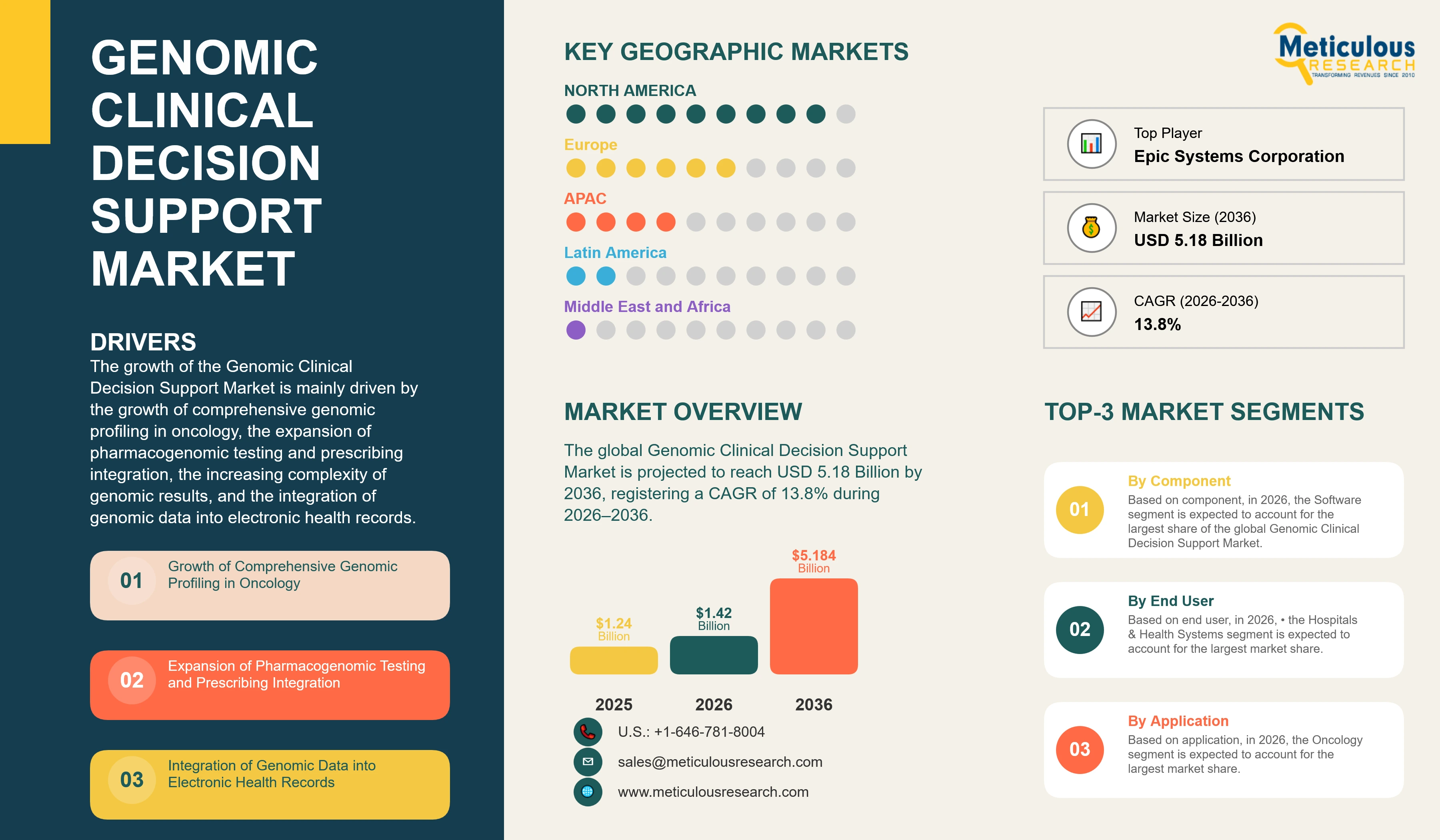
The global Genomic Clinical Decision Support Market was valued at USD 1.24 billion in 2025. This market is expected to reach USD 5.18 billion by 2036 from an estimated USD 1.42 billion in 2026, registering a CAGR of 13.8% during the forecast period (2026-2036).
- Published
- Oct 2026
- Pages
- 327
- Format
- PDF + Excel
- Report ID
- MRHC - 1042354
- Base year
- 2025
- 2025 · BASELINE
- $1.24B
- 2036
- $5.18B
- CAGR 2026–2036
- 13.8%
2025 baseline · 2026–2036 forecast at 13.8% CAGR · hover a bar for the value
Key highlights
The global Genomic Clinical Decision Support Market is projected to reach USD 5.18 billion by 2036, driven by oncology genomic profiling, pharmacogenomic prescribing support, EHR integration of genomic data, and AI-driven evidence curation.
Pharmacogenomic guidance at the point of prescribing is changing prescribing decisions. In England, the NHS PROGRESS pharmacogenomics trial expanded to 20 general practices, using the PROGRESSRx tool to integrate pharmacogenomic results into prescribing systems and display guidance at the point of prescribing; 93% of participants carried a clinically relevant variant in at least one of the four study genes, about 80% of the guidance was followed, and 35% of participants had a change to their prescription.
Regulators are clarifying the boundary for CDS software. In January 2026, the U.S. Food and Drug Administration (FDA) published revised guidance on clinical decision support (CDS) software, superseding its 2022 guidance, clarifying which CDS functions are exempt from device regulation under the 21st Century Cures Act, and indicating that certain CDS that provides a single clinically appropriate recommendation for review by a healthcare provider, based on medical record information and clinical guidelines, may fall outside FDA regulation if it meets all statutory criteria.
North America is expected to account for the largest market share in 2026, supported by high volumes of oncology genomic testing, EHR adoption with genomic modules, and the presence of leading CDS and genomic testing companies, while Asia-Pacific is projected to register the fastest growth during the forecast period.
By application, Oncology is expected to account for the largest market share in 2026, whereas Pharmacogenomics is projected to witness the fastest growth through 2036, as health systems move from reactive single-gene testing to preemptive pharmacogenomic panels with automated prescribing alerts.
Report summary
| Particulars | Details |
|---|---|
| Forecast Period | 2026-2036 |
| Base Year | 2025 |
| Estimated Year | 2026 |
| CAGR (Value) | 13.8% |
| Format | PDF, Excel & Cloud Portal · 327 pages |
| Market Size (Value) in 2026 | USD 1.42 Billion |
| Market Size (Value) in 2036 | USD 5.18 Billion |
| Segments Covered | By Component: Software (Standalone CDS Platforms, EHR-Embedded Genomic Modules), Knowledge Bases & Content, Services (Implementation & Integration Services, Curation & Interpretation Services). By Application: Oncology (Therapy Selection, Clinical Trial Matching, Disease Monitoring), Pharmacogenomics, Rare & Inherited Diseases, Hereditary Cancer & Cardiovascular Risk, Reproductive & Prenatal Health, Other Applications. By Integration Type: EHR-Integrated, Standalone. By Deployment Mode: Cloud-Based, On-Premise. By End User: Hospitals & Health Systems, Clinical & Reference Laboratories, Ambulatory & Primary Care Practices, Specialty Clinics & Cancer Centers, Other End Users. |
| Countries Covered | North America: U.S., Canada. Europe: U.K., Germany, France, Netherlands, Italy, Spain, Rest of Europe. Asia-Pacific: China, Japan, South Korea, Australia, Singapore, India, Rest of Asia-Pacific. Latin America: Brazil, Mexico, Rest of Latin America. Middle East & Africa: Saudi Arabia, UAE, Qatar, Rest of Middle East & Africa. |
| Key Companies | Epic Systems Corporation, Oracle Corporation (Oracle Health), F. Hoffmann-La Roche Ltd, QIAGEN N.V., Illumina, Inc., Tempus AI, Inc., SOPHiA GENETICS SA, and Velsera, Inc. |
Report overview
Segments covered: component, application, integration, end user.
The growth of this market is mainly driven by the rapid growth of comprehensive genomic profiling in oncology and the need to match patients to targeted therapies and clinical trials, the expansion of pharmacogenomic testing and the integration of pharmacogenomic guidance into prescribing workflows, the increasing complexity of genomic results and the number of actionable biomarkers, guidelines, and approved therapies that clinicians must interpret, and the integration of genomic data into electronic health records (EHRs). In addition, the clarification of regulatory frameworks for CDS software, the application of artificial intelligence (AI) and large language models to genomic interpretation and evidence curation, the growth of national genomic medicine programs, and the shortage of genetics specialists relative to the number of patients receiving genomic tests are further supporting the growth of this market.
The Genomic Clinical Decision Support Market, also referred to as the genomic CDS market, genomics-enabled clinical decision support market, or precision medicine decision support market, comprises the software, knowledge bases and content, and services that translate genomic test results into clinical recommendations for healthcare providers at the point of care. The market includes oncology decision support for matching tumor genomic alterations to approved therapies, guidelines, and clinical trials; pharmacogenomic CDS that generates drug-gene alerts and dosing recommendations in prescribing systems; decision support for hereditary cancer, cardiovascular, rare, and inherited diseases, including risk management and cascade testing recommendations; reproductive and prenatal decision support; genomic modules within EHRs that store discrete genomic results and trigger alerts; curated genomic knowledge bases of variant, biomarker, therapy, and guideline evidence; and implementation, integration, and curation services. The market ecosystem extends from CDS software and knowledge base providers, EHR vendors, and genomic testing companies to hospitals and health systems, cancer centers, primary care and specialty practices, clinical laboratories, pharmacies, payers, and national genomic medicine programs.
Genomic medicine creates a decision problem for clinicians. Comprehensive genomic profiling of tumors can identify hundreds of alterations, each of which may be linked to approved therapies, investigational drugs, clinical trials, and guidelines that change frequently. Pharmacogenomic results affect the choice and dosing of many commonly prescribed drugs, such as antidepressants, statins, anticoagulants, antiplatelet agents, and proton pump inhibitors, and these results need to be available every time a relevant drug is prescribed, often years after the test. Most clinicians are not genetics specialists, and the number of patients receiving genomic tests far exceeds the number of genetic counselors and clinical geneticists. Genomic CDS addresses this gap by delivering curated, actionable recommendations within clinical workflows.
Oncology is the largest market. Genomic testing companies, cancer centers, and CDS providers use curated knowledge bases to match tumor alterations to therapies and trials and to generate clinician-facing reports, and health systems increasingly integrate these results into EHRs. In the second quarter of 2026, Tempus AI, Inc. reported revenue of USD 382.5 million, up 22% year over year, with oncology testing volume up 31% and Data and Applications revenue of USD 93.2 million, up 28%, and raised its full-year 2026 revenue guidance to USD 1.595-1.605 billion. The growth of oncology testing volumes, the expanding number of biomarker-driven therapies, and the use of molecular residual disease testing are increasing demand for oncology decision support.
Pharmacogenomics is the fastest-growing area. In England, the NHS PROGRESS pharmacogenomics trial expanded to 20 general practices, using the PROGRESSRx tool to integrate pharmacogenomic results into prescribing systems and display guidance at the point of prescribing; 93% of participants carried a clinically relevant variant in at least one of the four study genes, about 80% of the guidance was followed, and 35% of participants had a change to their prescription. Health systems in the U.S. and Europe are implementing preemptive pharmacogenomic testing, in which a panel of genes is tested once and results are stored in the EHR to trigger alerts whenever relevant drugs are prescribed, and guidelines from the Clinical Pharmacogenetics Implementation Consortium (CPIC) and the Dutch Pharmacogenetics Working Group (DPWG) provide the evidence base. EHR vendors, such as Epic Systems with its Genomics module, are enabling health systems to store discrete genomic results and build CDS alerts.
The regulatory environment for CDS software is becoming clearer. In January 2026, the U.S. Food and Drug Administration (FDA) published revised guidance on clinical decision support (CDS) software, superseding its 2022 guidance, clarifying which CDS functions are exempt from device regulation under the 21st Century Cures Act, and indicating that certain CDS that provides a single clinically appropriate recommendation for review by a healthcare provider, based on medical record information and clinical guidelines, may fall outside FDA regulation if it meets all statutory criteria. At the same time, genomic CDS that analyzes data to provide diagnostic or treatment recommendations without allowing clinicians to independently review the basis may remain subject to device regulation, and in Europe, software that provides diagnostic or therapeutic information may be regulated under the In Vitro Diagnostic Regulation or the Medical Device Regulation.
The market includes EHR vendors such as Epic Systems and Oracle Health; genomic interpretation and CDS providers such as QIAGEN, Illumina, Roche (including Foundation Medicine and the navify portfolio), SOPHiA GENETICS, and Velsera; and AI-driven precision medicine companies such as Tempus AI. These companies compete on the quality, breadth, and currency of curated knowledge bases, integration with EHRs and laboratory systems, clinical trial matching, regulatory compliance, ease of use for clinicians, and evidence of clinical utility.
At the same time, the market faces challenges, including the difficulty of integrating genomic data into EHRs in structured form, alert fatigue among clinicians, the cost and effort of maintaining up-to-date knowledge bases, limited reimbursement for pharmacogenomic testing and for decision support itself, and the need for evidence that genomic CDS improves outcomes. As a result, companies that combine curated and continuously updated knowledge, seamless EHR integration, clinician-friendly workflows, AI-assisted curation, and evidence of clinical and economic value are expected to capture the largest share of growth over the forecast period.
Report infographic
Market dynamics
15 factors across 5 forcesGrowth of Comprehensive Genomic Profiling in Oncology
The growth of comprehensive genomic profiling in oncology is a major factor driving the Genomic Clinical Decision Support Market, as each test generates results that must be matched to therapies, guidelines, and clinical trials. Tumor profiling is recommended in guidelines for many advanced cancers, the number of biomarker-driven targeted therapies and immunotherapies continues to grow, and liquid biopsy and molecular residual disease testing are expanding. In the second quarter of 2026, Tempus AI, Inc. reported revenue of USD 382.5 million, up 22% year over year, with oncology testing volume up 31% and Data and Applications revenue of USD 93.2 million, up 28%, and raised its full-year 2026 revenue guidance to USD 1.595-1.605 billion.
As the number of actionable biomarkers grows, oncologists need decision support to interpret complex reports, identify all relevant options, and find clinical trials for patients. Cancer centers and community oncology practices are adopting decision support that integrates genomic results, guidelines, and trial matching into their workflows, creating sustained demand for oncology CDS.
Expansion of Pharmacogenomic Testing and Prescribing Integration
The expansion of pharmacogenomic testing and its integration into prescribing is significantly driving market growth. In England, the NHS PROGRESS pharmacogenomics trial expanded to 20 general practices, using the PROGRESSRx tool to integrate pharmacogenomic results into prescribing systems and display guidance at the point of prescribing; 93% of participants carried a clinically relevant variant in at least one of the four study genes, about 80% of the guidance was followed, and 35% of participants had a change to their prescription. Pharmacogenomic results are only useful if they are available when a drug is prescribed, which requires CDS that stores results and generates alerts in prescribing systems. Health systems implementing preemptive pharmacogenomic testing, national programs exploring pharmacogenomic services, and the availability of CPIC and DPWG guidelines are driving demand for pharmacogenomic CDS.
Increasing Complexity of Genomic Results
The increasing complexity of genomic results is an important driver of demand. Whole-exome and whole-genome sequencing, large multi-gene panels, and multi-omic testing generate many variants, most of which are of uncertain or no significance, and the evidence for interpreting variants and biomarkers changes as new research, therapies, and guidelines are published. Clinicians cannot track this evidence alone, and laboratories and health systems rely on curated knowledge bases and decision support to provide current, consistent recommendations.
The shortage of genetics specialists further increases the need for decision support. The number of patients receiving genomic tests is growing much faster than the number of genetic counselors and clinical geneticists, and genomic results are increasingly ordered and acted on by oncologists, cardiologists, primary care physicians, and pharmacists. Decision support allows these clinicians to act on genomic results with appropriate guidance and to identify when referral to genetics specialists is needed.
Integration of Genomic Data into Electronic Health Records
The integration of genomic data into EHRs supports market growth. EHR vendors have developed genomic modules that store discrete genomic results, such as genotypes, phenotypes, and variants, rather than scanned reports, enabling automated CDS alerts and population-level identification of patients who may benefit from new therapies or testing. Standards such as HL7 Fast Healthcare Interoperability Resources (FHIR) Genomics are supporting the exchange of structured genomic results between laboratories and EHRs. As more health systems implement these modules, demand for genomic CDS content and integration is expected to grow.
Table of contents
13 chapters · 143 sections · 327 pages · click to expandSegmental analysis
| Segment | Largest share (2026) | Fastest growth (2026–2036) |
|---|---|---|
| By Component | Software | Services |
| By Application | Oncology | Pharmacogenomics |
| By Integration Type | Standalone | EHR-Integrated |
| By Deployment Mode | Cloud-Based | — |
| By End User | Hospitals & Health Systems | Ambulatory & Primary Care Practices |
By Component
- Genomic Clinical Decision Support Market Analysis by Component
- Software is further segmented into Standalone CDS Platforms and EHR-Embedded Genomic Modules, while Services are further segmented into Implementation & Integration Services and Curation & Interpretation Services.
- The Software segment is expected to account for the largest share of the global Genomic Clinical Decision Support Market.
- The large share of this segment is mainly due to the adoption of oncology decision support platforms, pharmacogenomic CDS software, and genomic interpretation and reporting software by laboratories, cancer centers, and health systems, and the integration of genomic modules into EHRs.
- However, the Services segment is projected to register the highest CAGR during the forecast period.
- The rapid growth of this segment is attributed to the complexity of integrating genomic results with EHRs and laboratory systems, the demand for expert curation and interpretation services, and the need of health systems to design, implement, and optimize genomic CDS alerts and workflows.
- The Knowledge Bases & Content segment is expected to record strong growth, supported by the expanding number of biomarkers, therapies, and guidelines.
By Application
- Genomic Clinical Decision Support Market Analysis by Application
- Oncology is further segmented into Therapy Selection, Clinical Trial Matching, and Disease Monitoring.
- The Oncology segment is expected to account for the largest share of the market.
- The large share of this segment is mainly due to the high volume of comprehensive genomic profiling and liquid biopsy testing, the large and growing number of biomarker-driven therapies and clinical trials, and the need for oncologists to interpret complex genomic reports, reflected in the 31% growth in oncology testing volume reported by Tempus in the second quarter of 2026.
- However, the Pharmacogenomics segment is projected to register the highest CAGR during the forecast period.
- The rapid growth of this segment is attributed to the shift toward preemptive pharmacogenomic testing, the integration of pharmacogenomic results into prescribing systems, the evidence from programs such as the NHS PROGRESS trial that pharmacogenomic guidance changes prescribing for a significant share of patients, and the availability of CPIC and DPWG guidelines.
By Integration Type
- Genomic Clinical Decision Support Market Analysis by Integration Type
- The Standalone segment is expected to account for the largest share of the market.
- The large share of this segment is mainly due to the widespread use of web-based oncology decision support platforms, laboratory interpretation and reporting portals, and clinician-facing applications provided by genomic testing companies, which do not require deep integration with EHRs.
- However, the EHR-Integrated segment is projected to register the highest CAGR during the forecast period.
- The rapid growth of this segment is attributed to the adoption of genomic modules in EHRs, the need for pharmacogenomic alerts at the point of prescribing, the growth of structured genomic data exchange using HL7 FHIR Genomics, and the preference of clinicians for decision support within their existing workflows.
By Deployment Mode
- Genomic Clinical Decision Support Market Analysis by Deployment Mode
- The Cloud-Based segment is expected to account for the largest share of the market and is also projected to register the higher CAGR during the forecast period.
- This is mainly due to the delivery of oncology decision support and knowledge bases as cloud services that can be updated continuously, the adoption of cloud-hosted EHRs, and the lower implementation cost of cloud solutions for smaller health systems and practices.
By End User
- Genomic Clinical Decision Support Market Analysis by End User
- Other End Users include pharmacies and payers.
- The Hospitals & Health Systems segment is expected to account for the largest share of the market.
- The large share of this segment is mainly due to the concentration of genomic testing, oncology care, and EHR investment in hospitals and integrated health systems, their implementation of genomic modules and pharmacogenomic programs, and their need for enterprise-wide decision support.
- However, the Ambulatory & Primary Care Practices segment is projected to register the highest CAGR during the forecast period.
- The rapid growth of this segment is attributed to the expansion of pharmacogenomic testing in primary care, as demonstrated by the NHS PROGRESS trial in general practices, the growing use of genomic risk information for hereditary conditions in primary care, and the adoption of cloud-based decision support by ambulatory practices.
Geographic analysis
North America
Largest shareIn 2026, North America is expected to account for the largest share of the global Genomic Clinical Decision Support Market. The large share of this region is mainly attributed to the high volume of oncology genomic testing, the adoption of EHRs with genomic modules by health systems, pharmacogenomic programs at academic medical centers and integrated health systems, and the presence of leading companies such as Epic Systems, Oracle Health, Illumina, Tempus AI, and Velsera. In January 2026, the U.S. Food and Drug Administration (FDA) published revised guidance on clinical decision support (CDS) software, superseding its 2022 guidance, clarifying which CDS functions are exempt from device regulation under the 21st Century Cures Act, and indicating that certain CDS that provides a single clinically appropriate recommendation for review by a healthcare provider, based on medical record information and clinical guidelines, may fall outside FDA regulation if it meets all statutory criteria.
Europe
Europe is expected to account for a significant share of the market, supported by national genomic medicine programs, such as the NHS Genomic Medicine Service in England, pharmacogenomic initiatives, such as the NHS PROGRESS trial and the integration of pharmacogenetic guidelines into the national medicines database in the Netherlands, and the presence of companies such as QIAGEN, Roche, and SOPHiA GENETICS. In England, the NHS PROGRESS pharmacogenomics trial expanded to 20 general practices, using the PROGRESSRx tool to integrate pharmacogenomic results into prescribing systems and display guidance at the point of prescribing; 93% of participants carried a clinically relevant variant in at least one of the four study genes, about 80% of the guidance was followed, and 35% of participants had a change to their prescription.
Asia-Pacific
Fastest growthAsia-Pacific is projected to register the highest CAGR during the forecast period. The growth of this region is driven by the expansion of oncology genomic testing in China, Japan, South Korea, and Australia, national precision medicine programs, such as cancer genomic medicine under the Japanese national health insurance system and population genomics programs in Singapore, the adoption of EHRs in hospitals, and growing interest in pharmacogenomics, as several genetic variants affecting drug response are more common in Asian populations.
Latin America
Latin America and the Middle East & Africa are expected to account for smaller shares of the market.
Middle East & Africa
In the Middle East, national genome programs in Saudi Arabia, the UAE, and Qatar are expected to support demand for genomic decision support, while in Latin America, oncology genomic testing in Brazil and Mexico is expected to support growth.
Competitive landscape
The global Genomic Clinical Decision Support Market is moderately fragmented, with EHR vendors, genomic interpretation and CDS software providers, genomic testing companies, and knowledge base providers participating across applications and regions. Market participants compete primarily on the quality, breadth, and currency of curated knowledge bases, integration with EHRs and laboratory systems, clinical trial matching, regulatory compliance, ease of use for clinicians, and evidence of clinical utility.
Leading companies are integrating genomic results into EHR workflows, expanding curated knowledge bases, applying AI to evidence curation and interpretation, developing clinical trial matching, and combining testing, decision support, and data services. Recent market context includes the revised FDA guidance on CDS software published in January 2026, the 22% revenue growth and 28% Data and Applications revenue growth reported by Tempus in the second quarter of 2026, and the pending acquisition of Personalis by Tempus.
The report provides a comprehensive competitive assessment of the leading companies operating in the global Genomic Clinical Decision Support Market. The key players profiled in the report include Epic Systems Corporation (U.S.), Oracle Corporation (Oracle Health) (U.S.), F. Hoffmann-La Roche Ltd (Switzerland), QIAGEN N.V. (Netherlands), Illumina, Inc. (U.S.), Tempus AI, Inc. (U.S.), SOPHiA GENETICS SA (Switzerland), and Velsera, Inc. (U.S.).
- Epic Systems Corporation
- Oracle Corporation · Oracle Health
- F. Hoffmann-La Roche Ltd
- QIAGEN N.V.
- Illumina, Inc.
- Tempus AI, Inc.
- SOPHiA GENETICS SA
- Velsera, Inc
Expert perspectives
The Genomic Clinical Decision Support Market is growing because genomic testing has outpaced the ability of clinicians to interpret and act on results without help. With oncology testing volumes growing rapidly, pharmacogenomic guidance changing prescriptions for about a third of participants in the NHS PROGRESS trial, and the FDA clarifying the regulatory boundary for CDS software in January 2026, decision support is becoming the link between genomic data and clinical action. The binding constraint is shifting from generating genomic results to delivering current, actionable guidance within clinical workflows.
Three structural changes are expected to shape competitive positions through 2036. First, decision support is expected to move from reports into EHRs and prescribing systems, favoring providers that integrate deeply with EHR vendors. Second, preemptive pharmacogenomics is expected to create a large, recurring market for prescribing support, favoring providers with scalable pharmacogenomic content and alerting. Third, AI is expected to transform evidence curation and interpretation, favoring providers that combine AI with expert oversight and regulatory compliance.
For companies planning entry or expansion, the most defensible positions over the forecast period are likely to be found in pharmacogenomic CDS for health systems and primary care, EHR-integrated oncology decision support and trial matching, AI-assisted knowledge curation, and decision support for national genomic medicine programs in Europe, the Middle East, and Asia-Pacific. For established providers, the principal priorities are maintaining current knowledge, reducing alert fatigue, and demonstrating clinical and economic value.
Overall, the market is expected to grow strongly, with software, oncology, standalone solutions, cloud-based deployment, hospitals and health systems, and North America providing the core of demand and services, pharmacogenomics, EHR-integrated solutions, ambulatory and primary care practices, and Asia-Pacific providing the fastest growth.
Customer perspectives
Insights gathered during primary interviews with oncologists, health system pharmacogenomics leads, and clinical informatics officers operating in this market highlight where procurement priorities are shifting. The following perspectives reflect recurring themes raised across these discussions.
“This reflects the demand for actionable oncology decision support.”
“This indicates the importance of EHR-integrated pharmacogenomic CDS.”
“This points to structured data and alert design as key requirements.”
Frequently asked questions
The global Genomic Clinical Decision Support Market is estimated at USD 1.42 billion in 2026.
Cite this report
Meticulous Research. (2026). Genomic Clinical Decision Support Market - Global Opportunity Analysis And Industry Forecasts (2026-2036) (Report No. MRHC - 1042354). Meticulous Market Research Pvt. Ltd. https://www.meticulousresearch.com/product/genomic-clinical-decision-support-market-7037