Forensic Genomics Market (2026-2036)
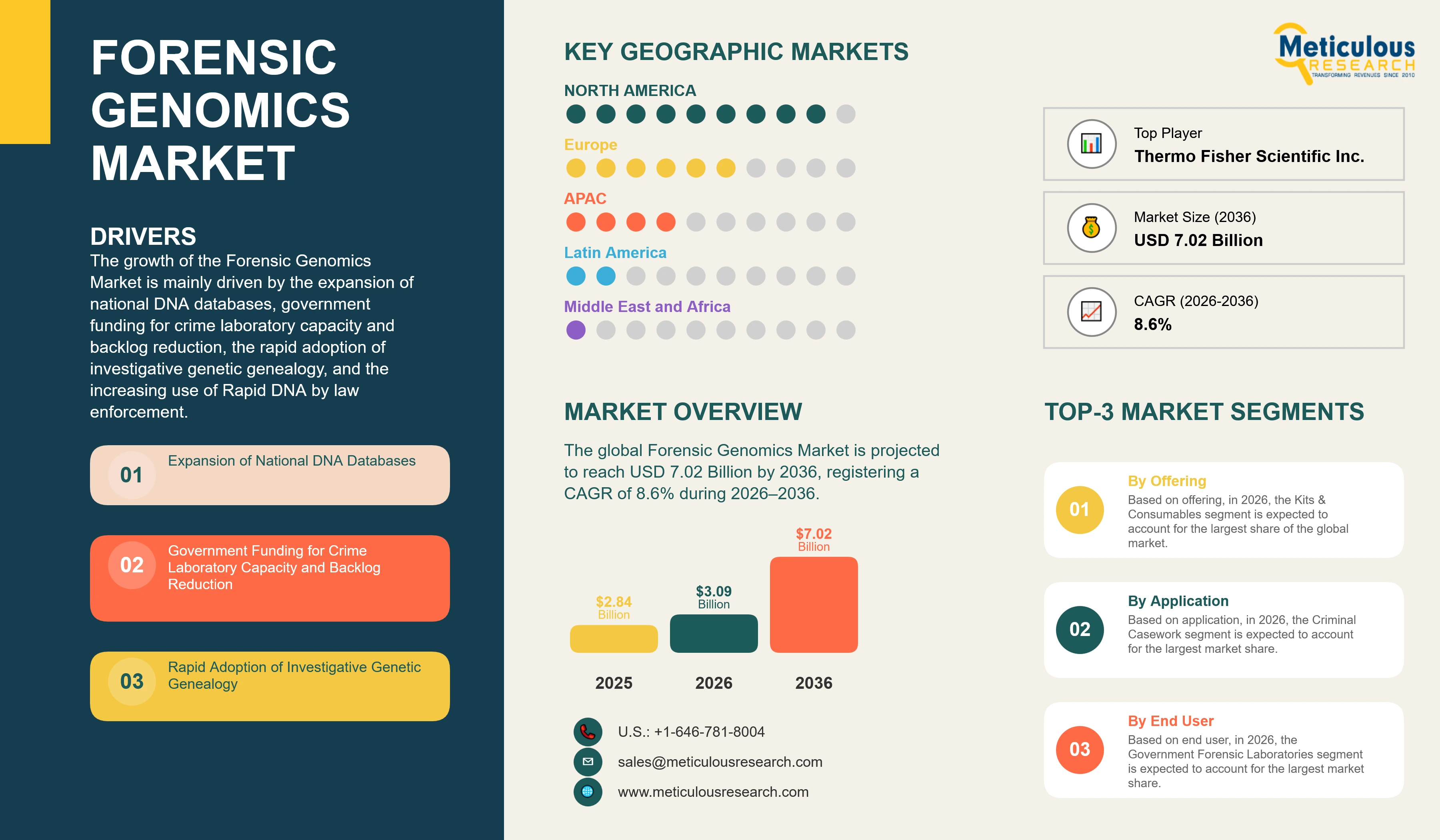
The global Forensic Genomics Market was valued at USD 2.84 billion in 2025. This market is expected to reach USD 7.02 billion by 2036 from an estimated USD 3.09 billion in 2026, registering a CAGR of 8.6% during the forecast period (2026-2036).
- Published
- Oct 2026
- Pages
- 317
- Format
- PDF + Excel
- Report ID
- MRHC - 1042358
- Base year
- 2025
- 2025 · BASELINE
- $2.84B
- 2036
- $7.02B
- CAGR 2026–2036
- 8.6%
2025 baseline · 2026–2036 forecast at 8.6% CAGR · hover a bar for the value
Key highlights
The global Forensic Genomics Market is projected to reach USD 7.02 billion by 2036, driven by DNA database expansion, crime laboratory funding, investigative genetic genealogy, Rapid DNA adoption, and forensic NGS.
DNA databases continue to expand. According to the Federal Bureau of Investigation (FBI), the National DNA Index System (NDIS) holds more than 26.5 million offender DNA profiles and more than 1.48 million crime scene DNA profiles, the Combined DNA Index System (CODIS) has aided more than 776,000 investigations, more than 200 laboratories participate in NDIS, and CODIS software is used at 132 sites in 65 countries.
Rapid DNA is moving from booking stations to crime scenes. In July 2026, the FBI approved the Applied Biosystems RapidINTEL Plus Cartridge of Thermo Fisher Scientific, used with the RapidHIT ID System, for qualifying forensic crime scene samples, making it the first Rapid DNA workflow whose crime scene profiles are eligible for national CODIS searches after review by qualified laboratory personnel; in one example, Connecticut investigators generated an investigative lead in about 90 minutes for evidence that traditionally took about 90 days to process.
North America is expected to account for the largest market share in 2026, supported by the scale of CODIS, federal crime laboratory funding, and the rapid adoption of investigative genetic genealogy, while Asia-Pacific is projected to register the fastest growth during the forecast period.
By application, Criminal Casework is expected to account for the largest market share in 2026, whereas Forensic Genetic Genealogy & Cold Case Investigation is projected to witness the fastest growth through 2036, as law enforcement agencies apply genomic SNP testing and genealogy databases to unresolved cases.
Report summary
| Particulars | Details |
|---|---|
| Forecast Period | 2026-2036 |
| Base Year | 2025 |
| Estimated Year | 2026 |
| CAGR (Value) | 8.6% |
| Format | PDF, Excel & Cloud Portal · 317 pages |
| Market Size (Value) in 2026 | USD 3.09 Billion |
| Market Size (Value) in 2036 | USD 7.02 Billion |
| Segments Covered | By Offering: Kits & Consumables (Sample Collection & DNA Extraction Kits, DNA Quantification Kits, STR Amplification Kits, Forensic NGS Kits & Panels, Rapid DNA Cartridges, Other Consumables), Instruments (Genetic Analyzers, Rapid DNA Systems, Sequencers, Real-Time PCR Systems, Automation & Liquid Handling Systems), Software (Probabilistic Genotyping Software, Analysis & Database Software, Laboratory Information Management Systems), Services (Forensic DNA Testing Services, Forensic Genetic Genealogy Services). By Technology: Capillary Electrophoresis, Next-Generation Sequencing, Rapid DNA Analysis, PCR, SNP Microarrays, Other Technologies. By Application: Criminal Casework, DNA Databasing, Forensic Genetic Genealogy & Cold Case Investigation, Disaster Victim Identification & Missing Persons, Paternity & Kinship Testing, Other Applications. By End User: Government Forensic Laboratories, Law Enforcement Agencies, Private Forensic Laboratories, Academic & Research Institutes. |
| Countries Covered | North America: U.S., Canada. Europe: U.K., Germany, France, Netherlands, Italy, Spain, Rest of Europe. Asia-Pacific: China, India, Japan, South Korea, Australia, Singapore, Rest of Asia-Pacific. Latin America: Brazil, Mexico, Colombia, Rest of Latin America. Middle East & Africa: UAE, Saudi Arabia, South Africa, Rest of Middle East & Africa. |
| Key Companies | Thermo Fisher Scientific Inc., QIAGEN N.V., Promega Corporation, ANDE Corporation, Othram Inc., Parabon NanoLabs, Inc., Bode Technology Group, Inc., and Eurofins Scientific SE. |
Report overview
Segments covered: offering, technology, application, end user.
The growth of this market is mainly driven by the expansion of national DNA databases and the growing number of offender, arrestee, and crime scene profiles processed each year; government funding for crime laboratory capacity and DNA backlog reduction; the rapid adoption of investigative genetic genealogy to resolve violent crimes, cold cases, and unidentified human remains; and the increasing use of Rapid DNA systems in booking stations and, more recently, for crime scene samples. In addition, the adoption of next-generation sequencing (NGS) for forensic analysis of degraded and mixed samples, the growing use of probabilistic genotyping software, the expansion of disaster victim identification and missing persons programs, and cross-border DNA data exchange are further supporting the growth of this market.
The Forensic Genomics Market, also referred to as the forensic DNA analysis market, DNA forensics market, or forensic human identification market, comprises the kits and consumables, instruments, software, and services used to analyze human DNA for criminal investigation, DNA databasing, identification of missing persons and disaster victims, and kinship testing. The market includes sample collection and DNA extraction products; DNA quantification kits; short tandem repeat (STR) amplification kits, including autosomal, Y-chromosome, and X-chromosome STR kits; capillary electrophoresis genetic analyzers; Rapid DNA instruments and cartridges; forensic NGS panels and sequencers that analyze STRs, single nucleotide polymorphisms (SNPs), mitochondrial DNA, and ancestry and phenotype markers; whole-genome sequencing and dense SNP genotyping for investigative genetic genealogy; laboratory automation; probabilistic genotyping, analysis, and database software; and forensic DNA testing and genealogy services. The market ecosystem extends from manufacturers of forensic kits, instruments, and software to public crime laboratories, law enforcement agencies, medical examiners, private forensic laboratories, genetic genealogy service providers, and research institutions.
DNA analysis has become one of the most powerful tools in criminal justice. DNA profiles generated from crime scene evidence can be compared with profiles of suspects and searched against national databases to identify offenders, link crimes, and exonerate the innocent. According to the Federal Bureau of Investigation (FBI), the National DNA Index System (NDIS) holds more than 26.5 million offender DNA profiles and more than 1.48 million crime scene DNA profiles, the Combined DNA Index System (CODIS) has aided more than 776,000 investigations, more than 200 laboratories participate in NDIS, and CODIS software is used at 132 sites in 65 countries. The growth of these databases, driven by laws requiring DNA collection from convicted offenders and, in many jurisdictions, from arrestees, creates recurring demand for collection kits, STR kits, genetic analyzers, and laboratory capacity.
Public funding is central to the market, as most forensic DNA analysis is performed by government laboratories. In 2026, the U.S. Bureau of Justice Assistance (BJA) opened the FY 2026 DNA Capacity Enhancement for Backlog Reduction (CEBR) Competitive Grants Program, offering up to USD 4.9 million to increase the capacity of public crime laboratories to process DNA samples for entry into CODIS, including a dedicated category for implementing Rapid DNA in booking stations. Crime laboratories in many countries face backlogs of sexual assault kits and other casework, and governments fund equipment, automation, staff, and outsourcing to private laboratories to reduce turnaround times. The FBI Quality Assurance Standards and accreditation requirements govern the methods and products used by laboratories that contribute to CODIS.
Investigative genetic genealogy has transformed cold case investigation. Unlike traditional STR profiling, which can only identify an individual already in a database, genealogy-based methods use hundreds of thousands of SNPs, generated by whole-genome sequencing or dense SNP genotyping, to identify distant relatives in consumer genealogy databases and build family trees leading to an identification. Investigative genetic genealogy has helped resolve more than 1,600 cases in the U.S. and Canada, according to an ongoing tally reported by NBC News, and Othram, a Texas-based forensic genomics laboratory, states that its work has helped solve at least 600 cold cases; in April 2026, the Florida Attorney General announced a USD 600,000 partnership with Othram to address a backlog of more than 21,000 unsolved murder cases in the state. The proposed Carla Walker Act in the U.S. would provide USD 10 million in annual federal grants to help law enforcement pay for genetic genealogy services, reflecting growing policy support.
Rapid DNA is extending DNA analysis beyond the laboratory. Under the Rapid DNA Act of 2017, the FBI approved Rapid DNA systems, including the ANDE 6C Series G and the RapidHIT ID DNA Booking System, for use in law enforcement booking stations, allowing arrestee DNA profiles to be generated and searched in less than two hours. In July 2026, the FBI approved the Applied Biosystems RapidINTEL Plus Cartridge of Thermo Fisher Scientific, used with the RapidHIT ID System, for qualifying forensic crime scene samples, making it the first Rapid DNA workflow whose crime scene profiles are eligible for national CODIS searches after review by qualified laboratory personnel; in one example, Connecticut investigators generated an investigative lead in about 90 minutes for evidence that traditionally took about 90 days to process. These developments are expected to increase the speed of investigations and expand the use of Rapid DNA by law enforcement agencies.
The market includes life science companies such as Thermo Fisher Scientific, QIAGEN (which acquired Verogen, the forensic NGS company, in 2023), and Promega Corporation, which supply STR kits, genetic analyzers, NGS solutions, and automation; Rapid DNA specialists such as ANDE Corporation; forensic genomics and genealogy laboratories such as Othram and Parabon NanoLabs; and forensic DNA service providers such as Bode Technology and Eurofins Scientific. These companies compete on sensitivity with low-template and degraded samples, the ability to resolve mixtures, compatibility with national database standards, validation and accreditation support, throughput and turnaround time, and software.
At the same time, the market faces challenges, including privacy, ethical, and legal concerns about investigative genetic genealogy and the expansion of DNA databases, differences in national laws governing DNA collection and retention, the limited budgets and staffing of public crime laboratories, the complexity of interpreting mixed and low-level DNA profiles, and the need to validate new technologies such as NGS before they can be used in casework. As a result, companies that combine validated, database-compatible products, solutions for difficult samples, Rapid DNA and NGS capabilities, interpretation software, and strong support for laboratory accreditation are expected to capture the largest share of growth over the forecast period.
Report infographic
Market dynamics
15 factors across 5 forcesExpansion of National DNA Databases
The expansion of national DNA databases is a major factor driving the Forensic Genomics Market, as each new offender, arrestee, and crime scene profile requires sample collection, DNA extraction, amplification, and analysis. According to the Federal Bureau of Investigation (FBI), the National DNA Index System (NDIS) holds more than 26.5 million offender DNA profiles and more than 1.48 million crime scene DNA profiles, the Combined DNA Index System (CODIS) has aided more than 776,000 investigations, more than 200 laboratories participate in NDIS, and CODIS software is used at 132 sites in 65 countries. Many U.S. states and other countries have expanded DNA collection to include arrestees and a broader range of offenses, increasing the volume of reference samples processed each year.
The value of databases increases as they grow, because larger databases generate more matches between crime scenes and offenders. The success of CODIS in aiding hundreds of thousands of investigations encourages further investment, and countries in Asia-Pacific, the Middle East, and Latin America are building and expanding national DNA databases, many using CODIS software. In Europe, the exchange of DNA data between member states under the Prüm framework, strengthened by the Prüm II Regulation adopted in 2024, increases the use of DNA profiles across borders.
Government Funding for Crime Laboratory Capacity and Backlog Reduction
Government funding for crime laboratory capacity and backlog reduction is significantly driving market growth. In 2026, the U.S. Bureau of Justice Assistance (BJA) opened the FY 2026 DNA Capacity Enhancement for Backlog Reduction (CEBR) Competitive Grants Program, offering up to USD 4.9 million to increase the capacity of public crime laboratories to process DNA samples for entry into CODIS, including a dedicated category for implementing Rapid DNA in booking stations. Federal programs in the U.S. fund equipment, automation, overtime, and outsourcing for public laboratories, and state governments fund sexual assault kit testing and cold case programs. These investments directly support the purchase of forensic kits, instruments, and software and the use of private laboratory services.
Rapid Adoption of Investigative Genetic Genealogy
The rapid adoption of investigative genetic genealogy is an important driver of demand. Investigative genetic genealogy has helped resolve more than 1,600 cases in the U.S. and Canada, according to an ongoing tally reported by NBC News, and Othram, a Texas-based forensic genomics laboratory, states that its work has helped solve at least 600 cold cases; in April 2026, the Florida Attorney General announced a USD 600,000 partnership with Othram to address a backlog of more than 21,000 unsolved murder cases in the state. Investigative genetic genealogy requires whole-genome sequencing or dense SNP genotyping of often degraded and low-quantity samples, followed by genealogical research, creating demand for specialized laboratory services, sequencing products, and bioinformatics.
State governments and law enforcement agencies are establishing dedicated funding and programs for genetic genealogy, as shown by the partnership between the Florida Attorney General and Othram, and the proposed Carla Walker Act would provide federal grants for genetic genealogy services. As agencies apply the method to violent crimes as well as cold cases and unidentified human remains, demand for forensic genomic services is expected to grow rapidly.
Increasing Use of Rapid DNA by Law Enforcement
The increasing use of Rapid DNA by law enforcement is supporting market growth. Rapid DNA systems generate DNA profiles from reference samples in less than two hours without laboratory personnel, allowing booking stations to search arrestee profiles against CODIS before release. In July 2026, the FBI approved the Applied Biosystems RapidINTEL Plus Cartridge of Thermo Fisher Scientific, used with the RapidHIT ID System, for qualifying forensic crime scene samples, making it the first Rapid DNA workflow whose crime scene profiles are eligible for national CODIS searches after review by qualified laboratory personnel; in one example, Connecticut investigators generated an investigative lead in about 90 minutes for evidence that traditionally took about 90 days to process. The FY 2026 CEBR program includes a category for implementing Rapid DNA in booking stations, and the extension of Rapid DNA to crime scene samples is expected to increase adoption by law enforcement agencies and laboratories.
Table of contents
12 chapters · 156 sections · 317 pages · click to expandSegmental analysis
| Segment | Largest share (2026) | Fastest growth (2026–2036) |
|---|---|---|
| By Offering | Kits & Consumables | Services |
| By Technology | Capillary Electrophoresis | Next-Generation Sequencing |
| By Application | Criminal Casework | Forensic Genetic Genealogy & Cold Case Investigation |
| By End User | Government Forensic Laboratories | Law Enforcement Agencies |
By Offering
- Forensic Genomics Market Analysis by Offering
- Kits & Consumables are further segmented into Sample Collection & DNA Extraction Kits, DNA Quantification Kits, STR Amplification Kits, Forensic NGS Kits & Panels, Rapid DNA Cartridges, and Other Consumables; Instruments are further segmented into Genetic Analyzers (Capillary Electrophoresis), Rapid DNA Systems, Sequencers, Real-Time PCR Systems, and Automation & Liquid Handling Systems; and Services are further segmented into Forensic DNA Testing Services and Forensic Genetic Genealogy Services.
- The Kits & Consumables segment is expected to account for the largest share of the global Forensic Genomics Market.
- The large share of this segment is mainly due to the recurring use of extraction, quantification, and STR amplification kits in every forensic DNA analysis, the large and growing volume of offender, arrestee, and crime scene samples processed for national databases, and the use of Rapid DNA cartridges in booking stations.
- With NDIS holding more than 26.5 million offender profiles, the continuous addition of new samples sustains demand for kits and consumables.
- However, the Services segment is projected to register the highest CAGR during the forecast period.
- The rapid growth of this segment is attributed to the rapid adoption of investigative genetic genealogy, which is mostly performed by specialized private laboratories such as Othram and Parabon NanoLabs, government funding for outsourcing to reduce casework and sexual assault kit backlogs, and the growing demand for forensic DNA testing services in cold case, missing persons, and identification programs.
- The Software segment is expected to record strong growth, supported by the adoption of probabilistic genotyping and laboratory information management systems.
By Technology
- Forensic Genomics Market Analysis by Technology
- PCR includes real-time PCR for DNA quantification and other PCR applications.
- The Capillary Electrophoresis segment is expected to account for the largest share of the market.
- The large share of this segment is mainly due to the role of STR analysis by capillary electrophoresis as the standard method for national DNA databases, including CODIS, and for criminal casework, the large installed base of genetic analyzers in crime laboratories worldwide, and the established validation, accreditation, and legal acceptance of the method.
- However, the Next-Generation Sequencing segment is projected to register the highest CAGR during the forecast period.
- The rapid growth of this segment is attributed to the use of whole-genome sequencing in investigative genetic genealogy, the advantages of forensic NGS for degraded samples, mixtures, and missing persons cases, and the analysis of ancestry, phenotype, and mitochondrial markers.
- The Rapid DNA Analysis segment is also expected to grow strongly, supported by booking station adoption and the approval of Rapid DNA for crime scene samples.
By Application
- Forensic Genomics Market Analysis by Application
- Other Applications include wildlife forensics and research.
- The Criminal Casework segment is expected to account for the largest share of the market.
- The large share of this segment is mainly due to the large volume of crime scene evidence analyzed by crime laboratories for violent crimes, sexual assaults, and property crimes, the complexity and cost of casework analysis compared with database samples, and government funding for sexual assault kit and casework backlog reduction.
- However, the Forensic Genetic Genealogy & Cold Case Investigation segment is projected to register the highest CAGR during the forecast period.
- The rapid growth of this segment is attributed to the success of genetic genealogy in resolving more than 1,600 cases in the U.S. and Canada, dedicated state funding programs, such as the USD 600,000 partnership between the Florida Attorney General and Othram announced in April 2026, the large number of unresolved violent crimes and unidentified remains, and the proposed federal funding under the Carla Walker Act.
- The DNA Databasing segment is expected to account for a significant share, supported by the continued growth of offender and arrestee databases.
By End User
- Forensic Genomics Market Analysis by End User
- Government Forensic Laboratories include federal, state, and local crime laboratories and medical examiner laboratories.
- The Government Forensic Laboratories segment is expected to account for the largest share of the market.
- The large share of this segment is mainly due to the responsibility of public crime laboratories for most forensic DNA casework and database analysis, their participation in national DNA databases such as NDIS, which includes more than 200 laboratories, and government funding for laboratory equipment, consumables, and capacity.
- However, the Law Enforcement Agencies segment is projected to register the highest CAGR during the forecast period.
- The rapid growth of this segment is attributed to the adoption of Rapid DNA systems in booking stations, the approval of Rapid DNA for qualifying crime scene samples, federal funding for Rapid DNA implementation under the FY 2026 CEBR program, and the direct procurement of genetic genealogy services by police departments and prosecutors.
- The Private Forensic Laboratories segment is also expected to grow strongly, supported by outsourcing and genetic genealogy.
Geographic analysis
North America
Largest shareIn 2026, North America is expected to account for the largest share of the global Forensic Genomics Market. The large share of this region is mainly attributed to the scale of CODIS, with more than 26.5 million offender profiles and more than 1.48 million crime scene profiles, federal and state funding for crime laboratories and backlog reduction, the leadership of the U.S. in investigative genetic genealogy and Rapid DNA, and the presence of leading companies such as Thermo Fisher Scientific, Promega, ANDE, Othram, Parabon NanoLabs, and Bode Technology. In July 2026, the FBI approved the Applied Biosystems RapidINTEL Plus Cartridge of Thermo Fisher Scientific, used with the RapidHIT ID System, for qualifying forensic crime scene samples, making it the first Rapid DNA workflow whose crime scene profiles are eligible for national CODIS searches after review by qualified laboratory personnel; in one example, Connecticut investigators generated an investigative lead in about 90 minutes for evidence that traditionally took about 90 days to process.
Europe
Europe is expected to account for a significant share of the market, supported by large national DNA databases, such as the National DNA Database of the U.K., cross-border DNA data exchange under the Prüm framework and the Prüm II Regulation, established forensic science institutes, and growing interest in forensic NGS. QIAGEN, headquartered in Germany and the Netherlands, and Eurofins Scientific, which provides forensic services in several countries, are active in the region. At the same time, strict data protection rules in the EU govern the collection and retention of DNA profiles and the use of genetic genealogy.
Asia-Pacific
Fastest growthAsia-Pacific is projected to register the highest CAGR during the forecast period. The growth of this region is driven by the expansion of national DNA databases and forensic laboratory capacity in China, India, and Southeast Asian countries, government investment in public security and criminal justice modernization, the large populations of these countries, and the adoption of advanced forensic technologies in Japan, South Korea, Australia, and Singapore. China operates one of the largest forensic DNA databases in the world, and India is expanding forensic infrastructure under criminal justice reforms that emphasize forensic evidence.
Latin America
Latin America and the Middle East & Africa are expected to account for smaller shares of the market. In Latin America, investment in forensic laboratories, missing persons identification, and national DNA databases in Brazil, Mexico, and Colombia is expected to support demand, while in the Middle East & Africa, the development of national DNA databases in Gulf countries and forensic capacity building in Africa are expected to support growth.
Competitive landscape
The global Forensic Genomics Market is moderately consolidated in products, with a small number of life science companies supplying most STR kits, genetic analyzers, and Rapid DNA systems, and fragmented in services, with private forensic laboratories and genetic genealogy providers competing across regions and applications. Market participants compete primarily on sensitivity with low-template and degraded samples, mixture resolution, compatibility with national database standards, validation and accreditation support, throughput and turnaround time, and software.
Leading companies are developing Rapid DNA workflows for crime scene samples, forensic NGS and whole-genome sequencing solutions, probabilistic genotyping and analysis software, and automated laboratory workflows, and are expanding genetic genealogy services through partnerships with state and local agencies. Recent examples include the FBI approval of the RapidINTEL Plus Cartridge of Thermo Fisher Scientific for qualifying crime scene samples in July 2026, the partnership between the Florida Attorney General and Othram in April 2026, and the forensic NGS portfolio of QIAGEN following its acquisition of Verogen.
The report provides a comprehensive competitive assessment of the leading companies operating in the global Forensic Genomics Market. The key players profiled in the report include Thermo Fisher Scientific Inc. (U.S.), QIAGEN N.V. (Netherlands), Promega Corporation (U.S.), ANDE Corporation (U.S.), Othram Inc. (U.S.), Parabon NanoLabs, Inc. (U.S.), Bode Technology Group, Inc. (U.S.), and Eurofins Scientific SE (Luxembourg).
- Thermo Fisher Scientific Inc.
- QIAGEN N.V.
- Promega Corporation
- ANDE Corporation
- Othram Inc.
- Parabon NanoLabs, Inc.
- Bode Technology Group, Inc.
- Eurofins Scientific SE
Expert perspectives
The Forensic Genomics Market is moving from a market defined by STR profiling in central laboratories to one that includes rapid, decentralized testing and genome-scale investigation. With NDIS holding more than 26.5 million offender profiles, genetic genealogy credited with resolving more than 1,600 cases in North America, and the first Rapid DNA workflow for crime scene profiles eligible for national CODIS searches approved in July 2026, forensic DNA is becoming faster and more informative. The binding constraint is shifting from the ability to generate DNA profiles to laboratory capacity, validation, interpretation, and the legal and policy frameworks that govern how new methods are used.
Three structural changes are expected to shape competitive positions through 2036. First, Rapid DNA is expected to move a growing share of reference and, increasingly, crime scene testing out of central laboratories, favoring companies with approved systems and cartridges. Second, genome-scale methods such as whole-genome sequencing and dense SNP analysis are expected to become standard tools for cold cases and difficult samples, favoring companies with sequencing and bioinformatics capabilities. Third, software for interpretation, case management, and genealogy is becoming a key differentiator as data volumes grow.
For companies planning entry or expansion, the most defensible positions over the forecast period are likely to be found in investigative genetic genealogy and whole-genome sequencing services, Rapid DNA products for crime scene and field use, forensic NGS and interpretation software, and laboratory capacity building in Asia-Pacific and other emerging regions. For established providers, the principal priorities are maintaining compatibility with database standards, supporting laboratory validation and accreditation, and addressing privacy and legal concerns through transparent policies.
Overall, the market is expected to grow steadily, with kits and consumables, capillary electrophoresis, criminal casework, government forensic laboratories, and North America providing the core of demand and services, next-generation sequencing, forensic genetic genealogy, law enforcement agencies, and Asia-Pacific providing the fastest growth.
Customer perspectives
Insights gathered during primary interviews with crime laboratory directors, law enforcement investigators, and forensic genealogy specialists operating in this market highlight where procurement priorities are shifting. The following perspectives reflect recurring themes raised across these discussions.
“This reflects the importance of capacity and efficiency for public laboratories.”
“This indicates the demand for genealogy funding and services.”
“This points to validation as the main barrier to new technologies.”
Frequently asked questions
The global Forensic Genomics Market is estimated at USD 3.09 billion in 2026.
Cite this report
Meticulous Research. (2026). Forensic Genomics Market - Global Opportunity Analysis And Industry Forecasts (2026-2036) (Report No. MRHC - 1042358). Meticulous Market Research Pvt. Ltd. https://www.meticulousresearch.com/product/forensic-genomics-market-7041