
Food Enzymes Market (2023-2030)
The Food Enzymes Market Is Slated to Register a CAGR of 7.3% from 2023–2030 to Reach $3.66 Billion by 2030.
- Published
- Jun 2023
- Pages
- 170
- Format
- PDF + Excel
- Report ID
- MRFB - 104242
- Base year
- 2022
- 2030 · FORECAST
- $3.66B
- 2030
- $3.66B
- CAGR 2023–2030
- 7.3%
2022 baseline · 2023–2030 forecast at 7.3% CAGR · hover a bar for the value
Report summary
| Particulars | Details |
|---|---|
| Base Year | 2022 |
| Estimated Year | 2023 |
| Forecast Period | 2023–2030 |
| Market Size (2030) | USD 3.66 billion |
| CAGR (2023–2030) | 7.3% |
| Format | PDF, Excel & Cloud Portal · 170 pages |
| Segments Covered | By Type: Carbohydrases Amylases, Cellulases, Other Carbohydrases · By Form: Liquid, Solid · By Source: Microorganisms Fungi, Bacteria, Yeast · By Application: Bakery, Dairy, Beverages Non-alcoholic Beverages, Brewing and Alcohol Production |
| Countries Covered | North America (Canada), Europe (Germany, France, U.K, Italy, Spain, Rest of Europe), Asia-Pacific (China, Japan, India, Australia, Rest of Asia-Pacific), Latin America (Brazil) |
| Key Companies | Fragrances Inc., Koninklijke DSM N.V., BASF SE, Enzymes GmbH, Amano Enzyme Inc., Kemin Industries, Inc., Advanced Enzyme Technologies Limited, Biocatalysts Limited, Enzyme Development Corporation |
Report overview
Segments covered: type, form, source, application. Regions: North America, Europe, Asia-Pacific, Latin America.
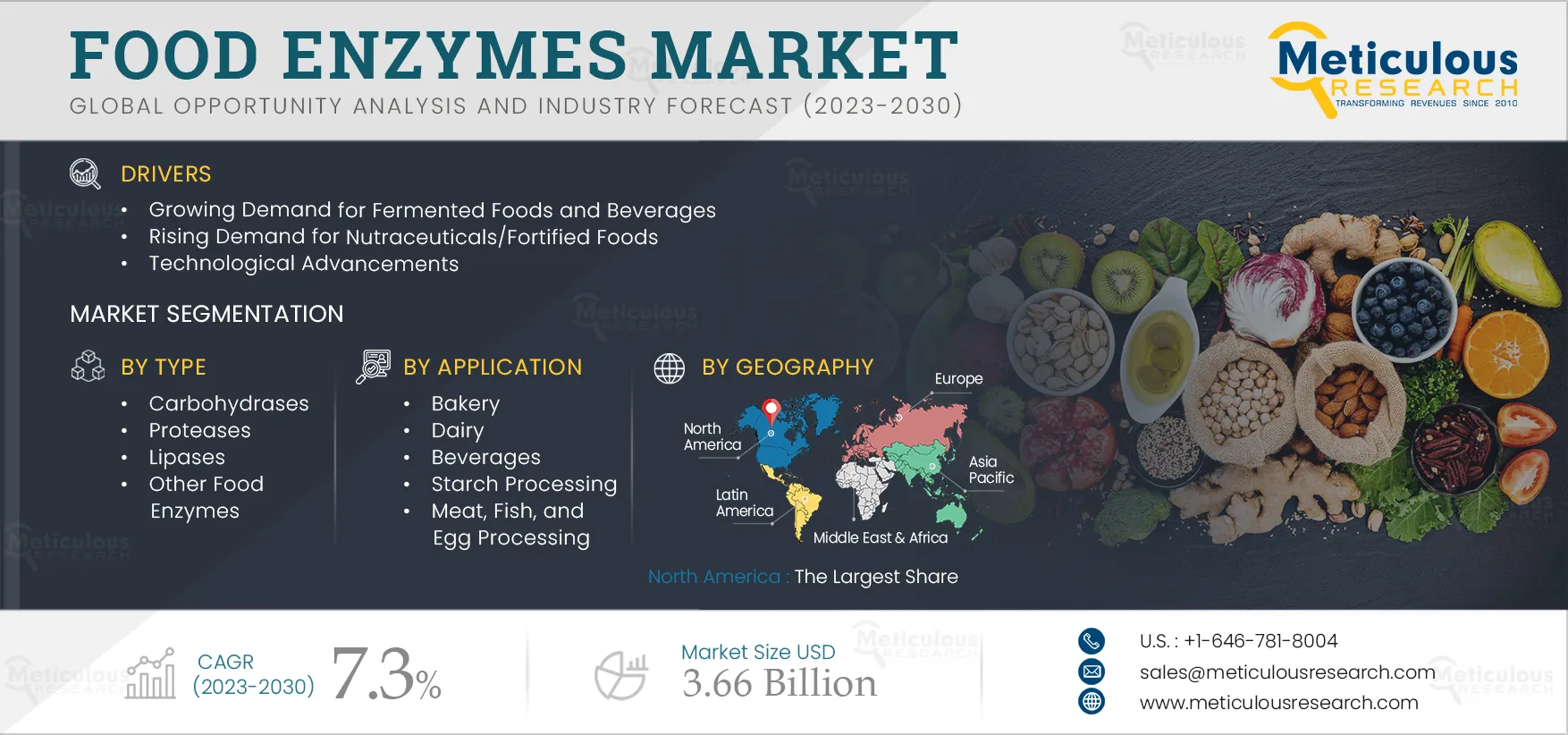
The popularity of food enzymes is rising as they help improve the safety and quality of foods and the efficiency of food manufacturing processes. The food enzymes market is driven by the growing demand for fermented foods and beverages, nutraceuticals, and fortified foods, coupled with technological innovations in the enzymatic food processing industry. However, stringent regulations and the restrictive temperatures and pH levels of enzymes are expected to restrain the growth of this market.
Report infographic
Market dynamics
1 factors across 1 forceGrowing Demand for Fermented Foods and Beverages
Fermented food and beverages are obtained through the fermentation process in which microorganisms such as yeast and bacteria break down food components (e.g., sugars such as glucose) into other products (e.g., organic acids, gases, or alcohol). Fermentation provides foods with a unique and desirable taste, aroma, texture, and appearance.
Nowadays, consumers’ growing health consciousness is driving the demand for fermented foods and beverages. The beneficial bacteria in fermented foods and beverages offer several health benefits. Fermented foods/drinks help improve gut functionality. Digestive disorders, obesity, and diabetes are major concerns for consumers. As a result, they have become more conscious about their food habits and preferences.
Fermented food and beverage products also help prevent metabolic disorders and improve overall health. Furthermore, fermented food products, like sauerkraut, kombucha, and kefir, are gaining popularity among consumers due to their anti-inflammatory, antioxidant, anti-diabetic, and anti-fungal properties. In addition, consumers prefer fermented beverages like Kvass (a fermented cereal-based non-alcoholic beverage) as they are nutritious, natural, delicious, and fit their healthy lifestyles. Furthermore, in September 2022, the Ministry of Agriculture and Food Security of France launched the $48.9 million (€48.3 million) publicly funded ‘Ferments du Futur’ initiative for the agri-food sector to develop natural fermentation techniques that will accelerate the agricultural and food revolution. All these factors are expected to drive the demand for fermented foods, boosting the food enzymes market.
Table of contents
12 chapters · 106 sections · 170 pages · click to expandSegmental analysis
| Segment | Largest share (2023) | Fastest growth (2023–2030) |
|---|---|---|
| By Type | Carbohydrases | — |
| By Form | — | Rapid growth of this |
| By Source | Microorganisms | — |
| By Application | Bakery | — |
By Type
- The food enzymes market is segmented into (carbohydrases [amylases, cellulases, and other carbohydrases], proteases, lipases, and other food enzymes).
- The carbohydrases segment is expected to account for the largest share of the food enzymes market.
- The segment’s large market share is attributed to the wide range of applications of carbohydrases in the food & beverage industry, such as the manufacture of bakery products, beer, and dairy products.
- The low costs of carbohydrases are further expected to boost the growth of this segment.
By Form
- The food enzymes market is segmented into (liquid and solid).
- The solid segment is slated to register the higher CAGR during the forecast period.
- The rapid growth of this segment is attributed to the rising demand for solid food enzymes due to their benefits such as ease of handling, high gravity fermentation & stability, easy transportation & storage, and longer shelf life.
By Source
- The food enzymes market is segmented into (microorganisms [fungi, bacteria, and yeast], animals, and plants).
- The microorganisms segment is expected to account for the largest share of the food enzymes market.
- The large market share of this segment is attributed to the high stability, cost-effectiveness, lower time & space requirements, and higher consistency of microorganism-derived food enzymes and their increasing utilization in the manufacture of food & beverage products, pharmaceuticals, animal feed, glucose syrups, crystalline glucose, high-fructose corn syrups, and maltose syrups.
By Application
- The food enzymes market is segmented into (bakery, dairy, beverages [non-alcoholic beverages, brewing, and alcohol production], fruit and vegetable processing, starch processing, meat, fish and egg processing, grain & oilseed processing, and other food applications).
- The bakery segment is expected to account for the largest share of the food enzymes market.
- The large market share of this segment is attributed to the high utilization of food enzymes in the manufacture of bakery products, the increasing consumption of bakery products, growing urbanization, and innovations in the bakery industry.
Geographic analysis
North America
Largest shareThe food enzymes market is segmented into five major regions—North America, Europe, Asia-Pacific, Latin America, and the Middle East & Africa. In 2023, North America is expected to account for the largest share of the food enzymes market. North America’s large share is attributed to technological advancements in the food industry, the increasing diversity of enzyme applications, the high availability of novel and innovative products, rapid industrialization, the increasing demand for alcoholic beverages and processed foods, and growing awareness regarding green technologies. North America to Dominate the Food Enzymes Market in 2023
Asia-Pacific
Fastest growthHowever, Asia-Pacific is slated to register the highest CAGR during the forecast period. The growth of this regional market is driven by increasing government initiatives to improve food processing, technological advancements in the food & beverage industry, growing demand for processed foods, economic growth, wide availability of raw materials, and rising investments & expansions by major market players.
Competitive landscape
- Fragrances Inc.
- Koninklijke DSM N.V.
- BASF SE
- Enzymes GmbH
- Amano Enzyme Inc.
- Kemin Industries, Inc.
- Advanced Enzyme Technologies Limited
- Biocatalysts Limited
- Enzyme Development Corporation
Frequently asked questions
The food enzymes market is projected to reach $3.66 billion by 2030, at a CAGR of 7.3% from 2023 to 2030.
Cite this report
Meticulous Research. (2023). Food Enzymes Market - Global Opportunity Analysis and Industry Forecast (2023-2030) (Report No. MRFB - 104242). Meticulous Market Research Pvt. Ltd. https://www.meticulousresearch.com/product/food-enzymes-market-4955