Federated Genomics Analysis Market (2026-2036)
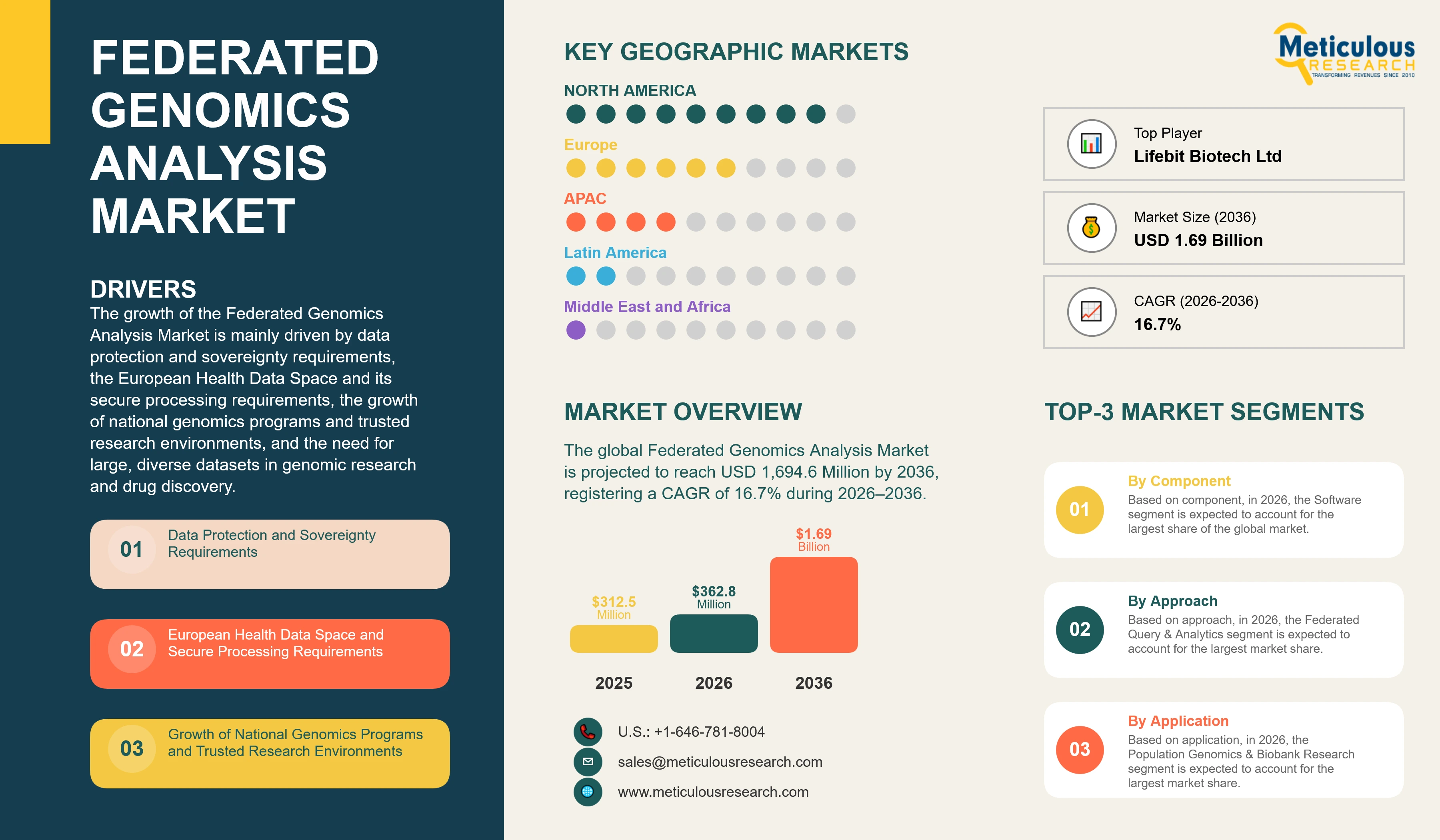
The global Federated Genomics Analysis Market was valued at USD 312.5 million in 2025. This market is expected to reach USD 1,694.6 million by 2036 from an estimated USD 362.8 million in 2026, registering a CAGR of 16.7% during the forecast period (2026-2036).
- Published
- Oct 2026
- Pages
- 318
- Format
- PDF + Excel
- Report ID
- MRHC - 1042355
- Base year
- 2025
- 2025 · BASELINE
- $312.5M
- 2036
- $1.69B
- CAGR 2026–2036
- 16.7%
2025 baseline · 2026–2036 forecast at 16.7% CAGR · hover a bar for the value
Key highlights
The global Federated Genomics Analysis Market is projected to reach USD 1, 694.6 million by 2036, driven by data sovereignty requirements, the European Health Data Space, national genomics programs, pharmaceutical data collaboration, and federated AI.
Regulation is making secure, non-download data access the norm in Europe. Under the European Health Data Space (EHDS) Regulation (EU) 2025/327, published in March 2025, EU Member States must designate health data access bodies by March 2027, and by March 2029 these bodies must provide secure processing environments in which the download of personal data is strictly prohibited and only aggregated or anonymized results may be extracted; human genetic, genomic, and other molecular data must become discoverable and available for secondary use by March 2031.
Cross-border genomic data infrastructure is becoming operational. Under the European Genomic Data Infrastructure (GDI) project of the 1+ Million Genomes initiative, 15 countries have securely connected national genomic data services to a common European portal, enabling cross-border data discovery through a genome allele frequency browser and dataset catalogue, and national nodes are being harmonized to prepare for federated gene variant lookups.
Europe is expected to account for the largest market share in 2026, supported by the EHDS, the Genomic Data Infrastructure, U.K. trusted research environments, and leading federated platform providers, while Asia-Pacific is projected to register the fastest growth during the forecast period.
By approach, Federated Query & Analytics is expected to account for the largest market share in 2026, whereas Federated Learning is projected to witness the fastest growth through 2036, as pharmaceutical companies and research consortia train AI models on distributed genomic and clinical data without moving it.
Report summary
| Particulars | Details |
|---|---|
| Forecast Period | 2026-2036 |
| Base Year | 2025 |
| Estimated Year | 2026 |
| CAGR (Value) | 16.7% |
| Format | PDF, Excel & Cloud Portal · 318 pages |
| Market Size (Value) in 2026 | USD 362.8 Million |
| Market Size (Value) in 2036 | USD 1,694.6 Million |
| Segments Covered | By Component: Software (Federated Analysis & Trusted Research Environment Platforms, Federated Learning Platforms & Frameworks, Privacy-Enhancing Technology Software, Data Discovery, Access & Governance Tools), Services (Implementation & Node Deployment Services, Data Harmonization Services, Managed Services). By Approach: Federated Query & Analytics, Federated Learning, Privacy-Enhancing Computation. By Network Model: Single-Institution Trusted Research Environments, National & Multi-Institution Networks, Cross-Border & International Networks, Industry-Biobank Consortia. By Application: Population Genomics & Biobank Research, Drug Target Discovery & AI Model Development, Rare Disease Research & Diagnosis, Oncology Research, Clinical Trial Feasibility & Real-World Evidence, Pathogen Genomics & Public Health Surveillance. By End User: Government Agencies, National Genomics Programs & Biobanks, Pharmaceutical & Biotechnology Companies, Academic & Research Institutes, Hospitals & Health Systems. |
| Countries Covered | Europe: U.K., Germany, France, Netherlands, Nordic Countries, Spain, Italy, Rest of Europe. North America: U.S., Canada. Asia-Pacific: China, Japan, South Korea, Singapore, Australia, India, Rest of Asia-Pacific. Latin America: Brazil, Mexico, Rest of Latin America. Middle East & Africa: Saudi Arabia, UAE, Qatar, Rest of Middle East & Africa. |
| Key Companies | Lifebit Biotech Ltd, DNAnexus, Inc., Velsera, Inc., Aridhia Informatics Ltd, Apheris GmbH, Rhino Federated Computing, Inc., Owkin, Inc., NVIDIA Corporation, Amazon Web Services, Inc., and Google LLC (Google Cloud). |
Report overview
Segments covered: component, approach, network model, application, end user.
The growth of this market is mainly driven by data protection and sovereignty requirements that prevent genomic data from being centralized or transferred across borders, regulatory frameworks such as the European Health Data Space that require secure processing environments for the secondary use of health data, the growth of national genomics programs and biobanks that provide data through trusted research environments, and the need of researchers and pharmaceutical companies to analyze genomic data across many sources to achieve statistical power and population diversity. In addition, the growth of federated learning for artificial intelligence (AI) model development, the adoption of privacy-enhancing technologies, the development of interoperability standards by the Global Alliance for Genomics and Health (GA4GH), and the expansion of cross-border genomic data infrastructures are further supporting the growth of this market.
The Federated Genomics Analysis Market, also referred to as the federated genomic data analysis market, federated trusted research environment market, or privacy-preserving genomic analytics market, comprises the software platforms and services that allow genomic and associated health data held in separate locations to be discovered, queried, analyzed, and used to train models without the data being moved or pooled in a single repository. The market includes federated data analysis and trusted research environment platforms that connect multiple data holders; federated query and data discovery tools, such as variant lookup, allele frequency browsers, and dataset catalogs; federated statistical analysis, such as distributed genome-wide association studies; federated learning frameworks and platforms for AI model training; privacy-enhancing technologies, such as secure multiparty computation, homomorphic encryption, differential privacy, and confidential computing; data access, identity, and governance tools based on GA4GH standards; and implementation, node deployment, data harmonization, and managed services. The market ecosystem extends from federated platform and privacy technology providers and cloud providers to national genomics programs, biobanks, hospitals and health systems, pharmaceutical and biotechnology companies, research consortia, and academic institutions.
Federation addresses a central problem in genomics. The value of genomic data increases with the size and diversity of the dataset, as many discoveries require hundreds of thousands to millions of genomes from diverse populations. At the same time, genomic data are highly sensitive and potentially identifiable, and data protection laws, national security considerations, and public trust increasingly prevent data from being copied, centralized, or transferred across borders. Federated approaches resolve this tension by bringing analysis to the data: queries, algorithms, and models are sent to each data location, and only aggregated or approved results are returned.
Europe is leading the shift toward federation through regulation and infrastructure. Under the European Health Data Space (EHDS) Regulation (EU) 2025/327, published in March 2025, EU Member States must designate health data access bodies by March 2027, and by March 2029 these bodies must provide secure processing environments in which the download of personal data is strictly prohibited and only aggregated or anonymized results may be extracted; human genetic, genomic, and other molecular data must become discoverable and available for secondary use by March 2031. Under the European Genomic Data Infrastructure (GDI) project of the 1+ Million Genomes initiative, 15 countries have securely connected national genomic data services to a common European portal, enabling cross-border data discovery through a genome allele frequency browser and dataset catalogue, and national nodes are being harmonized to prepare for federated gene variant lookups. These frameworks establish secure processing and federated access as the standard model for the secondary use of genomic and health data in the EU, creating long-term demand for federated platforms, nodes, and services in every Member State.
National programs and biobanks are adopting trusted research environments as the main mode of access. In the U.K., Our Future Health, the largest health research program in the country, has recruited more than 2.02 million participants and genotyped 755,000 of them, with genotype array, imputed genotype, and genetic ancestry data accessible only within its Trusted Research Environment (TRE). In June 2026, the All of Us Research Program of the U.S. National Institutes of Health (NIH) expanded its dataset to 535,000 whole-genome sequences linked to nearly 482,000 electronic health records, accessed by approved researchers within its cloud-based Researcher Workbench rather than through data download. Genomics England provides access to its data through a research environment, and biobanks in the U.K., the Nordic countries, and elsewhere have adopted similar models. Connecting these trusted research environments through federation allows researchers to analyze data across programs while each data holder retains control.
Pharmaceutical companies are a major and growing source of demand. Drug discovery increasingly depends on human genetic evidence from large, diverse cohorts, and pharmaceutical companies want to analyze data from multiple biobanks, hospitals, and national programs. Federated platforms allow companies to run analyses and train AI models on data they cannot access directly, and federated learning is being applied in consortia for drug discovery and biologics engineering. These collaborations generate recurring demand for federated infrastructure and services.
The market includes federated genomics and trusted research environment providers such as Lifebit, DNAnexus, Velsera, and Aridhia Informatics; federated learning and privacy technology providers such as Apheris, Rhino Federated Computing, Owkin, and NVIDIA, which develops the open-source NVIDIA FLARE federated learning framework; and cloud providers such as Amazon Web Services (AWS) and Google Cloud, which provide the infrastructure on which many federated nodes run. These companies compete on security and governance, compliance with national and regional regulations, interoperability with GA4GH standards, scalability across many nodes, support for genomic analysis workflows and AI, and experience with national programs and pharmaceutical consortia.
At the same time, the market faces challenges, including the complexity of harmonizing data formats, ontologies, and quality across data holders, the technical and computational overhead of federated analysis compared with centralized analysis, differences in legal and ethical approval processes between institutions and countries, the limited number of production-scale cross-border federated networks, and the need to prove that federated methods produce results equivalent to pooled analysis. As a result, companies that combine robust security and governance, standards-based interoperability, scalable deployment across sovereign environments, data harmonization services, and support for both statistical genomics and AI are expected to capture the largest share of growth over the forecast period.
Report infographic
Market dynamics
15 factors across 5 forcesData Protection and Sovereignty Requirements
Data protection and sovereignty requirements are a major factor driving the Federated Genomics Analysis Market, as they increasingly prevent genomic data from being centralized or transferred across institutional and national boundaries. Genomic data are considered sensitive personal data under the EU General Data Protection Regulation (GDPR) and similar laws in many countries, and several countries restrict the export of human genetic data or require it to be stored domestically. National genomics programs often commit to participants that their data will remain under national control.
These requirements make traditional data-sharing models, in which datasets are copied to a central repository, increasingly difficult. Federated analysis allows data to remain in place while still being used for research, and it is often the only model acceptable to data holders, regulators, and the public. As more countries adopt data localization rules and national genomics programs grow, demand for federated approaches is expected to increase.
European Health Data Space and Secure Processing Requirements
The European Health Data Space and its secure processing requirements are significantly driving market growth. Under the European Health Data Space (EHDS) Regulation (EU) 2025/327, published in March 2025, EU Member States must designate health data access bodies by March 2027, and by March 2029 these bodies must provide secure processing environments in which the download of personal data is strictly prohibited and only aggregated or anonymized results may be extracted; human genetic, genomic, and other molecular data must become discoverable and available for secondary use by March 2031. Health data access bodies in each Member State will need secure processing environments, and the HealthData@EU cross-border infrastructure will connect national nodes. Under the European Genomic Data Infrastructure (GDI) project of the 1+ Million Genomes initiative, 15 countries have securely connected national genomic data services to a common European portal, enabling cross-border data discovery through a genome allele frequency browser and dataset catalogue, and national nodes are being harmonized to prepare for federated gene variant lookups. These requirements create demand for federated platforms, node deployment, and services across the EU over the forecast period.
Growth of National Genomics Programs and Trusted Research Environments
The growth of national genomics programs and trusted research environments is an important driver of demand. In the U.K., Our Future Health, the largest health research program in the country, has recruited more than 2.02 million participants and genotyped 755,000 of them, with genotype array, imputed genotype, and genetic ancestry data accessible only within its Trusted Research Environment (TRE). In June 2026, the All of Us Research Program of the U.S. National Institutes of Health (NIH) expanded its dataset to 535,000 whole-genome sequences linked to nearly 482,000 electronic health records, accessed by approved researchers within its cloud-based Researcher Workbench rather than through data download. Programs in the U.K., the U.S., the Nordic countries, the Middle East, and Asia-Pacific provide data through trusted research environments rather than by distributing copies. As the number of programs grows, researchers and pharmaceutical companies increasingly need to analyze data across them, which requires federation between trusted research environments.
Need for Large, Diverse Datasets in Genomic Research and Drug Discovery
The need for large and diverse datasets in genomic research and drug discovery supports market growth. Discovering genetic associations with rare variants, studying rare diseases, and ensuring that findings apply to all populations require data from many cohorts and countries. Drug targets supported by human genetic evidence are more likely to succeed in clinical development, and pharmaceutical companies seek access to as many diverse cohorts as possible. Federated analysis allows these datasets to be combined analytically without being combined physically, and federated genome-wide association studies and meta-analyses are increasingly used across consortia.
Table of contents
13 chapters · 149 sections · 318 pages · click to expandSegmental analysis
| Segment | Largest share (2026) | Fastest growth (2026–2036) |
|---|---|---|
| By Component | Software | Services |
| By Approach | Federated Query & Analytics | Federated Learning |
| By Network Model | National & Multi-Institution Networks | Cross-Border & International Networks |
| By Application | Population Genomics & Biobank Research | Drug Target Discovery & AI Model Development |
| By End User | Government Agencies, National Genomics Programs & Biobanks | Pharmaceutical & Biotechnology Companies |
By Component
- Federated Genomics Analysis Market Analysis by Component
- Software is further segmented into Federated Analysis & Trusted Research Environment Platforms, Federated Learning Platforms & Frameworks, Privacy-Enhancing Technology Software, and Data Discovery, Access & Governance Tools, while Services are further segmented into Implementation & Node Deployment Services, Data Harmonization Services, and Managed Services.
- The Software segment is expected to account for the largest share of the global Federated Genomics Analysis Market.
- The large share of this segment is mainly due to the adoption of federated analysis and trusted research environment platforms by national genomics programs, biobanks, and health systems, the subscription-based nature of platform revenue, and the deployment of data discovery and access management tools across federated networks.
- However, the Services segment is projected to register the highest CAGR during the forecast period.
- The rapid growth of this segment is attributed to the complexity of deploying and connecting federated nodes, the need for data harmonization across data holders, the implementation of secure processing environments under the EHDS, and the demand for managed operation of federated networks by national programs and consortia.
By Approach
- Federated Genomics Analysis Market Analysis by Approach
- Federated Query & Analytics includes federated data discovery, variant lookup, and federated statistical analysis, while Privacy-Enhancing Computation includes secure multiparty computation, homomorphic encryption, differential privacy, and confidential computing.
- The Federated Query & Analytics segment is expected to account for the largest share of the market.
- The large share of this segment is mainly due to the established use of federated data discovery and variant lookup in genomic networks, the use of federated genome-wide association studies and meta-analyses in research consortia, and the focus of national infrastructures such as the GDI on data discovery and federated variant queries.
- However, the Federated Learning segment is projected to register the highest CAGR during the forecast period.
- The rapid growth of this segment is attributed to the growing use of AI in drug discovery and genomic medicine, the need to train models on distributed datasets that cannot be shared, the formation of pharmaceutical and hospital consortia for federated AI, and the availability of federated learning frameworks such as NVIDIA FLARE.
By Network Model
- Federated Genomics Analysis Market Analysis by Network Model
- The National & Multi-Institution Networks segment is expected to account for the largest share of the market.
- The large share of this segment is mainly due to the deployment of federated platforms by national genomics programs, national health research infrastructures, and networks of hospitals and research institutes, such as federated research environments in the U.K. and the Nordic countries.
- However, the Cross-Border & International Networks segment is projected to register the highest CAGR during the forecast period.
- The rapid growth of this segment is attributed to the implementation of the EHDS and HealthData@EU, the connection of national nodes through the GDI, the growth of international research consortia for rare diseases and diverse populations, and the demand of pharmaceutical companies for access to data across countries.
By Application
- Federated Genomics Analysis Market Analysis by Application
- The Population Genomics & Biobank Research segment is expected to account for the largest share of the market.
- The large share of this segment is mainly due to the large number of researchers using national programs and biobanks such as Our Future Health, All of Us, UK Biobank, and Genomics England through trusted research environments, and the use of federated analysis to combine population cohorts for genetic association studies.
- However, the Drug Target Discovery & AI Model Development segment is projected to register the highest CAGR during the forecast period.
- The rapid growth of this segment is attributed to the value of human genetic evidence for drug development, the demand of pharmaceutical companies for access to diverse cohorts across multiple data holders, and the use of federated learning to train AI models for target discovery and biologics engineering.
By End User
- Federated Genomics Analysis Market Analysis by End User
- The Government Agencies, National Genomics Programs & Biobanks segment is expected to account for the largest share of the market.
- The large share of this segment is mainly due to their investment in trusted research environments and federated infrastructure, their responsibility for protecting participant data, and requirements such as the EHDS that oblige public bodies to provide secure processing environments.
- However, the Pharmaceutical & Biotechnology Companies segment is projected to register the highest CAGR during the forecast period.
- The rapid growth of this segment is attributed to the growing use of federated access to biobank and national program data for target discovery, the formation of industry-biobank consortia, and the adoption of federated learning for AI model development.
Geographic analysis
Europe
Largest shareIn 2026, Europe is expected to account for the largest share of the global Federated Genomics Analysis Market. The large share of this region is mainly attributed to the EHDS and its requirements for secure processing environments, the GDI and the 1+ Million Genomes initiative, strict data protection under the GDPR, the adoption of trusted research environments by U.K. programs such as Our Future Health and Genomics England, and the presence of federated platform providers such as Lifebit, Aridhia Informatics, Apheris, and Owkin. Under the European Genomic Data Infrastructure (GDI) project of the 1+ Million Genomes initiative, 15 countries have securely connected national genomic data services to a common European portal, enabling cross-border data discovery through a genome allele frequency browser and dataset catalogue, and national nodes are being harmonized to prepare for federated gene variant lookups.
North America
North America is expected to account for a significant share of the market, supported by large programs such as All of Us, which provides data access through its cloud-based Researcher Workbench, pharmaceutical demand for federated access to diverse data, hospital and academic federated learning networks, and the presence of companies such as DNAnexus, Velsera, Rhino Federated Computing, NVIDIA, AWS, and Google Cloud. In June 2026, the All of Us Research Program of the U.S. National Institutes of Health (NIH) expanded its dataset to 535,000 whole-genome sequences linked to nearly 482,000 electronic health records, accessed by approved researchers within its cloud-based Researcher Workbench rather than through data download.
Asia-Pacific
Fastest growthAsia-Pacific is projected to register the highest CAGR during the forecast period. The growth of this region is driven by national genome programs in Singapore, Japan, South Korea, Australia, and China, strict data localization requirements, including restrictions on the export of human genetic data in China, and the growing participation of Asian cohorts in international research and pharmaceutical collaborations, which require federated access to keep data in-country.
Latin America
Latin America and the Middle East & Africa are expected to account for smaller shares of the market.
Middle East & Africa
In the Middle East, national genome programs in Saudi Arabia, the UAE, and Qatar, combined with data localization requirements, are expected to create demand for federated platforms, while in Latin America and Africa, federated approaches are expected to support the inclusion of underrepresented populations in genomic research.
Competitive landscape
The global Federated Genomics Analysis Market is fragmented and emerging, with federated genomics and trusted research environment providers, federated learning and privacy technology companies, genomic data platform companies, and cloud providers participating across applications and regions. Market participants compete primarily on security and governance, compliance with national and regional regulations, interoperability with GA4GH standards, scalability across many nodes, support for genomic analysis workflows and AI, and experience with national programs and pharmaceutical consortia.
Leading companies are deploying trusted research environments for national programs, connecting environments through federation, adding federated learning and privacy-enhancing technologies, adopting GA4GH standards, and forming partnerships with biobanks, health systems, and pharmaceutical companies. Recent market context includes the connection of 15 national data services to the European GDI portal, the expansion of the All of Us dataset in June 2026, the release of genetic ancestry data by Our Future Health in May 2026, and the USD 15 million Series A funding of Rhino Federated Computing in 2025.
The report provides a comprehensive competitive assessment of the leading companies operating in the global Federated Genomics Analysis Market. The key players profiled in the report include Lifebit Biotech Ltd (U.K.), DNAnexus, Inc. (U.S.), Velsera, Inc. (U.S.), Aridhia Informatics Ltd (U.K.), Apheris GmbH (Germany), Rhino Federated Computing, Inc. (U.S.), Owkin, Inc. (France/U.S.), NVIDIA Corporation (U.S.), Amazon Web Services, Inc. (U.S.), and Google LLC (Google Cloud) (U.S.).
- Lifebit Biotech Ltd
- DNAnexus, Inc.
- Velsera, Inc.
- Aridhia Informatics Ltd
- Apheris GmbH
- Rhino Federated Computing, Inc.
- Owkin, Inc.
- NVIDIA Corporation
- Amazon Web Services, Inc.
- Google LLC · Google Cloud
Expert perspectives
The Federated Genomics Analysis Market is emerging because the two most important forces in genomics, the need for ever larger and more diverse datasets and the tightening of data protection and sovereignty, point in opposite directions, and federation is the way to reconcile them. With the EHDS prohibiting the download of personal data from secure processing environments, 15 countries connected to the European GDI portal, and programs such as Our Future Health and All of Us providing access only within trusted research environments, analysis is moving to the data. The binding constraint is shifting from access to individual datasets to the ability to analyze across many governed datasets efficiently and with trust.
Three structural changes are expected to shape competitive positions through 2036. First, regulation, led by the EHDS, is expected to make secure processing environments and federated access mandatory infrastructure, favoring providers with compliant, standards-based platforms. Second, federated learning is expected to become central as AI moves into drug discovery and genomic medicine, favoring providers that support both genomics workflows and AI at scale. Third, cross-border and industry-biobank networks are expected to create recurring demand for orchestration, harmonization, and governance services.
For companies planning entry or expansion, the most defensible positions over the forecast period are likely to be found in secure processing environments for EHDS health data access bodies, federated networks connecting biobanks to pharmaceutical users, federated learning for drug discovery, data harmonization services, and sovereign federated deployments in the Middle East and Asia-Pacific. For established providers, the principal priorities are interoperability with GA4GH standards, reducing the cost of deploying and operating nodes, and demonstrating that federated results match pooled analysis.
Overall, the market is expected to grow very strongly from a small base, with software, federated query and analytics, national and multi-institution networks, population genomics and biobank research, government agencies and national programs, and Europe providing the core of demand and services, federated learning, cross-border networks, drug target discovery and AI model development, pharmaceutical and biotechnology companies, and Asia-Pacific providing the fastest growth.
Customer perspectives
Insights gathered during primary interviews with national genomics program leaders, pharmaceutical human genetics leaders, and research infrastructure managers operating in this market highlight where procurement priorities are shifting. The following perspectives reflect recurring themes raised across these discussions.
“This reflects the role of federation in data sovereignty.”
“This indicates pharmaceutical demand for federated networks.”
“This points to harmonization as the main operational challenge.”
Frequently asked questions
The global Federated Genomics Analysis Market is estimated at USD 362.8 million in 2026.
Cite this report
Meticulous Research. (2026). Federated Genomics Analysis Market - - Global Opportunity Analysis And Industry Forecasts (2026-2036) (Report No. MRHC - 1042355). Meticulous Market Research Pvt. Ltd. https://www.meticulousresearch.com/product/federated-genomics-analysis-market-7038