Environmental Monitoring Market (2024-2031)
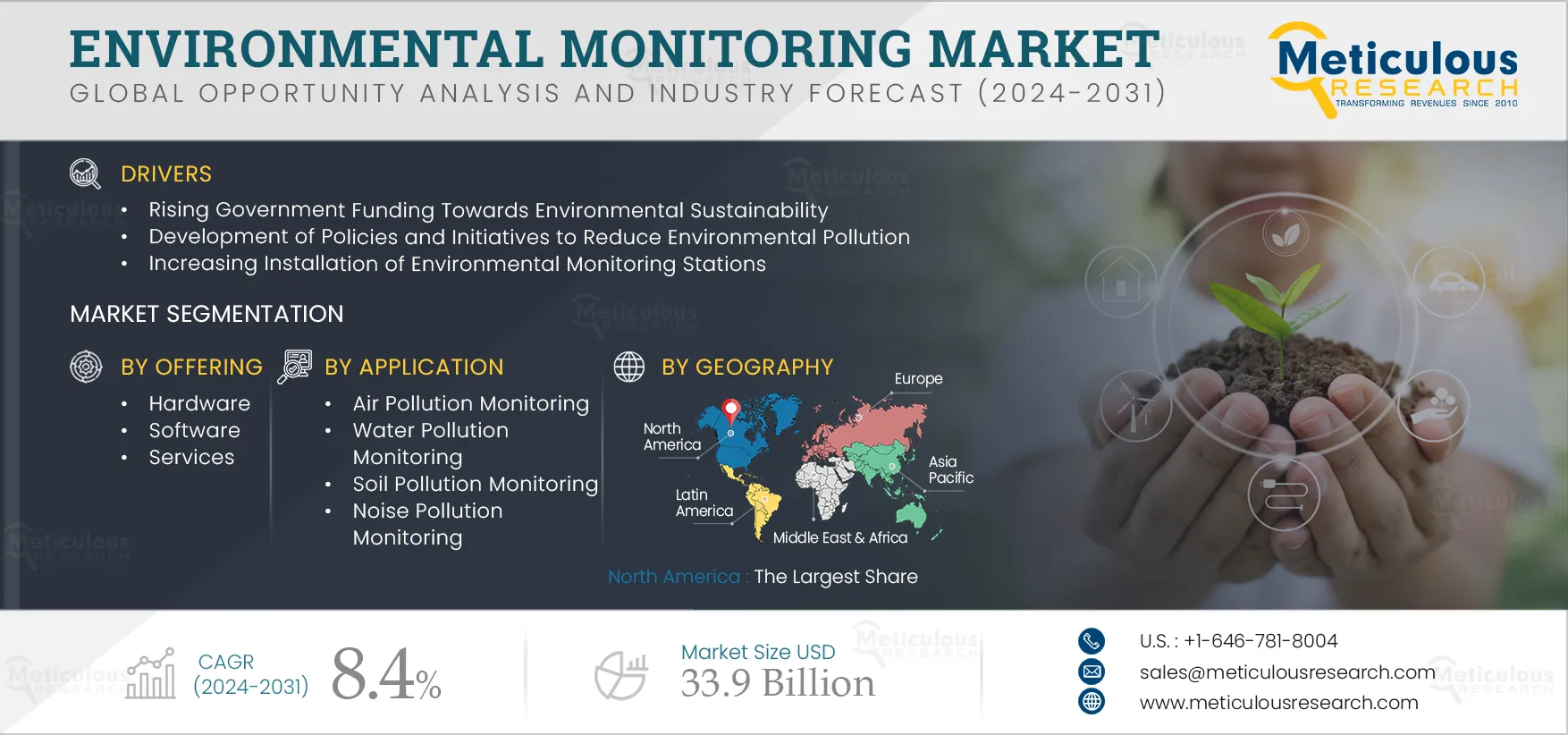
The Environmental Monitoring Market was valued at $18 billion in 2023. This market is expected to reach $33.9 billion by 2031 from an estimated $19.3 billion in 2024, at a CAGR of 8.4% during the forecast period 2024-2031 Environmental Monitoring Market Size & Forecast Key factors driving the growth
- Published
- Jun 2024
- Pages
- 225
- Format
- PDF + Excel
- Report ID
- MR-324
- Base year
- 2023
- 2023 · BASELINE
- $18.00B
- 2031
- $33.90B
- CAGR 2024–2031
- 8.4%
2023 baseline · 2024–2031 forecast at 8.4% CAGR · hover a bar for the value
Key highlights
By Offering: In 2024, the Hardware Segment to Dominate the Environmental Monitoring Market
By Sampling Method: In 2024, the Continuous Monitoring Segment to Dominate the Environmental Monitoring Market
By Application: In 2024, the Air Pollution Monitoring Segment to Dominate the Environmental Monitoring Market
By End User: In 2024, the Industrial Segment to Dominate the Environmental Monitoring Market
Report summary
| Particulars | Details |
|---|---|
| Number of Pages | 225 |
| Format | |
| Forecast Period | 2024–2031 |
| Base Year | 2023 |
| CAGR | 8.4% |
| Market Size (Value) | USD 33.9 Billion by 2031 |
| Segments Covered | By Offering · Hardware · Sensors · Particulate & Gas Sensors · Chemical Sensors · Pressure Sensors · Humidity & Moisture Sensors · Temperature Sensors · Noise Sensors · Other Sensors · Monitors · Other Hardware · Software · Services · By Sampling Method · Continuous Monitoring · Intermittent Monitoring · Passive Monitoring · Active Monitoring · By Application · Air Pollution Monitoring · Water Pollution Monitoring · Soil Pollution Monitoring · Noise Pollution Monitoring · Other Applications · Bby End User · Residential · Government & Public Utilities · Commercial · Transportation & Logistics · Education · Healthcare · Other Commercial Sectors · Industrial · Automotive · Pharmaceutical · Oil & Gas · Consumer Electronics · Chemicals · Other Industries |
| Countries Covered | North America (U.S., Canada), Europe (Germany, U.K., France, Italy, Spain, Sweden, Denmark, and Rest of Europe), Asia-Pacific (China, Japan, India, South Korea, Singapore, Malaysia, Indonesia, and Rest of Asia-Pacific), Latin America (Brazil, Mexico, and Rest of Latin America), and Middle East & Africa (UAE, Israel, Rest of Middle East & Africa) |
| Key Companies | Danaher Corporation (U.S.), Thermo Fisher Scientific Inc. (U.S.), Merck KGaA (Germany), Agilent Technologies, Inc. (U.S.), TE Connectivity Ltd. (Switzerland), Siemens AG (Germany), Emerson Electric Co. (U.S.), Honeywell International Inc. (U.S.), Teledyne Technologies Incorporated (U.S.), Horiba, Ltd (Japan), Shimadzu Corporation (Japan), Testo SE & Co. KGaA (Germany), ACOEM Group (France), and Halma plc (U.K.). |
Report overview
Segments covered: offering, sampling, application, end user. Regions: North America, Europe, Asia-Pacific, Latin America, Middle East & Africa.
Key factors driving the growth of the environmental monitoring stations market include rising government investments aimed at promoting environmental sustainability, the formulation of policies and initiatives aimed at curbing pollution, and an increase in the installation of environmental monitoring stations. However, trade constraints on environmental technologies in developing countries and the gradual pace of adopting & enforcing pollution control policies restrain the growth of this market.
Furthermore, the incorporation of IoT and nanotechnology into environmental monitoring systems and the increasing deployment of unmanned aerial vehicles for monitoring purposes are anticipated to offer opportunities for market growth. However, the high costs of implementing environmental monitoring solutions pose challenges to the market's growth.
Report infographic
Market dynamics
4 factors across 3 forcesRising Government Investments Aimed at Promoting Environmental Sustainability
In recent years, taking decisive action to achieve environmental sustainability has become crucial globally. Key practices to promote sustainability include protecting renewable resources by adopting sustainable agriculture, buying from local farmers, purchasing carbon offsets to support reforestation and other regenerative projects, shifting away from fossil fuels in favor of renewable energy sources, and supporting clean air and water initiatives. Governments and organizations worldwide are increasingly investing in efforts to reduce carbon footprints and foster an environmentally sustainable economy.
Various green investment banks (GIBs), such as the UK Green Investment Bank, Malaysian Green Technology Corporation (GreenTech Malaysia), Connecticut Green Bank, Clean Energy Finance Corporation (CEFC), and California CLEEN Center, are focusing on investing in and funding projects that have the potential to reduce greenhouse gas (GHG) emissions.
Formulation of Policies and Initiatives Aimed At Curbing Pollution
Government regulations and policies are essential for shaping and improving a country’s environmental conditions. International agreements tackle major global issues such as air and water pollution, hazardous waste management, and climate change. However, since no single policy can address all environmental challenges, the number of policies has increased to handle more complex issues and meet future emission reduction goals. For instance, the Paris Climate Agreement and the 2030 Agenda have progressively adapted to address these growing environmental challenges.
Table of contents
12 chapters · 132 sections · 225 pages · click to expandSegmental analysis
| Segment | Largest share (2024) | Fastest growth (2024–2031) |
|---|---|---|
| By Offering | Hardware | — |
| By Sampling Method | Continuous Monitoring | — |
| By Application | Air Pollution Monitoring | — |
| By End User | Industrial | — |
By Offering
- The Hardware Segment to Dominate the Environmental Monitoring Market
- The hardware segment is expected to dominate the environmental monitoring market with over 78.0% of the total share.
- This segment’s significant market share can be attributed to the increasing installation of environmental monitoring stations, the growing application of environmental sensors in the industrial sector, and the implementation of stringent regulations aimed at lowering environmental pollution.
- However, the solutions segment is slated to register the highest compound annual growth rate during the forecast period.
- This growth is driven by the increasing adoption of environmental monitoring solutions by organizations in the industrial sector to better manage and reduce their environmental impact and the initiatives by market players to develop innovative environmental monitoring technologies.
By Sampling Method
- The continuous monitoring segment is expected to dominate the environmental monitoring market with over 47.5% of the total share.
- This segment’s significant market share can be attributed to the benefits offered by continuous monitoring systems, which include rapid pollutant analysis, real-time detection of changes in pollutant levels, and the facilitation of swift corrective actions.
- Furthermore, the continuous monitoring segment is slated to register the highest compound annual growth rate during the forecast period.
By Application
- The air pollution monitoring segment is expected to dominate the environmental monitoring market with over 42.5% of the total share.
- This segment’s significant market share can be attributed to increasing air pollution levels and the implementation of stringent guidelines & regulations for air quality control.
- Furthermore, the air pollution monitoring segment is slated to register the highest compound annual growth rate during the forecast period.
By End User
- The Industrial Segment to Dominate the Environmental Monitoring Market
- The industrial segment is expected to dominate the environmental monitoring market.
- This segment’s significant market share can be attributed to the increasing focus on predictive maintenance and remote monitoring, stringent government regulations on pollution monitoring in the industrial sector, and rapid industrialization globally.
- Furthermore, the industrial segment is slated to register the highest compound annual growth rate during the forecast period.
Geographic analysis
North America
Largest shareIn 2024, North America is expected to dominate the environmental monitoring market with over 34.4% of the total share. North America’s significant market share can be attributed to the widespread adoption of advanced monitoring technologies, stringent environmental regulations, and rising environmental protection initiatives in the region.
Asia-Pacific
However, the market in Asia-Pacific is slated to register the highest compound annual growth rate of over 9.0% during the forecast period. This growth is driven by the increasing implementation of stringent environmental regulations and the rising adoption of monitoring technologies among organizations in the industrial sector.
Competitive landscape
- March 2021
Thermo Fisher Scientific Inc. (U.S.) launched Thermo Scientific Orbitrap Exploris GC-MS for various applications, including environmental contaminants.
- January 2021
Teledyne Technologies Incorporated (U.S.) launched N series gas instruments for continuous emissions monitoring (CEM) applications.
- April 2021
ACOEM Group (France) launched Serinus 31, the next-generation carbon dioxide analyzer. Its non-dispersive infrared (NDIR) gas correlation spectroscopy ensures accurate, stable, and repeatable measurements of carbon dioxide in ambient air.
- Danaher Corporation (U.S.)
- Thermo Fisher Scientific Inc. (U.S.)
- Merck KGaA · Germany
- Agilent Technologies, Inc. (U.S.)
- TE Connectivity Ltd. · Switzerland
- Siemens AG · Germany
- Emerson Electric Co. (U.S.)
- Honeywell International Inc. (U.S.)
- Teledyne Technologies Incorporated (U.S.)
- Horiba, Ltd · Japan
- Shimadzu Corporation · Japan
- Testo SE & Co. KGaA · Germany
- ACOEM Group · France
- Halma plc (U.K.)
Frequently asked questions
This study focuses on market assessment and opportunity analysis by analyzing the sales of environmental monitoring solutions across various regions and countries. This study also offers a competitive analysis of the environmental monitoring market based on an extensive assessment of the leading players' product portfolios, geographic presence, and key growth strategies.
Cite this report
Meticulous Research. (2024). Environmental Monitoring Market - Global Opportunity Analysis and Industry Forecast (2024-2031) (Report No. MR-324). Meticulous Market Research Pvt. Ltd. https://www.meticulousresearch.com/product/environmental-monitoring-market-5024