Environmental DNA (eDNA) Market (2026-2036)
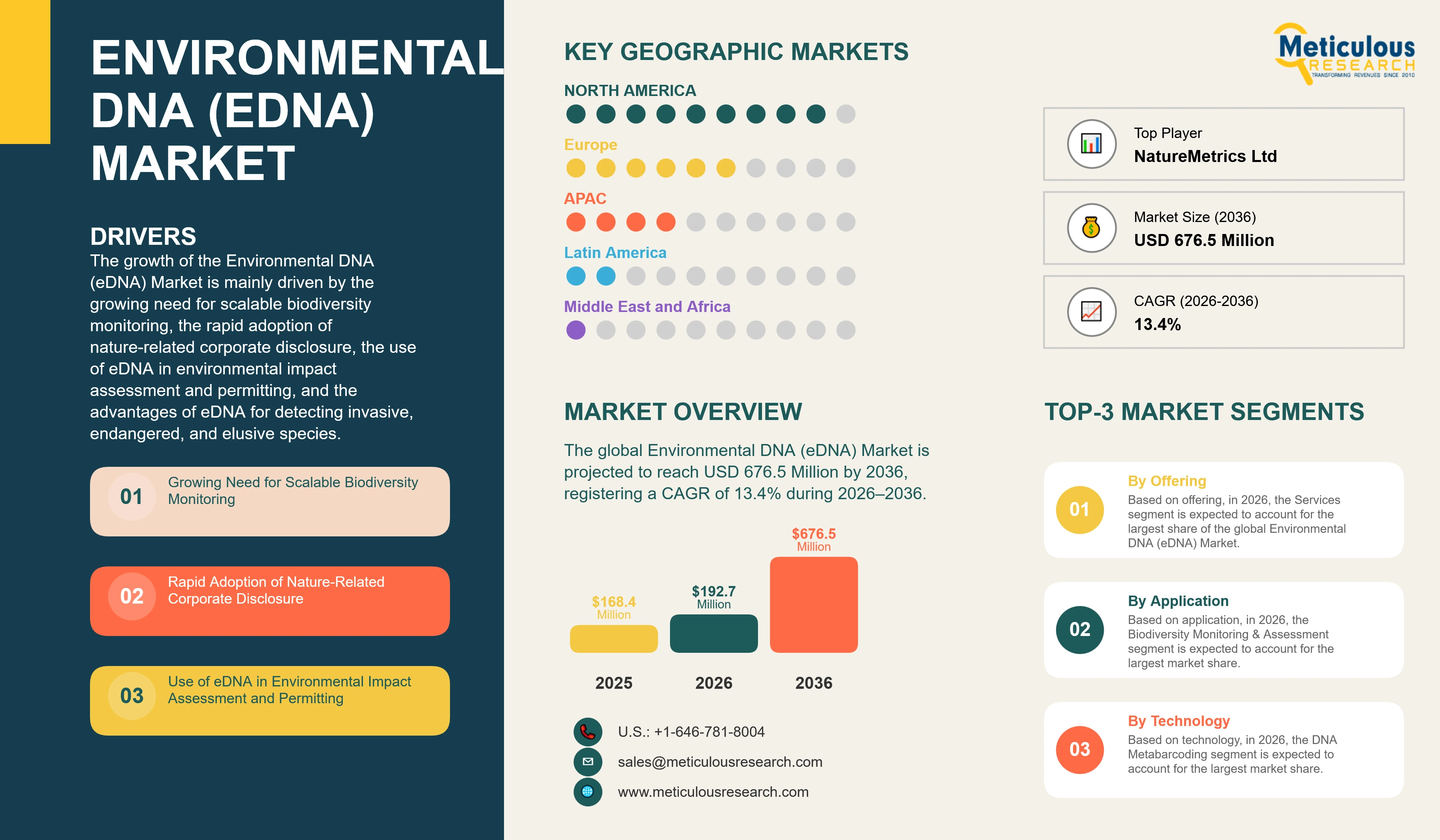
The global Environmental DNA (eDNA) Market was valued at USD 168.4 million in 2025. This market is expected to reach USD 676.5 million by 2036 from an estimated USD 192.7 million in 2026, registering a CAGR of 13.4% during the forecast period (2026-2036).
- Published
- Oct 2026
- Pages
- 367
- Format
- PDF + Excel
- Report ID
- MRHC - 1042360
- Base year
- 2025
- 2025 · BASELINE
- $168.4M
- 2036
- $676.5M
- CAGR 2026–2036
- 13.4%
2025 baseline · 2026–2036 forecast at 13.4% CAGR · hover a bar for the value
Key highlights
The global Environmental DNA (eDNA) Market is projected to reach USD 676.5 million by 2036, driven by biodiversity monitoring, nature-related disclosure, environmental impact assessment, invasive species detection, and international standardization.
Corporate demand for nature data is rising rapidly. According to the Taskforce on Nature-related Financial Disclosures (TNFD) 2026 Status Report, published in September 2026, more than 1,000 organizations from 56 countries and jurisdictions have published TNFD-aligned disclosures, roughly double the previous year, and 802 organizations have committed to adopt the TNFD recommendations, including financial institutions with USD 26.6 trillion in assets under management.
Standardization is supporting regulatory and commercial adoption. In July 2026, the International Organization for Standardization (ISO) published ISO 17805:2026, Water quality: Sampling, capture and preservation of environmental DNA from water, the first international standard for eDNA sampling, which sets out procedures for sampling, capturing, and preserving eDNA from aquatic environments, avoiding contamination, preserving DNA integrity, and reporting equipment and metadata.
Europe is expected to account for the largest market share in 2026, supported by EU and U.K. nature policies and leading eDNA service providers, while Asia-Pacific is projected to register the fastest growth during the forecast period. In January 2025, NatureMetrics, a leading eDNA biodiversity monitoring company that serves more than 600 organizations in 110 countries and operates laboratories in the U.K. and Canada and a partner laboratory in Indonesia, raised EUR 24.3 million in Series B funding led by Just Climate, EDF Pulse Ventures, and the Monaco ReOcean Fund to expand its AI-enhanced Nature Intelligence Platform.
By application, Biodiversity Monitoring & Assessment is expected to account for the largest market share in 2026, whereas Nature-Related Corporate Reporting & Nature Markets are projected to witness the fastest growth through 2036, as companies, investors, and nature credit schemes require verifiable biodiversity data.
Report summary
| Particulars | Details |
|---|---|
| Forecast Period | 2026-2036 |
| Base Year | 2025 |
| Estimated Year | 2026 |
| CAGR (Value) | 13.4% |
| Format | PDF, Excel & Cloud Portal · 367 pages |
| Market Size (Value) in 2026 | USD 192.7 Million |
| Market Size (Value) in 2036 | USD 676.5 Million |
| Segments Covered | By Offering: Services (Laboratory Analysis Services, Sampling & Survey Services), Kits & Consumables (Sampling & Filtration Kits, Extraction & Preservation Kits, Assays & Reagents), Instruments, Software & Data Platforms. By Technology: DNA Metabarcoding, qPCR & Digital PCR, Shotgun Metagenomics & Environmental RNA, Other Technologies. By Sample Type: Water (Freshwater, Marine Water), Soil & Sediment, Air, Other Samples. By Application: Biodiversity Monitoring & Assessment, Invasive & Endangered Species Detection, Environmental Impact Assessment & Permitting, Nature-Related Corporate Reporting & Nature Markets, Fisheries & Aquaculture Management, Water Quality & Ecosystem Health. By End User: Government & Environmental Agencies, Corporations (Energy & Utilities, Mining, Infrastructure & Construction, Food & Agriculture, Financial Institutions), Environmental Consultancies, Academic & Research Institutes, Conservation Organizations & NGOs. |
| Countries Covered | Europe: U.K., France, Germany, Netherlands, Nordic Countries, Rest of Europe. North America: U.S., Canada. Asia-Pacific: Japan, Australia, New Zealand, China, Indonesia, India, Rest of Asia-Pacific. Latin America: Brazil, Chile, Peru, Colombia, Rest of Latin America. Middle East & Africa: South Africa, Saudi Arabia, UAE, Rest of Middle East & Africa. |
| Key Companies | NatureMetrics Ltd, SPYGEN, Jonah Ventures LLC, Wilderlab NZ Ltd, Smith-Root, Inc., Illumina, Inc., Thermo Fisher Scientific Inc., Oxford Nanopore Technologies plc, and QIAGEN N.V. |
Report overview
Segments covered: offering, technology, sample type, application, end user.
The growth of this market is mainly driven by the growing need for scalable biodiversity monitoring to support national and international nature commitments, the rapid adoption of nature-related corporate disclosure frameworks, the increasing use of eDNA in environmental impact assessment and permitting for infrastructure, energy, and mining projects, and the advantages of eDNA in detecting invasive, endangered, and elusive species non-invasively. In addition, the publication of international standards for eDNA sampling, the declining cost of sequencing and the development of portable and autonomous samplers, the expansion of eDNA in fisheries and aquaculture management, and the integration of eDNA data with artificial intelligence (AI) and geospatial platforms are further supporting the growth of this market.
The Environmental DNA (eDNA) Market, also referred to as the eDNA biomonitoring market, eDNA biodiversity monitoring market, or environmental genomics for biodiversity market, comprises the services, kits and consumables, instruments, and software used to collect, analyze, and interpret DNA shed by organisms into water, soil, sediment, air, and other environmental samples. By detecting this DNA, eDNA methods can identify which species are present in an ecosystem without needing to see, capture, or disturb them. The market includes targeted species detection using quantitative PCR (qPCR) and digital PCR; community-level analysis using DNA metabarcoding with next-generation sequencing (NGS); emerging shotgun metagenomic and environmental RNA approaches; sampling equipment, filters, preservation, and extraction kits; autonomous and portable samplers; laboratory analysis services; and bioinformatics, reference databases, and data platforms. The market ecosystem extends from sequencing and PCR technology providers and sampling equipment manufacturers to specialized eDNA laboratories, environmental consultancies, government environmental and fisheries agencies, companies in energy, mining, infrastructure, water, and food sectors, financial institutions, conservation organizations, and research institutions.
The market is experiencing strong growth as the need for biodiversity data rises. Biodiversity loss is now recognized as a major environmental and economic risk, and the Kunming-Montreal Global Biodiversity Framework, adopted in December 2022, sets targets for conserving and restoring ecosystems, including protecting 30% of land and sea by 2030. Meeting these targets and measuring progress requires biodiversity monitoring at a scale that traditional field surveys, which depend on specialist taxonomists and are slow and expensive, cannot easily provide. eDNA allows hundreds of species to be detected from a single water or soil sample, making large-scale and repeated monitoring more feasible.
Corporate demand for nature data is a major new driver. According to the Taskforce on Nature-related Financial Disclosures (TNFD) 2026 Status Report, published in September 2026, more than 1,000 organizations from 56 countries and jurisdictions have published TNFD-aligned disclosures, roughly double the previous year, and 802 organizations have committed to adopt the TNFD recommendations, including financial institutions with USD 26.6 trillion in assets under management. Companies in sectors such as mining, energy, infrastructure, agriculture, food, and finance increasingly need to measure their impacts and dependencies on nature, and eDNA provides a standardized and scalable way to generate site-level biodiversity data for disclosure, target setting, and the verification of nature-positive actions. Biodiversity net gain requirements, such as the mandatory biodiversity net gain introduced in England in 2024, and emerging nature credit markets are also creating demand for verifiable biodiversity measurements.
eDNA service providers are scaling to meet this demand. In January 2025, NatureMetrics, a leading eDNA biodiversity monitoring company that serves more than 600 organizations in 110 countries and operates laboratories in the U.K. and Canada and a partner laboratory in Indonesia, raised EUR 24.3 million in Series B funding led by Just Climate, EDF Pulse Ventures, and the Monaco ReOcean Fund to expand its AI-enhanced Nature Intelligence Platform. Other specialized eDNA laboratories, including SPYGEN in France, Jonah Ventures in the U.S., and Wilderlab in New Zealand, provide eDNA analysis to government agencies, consultancies, and companies, while technology providers such as Illumina, Thermo Fisher Scientific, Oxford Nanopore Technologies, and QIAGEN supply sequencing, PCR, and extraction products, and Smith-Root provides eDNA sampling equipment.
Standardization and technology advances are increasing confidence in eDNA results. In July 2026, the International Organization for Standardization (ISO) published ISO 17805:2026, Water quality: Sampling, capture and preservation of environmental DNA from water, the first international standard for eDNA sampling, which sets out procedures for sampling, capturing, and preserving eDNA from aquatic environments, avoiding contamination, preserving DNA integrity, and reporting equipment and metadata. Standardized methods are important for regulatory acceptance, comparability of data across studies and countries, and the use of eDNA in legal and commercial decisions. At the same time, autonomous and portable samplers, airborne eDNA collection, portable sequencing, and expanding reference databases are extending eDNA to new environments and applications.
eDNA is also widely used in specific regulatory and management applications. Agencies use eDNA to detect invasive species such as invasive carp and mussels early, to monitor endangered and protected species such as great crested newts in the U.K., and to assess fish populations for fisheries management. In environmental impact assessment, eDNA is used to establish biodiversity baselines and monitor the effects of offshore wind, hydropower, mining, and infrastructure projects.
At the same time, the market faces challenges related to the interpretation of eDNA results, including the inability of eDNA to directly measure abundance, age, or health of populations, the transport and persistence of DNA in the environment, and gaps in reference databases for many species and regions. Regulatory acceptance of eDNA varies between countries and applications, and some users remain cautious about replacing traditional surveys. As a result, providers that combine standardized sampling and analysis, comprehensive reference databases, robust interpretation, and integration with other biodiversity data are expected to capture the largest share of growth over the forecast period.
Report infographic
Market dynamics
15 factors across 5 forcesGrowing Need for Scalable Biodiversity Monitoring
The growing need for scalable biodiversity monitoring is a major factor driving the Environmental DNA (eDNA) Market, as governments, companies, and conservation organizations require data to assess the state of ecosystems and track progress toward biodiversity targets. The Kunming-Montreal Global Biodiversity Framework commits countries to conserving 30% of land and sea and restoring degraded ecosystems by 2030, and national biodiversity strategies require monitoring systems to measure progress. Traditional field surveys are labor-intensive and depend on scarce taxonomic expertise, whereas eDNA can detect many species from a single sample.
As monitoring programs expand in scope and frequency, eDNA is increasingly adopted as a cost-effective complement to traditional methods, creating demand for sampling equipment, laboratory analysis, and data platforms.
Rapid Adoption of Nature-Related Corporate Disclosure
The rapid adoption of nature-related corporate disclosure is significantly accelerating market growth. According to the Taskforce on Nature-related Financial Disclosures (TNFD) 2026 Status Report, published in September 2026, more than 1,000 organizations from 56 countries and jurisdictions have published TNFD-aligned disclosures, roughly double the previous year, and 802 organizations have committed to adopt the TNFD recommendations, including financial institutions with USD 26.6 trillion in assets under management. Disclosure frameworks require companies to assess their impacts and dependencies on nature at specific locations, and eDNA provides standardized, auditable biodiversity data that can be collected across many sites. As disclosure becomes more widespread and moves toward mandatory requirements in some jurisdictions, corporate demand for eDNA monitoring is expected to grow rapidly.
Use of eDNA in Environmental Impact Assessment and Permitting
The use of eDNA in environmental impact assessment and permitting is an important driver of demand. Developers of offshore wind farms, hydropower, mining, oil and gas, and infrastructure projects must establish biodiversity baselines and monitor impacts during construction and operation, and eDNA can provide faster and more comprehensive surveys, particularly in marine and freshwater environments that are difficult to survey directly. Regulators in several countries accept eDNA for specific purposes, such as great crested newt surveys in England, and broader acceptance is expected as standards develop.
Offshore wind development is a particularly important source of demand, as developers must assess marine biodiversity across large and inaccessible areas before, during, and after construction. eDNA sampling from vessels can cover these areas more efficiently than trawl, grab, or diver surveys, and can detect fish, marine mammals, and invertebrates in a single analysis. As offshore wind, deep-sea, and coastal infrastructure projects expand, demand for marine eDNA surveys is expected to grow strongly.
Advantages for Detecting Invasive, Endangered, and Elusive Species
The advantages of eDNA for detecting invasive, endangered, and elusive species support its adoption by environmental and fisheries agencies. eDNA can detect species at low densities, allowing early detection of invasive species when eradication is still possible, and can confirm the presence of rare or endangered species without capturing or disturbing them. These capabilities make eDNA particularly valuable for biosecurity programs, protected species management, and conservation planning.
Table of contents
13 chapters · 160 sections · 367 pages · click to expandSegmental analysis
| Segment | Largest share (2026) | Fastest growth (2026–2036) |
|---|---|---|
| By Offering | Services | Software & Data Platforms |
| By Technology | DNA Metabarcoding | Shotgun Metagenomics & Environmental RNA |
| By Sample Type | Water | Air |
| By Application | Biodiversity Monitoring & Assessment | Nature-Related Corporate Reporting & Nature Markets |
| By End User | Government & Environmental Agencies | Corporations |
By Offering
- Environmental DNA (eDNA) Market Analysis by Offering
- Services are further segmented into Laboratory Analysis Services and Sampling & Survey Services, while kits and consumables are further segmented into Sampling & Filtration Kits, Extraction & Preservation Kits, and Assays & Reagents.
- The Services segment is expected to account for the largest share of the global Environmental DNA (eDNA) Market.
- The large share of this segment is mainly due to the reliance of government agencies, consultancies, and companies on specialized eDNA laboratories for analysis and interpretation, and the growth of service providers such as NatureMetrics, which serves more than 600 organizations in 110 countries.
- However, the Software & Data Platforms segment is projected to register the highest CAGR during the forecast period.
- The rapid growth of this segment is attributed to the demand for biodiversity intelligence platforms that integrate eDNA with geospatial, acoustic, and other data, and the need for standardized reporting for nature-related disclosure.
- The Kits & Consumables segment is expected to record strong growth, supported by standardized sampling under ISO 17805:2026, while the Instruments segment is expected to grow with the adoption of autonomous and portable samplers and sequencers.
By Technology
- Environmental DNA (eDNA) Market Analysis by Technology
- The DNA Metabarcoding segment is expected to account for the largest market share, due to its ability to detect hundreds of species from a single sample, making it the preferred method for biodiversity monitoring, environmental assessment, and corporate reporting.
- However, the Shotgun Metagenomics & Environmental RNA segment is projected to register the highest CAGR during the forecast period, owing to the potential of metagenomic approaches to provide broader taxonomic and functional information and of environmental RNA to indicate recently active organisms.
- The qPCR & Digital PCR segment is expected to remain important for targeted detection of invasive and protected species.
By Sample Type
- Environmental DNA (eDNA) Market Analysis by Sample Type
- Water is further segmented into Freshwater and Marine Water.
- The Water segment is expected to account for the largest market share, due to the efficiency of eDNA sampling in rivers, lakes, wetlands, and oceans, its established use for fish, amphibian, and invasive species monitoring, and the publication of ISO 17805:2026 for water sampling.
- However, the Air segment is projected to register the highest CAGR during the forecast period, driven by the development of airborne eDNA collection for monitoring terrestrial biodiversity across large areas.
- The Soil & Sediment segment is also expected to record strong growth, supported by soil biodiversity and land-based nature assessments.
By Application
- Environmental DNA (eDNA) Market Analysis by Application
- The Biodiversity Monitoring & Assessment segment is expected to account for the largest market share, due to the broad use of eDNA in national and regional biodiversity monitoring programs, research, and conservation.
- However, the Nature-Related Corporate Reporting & Nature Markets segment is projected to register the highest CAGR during the forecast period, driven by the doubling of TNFD-aligned disclosures to more than 1,000 organizations, biodiversity net gain requirements, and the emergence of biodiversity credit markets.
By End User
- Environmental DNA (eDNA) Market Analysis by End User
- Corporations are further analyzed across Energy & Utilities, Mining, Infrastructure & Construction, Food & Agriculture, and Financial Institutions.
- The Government & Environmental Agencies segment is expected to account for the largest market share, as environmental, fisheries, and water agencies are the main users of eDNA for monitoring and regulatory purposes.
- However, the Corporations segment is projected to register the highest CAGR during the forecast period, driven by nature-related disclosure, environmental impact assessment, biodiversity net gain, and investor demand for nature data.
Geographic analysis
Europe
Largest shareIn 2026, Europe is expected to account for the largest share of the global Environmental DNA (eDNA) Market. The large share of this region is mainly attributed to strong biodiversity policies, including the EU Nature Restoration Law and the mandatory biodiversity net gain introduced in England in 2024, regulatory acceptance of eDNA for specific surveys such as great crested newts in the U.K., the presence of leading eDNA service providers such as NatureMetrics in the U.K. and SPYGEN in France, and strong corporate engagement with nature-related disclosure. The U.K., France, Germany, the Netherlands, and the Nordic countries are expected to account for the largest shares, supported by water and biodiversity monitoring programs and offshore wind development. The publication of ISO 17805:2026, adopted in Europe as EN ISO 17805:2026, is expected to further support the use of eDNA in official water and biodiversity monitoring across the region.
North America
North America is expected to account for a significant share of the market, supported by the use of eDNA by federal and state agencies for invasive species detection, such as invasive carp in the Great Lakes region, fisheries management, and endangered species monitoring, and the presence of service providers such as Jonah Ventures and technology providers such as Illumina, Thermo Fisher Scientific, and Smith-Root. Canada, where NatureMetrics operates a laboratory, uses eDNA for fisheries, aquatic invasive species, and environmental assessment. Corporate demand is also growing in the region, as mining, energy, and infrastructure companies with operations in North America adopt nature-related disclosure and require site-level biodiversity data.
Asia-Pacific
Fastest growthAsia-Pacific is projected to register the highest CAGR during the forecast period. The growth of this region is driven by high biodiversity, large infrastructure and mining development, growing corporate adoption of nature-related disclosure, and expanding national biodiversity monitoring. Japan has one of the most active eDNA research and monitoring communities, Australia and New Zealand use eDNA for biosecurity and conservation, with Wilderlab operating in New Zealand, and China, Indonesia, and other Southeast Asian countries are expected to see strong growth. NatureMetrics operates a partner laboratory in Indonesia, reflecting growing demand in the region.
Latin America
Latin America and the Middle East & Africa are expected to account for smaller shares of the market. In Latin America, high biodiversity, mining, and energy development in Brazil, Chile, Peru, and Colombia are expected to support demand for eDNA in environmental assessment and conservation, while in the Middle East & Africa, mining, infrastructure, and conservation programs are expected to support adoption.
Competitive landscape
The global Environmental DNA (eDNA) Market is fragmented, with specialized eDNA laboratories and biodiversity intelligence companies, environmental consultancies, sampling equipment manufacturers, and sequencing and PCR technology providers participating across regions and applications. Market participants compete primarily on the breadth and accuracy of species detection, reference database coverage, compliance with standards and accreditation, turnaround time, cost per sample, field sampling support, data platforms and reporting, and the ability to support regulatory and corporate reporting requirements.
Leading companies are expanding laboratory capacity, developing biodiversity intelligence platforms that integrate eDNA with AI and other data, building reference databases, adopting standardized methods, and expanding internationally. Recent examples include the EUR 24.3 million Series B funding of NatureMetrics in January 2025, the publication of ISO 17805:2026 in July 2026, and the growth in TNFD-aligned disclosures reported in September 2026.
The report provides a comprehensive competitive assessment of the leading companies operating in the global Environmental DNA (eDNA) Market. The key players profiled in the report include NatureMetrics Ltd (U.K.), SPYGEN (France), Jonah Ventures LLC (U.S.), Wilderlab NZ Ltd (New Zealand), Smith-Root, Inc. (U.S.), Illumina, Inc. (U.S.), Thermo Fisher Scientific Inc. (U.S.), Oxford Nanopore Technologies plc (U.K.), and QIAGEN N.V. (Netherlands).
- NatureMetrics Ltd
- SPYGEN
- Jonah Ventures LLC
- Wilderlab NZ Ltd
- Smith-Root, Inc.
- Illumina, Inc.
- Thermo Fisher Scientific Inc.
- Oxford Nanopore Technologies plc
- QIAGEN N.V
Expert perspectives
The Environmental DNA (eDNA) Market is entering a period in which commercial and regulatory demand, rather than research, is becoming the main driver of growth. With more than 1,000 organizations publishing TNFD-aligned disclosures, the first international standard for eDNA water sampling published in July 2026, and leading eDNA providers serving hundreds of organizations across more than 100 countries, eDNA is becoming a mainstream tool for measuring biodiversity. The binding constraint is shifting from technical feasibility to standardization, regulatory acceptance, reference data coverage, and the ability to translate eDNA results into decision-useful biodiversity metrics.
Three structural changes are expected to shape competitive positions through 2036. First, nature-related disclosure and nature markets are creating recurring corporate demand, favoring providers with scalable platforms and global reach. Second, standardization is expected to support regulatory acceptance and comparability, favoring providers with accredited, standardized methods. Third, the integration of eDNA with AI, geospatial, and acoustic data is shifting value from laboratory analysis toward biodiversity intelligence platforms.
For companies planning entry or expansion, the most defensible positions over the forecast period are likely to be found in biodiversity intelligence platforms for corporate reporting and nature markets, standardized sampling kits and autonomous samplers, reference database development, and eDNA services for environmental assessment in high-growth regions. For established providers, the principal risks are interpretation limitations, uneven regulatory acceptance, and methodological variability.
Overall, the market is expected to grow strongly, with services, metabarcoding, water samples, biodiversity monitoring, government agencies, and Europe providing the core of demand and software and data platforms, metagenomics and eRNA, air samples, corporate reporting, corporations, and Asia-Pacific providing the fastest growth.
Customer perspectives
Insights gathered during primary interviews with environmental agency scientists, corporate sustainability managers, and environmental consultants operating in this market highlight where procurement priorities are shifting. The following perspectives reflect recurring themes raised across these discussions.
“This reflects the role of eDNA in corporate nature disclosure.”
“This indicates the value of eDNA and standardization for regulators.”
“This points to the importance of interpretation in commercial use.”
Frequently asked questions
The global Environmental DNA (eDNA) Market is estimated at USD 192.7 million in 2026.
Cite this report
Meticulous Research. (2026). Environmental DNA (eDNA) Market - Global Opportunity Analysis And Industry Forecasts (2026-2036) (Report No. MRHC - 1042360). Meticulous Market Research Pvt. Ltd. https://www.meticulousresearch.com/product/environmental-dna-edna-market-7043