Enterprise Browser Security Market (2026-2036)
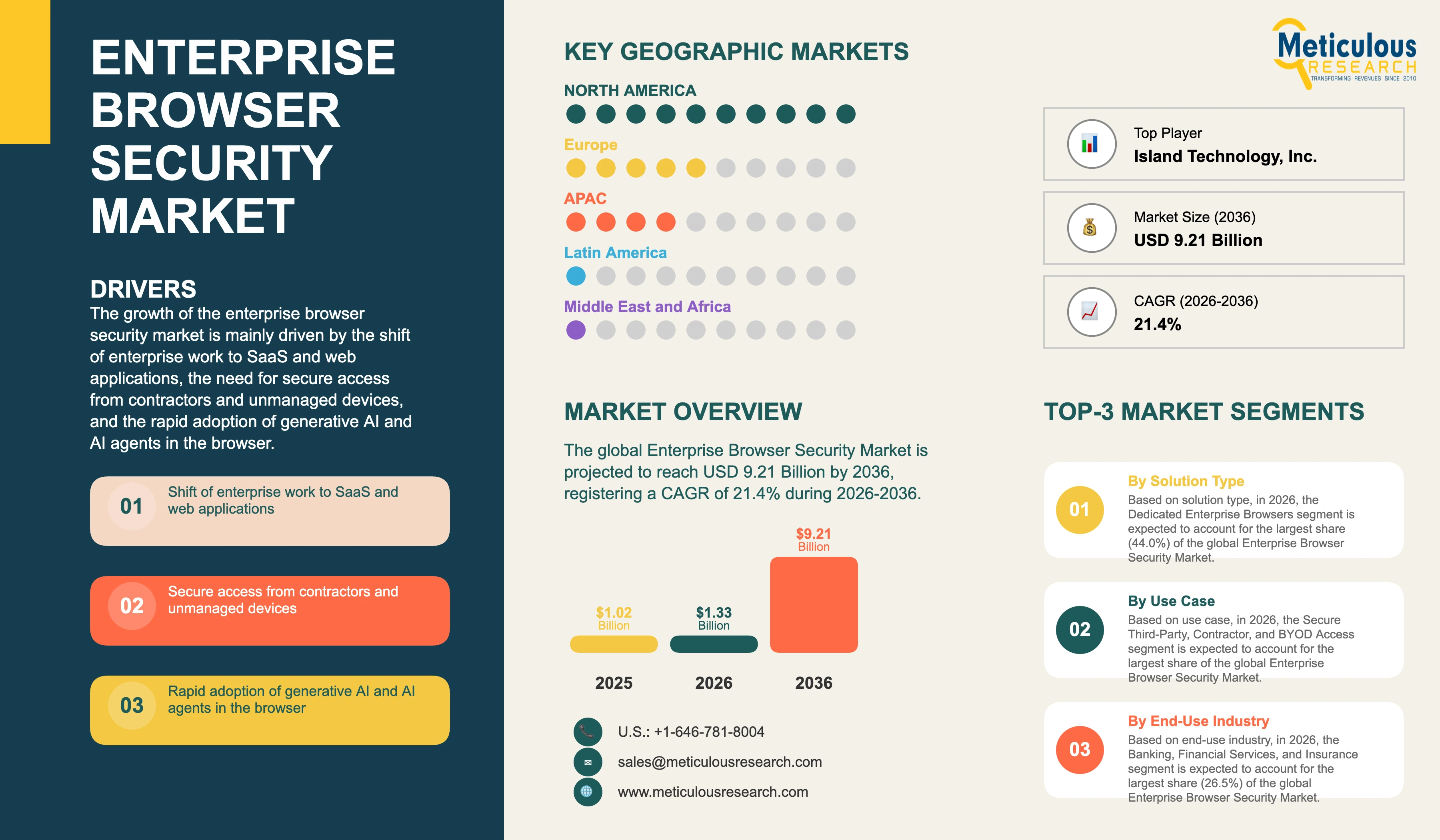
The global enterprise browser security market was valued at USD 1.02 billion in 2025. This market is expected to reach USD 9.21 billion by 2036 from an estimated USD 1.33 billion in 2026, registering a CAGR of 21.4% during the forecast period (2026-2036).
- Published
- Nov 2026
- Pages
- 311
- Format
- PDF + Excel
- Report ID
- MRICT - 1042494
- Base year
- 2025
- 2025 · BASELINE
- $1.02B
- 2036
- $9.21B
- CAGR 2026–2036
- 21.4%
2025 baseline · 2026–2036 forecast at 21.4% CAGR · hover a bar for the value
Key highlights
Island, the developer of the Island Enterprise Browser, raised USD 400 million at a valuation of USD 6.4 billion in September 2026, with annual recurring revenue reported at about USD 200 million and having doubled in each fiscal year since its 2022 launch.
CrowdStrike agreed in January 2026 to acquire browser runtime security company Seraphic Security, in a deal reported at about USD 420 million, to bring in-browser protection to its Falcon platform; CrowdStrike notes that employees spend about 85% of their workday in the browser.
Zscaler completed its acquisition of browser security company SquareX on 5 February 2026 to extend zero trust controls into standard browsers on managed and unmanaged devices, and Akamai agreed in May 2026 to acquire LayerX for USD 205 million to secure generative AI and SaaS use in the browser.
Palo Alto Networks offers Prisma Access Browser, built on its acquisition of Talon Cyber Security, while Google offers Chrome Enterprise Premium and Microsoft offers Edge for Business with built-in enterprise security controls.
Menlo Security, a pioneer of cloud-delivered browser isolation, serves nine of the 10 largest global banks, and Island introduced browser controls for AI agents accessing enterprise applications in October 2026.
Browser security extensions and runtime protection is the fastest-growing solution type, generative AI and AI agent governance is the fastest-growing use case, and business process outsourcing and professional services is the fastest-growing end-use industry.
By offering, solutions account for the larger share of 84.0% in 2026 and also register the higher CAGR.
By solution type, dedicated enterprise browsers account for the largest share of 44.0% in 2026, while browser security extensions and runtime protection register the highest CAGR.
By use case, secure third-party, contractor, and BYOD access accounts for the largest share in 2026, while generative AI and AI agent governance registers the highest CAGR.
By deployment, cloud-managed solutions account for the larger share in 2026 and also register the higher CAGR.
By organization size, large enterprises account for the larger share in 2026, while small and medium-sized enterprises register the higher CAGR.
By end-use industry, banking, financial services, and insurance accounts for the largest share of 26.5% in 2026, while business process outsourcing and professional services registers the highest CAGR.
By geography, North America accounts for the largest share of 49.0% in 2026, while Asia-Pacific registers the highest CAGR of 25.4% during the forecast period.
Report summary
| Particulars | Details |
|---|---|
| Forecast Period | 2026-2036 |
| Base Year | 2025 |
| Estimated Year | 2026 |
| CAGR (Value) | 21.4% |
| Format | PDF, Excel & Cloud Portal · 311 pages |
| Market Size (Value) in 2025 | USD 1.02 billion |
| Market Size (Value) in 2026 | USD 1.33 billion |
| Market Size (Value) by 2036 | USD 9.21 billion |
| Largest Segment by Offering (2026) | Solutions (84.0%) |
| Largest Segment by Solution Type (2026) | Dedicated Enterprise Browsers (44.0%) |
| Largest Segment by End-Use Industry (2026) | Banking, Financial Services, and Insurance (26.5%) |
| Largest Region (2026) | North America (49.0%) |
| Fastest-Growing Region | Asia-Pacific (CAGR 25.4%) |
| Segments Covered | Offering, Solution Type, Use Case, Deployment, Organization Size, End-Use Industry, Geography |
| Countries Covered | U.S., Canada, Germany, U.K., France, Netherlands, Italy, Spain, Nordics, Rest of Europe, Japan, China, India, Australia, Singapore, South Korea, Philippines, Rest of Asia-Pacific, Brazil, Mexico, Rest of Latin America, Saudi Arabia, U.A.E., Israel, South Africa, Rest of Middle East & Africa |
| Key Companies | 15 companies and other companies |
Report overview
Segments covered: offering, solution type, use case, deployment, organization size, end-use industry.
The growth of this market is mainly driven by the shift of enterprise work to SaaS and web applications that are accessed through the browser, the need to give contractors, partners, and employees on unmanaged devices secure access without virtual desktops, the rapid adoption of generative AI tools and AI agents that operate in the browser and create new data leakage risks, and the rise of browser-based attacks such as phishing, session hijacking, and malicious extensions. However, factors such as user and IT resistance to replacing familiar consumer browsers and the overlap of browser security with existing secure access service edge (SASE) and endpoint tools are expected to restrain the growth of this market to some extent.
Enterprise browser security covers products that apply an organization's security, access, and data protection policies directly in the web browser, which has become the main place where employees work. As companies move from installed applications to SaaS and web applications, most daily work, including email, collaboration, customer relationship management, finance, development, and now generative AI, happens inside a browser tab. Traditional security tools such as firewalls, secure web gateways, and endpoint agents have limited visibility into what users do inside these browser sessions, such as copying data, uploading files, or pasting sensitive information into AI tools.
The market includes three main types of solutions, starting with dedicated enterprise browsers, such as the Island Enterprise Browser and Palo Alto Networks' Prisma Access Browser, are Chromium-based browsers built for business use, with security, access, and data controls built in and managed centrally. Browser security extensions and runtime protection, offered by companies such as Seraphic (now part of CrowdStrike), SquareX (now part of Zscaler), LayerX (being acquired by Akamai), and others, add enterprise controls to the browsers employees already use, such as Chrome and Edge, without replacing them. Remote browser isolation, offered by companies such as Menlo Security, Cloudflare, and Zscaler, runs web content in the cloud and sends only safe content to the user's device, protecting against web-based threats.
A key reason for adoption is the need to replace virtual desktop infrastructure (VDI) and VPNs for certain users. Many organizations have used virtual desktops to give contractors, offshore teams, call center agents, and employees on personal devices secure access to corporate applications, but VDI is expensive, complex, and often slow for users. Enterprise browsers can provide controlled access to web and SaaS applications from any device, with policies that prevent data from being copied, downloaded, or printed, at a lower cost and with a better user experience. This use case has been a major driver of growth for Island and other vendors.
Generative AI has added a powerful new driver, as employees use AI chatbots and AI features within SaaS applications through the browser, often pasting sensitive data into prompts or uploading confidential files, and many of these tools are used without IT approval. AI agents that browse websites and act within web applications on behalf of users create further risks. Browser-level controls can see and govern these interactions in a way that network tools cannot, which has made AI governance one of the fastest-growing reasons to buy browser security, as shown by Akamai's acquisition of LayerX and Island's launch of controls for AI agents in 2026.
The market is consolidating quickly as large security vendors add browser security to their platforms. Palo Alto Networks acquired Talon in 2023 to create Prisma Access Browser, and in 2026 CrowdStrike agreed to acquire Seraphic, Zscaler acquired SquareX, and Akamai agreed to acquire LayerX. Browser makers are also adding enterprise security features, with Google offering Chrome Enterprise Premium and Microsoft building security controls into Edge for Business. At the same time, Island has grown into a large independent vendor, and newer companies such as Surf Security, Red Access, Keep Aware, and Push Security offer specialized browser security solutions.
Two approaches now compete for buyers, as dedicated enterprise browsers offer the deepest control and strong features for VDI replacement and third-party access, but they require users to switch browsers. Extension-based and browser-native approaches work with existing browsers and are easier to roll out across large workforces, but they may offer less control over some activities. Many large organizations are expected to use both, deploying enterprise browsers for high-risk users and contractors and extensions for the wider workforce, which supports growth across solution types. Pricing is mostly per user per year, and vendors increasingly bundle browser security with secure access, data protection, and AI governance features, which raises the average spend per user as deployments mature. Larger deployments also tend to expand into contractor and unmanaged device use cases.
Every new client asks how we stop agents from copying their customer data. With a managed browser, we can show them the controls, onboard new staff in hours, and avoid buying a laptop for every seat.
Client security demands and cost pressure are driving rapid adoption among outsourcing companies, supporting the fast growth of the business process outsourcing and professional services segment and Asia-Pacific's position as the fastest-growing region at a CAGR of 25.4%.
Browser security extensions and runtime protection is projected to register the highest CAGR, while dedicated enterprise browsers hold the largest share of 44.0% in 2026.
Generative AI and AI agent governance is projected to register the highest CAGR, while secure third-party, contractor, and BYOD access holds the largest share in 2026.
Banking, financial services, and insurance is expected to account for the largest share of 26.5% of the market in 2026, while business process outsourcing and professional services is projected to register the highest CAGR.
North America is expected to account for the largest share of 49.0% of the market in 2026.
Asia-Pacific is projected to register the highest CAGR of 25.4% during the forecast period, led by India, the Philippines, Japan, and Australia.
The report profiles 15 companies, including Island Technology, Inc., Palo Alto Networks, Inc., Alphabet Inc. (Google), Microsoft Corporation, CrowdStrike Holdings, Inc., and Zscaler, Inc. The top five players account for an estimated 54.0% of the market in 2025.
Solutions are expected to account for the larger share of 84.0% of the market in 2026 and also register the higher CAGR.
Report infographic
Market dynamics
15 factors across 5 forcesShift of enterprise work to SaaS and web applications
Most new enterprise applications are delivered as SaaS or web applications, and many older applications have been moved to the cloud and are accessed through a browser. As a result, the browser has become the main workspace for employees and the point where corporate data is accessed, created, and shared. CrowdStrike estimates that employees spend about 85% of their workday in the browser, and Island reports that millions of users now rely on its enterprise browser.
This shift leaves a gap in traditional security, which was built to protect networks, devices, and installed applications. Network-based tools see encrypted traffic but not what users do on a web page, and endpoint tools may not understand activity inside web applications. Browser security fills this gap by applying controls where the work happens, such as blocking copying of sensitive data, preventing downloads to unmanaged devices, and watermarking screens. As SaaS adoption continues, the browser is becoming a core control point in enterprise security architecture. This also changes how security teams think about access, moving from protecting the network and device to protecting the session in which work actually happens.
Need for secure access from contractors and unmanaged devices
Organizations increasingly depend on contractors, outsourcing partners, offshore teams, and employees using personal devices, and they need to give these users access to corporate applications without exposing data. Traditional options, such as shipping company laptops or providing virtual desktops, are expensive and slow to set up. Enterprise browsers and browser security extensions allow organizations to give secure access from any device, with controls that keep corporate data inside the managed session.
This use case is especially important in industries that rely heavily on third parties, such as financial services, healthcare, insurance, and business process outsourcing. Replacing virtual desktops with enterprise browsers can reduce infrastructure costs, speed up onboarding, and improve user experience, which gives buyers a clear financial case for adoption. Zscaler's acquisition of SquareX was aimed in part at securing access from unmanaged and third-party devices without a full agent or dedicated browser. The same approach helps organizations give acquired companies quick access to shared applications after mergers, before devices and networks are fully integrated.
Rapid adoption of generative AI and AI agents in the browser
Employees use generative AI tools such as chatbots, writing assistants, and AI features within SaaS applications mainly through the browser, and many organizations have limited visibility into what data is shared with these tools. Sensitive information such as customer data, source code, and financial details can be pasted into prompts or uploaded as files, creating data leakage and compliance risks. AI agents that can browse websites and act in web applications add new risks, as they may access data or take actions beyond what organizations intend.
Browser security tools can detect which AI tools are in use, apply policies on what data can be shared, and monitor or block risky actions, both by users and by AI agents. Vendors have moved quickly to address this need, as shown by Akamai's acquisition of LayerX to secure generative AI and SaaS use in the browser and Island's launch of browser controls for AI agents in October 2026. AI governance is expected to be one of the strongest growth drivers for the market over the forecast period. Regulations on AI and data protection, such as the EU AI Act and GDPR, add pressure on organizations to show that they control how personal data is used with AI tools.
Rise of browser-based attacks
Attackers increasingly target the browser through phishing pages, malicious browser extensions, session token theft, and malicious downloads. Stolen session cookies can allow attackers to bypass multi-factor authentication and take over SaaS accounts, and malicious or compromised extensions can read data from every page a user visits. Many of these attacks are difficult for network and endpoint tools to detect, because they happen inside encrypted browser sessions.
Browser security solutions protect against these threats by monitoring browser activity, controlling which extensions can be installed, protecting session data, and isolating risky web content. CrowdStrike's acquisition of Seraphic to add browser runtime protection to its Falcon platform reflects the growing view among security vendors that the browser must be protected as a key endpoint. Remote browser isolation continues to be used by organizations, especially banks, that want to keep web threats away from their devices entirely. Browser security also helps protect against attacks that use legitimate SaaS applications and cloud storage to deliver malware or steal data, which traditional web filters may allow.
Table of contents
14 chapters · 141 sections · 311 pages · click to expandSegmental analysis
| Segment | Largest share (2026) | Fastest growth (2026–2036) |
|---|---|---|
| By Offering | — | — |
| By Solution Type | Dedicated enterprise browsers | Browser security extensions and runtime protection |
| By Use Case | Secure third-party, contractor, and BYOD access | Generative AI and AI agent governance |
| By Deployment | — | — |
| By Organization Size | Large enterprises | Rapid growth of this |
| By End-Use Industry | Banking, financial services, and insurance | Business process outsourcing and professional services |
By Offering
- Enterprise Browser Security Market Analysis by Offering
- The solutions segment is expected to account for the larger share of 84.0% of the global enterprise browser security market.
- This segment is also projected to register the higher CAGR during the forecast period.
- The large share and faster growth of this segment are mainly due to the subscription-based sale of enterprise browsers, browser security extensions, and browser isolation services, usually priced per user per year, and the growing number of users covered as organizations expand deployments from pilot groups to the whole workforce.
- Solution revenue in this market is mostly recurring, as vendors sell annual or multi-year subscriptions based on the number of users.
- Organizations typically start with a specific group, such as contractors, call center agents, or high-risk users, and then expand to more users and add features such as data loss prevention, AI governance, and advanced threat protection, which increases spending over time.
- Island's annual recurring revenue doubling each year since its launch shows how quickly deployments can grow once organizations see value.
- Large vendors such as Palo Alto Networks, Zscaler, CrowdStrike, and Akamai also sell browser security as add-ons to their SASE and endpoint platforms, which allows customers to add it through existing contracts.
- The services segment includes deployment, integration, policy design, and managed services, and it remains important for large enterprises that are replacing VDI or rolling out enterprise browsers across complex environments.
By Solution Type
- Enterprise Browser Security Market Analysis by Solution Type
- The dedicated enterprise browsers segment is expected to account for the largest share of 44.0% of the market.
- The large share of this segment is mainly due to the strong adoption of the Island Enterprise Browser and Palo Alto Networks' Prisma Access Browser, their use in replacing VDI and providing secure access for contractors and unmanaged devices, and the deep level of control they offer over data and user activity.
- Dedicated enterprise browsers give organizations full control over the browser itself, including how data can be copied, downloaded, printed, or shared, which extensions can run, how sessions are recorded, and how applications are accessed.
- This makes them well suited to high-risk uses, such as giving offshore contractors access to customer data, allowing call center agents to work from personal devices, or providing developers with secure access to internal tools.
- Island has built a large business on these use cases, reaching a significant scale in annual recurring revenue, while Palo Alto Networks offers Prisma Access Browser as part of its SASE platform.
- Google and Microsoft also offer enterprise versions of Chrome and Edge with central management and security controls, which broadens the segment.
- Large financial institutions, healthcare organizations, and government agencies have been early adopters, often deploying enterprise browsers to tens of thousands of users.
- The segment is expected to keep growing strongly, though its share declines over the forecast period as browser-agnostic approaches expand faster.
- However, the browser security extensions and runtime protection segment is projected to register the highest CAGR during the forecast period.
- The rapid growth of this segment is driven by the ease of deploying security to existing browsers without changing user habits, recent acquisitions by CrowdStrike, Zscaler, and Akamai that will bring these products to large customer bases, and strong demand for AI governance across the whole workforce.
- Remote browser isolation remains an important segment, particularly in banking, but grows more slowly as organizations adopt lighter-weight browser security approaches.
By Use Case
- Enterprise Browser Security Market Analysis by Use Case
- The secure third-party, contractor, and BYOD access segment is expected to account for the largest share of the market.
- The large share of this segment is mainly due to the growing reliance of organizations on contractors, outsourcing partners, and employees using personal devices, and the need to give these users access to corporate applications without exposing sensitive data.
- This use case has been the main entry point for enterprise browser adoption because it solves a clear and costly problem.
- Organizations that work with large numbers of contractors or outsourcing partners, such as banks, insurers, healthcare providers, and technology companies, have traditionally shipped company laptops or provided virtual desktops, both of which are expensive and slow to set up.
- Browser security allows these users to access approved applications from their own devices, with controls that keep data within the managed session and record activity for audit purposes.
- Onboarding can be reduced from days or weeks to hours, and organizations can quickly remove access when a contract ends.
- Mergers and acquisitions also create demand, as acquired employees need quick access to the parent company's applications before devices and networks are integrated.
- However, the generative AI and AI agent governance segment is projected to register the highest CAGR during the forecast period.
- The rapid growth of this segment is driven by the widespread use of AI tools through the browser, concerns about data leakage into AI prompts, the rise of AI agents that act in web applications, and the launch of AI-specific browser controls by leading vendors.
- VDI and DaaS replacement, data loss prevention and SaaS governance, and web threat and phishing protection make up the rest of the market.
By Deployment
- Enterprise Browser Security Market Analysis by Deployment
- The cloud-managed segment is expected to account for the larger share of the market.
- This segment is also expected to grow at the faster rate during the forecast period.
- The large share and fast growth of this segment are mainly due to the cloud-based management consoles used by most enterprise browser and extension vendors, the cloud delivery of browser isolation services, and buyers' preference for solutions that can be deployed and updated quickly across distributed workforces.
- Cloud management allows organizations to set and update policies for users anywhere, including contractors and remote workers who never connect to the corporate network.
- It also allows vendors to update threat protection and AI governance features continuously.
- On-premises and hybrid deployments are used mainly by government, defense, and highly regulated organizations that need to keep management and data within their own environments.
By Organization Size
- Enterprise Browser Security Market Analysis by Organization Size
- The large enterprises segment is expected to account for the larger share of the market.
- The large share of this segment is mainly due to their large numbers of SaaS applications, contractors, and remote workers, their high spending on VDI that browser security can replace, and their strict regulatory requirements for data protection.
- Large enterprises are the main buyers of dedicated enterprise browsers and have driven the growth of vendors such as Island and Menlo Security, which serves nine of the 10 largest global banks.
- They often deploy browser security to tens of thousands of users across many countries, integrate it with identity, SASE, and data protection platforms, and use it to support major projects such as VDI replacement and cloud migration.
- Many large enterprises are also among the first to set formal policies for generative AI use, which increases demand for browser-based AI governance.
- However, the small and medium-sized enterprises segment is projected to register the higher CAGR during the forecast period.
- The rapid growth of this segment is driven by the availability of simple, cloud-managed browser security extensions, the growing reliance of smaller firms on SaaS applications and remote workers, and the inclusion of browser security in managed security services.
By End-Use Industry
- Enterprise Browser Security Market Analysis by End-Use Industry
- The banking, financial services, and insurance segment is expected to account for the largest share of 26.5% of the market.
- The large share of this segment is mainly due to strict regulations on data protection and third-party risk, large numbers of contractors and outsourcing partners, high spending on VDI, and the early adoption of browser isolation and enterprise browsers by large banks.
- Financial institutions handle highly sensitive customer and financial data and are subject to strict rules on how this data is accessed and protected, including the EU's Digital Operational Resilience Act and national banking regulations.
- They rely on large numbers of contractors, offshore teams, and outsourcing providers for operations, development, and customer service, which makes secure third-party access a major need.
- Banks were early adopters of remote browser isolation to protect against web-based threats, and Menlo Security reports that it serves nine of the 10 largest global banks.
- Many banks and insurers are now deploying enterprise browsers to replace VDI for contractors and call centers and to control the use of generative AI tools by employees.
- These factors make BFSI the largest buyer of browser security and a key reference market for vendors.
- However, the business process outsourcing and professional services segment is projected to register the highest CAGR during the forecast period.
- The rapid growth of this segment is driven by the large number of outsourcing and contact center workers who access client systems through the browser, client requirements for strong data controls, and the cost savings of replacing virtual desktops with enterprise browsers.
- Healthcare and life sciences, government and defense, IT and telecommunications, retail and e-commerce, manufacturing, and other industries make up the rest of the market.
Geographic analysis
North America
Largest shareIn 2026, North America is expected to account for the largest share of 49.0% of the global enterprise browser security market. The large share of this region is mainly due to the high adoption of SaaS applications, large numbers of contractors and remote workers, strong security spending by financial institutions, healthcare organizations, and government agencies, and the presence of leading vendors such as Island, Palo Alto Networks, Google, Microsoft, CrowdStrike, Zscaler, Akamai, Menlo Security, and Cloudflare. The U.S. is the largest single country market, supported by early adoption of enterprise browsers by large banks, insurers, and healthcare organizations, strong venture investment in browser security start-ups, and federal and state requirements for data protection and secure access. Island is based in Dallas and has achieved certifications such as TX-RAMP for public sector use in Texas, while federal agencies are evaluating enterprise browsers for secure access and AI governance. Canada adds demand from financial institutions and public sector organizations.
Asia-Pacific
Fastest growthAsia-Pacific is projected to register the highest CAGR of 25.4% during the forecast period. Growth is driven by the large business process outsourcing and contact center industries in India and the Philippines, rapid SaaS and generative AI adoption in Japan, Australia, Singapore, and South Korea, and rising cyber threats and data protection rules across the region. Outsourcing companies serving clients in North America and Europe are adopting enterprise browsers to meet client security requirements and reduce the cost of virtual desktops. Japan and Australia are early adopters among large enterprises, while India and the Philippines are the main markets for outsourcing-driven demand, and data protection laws such as India's Digital Personal Data Protection Act are increasing pressure on organizations to control how personal data is accessed.
Europe
Europe holds a significant share of the market, supported by GDPR, the NIS2 Directive, and the Digital Operational Resilience Act, which require strong data protection and third-party risk management. The U.K., Germany, France, the Netherlands, and the Nordic countries are the largest markets. European buyers place particular emphasis on privacy and data residency, which shapes how browser monitoring is deployed.
Latin America
Latin America and the Middle East & Africa account for smaller shares but are growing quickly, led by Brazil and Mexico, where outsourcing and financial services industries are expanding, and by Saudi Arabia, the U.A.E., and Israel, where national cybersecurity programs and a strong local cybersecurity industry support demand.
Competitive landscape
The enterprise browser security market includes dedicated enterprise browser vendors, large security platform vendors, browser makers, and browser isolation providers. Island is the largest independent enterprise browser vendor, with about USD 200 million in annual recurring revenue and a USD 6.4 billion valuation after its September 2026 funding round. Palo Alto Networks offers Prisma Access Browser, based on its acquisition of Talon Cyber Security, as part of its SASE platform, while Google and Microsoft provide enterprise security features in Chrome Enterprise Premium and Edge for Business.
Large security vendors have moved into the market through acquisitions, as CrowdStrike agreed to acquire Seraphic Security in January 2026 to add browser runtime protection to Falcon, Zscaler completed its acquisition of SquareX in February 2026, and Akamai agreed to acquire LayerX for USD 205 million in May 2026. Remote browser isolation providers include Menlo Security, Cloudflare, Zscaler, Netskope, and Check Point, and Netskope also offers an enterprise browser as part of its platform. Smaller specialists, such as Surf Security, Red Access, Keep Aware, and Push Security, focus on specific approaches such as lightweight enterprise browsers, agentless browser security, and browser-based identity protection.
The top five players are estimated to account for 54.0% of the market in 2025, reflecting the strong positions of Island, Palo Alto Networks, Google, Menlo Security, and Zscaler. Competition is expected to center on AI governance, ease of deployment, coverage of unmanaged devices, integration with SASE and endpoint platforms, and the ability to replace VDI at scale. Vendors with large existing customer bases in SASE and endpoint security are expected to gain share quickly as they bundle browser security into their platforms.
Vendors use several strategies to grow in this market, including acquisitions to add browser-agnostic security, partnerships with SASE, endpoint, and identity vendors, channel partnerships such as Island's with Sophos, and the launch of AI-specific controls. Pricing is typically per user per year, with premium tiers for advanced data protection, AI governance, and session recording. Competition on price is increasing as large platforms bundle browser security with other products, which puts pressure on standalone vendors to show clear additional value.
Some of the key players operating in the enterprise browser security market are Island Technology, Inc., Palo Alto Networks, Inc., Alphabet Inc. (Google), Microsoft Corporation, CrowdStrike Holdings, Inc., Zscaler, Inc., Akamai Technologies, Inc., Menlo Security, Inc., Cloudflare, Inc., Netskope, Inc., Check Point Software Technologies Ltd., Surf Security Ltd., Red Access Ltd., Keep Aware, Inc., and Push Security Ltd., among others.
- —
Island raised USD 400 million at a USD 6.4 billion valuation in September 2026, CrowdStrike agreed to acquire Seraphic Security in January 2026, Zscaler completed its acquisition of SquareX in February 2026, and Akamai agreed to acquire LayerX for USD 205 million in May 2026.
- Menlo Security
- Cloudflare
- Zscaler
- Netskope
- Check Point
- Netskope also
Expert perspectives
The browser has become the main workplace for knowledge workers, yet for years it was one of the least protected parts of the enterprise. Enterprise browser security addresses this gap, and the market has moved from early adoption to mainstream interest in just a few years. The combination of SaaS adoption, distributed and third-party workforces, and generative AI use has made browser-level control a clear priority for security leaders.
The wave of acquisitions in 2026 by CrowdStrike, Zscaler, and Akamai, following Palo Alto Networks' earlier purchase of Talon, shows that large security vendors see browser security as a necessary part of their platforms. This will bring browser security to many more customers, but it will also increase competition for independent vendors. Island's strong growth and large funding rounds suggest that there is room for a major independent enterprise browser vendor, particularly for organizations that want deep control and VDI replacement.
Browser security extensions and runtime protection is the fastest-growing solution type, as organizations look for ways to secure existing browsers without forcing users to switch. Generative AI and AI agent governance is the fastest-growing use case, and business process outsourcing and professional services is the fastest-growing industry because of the large number of outsourced workers accessing client systems through the browser. Dedicated enterprise browsers remain the largest solution type, driven by third-party access and VDI replacement.
North America leads the market, while Asia-Pacific is the fastest-growing region at a CAGR of 25.4%, supported by its large outsourcing industry and rapid SaaS and AI adoption. The main swing factors are how quickly browser makers add enterprise security features to Chrome and Edge, which could reduce demand for third-party products, and how quickly AI agents become common in enterprise work, which could greatly expand demand for browser-level governance.
For buyers, the key decision is whether to deploy a dedicated enterprise browser, add security to existing browsers, or use both for different user groups. Many large organizations are expected to adopt a mixed approach, and vendors that can support both models, along with strong AI governance and platform integration, will be best placed to win. Pricing pressure from bundled offerings is likely to grow, so vendors will need to prove value through measurable cost savings and risk reduction.
Overall, growth in this market rests on the central role of the browser in modern work and on the need to govern how humans and AI agents use corporate data. Vendors that combine deep control, easy deployment, and AI governance are expected to capture most of this growth.
Customer perspectives
Chief Information Security Officer - global insurance company, U.S.
We were paying for thousands of virtual desktops just so our offshore claims teams could use a handful of web applications. Moving them to an enterprise browser cut the cost sharply and gave us better control over what data leaves the session.
VDI replacement and secure third-party access are major reasons why dedicated enterprise browsers hold 44.0% of the market and why banking, financial services, and insurance is the largest end-use industry at 26.5%. Insurers and banks are using enterprise browsers to give contractors secure access at lower cost.
Head of Security Architecture - technology company, U.K.
Our people were pasting customer data into every AI tool they could find. We did not want to block AI, so we put controls into the browser that warn or block when sensitive data is about to be shared and let us see which tools are being used.
Concerns about data shared with AI tools are driving generative AI and AI agent governance to the highest CAGR among use cases, and they favor browser security extensions that can be deployed across the whole workforce without changing browsers.
Frequently asked questions
The market was valued at USD 1.02 billion in 2025 and USD 785.0 million in 2024, and is estimated at USD 1.33 billion in 2026.
The market is expected to reach USD 9.21 billion by 2036, supported by the shift of work to SaaS and web applications, the need for secure access from contractors and unmanaged devices, and the rapid adoption of generative AI and AI agents.
The market is expected to register a CAGR of 21.4% from 2026 to 2036.
Growth is driven by the shift of enterprise work to SaaS and web applications, the need for secure access from contractors and unmanaged devices, the rapid adoption of generative AI and AI agents in the browser, and the rise of browser-based attacks.
User and IT resistance to replacing consumer browsers and overlap with SASE, endpoint, and data protection tools restrain growth, while dependence on browser vendors and privacy concerns about user monitoring remain key challenges.
Key opportunities include governance of generative AI tools and AI agents, replacement of VDI and legacy remote access, integration with SASE, endpoint, and identity platforms, and expansion to small and medium-sized enterprises and emerging markets.
An enterprise browser is a dedicated, centrally managed browser with security and data controls built in, which users must switch to. A browser security extension adds enterprise controls to the browsers employees already use, such as Chrome and Edge, making it easier to deploy across large workforces.
Browser security tools can identify which AI tools employees use, apply policies on what data can be pasted or uploaded into AI prompts, and monitor or limit the actions of AI agents that operate in the browser, helping organizations use AI without exposing sensitive data.
Solutions are expected to account for the larger share of 84.0% of the market in 2026 and also register the higher CAGR.
Browser security extensions and runtime protection is projected to register the highest CAGR, while dedicated enterprise browsers hold the largest share of 44.0% in 2026.
Generative AI and AI agent governance is projected to register the highest CAGR, while secure third-party, contractor, and BYOD access holds the largest share in 2026.
Banking, financial services, and insurance is expected to account for the largest share of 26.5% of the market in 2026, while business process outsourcing and professional services is projected to register the highest CAGR.
North America is expected to account for the largest share of 49.0% of the market in 2026.
Asia-Pacific is projected to register the highest CAGR of 25.4% during the forecast period, led by India, the Philippines, Japan, and Australia.
The report profiles 15 companies, including Island Technology, Inc., Palo Alto Networks, Inc., Alphabet Inc. (Google), Microsoft Corporation, CrowdStrike Holdings, Inc., and Zscaler, Inc. The top five players account for an estimated 54.0% of the market in 2025.
Island raised USD 400 million at a USD 6.4 billion valuation in September 2026, CrowdStrike agreed to acquire Seraphic Security in January 2026, Zscaler completed its acquisition of SquareX in February 2026, and Akamai agreed to acquire LayerX for USD 205 million in May 2026.
Cite this report
Meticulous Research. (2026). Enterprise Browser Security Market - Global Opportunity Analysis and Industry Forecast (2026-2036) (Report No. MRICT - 1042494). Meticulous Market Research Pvt. Ltd. https://www.meticulousresearch.com/product/enterprise-browser-security-market-7177