Mobile Security Market (2022-2029)
obile Security Market is expected to reach $19.5 billion by 2029, at a CAGR of 21.7% during the forecast period 2022–2029.
- Published
- Nov 2022
- Pages
- 250
- Format
- PDF + Excel
- Report ID
- MR-719
- Base year
- 2021
- 2029 · FORECAST
- $19.50B
- 2029
- $19.50B
- CAGR 2022–2029
- 21.7%
2021 baseline · 2022–2029 forecast at 21.7% CAGR · hover a bar for the value
Key highlights
In 2022, the Android Segment is Expected to Account for the Largest Share of the Mobile Security Market
The Cloud-based Segment to Grow at the Highest CAGR During the Forecast Period
In 2022, the Enterprises Segment to Dominate the Mobile Security Market
Report summary
| Particulars | Details |
|---|---|
| Base Year | 2021 |
| Estimated Year | 2022 |
| Forecast Period | 2022–2029 |
| Market Size (2029) | USD 19.50 billion |
| CAGR (2022–2029) | 21.7% |
| Format | PDF, Excel & Cloud Portal · 250 pages |
| Segments Covered | By Component: Solutions Mobile Application Security, Mobile Data Security, Mobile Device Security, Others · By Operating System: Android, iOS, Other Operating Systems · By Deployment Mode: On-premise deployment, Cloud-based deployment · By End User: Enterprise BFSI, Telecom, Retail, Healthcare, Manufacturing, Other End Users |
| Countries Covered | North America (Canada), Europe (Germany, U.K., France, Italy, Spain, Rest of Europe), Asia-Pacific (China, Japan, India, South Korea, Rest of Asia-Pacific) |
| Key Companies | Armis, Inc., AT&T, Inc., Check Point Software Technologies Ltd., IBM Corporation, Nokia Corporation, Huawei Technologies Co., Ltd., VMware, Inc., Microsoft Corporation, Broadcom Inc., Fortinet, Inc., Juniper Networks, Inc. |
Report overview
Segments covered: component, operating system, deployment mode, end user. Regions: North America, Europe, Asia-Pacific.
The increase in smartphone users, the number of mobile phone subscriptions, and the increase in mobile-related cyber attacks are the major factors driving the growth of this market. Additionally, increasing demand for cloud-based solutions is expected to offer significant growth opportunities for this market. However, the growing adoption of open-source and free security solutions can restrain market growth to a certain extent. Furthermore, the increasing use of mobile as an attack vector is one of the key challenges to the growth of this market.
The COVID-19 pandemic has disrupted businesses and supply chains across the globe. Government bodies worldwide imposed restrictions during the COVID-19 pandemic, encouraging employees to work from home. The combat measures like complete lockdowns and quarantine have adversely impacted many industries, including a portion of the enterprise security industry. With many employees working from home and students learning virtually, enterprise virtual private network (VPN) servers have become a lifeline to organizations and institutions.
Enterprise Virtual Private Network (VPN) servers became a lifeline for organizations and institutions as numerous employees shifted to a work-from-home operating model and students adopted virtual and distance learning due to the COVID-19 pandemic. The rapid adoption of such approaches led to increased cyber-attacks and security threats in mobile devices. Spear-phishing emails (personalized emails sent to targeted users to trick them into sharing sensitive information) also increased tremendously amidst the COVID-19 pandemic. This helped the growth of the mobile security market during the pandemic.
In recent years, there has been a significant increase in the number of mobile & connected devices. The proliferation of mobile devices in enterprises has become a major security concern. The number of employees using smartphones for work is growing rapidly, increasing the risk of exposing company information to cybercriminals. The growing use of mobile devices and apps has introduced various new attack vectors and data security challenges for enterprises and individuals.
Employees are increasingly using their mobile devices in the workplace due to enterprises’ adoption of BYOD policies. As mobile devices are not secure, it is easy for hackers to gain unauthorized access and attack corporate networks. Therefore, enterprises are increasingly adopting cybersecurity solutions to protect their networks and provide employees with secure access to confidential information. The rising penetration of mobile & wireless devices, advancements in connectivity infrastructure, and the falling prices of mobile devices are all set to impact the mobile security market.
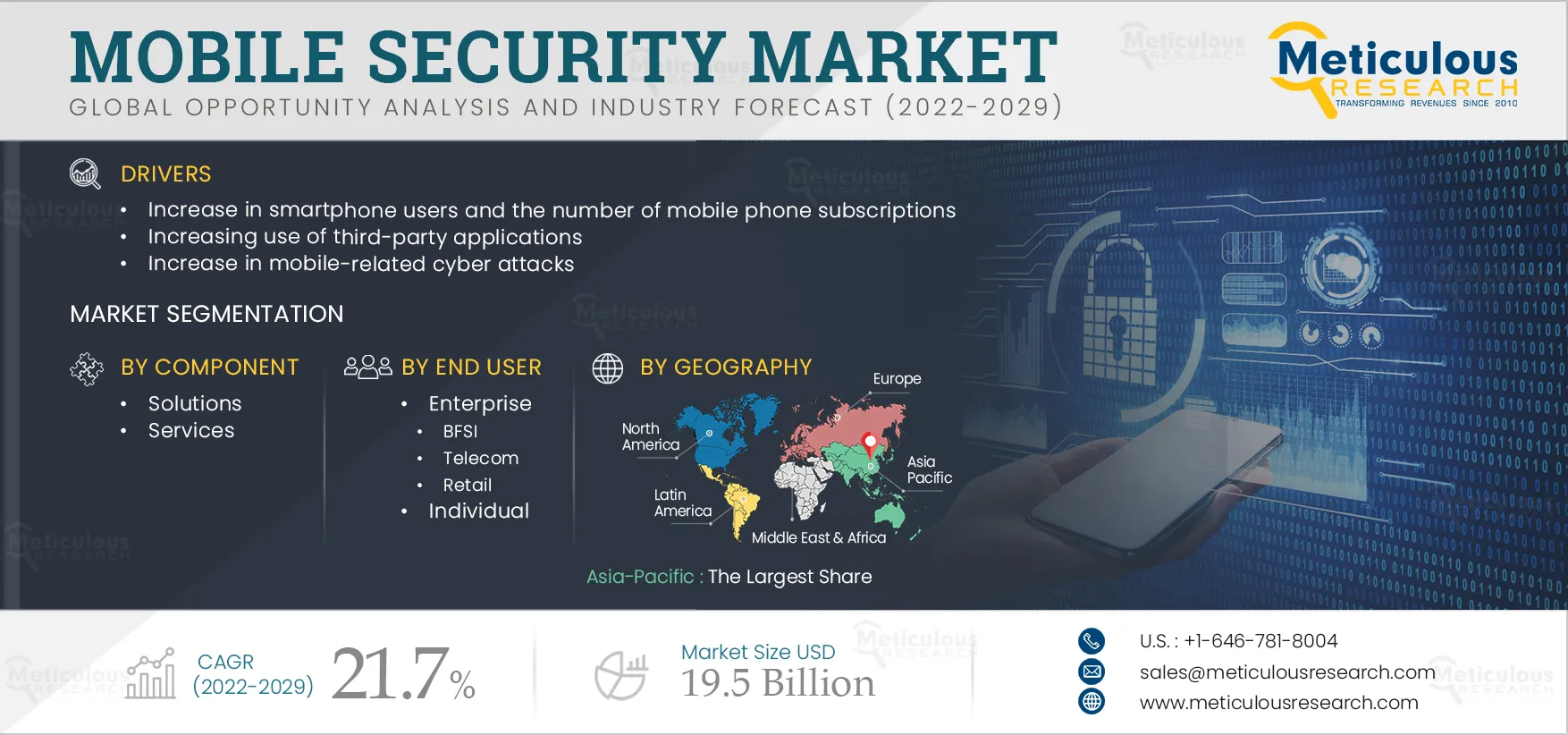
Table of contents
13 chapters · 118 sections · 250 pages · click to expandSegmental analysis
| Segment | Largest share (2022) | Fastest growth (2022–2029) |
|---|---|---|
| By Operating System | Android | — |
| By Deployment Mode | — | Cloud-based deployment |
| By End User | Enterprises | — |
By Operating System
- The android segment is expected to account for the largest share of the mobile security market.
- The growth of this segment is attributed to the increasing security risks has made the deployment of security software in mobile devices.
By Deployment Mode
- The Cloud-based Segment to Grow at the Highest CAGR During the Forecast Period
- The cloud-based deployment segment is projected to grow at the highest CAGR during the forecast period.
- The adoption of cloud computing is gaining popularity in enterprises.
- Several organizations are gradually moving towards cloud infrastructure, and this trend is expected to grow in the coming years.
- The benefits offered by cloud infrastructure, such as ease of adoption, scalability, and easy installation of security solutions, support the growth of this segment.
By End User
- The Enterprises Segment to Dominate the Mobile Security Market
- The enterprise segment is further sub-segmented into BFSI, telecom, retail, healthcare, manufacturing, and other end users.
- The enterprises segment is expected to account for the largest share of the mobile security market.
- The growing demand for BYOD, such as laptops, smartphones, and tablets in working places and increasing attacks on enterprise devices, such as malware and data breaches, are driving the growth of this segment.
- Asia-Pacific is expected to account for the largest share of the global mobile security market.
- The high concentration of IT hubs in the region and increasing demand for wireless security solutions are the factors supporting the growth of the mobile security market in the Asia-Pacific.
Competitive landscape
- Armis, Inc.
- AT&T, Inc.
- Check Point Software Technologies Ltd.
- IBM Corporation
- Nokia Corporation
- Huawei Technologies Co., Ltd.
- VMware, Inc.
- Microsoft Corporation
- Broadcom Inc.
- Fortinet, Inc.
- Juniper Networks, Inc.
Frequently asked questions
The global mobile security market is projected to reach $19.5 billion by 2029, at a CAGR of xx% during the forecast period.
Cite this report
Meticulous Research. (2022). Mobile Security Market - Global Opportunity Analysis and Industry Forecast (2022-2029) (Report No. MR-719). Meticulous Market Research Pvt. Ltd. https://www.meticulousresearch.com/product/mobile-security-market-5403