
Electronic Design Automation Market (2023-2030)
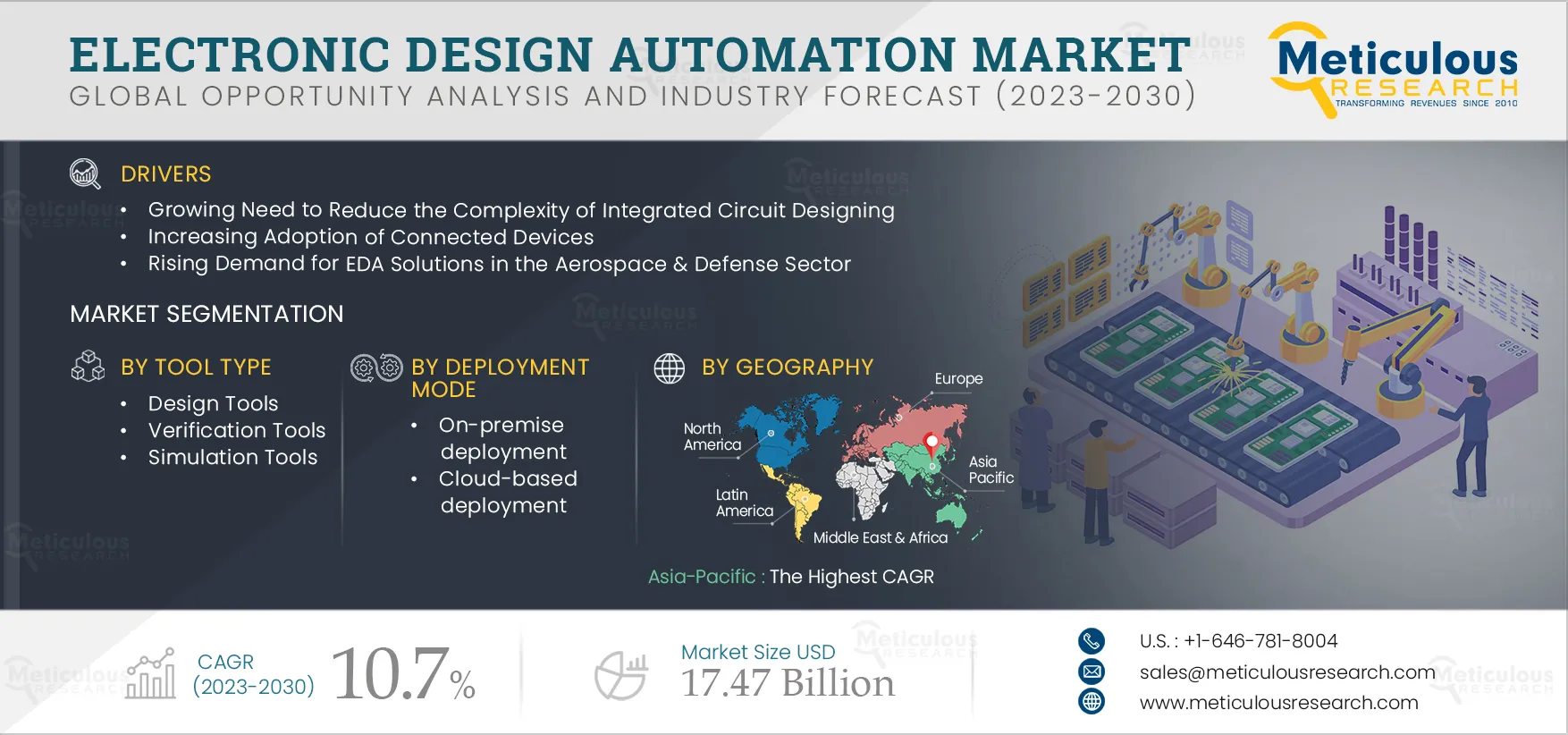
The Electronic Design Automation Market is expected to reach $17.47 billion by 2030, at a CAGR of 10.7% during the forecast period 2023–2030.
- Published
- Oct 2024
- Pages
- 157
- Format
- PDF + Excel
- Report ID
- MR-781
- Base year
- 2022
- 2030 · FORECAST
- $17.47B
- 2030
- $17.47B
- CAGR 2023–2030
- 10.7%
2022 baseline · 2023–2030 forecast at 10.7% CAGR · hover a bar for the value
Key highlights
Services Segment to Register the Highest CAGR During the Forecast Period
Cloud-based deployment Segment to Account for the Largest Share in 2023
Design Tools Segment to Register the Largest Share in 2023
Asia-Pacific to Register the Highest CAGR During the Forecast Period
Report summary
| Particulars | Details |
|---|---|
| Base Year | 2022 |
| Estimated Year | 2023 |
| Forecast Period | 2023–2030 |
| Market Size (2030) | USD 17.47 billion |
| CAGR (2023–2030) | 10.7% |
| Format | PDF, Excel & Cloud Portal · 157 pages |
| Segments Covered | By Offering: Solutions, Services · By Deployment Mode: Cloud-based deployment, On-premise deployment · By Tool Type: Design tools, Verification Tools, Simulation Tools |
| Key Companies | Cadence Design Systems, Inc., Synopsys, Inc., Siemens AG, ANSYS, Inc., Keysight Technologies, Inc., Xilinx, Inc., Altium Limited, Silvaco, Inc., Altair Engineering Inc., Autodesk, Inc., EMWorks, Inc., Aldec, Inc. |
Report overview
Segments covered: offering, deployment mode, tool type.
The growth of this market is driven by the growing need to reduce the complexity of integrated circuit designing, the increasing adoption of connected devices, and the rising demand for EDA solutions in the aerospace & defense sector. However, the availability of open-source EDA software restrains the growth of this market. The growing adoption of cloud technologies across SMEs and the increasing integration of machine learning technology are expected to create growth opportunities for the players operating in this market. However, constant technological changes are a challenge for market growth. Additionally, the emergence of domain-specific electronic product designs and the growing adoption of AI & ML technologies are major trends in the electronic design automation market.
COVID-19 emerged in Wuhan, China, in the last quarter of 2019. In March 2020, the World Health Organization declared a global pandemic as the virus had already spread to most countries, adversely impacting the global economy. The spread of COVID-19 had an unprecedented impact on various sectors. Most industries faced challenges such as disrupted supply chains, workforce scarcity, and employee safety.
The COVID-19 pandemic negatively impacted several economies across the globe and compelled governments to enforce lockdowns, which disrupted global supply chains creating a demand-supply gap. Manufacturing facilities had to operate at limited capacities or shut down completely due to government restrictions. The slowdown in production and shortage of raw materials affected many industries, including the semiconductors industry.
However, despite the challenges faced by the semiconductors industry, the Electronic Design Automation (EDA) industry witnessed an increase in revenues. EDA software providers remained profitable during the COVID-19 pandemic due to long-term and stable investments. The increased demand for EDA tools also drove the adoption of cloud-based EDA solutions, providing designers with 24/7 access to tools and reducing operating costs. Also, the U.S. government announced plans to invest in system-level design to produce advanced security chips. Thus, the COVID-19 pandemic had a mixed impact on the global EDA market.
Report infographic
Market dynamics
1 factors across 1 forceGrowing Need to Reduce the Complexity of Integrated Circuit Designing Driving the Growth of the Electronic Design Automation Market
With the evolution of modern technologies, the demand for complex integrated circuits is growing rapidly. Integrated circuits are complete systems that also include software. These complex integrated circuits are designed to increase reliability, decrease cost per component, increase component density, and improve the speed of electronic devices. Integrated circuits are used in various electronic devices such as wristwatches, radar, computers, logic devices, and video processors. There is a growing demand for complex integrated circuits across various industries. The process of designing integrated circuits is much more complex without the use of electronic design automation. Electronic design automation simplifies designing complex integrated circuits, saving time and money.
Several companies are offering electronic design automation solutions integrated with cutting-edge technologies such as Artificial Intelligence & Machine Learning to reduce the workload of design engineers. For instance, in July 2021, Cadence Design Systems, Inc. (U.S.) launched the Cerebrus Intelligent Chip Explorer machine learning tool to automate the chip design process and increase the productivity of design engineers. Also, in December 2021, Nexar (a part of Altium Limited) (U.S.) partnered with SnapEDA (U.S.) to improve the performance of printed circuit board (PCB) designs and help engineers design electronic circuits fasters by providing computer-aided design (CAD) models and software. Thus, the need to reduce the complexity of integrated circuit designing boosts the demand for EDA solutions, driving the growth of this market.
Table of contents
12 chapters · 99 sections · 157 pages · click to expandSegmental analysis
| Segment | Largest share (2023) | Fastest growth (2023–2030) |
|---|---|---|
| By Offering | — | Services |
| By Deployment Mode | Cloud-based deployment | — |
| By Tool Type | Design tools | — |
By Offering
- Services Segment to Register the Highest CAGR During the Forecast Period
- The services segment is slated to register the highest CAGR during the forecast period.
- The rising need to ensure smooth and efficient system roll-out and optimize operations is expected to drive the growth of this segment.
By Deployment Mode
- Cloud-based deployment Segment to Account for the Largest Share in 2023
- The cloud-based deployment segment is expected to account for the larger share of the global electronic design automation market.
- The large market share of this segment is attributed to the rising adoption of connected devices, the increasing demand for complex integrated circuits, and technological advancement in consumer electronics.
By Tool Type
- Design Tools Segment to Register the Largest Share in 2023
- The design tools segment is expected to account for the largest share of the global electronic design automation market.
- The rise of very large-scale integration (VLSI) systems and the increasing complexity of ICs and PCBs are expected to drive the growth of this segment.
Geographic analysis
Asia-Pacific
Fastest growthThe Asia-Pacific is slated to register the highest CAGR during the forecast period. The growth of this market is attributed to the rising number of electronic manufacturing companies. Additionally, increased demand for consumer devices and the expansion of facilities to meet this demand are expected to boost the growth of the EDA market in Asia-Pacific during the forecast period. Asia-Pacific to Register the Highest CAGR During the Forecast Period
Competitive landscape
- Cadence Design Systems, Inc.
- Synopsys, Inc.
- Siemens AG
- ANSYS, Inc.
- Keysight Technologies, Inc.
- Xilinx, Inc.
- Altium Limited
- Silvaco, Inc.
- Altair Engineering Inc.
- Autodesk, Inc.
- EMWorks, Inc.
- Aldec, Inc.
Frequently asked questions
The global electronic design automation market is projected to reach $17.47 billion by 2030 at a CAGR of 10.7% during the forecast period.
Cite this report
Meticulous Research. (2024). Electronic Design Automation Market - Global Opportunity Analysis And Industry Forecast (2023-2030) (Report No. MR-781). Meticulous Market Research Pvt. Ltd. https://www.meticulousresearch.com/product/electronic-design-automation-market-5465