E-Invoicing Market (2026-2036)
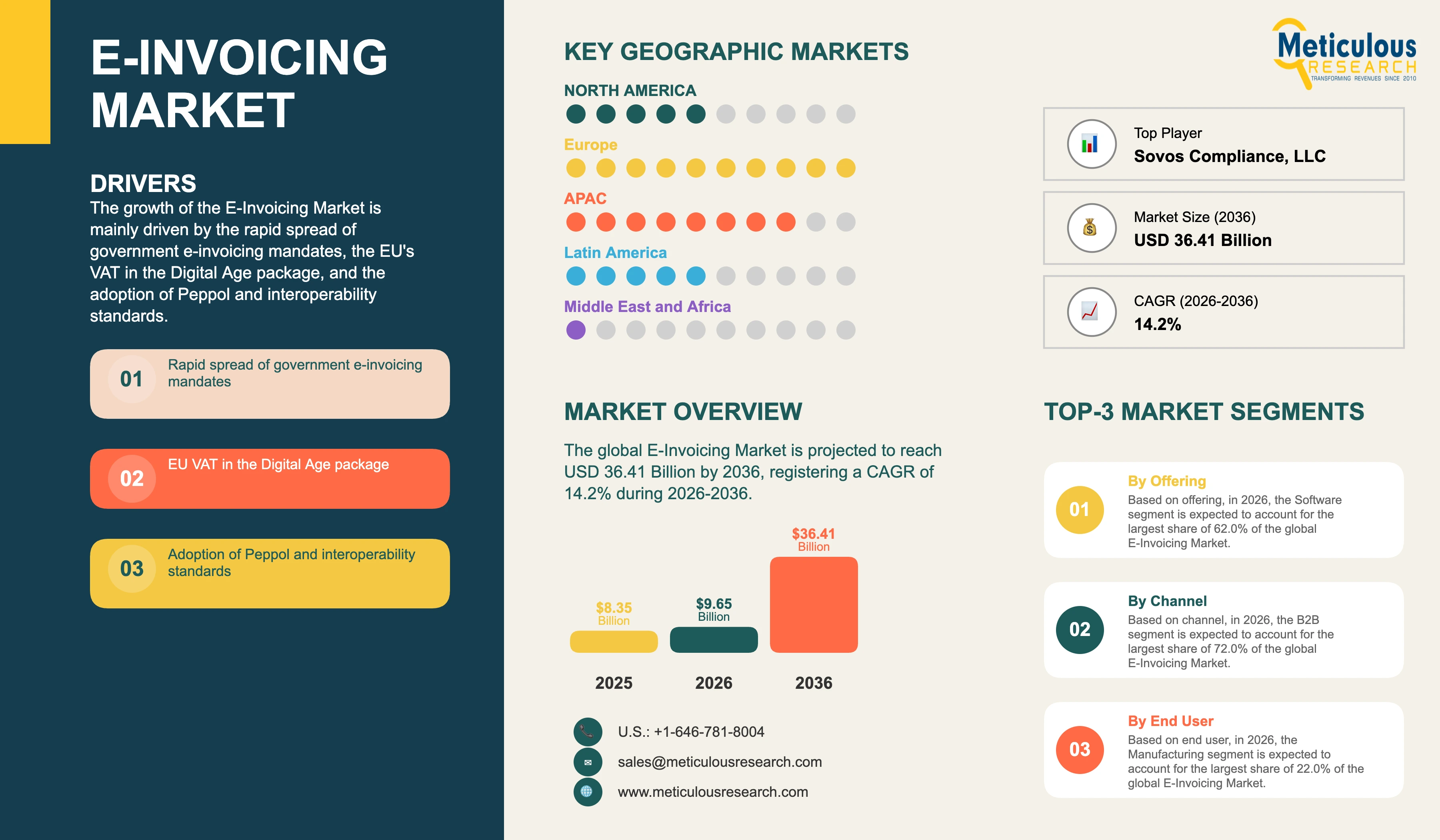
The global e-invoicing market was valued at USD 8.35 billion in 2025. This market is expected to reach USD 36.41 billion by 2036 from an estimated USD 9.65 billion in 2026, registering a CAGR of 14.2% during the forecast period (2026-2036).
- Published
- Nov 2026
- Pages
- 302
- Format
- PDF + Excel
- Report ID
- MRICT - 1042492
- Base year
- 2025
- 2025 · BASELINE
- $8.35B
- 2036
- $36.41B
- CAGR 2026–2036
- 14.2%
2025 baseline · 2026–2036 forecast at 14.2% CAGR · hover a bar for the value
Key highlights
2026 is one of the busiest years for e-invoicing mandates, with mandatory B2B e-invoicing taking effect in Belgium and Croatia in January, Poland's national KSeF system going live for large taxpayers on 1 February and for most other businesses on 1 April, and Greece phasing in mandatory e-invoicing during the year.
France began its e-invoicing mandate on 1 September 2026, when large and medium-sized businesses started issuing e-invoices and all businesses became required to receive them, with small businesses following in 2027.
Poland's KSeF processed more than 50, 000 invoices in its first days of operation, and the Polish Ministry of Finance announced in September 2026 that penalties for KSeF errors will remain suspended until the end of 2027 to give businesses time to adapt.
The UAE published its first comprehensive e-invoicing guidelines in February 2026, launched a voluntary pilot in July 2026, and plans to make e-invoicing mandatory for large businesses with annual revenue above AED 50 million from January 2027, using a Peppol-based model with accredited service providers.
The EU's ViDA package, adopted in 2025, will require e-invoicing and digital reporting for intra-EU business transactions from July 2030 and allows member states to introduce domestic e-invoicing mandates without seeking EU approval.
Germany has required businesses to be able to receive e-invoices since January 2025 and will require issuance in phases in 2027 and 2028, while Spain, Slovakia, and other countries have set timelines for B2B e-invoicing.
Malaysia entered a further phase of its mandatory e-invoicing rollout in January 2026, and Saudi Arabia continues to bring new groups of taxpayers into the integration phase of its FATOORA e-invoicing system.
Thomson Reuters' acquisition of Pagero and the expansion of tax technology providers, such as Avalara and Vertex, into e-invoicing show the growing convergence of e-invoicing and tax compliance.
By offering, software accounts for the largest share of 62.0% in 2026 and also registers the highest CAGR.
By channel, B2B accounts for the largest share in 2026 and also registers the highest CAGR.
By organization size, large enterprises account for the largest share in 2026, while small and medium-sized enterprises register the highest CAGR.
By end user, manufacturing accounts for the largest share of 22.0% in 2026, while retail and consumer goods register the highest CAGR.
By geography, Europe accounts for the largest share of 34.0% in 2026, while the Middle East and Africa registers the highest CAGR of 16.5%.
Report summary
| Particulars | Details |
|---|---|
| Base Year | 2025 |
| Estimated Year | 2026 |
| Forecast Period | 2026-2036 |
| Market Size in 2025 | USD 8.35 billion |
| Market Size in 2026 | USD 9.65 billion |
| Market Size by 2036 | USD 36.41 billion |
| CAGR (2026-2036) | 14.2% |
| Format | PDF, Excel & Cloud Portal · 302 pages |
| Largest Segment by Offering (2026) | Software (62.0%) |
| Largest Segment by End User (2026) | Manufacturing (22.0%) |
| Largest Region (2026) | Europe (34.0%) |
| Fastest-Growing Region | Middle East and Africa (CAGR 16.5%) |
| Segments Covered | Offering, Channel, Organization Size, End User, and Geography |
| Geographic Scope | Europe, Asia-Pacific, Latin America, North America, and Middle East and Africa |
| Key Companies Profiled | Sovos, Thomson Reuters (Pagero), SAP, Avalara, Coupa, Basware, Edicom, Comarch, Esker, Tungsten Automation, Unifiedpost Group, OpenText, TrueCommerce, and Baiwang |
Report overview
Segments covered: offering, channel, organization size, end user.
The growth of this market is mainly driven by the rapid spread of government mandates for business-to-business e-invoicing and real-time tax reporting, the EU's VAT in the Digital Age (ViDA) package, which will require e-invoicing for intra-EU business transactions from 2030, the adoption of the Peppol network and other interoperability standards, the cost savings and efficiency gains from automating invoice processing, and the shift of finance and procurement systems to the cloud. However, factors such as the complexity of complying with different formats and rules in many countries, integration challenges with legacy ERP systems, low digital readiness among small businesses in some markets, and frequent changes and delays in mandate timelines are expected to restrain the growth of this market to some extent.
E-invoicing is the creation, exchange, and processing of invoices in a structured digital format that can be read and processed automatically by computer systems, rather than paper or PDF invoices that must be read and entered manually. E-invoices contain standardized data, such as supplier and buyer details, items, quantities, prices, and taxes, which allows them to flow directly from the seller's billing system to the buyer's accounts payable system and, in many countries, to the tax authority. E-invoicing reduces processing costs, errors, and payment delays, and it gives tax authorities real-time visibility into transactions, which helps reduce VAT fraud. For businesses, the benefits include lower processing costs, fewer errors and disputes, faster payment, better cash flow visibility, and easier audits, while for tax authorities, real-time invoice data improves compliance and makes it possible to pre-fill VAT returns.
This market covers the global sales of e-invoicing software and services, measured in value, including platforms for creating, sending, receiving, validating, and archiving e-invoices, connections to government clearance platforms and exchange networks, such as Peppol, compliance updates, and implementation, integration, and managed services. It is segmented by offering, channel, organization size, end user, and geography. Broader accounts payable automation, procure-to-pay suites, and payment services are not included, except for their e-invoicing components. Free government portals provided by tax authorities are also excluded, although their use affects the demand for commercial solutions.
Governments have been the main force behind the adoption of e-invoicing, and Latin American countries, such as Mexico, Brazil, Chile, and Colombia, introduced mandatory e-invoicing and clearance systems in the 2000s and 2010s, in which invoices must be validated by the tax authority before they are valid. Italy introduced mandatory B2B e-invoicing through its central exchange system in 2019, and other countries, such as Turkey, Saudi Arabia, India, Egypt, Malaysia, and Romania, followed. In 2026, many more countries are implementing mandates, including Belgium, Croatia, Poland, Greece, and France, while Germany, Spain, Slovakia, the UAE, and others have set timelines for the coming years. The OECD and other organizations have also encouraged the use of e-invoicing and digital reporting as part of broader efforts to modernize tax administration.
Countries use different models for e-invoicing, and in clearance models, such as those in Mexico, Brazil, Italy, and Poland, invoices must be sent to a government platform for validation before they reach the buyer. In decentralized models, such as the Peppol-based models used in Belgium, Singapore, Australia, and the UAE, invoices are exchanged between accredited service providers, with data reported to the tax authority. France uses a hybrid model in which certified private platforms exchange invoices and report data to the tax authority. These differences mean that businesses operating in several countries need solutions that support many formats, networks, and government platforms.
The market includes global compliance providers, such as Sovos, Pagero, which is now part of Thomson Reuters, Avalara, Edicom, and Comarch, enterprise software vendors, such as SAP, Oracle, and Coupa, accounts payable and procure-to-pay providers, such as Basware, Esker, and Tungsten Automation, B2B network providers, such as OpenText and TrueCommerce, and many local and regional providers that are certified by tax authorities in individual countries, such as Baiwang in China. Accounting software providers and banks also offer e-invoicing to small businesses. Many providers are certified or accredited in individual countries, and certification requirements vary widely, which creates barriers to entry and favors providers with strong local expertise.
Over the forecast period, the e-invoicing market is expected to grow rapidly, as mandates spread across Europe, the Middle East, Africa, and Asia, as the EU prepares for ViDA in 2030, and as businesses move from compliance-driven adoption to using e-invoicing data for cash flow management, supply chain finance, and analytics. Small and medium-sized enterprises are expected to be the fastest-growing customer group, as mandates extend to all businesses and low-cost cloud solutions become widely available. The market is also expected to consolidate, as global providers acquire local and regional companies to expand their coverage.
Report infographic
Market dynamics
15 factors across 5 forcesRapid spread of government e-invoicing mandates
Governments are introducing mandatory e-invoicing to reduce VAT fraud, close tax gaps, and modernize tax administration. The EU estimates that its VAT gap, the difference between expected and actual VAT revenues, amounts to tens of billions of euros each year, and countries that have introduced e-invoicing and real-time reporting, such as Italy and Poland, have reported improvements in VAT collection. Mandates require businesses to issue and receive invoices in approved formats through approved channels, and they often include real-time reporting of invoice data. Penalties for non-compliance can include fines, the loss of VAT deduction rights for buyers, and the rejection of invoices, which makes compliance a high priority for finance teams.
The number of countries with mandates has grown rapidly, and 2026 has been one of the busiest years, with mandates taking effect in Belgium, Croatia, Poland, Greece, and France, along with new phases in Malaysia and other countries. Each mandate creates demand for software and services from businesses that must comply, and multinational companies need solutions that cover many countries. B2B is the largest and fastest-growing channel in this market. Governments in Africa and Asia, supported by international organizations, are also studying e-invoicing as a tool to expand the tax base and formalize economic activity.
EU VAT in the Digital Age package
The EU's ViDA package, adopted in 2025, is the most significant change to the EU VAT system in decades. It will require e-invoicing and digital reporting for intra-EU B2B transactions from July 2030, based on a European standard for e-invoices, and it allows member states to introduce domestic e-invoicing mandates without seeking a derogation from the European Commission. As a result, many EU countries are introducing or planning domestic mandates that align with the ViDA framework.
ViDA is expected to make e-invoicing the norm for business transactions across the EU by the early 2030s, creating large and sustained demand for e-invoicing solutions. Businesses in the EU and companies outside the EU that sell to EU customers will need to adapt their systems. ViDA also introduces changes to VAT rules for platforms in the short-term accommodation and passenger transport sectors and expands the EU's one-stop-shop for VAT, which will also affect tax and invoicing systems. Europe is the largest region in this market. The European Commission also expects ViDA to help reduce the EU VAT gap significantly and lower compliance costs for businesses over time.
Adoption of Peppol and interoperability standards
The Peppol network, which allows businesses to exchange e-invoices through certified access points using standard formats, has been adopted for B2G and B2B e-invoicing in many countries, including Belgium, the Netherlands, Norway, Australia, New Zealand, Singapore, Japan, Malaysia, and the UAE. Interoperability standards, such as the European e-invoicing standard EN 16931, make it easier for businesses to exchange e-invoices across different systems and countries.
These standards reduce the cost and complexity of e-invoicing, particularly for small businesses, and they create demand for access point and network services. Providers such as Pagero, Sovos, Edicom, Basware, and Storecove operate Peppol access points and offer connections to many countries. Governments that adopt Peppol benefit from an existing network and standards, which reduces the time and cost of implementing a mandate. Japan adopted Peppol as the basis for its digital invoice standard, and Malaysia and Singapore use Peppol-based networks.
Cost savings, efficiency, and cloud adoption
E-invoicing can significantly reduce the cost of processing invoices compared with paper or PDF invoices, by eliminating printing, postage, manual data entry, and errors, and it speeds up invoice approval and payment. Businesses also gain better visibility into their payables and receivables, which helps them manage cash flow and take advantage of early payment discounts.
The shift of finance and procurement systems to the cloud, such as SAP S/4HANA, Oracle Cloud, Microsoft Dynamics 365, Coupa, and SAP Ariba, makes it easier to adopt e-invoicing, because cloud platforms can connect to e-invoicing networks and government platforms through standard interfaces. Software is the largest and fastest-growing offering in this market. Banks and payment providers are also connecting e-invoicing with payment systems, which allows invoices to be paid automatically and reconciled more easily. Many companies report that e-invoicing pays for itself through lower processing costs and fewer late payment penalties.
Table of contents
12 chapters · 134 sections · 302 pages · click to expandSegmental analysis
| Segment | Largest share (2026) | Fastest growth (2026–2036) |
|---|---|---|
| By Offering | Software | Software |
| By Channel | B2B | B2B |
| By Organization Size | Large enterprises | Small and medium-sized enterprises |
| By End User | Manufacturing | Retail and consumer goods |
By Offering
- The software segment is expected to account for the largest share of 62.0% of the market and is also projected to register the highest CAGR during the forecast period.
- The large share and fast growth of this segment are mainly due to the growing adoption of cloud-based e-invoicing platforms that can create, send, receive, validate, and archive e-invoices and connect to government platforms and networks in many countries.
- E-invoicing software is mainly delivered as cloud subscriptions, with pricing based on transaction volumes, the number of countries, and the modules used.
- Providers continuously update their software to reflect changes in formats and rules, which is one of the main reasons businesses use specialized providers.
- Leading software providers include Sovos, Pagero, Avalara, Edicom, Comarch, Basware, SAP with its Document and Reporting Compliance solution, Coupa, and Esker.
- Software spending is being driven by new mandates, cloud ERP migrations, and the need to cover many countries with a single platform.
- Software is expected to remain the largest offering over the forecast period.
- Services make up the rest of the market and include implementation, integration, managed services, network and access point services, and support.
- Demand for managed services is growing as companies outsource the operation of their e-invoicing processes to reduce the burden on their finance and IT teams.
- Implementation and integration services are in high demand around mandate deadlines, when many businesses need to connect their systems to new government platforms within a short period.
- Network and access point services, which connect businesses to Peppol and other networks, are also growing with the adoption of decentralized models.
By Channel
- The B2B segment is expected to account for the largest share of the market and is also projected to register the highest CAGR during the forecast period.
- The large share and fast growth of this segment are mainly due to the spread of mandatory B2B e-invoicing in Europe, the Middle East, Africa, and Asia, and the large volume of invoices exchanged between businesses.
- B2B invoices account for most invoice volumes, and mandates in countries such as Italy, Poland, Belgium, France, Germany, Saudi Arabia, the UAE, Malaysia, and India require businesses to issue and receive them electronically.
- B2B e-invoicing also offers the greatest efficiency benefits, because it allows invoices to flow directly between suppliers' and buyers' systems.
- ViDA will extend mandatory e-invoicing to intra-EU B2B transactions from 2030, which will further increase demand.
- B2B e-invoicing is also increasingly linked to purchase orders, delivery notes, and payments, which supports end-to-end automation of procure-to-pay and order-to-cash processes.
- Providers are investing in connectors to the many government platforms and networks that B2B mandates require.
- B2B is expected to remain the largest channel over the forecast period.
- B2G and B2C make up the rest of the market, with B2G e-invoicing, which is mandatory for public procurement in the EU and many other countries, being the first area to adopt e-invoicing in many markets, while B2C e-invoicing and e-reporting are used in Latin America and some other countries.
- France's e-reporting requirements for B2C transactions are expected to add demand in Europe.
By Organization Size
- E-Invoicing Market Analysis by Organization Size
- The large enterprises segment is expected to account for the largest share of the market.
- The large share of this segment is mainly due to the large invoice volumes of large companies, their operations in many countries with different mandates, and their earlier obligations under phased mandates, which typically apply to large businesses first.
- Large enterprises use e-invoicing platforms integrated with their ERP systems and need solutions that can handle millions of invoices and comply with requirements in many countries.
- Many mandates, such as those in Poland, France, Germany, and the UAE, apply first to large businesses, which has made large enterprises the earliest adopters.
- They also invest in value-added services, such as accounts payable automation and supply chain finance, built on e-invoicing data.
- Large enterprises are expected to remain the largest segment over the forecast period, although their share will decline as small businesses adopt e-invoicing.
- Large enterprises are also more likely to use global providers and managed services, which increases their spending per company.
- However, the small and medium-sized enterprises segment is projected to register the highest CAGR during the forecast period.
- The rapid growth of this segment is driven by the extension of mandates to all businesses and the availability of low-cost cloud solutions and e-invoicing embedded in accounting software.
- Mandates in Poland, France, Belgium, and other countries extend to small businesses in 2026 and 2027, which is expected to bring millions of new users to e-invoicing.
By End User
- The manufacturing segment is expected to account for the largest share of 22.0% of the market.
- The large share of this segment is mainly due to the large volumes of B2B invoices exchanged between manufacturers, suppliers, and customers, complex global supply chains, and the operations of manufacturers in many countries with e-invoicing mandates.
- Manufacturers exchange invoices with thousands of suppliers and customers, often across many countries, and they use e-invoicing to automate their procure-to-pay and order-to-cash processes.
- Automotive, industrial, chemical, and electronics manufacturers have long used electronic data interchange for orders and invoices, and they are now adapting their systems to comply with government mandates.
- E-invoicing helps manufacturers reduce processing costs, improve supplier relationships, and gain visibility into their supply chains.
- Manufacturing is expected to remain one of the largest end users over the forecast period.
- E-invoicing also supports manufacturers' compliance with customs and export documentation requirements in some countries.
- However, the retail and consumer goods segment is projected to register the highest CAGR during the forecast period.
- The rapid growth of this segment is driven by large invoice volumes, B2C e-reporting requirements, and the adoption of e-invoicing by retailers and their many suppliers.
- Banking, financial services, and insurance, IT and telecommunications, government and public sector, healthcare and life sciences, energy and utilities, transportation and logistics, and other end users make up the rest of the market.
- Government and public sector organizations were early adopters of e-invoicing for public procurement, while banking, financial services, and insurance and IT and telecommunications companies use e-invoicing for large volumes of customer and supplier invoices.
Geographic analysis
Europe
Largest shareIn 2026, Europe is expected to account for the largest share of 34.0% of the global e-invoicing market. The large share of this region is mainly due to the large number of mandates being implemented across the region, including in Italy, Poland, Belgium, Croatia, Greece, France, Germany, and Spain, and the preparation for the EU's ViDA package. Italy was the first EU country to introduce mandatory B2B e-invoicing, and its clearance system processes billions of invoices each year. Poland's KSeF and France's mandate, both launched in 2026, are among the largest e-invoicing programs in the world, and Germany is phasing in mandatory issuance in 2027 and 2028. Belgium has adopted a Peppol-based model, and the Nordic countries have long used e-invoicing widely. European providers, such as Pagero, Basware, Comarch, Edicom, Esker, and Unifiedpost, are among the leading players in the market. Europe is expected to remain the largest region throughout the forecast period. Spain has also published an order starting the implementation timeline for B2B e-invoicing, and Slovakia is preparing to introduce its mandate in 2027.
Middle East & Africa
Fastest growthThe Middle East and Africa is projected to register the highest CAGR of 16.5% during the forecast period. Growth is driven by mandates in Saudi Arabia, the UAE, Oman, Egypt, Jordan, Kenya, Nigeria, and other countries, and by government digital transformation programs. The UAE's mandate for large businesses from January 2027, its Peppol-based model, and its requirement for businesses to appoint accredited service providers are expected to create significant demand. Egypt, Jordan, Oman, Kenya, and Nigeria have also introduced or announced e-invoicing systems.
Asia-Pacific
Asia-Pacific holds a significant share of the market, supported by mandates in India, China, South Korea, Malaysia, Singapore, and other countries, and by Peppol adoption in Australia, New Zealand, Japan, and Singapore. India's e-invoicing system, which requires businesses above a turnover threshold to register invoices on a government portal, and China's nationwide digital invoice system are among the largest in the world by volume.
Latin America
Latin America has a large and mature e-invoicing market, led by Mexico, Brazil, Chile, and Colombia, while North America is growing as businesses adopt e-invoicing for efficiency and as the U.S. develops voluntary standards.
North America
North America is expected to grow steadily as large U.S. companies adopt e-invoicing for efficiency and to comply with mandates in other countries. Canada is also exploring e-invoicing for government procurement.
Competitive landscape
The e-invoicing market is fragmented, with global compliance providers, enterprise software vendors, accounts payable and procure-to-pay providers, B2B network providers, and many local and regional providers. Leading companies include Sovos, Thomson Reuters through Pagero, SAP, Avalara, Coupa, Basware, Edicom, Comarch, Esker, Tungsten Automation, Unifiedpost Group, OpenText, TrueCommerce, and Baiwang.
Providers compete mainly on country coverage, certifications with tax authorities, integration with ERP and procurement systems, reliability, scalability, and value-added services. Global providers mainly serve multinational companies with platforms that cover many countries, while local providers often have strong positions in individual countries with complex requirements. Enterprise software vendors, such as SAP, Oracle, and Coupa, offer e-invoicing within their platforms and often partner with specialized providers for country coverage.
The top five players are estimated to account for 28.0% of the e-invoicing market in 2025, reflecting the large number of local and regional providers and the fragmentation of the market across countries. Concentration is higher in some countries, where a few certified providers serve most businesses. Market shares also vary widely by country, with local providers often leading in their home markets. Many providers are private companies backed by private equity investors, which has supported acquisitions and investment in product development.
Players use several strategies to grow and strengthen their positions in this market, including expanding country coverage, obtaining certifications and accreditations, acquiring regional providers, partnering with ERP vendors and accounting software providers, developing value-added services and AI capabilities, and targeting small and medium-sized enterprises. Thomson Reuters' acquisition of Pagero and Avalara's and Vertex's expansion into e-invoicing show the convergence of tax and e-invoicing. Providers are also investing in AI to automate invoice processing and exception handling, and in partnerships with banks to offer payment and financing services.
Competition is expected to center on global coverage, compliance reliability, integration, value-added services, and cost. Providers with broad country coverage, strong partner ecosystems, and AI capabilities are expected to gain share. Local providers are expected to remain important in countries with complex requirements, while consolidation is expected to continue. Pricing pressure is expected to increase for basic compliance, while value-added services and AI are expected to support margins.
Some of the key players operating in the e-invoicing market are Sovos Compliance, LLC, Thomson Reuters Corporation (Pagero), SAP SE, Avalara, Inc., Coupa Software Inc., Basware Corporation, EDICOM Group, Comarch S.A., Esker SA, Tungsten Automation, Unifiedpost Group SA, OpenText Corporation, TrueCommerce, Inc., and Baiwang Co., Ltd.
- —
Poland's KSeF and France's mandate went live in 2026, the UAE published its e-invoicing guidelines and launched a pilot, Poland suspended KSeF penalties until the end of 2027, and Spain published an order starting its B2B e-invoicing timeline.
- Sovos
- Thomson Reuters · Pagero
- SAP
- Avalara
- Coupa
- Basware
- Edicom
- Comarch
- Esker
- Tungsten Automation
- Unifiedpost Group
- OpenText
- TrueCommerce
- Baiwang
Expert perspectives
The e-invoicing market is in a period of rapid growth, driven by a wave of government mandates that is transforming how businesses exchange invoices. 2026 has been one of the busiest years for mandates, and ViDA will make e-invoicing the norm for business transactions across the EU by the early 2030s.
Over the forecast period, the market is expected to grow at about 14.2% per year, one of the fastest growth rates in finance software, supported by new mandates, ViDA, Peppol adoption, cloud migration, and value-added services. Growth is expected to be strongest in Europe, the Middle East and Africa, and Asia-Pacific, where new mandates are being introduced, while Latin America is a mature market. Value-added services, such as accounts payable automation, financing, and analytics, are expected to become increasingly important sources of growth as basic compliance becomes standardized. The convergence of e-invoicing with tax determination, payments, and procurement is also expected to reshape the market, favoring providers with broad platforms.
Software is both the largest and fastest-growing offering, B2B is both the largest and fastest-growing channel, small and medium-sized enterprises are the fastest-growing organization size segment, and retail and consumer goods is the fastest-growing end user. Large enterprises and manufacturing are the largest segments.
Europe remains the largest region, while the Middle East and Africa is the fastest-growing region at a CAGR of 16.5%. The main swing factors are the timing of mandates,The main swing factors that could change this outlook are the timing of mandates, the implementation of ViDA, the adoption of Peppol, and the ability of small businesses to comply.
For finance and tax teams in businesses, the key decisions are whether to use a single global provider or several local providers, how to integrate e-invoicing with ERP systems, and how to use e-invoicing data for value beyond compliance. For providers, success depends on broad country coverage, reliable compliance, strong integrations, and value-added services. Providers will also need to manage pricing pressure as competition increases and as governments offer free basic tools for small businesses. Businesses that treat e-invoicing as an opportunity to automate and improve their finance processes, rather than only as a compliance obligation, are expected to gain the most value.
Overall, e-invoicing is expected to become a standard part of business operations worldwide, with its market growing rapidly as mandates spread and businesses use e-invoicing data to improve their finance processes. ViDA and new mandates in the Gulf countries are expected to be the most important sources of growth over the next several years.
Customer perspectives
Global Head of Indirect Tax - industrial manufacturer, Germany
We operate in more than 30 countries, and in the past two years we have had to comply with new e-invoicing systems in Poland, France, Belgium, and others. Using one global provider connected to our ERP has been the only practical way to manage this.
Multinational manufacturers are expected to continue investing in global e-invoicing platforms as more countries introduce mandates.
The complexity of compliance across many countries is why software accounts for 62.0% of the market and manufacturing accounts for 22.0%.
Chief Financial Officer - retail chain, France
The French mandate forced us to change how we issue and receive invoices, but it has also cut our processing costs and improved our visibility into supplier payments.
Businesses that use e-invoicing data for cash flow management and supplier relationships gain benefits beyond compliance.
Mandates in France and other European countries are why Europe accounts for 34.0% of the market and retail and consumer goods is the fastest-growing end user.
Finance Manager - small trading company, UAE
We are preparing for the e-invoicing mandate by appointing an accredited service provider. A cloud solution connected to our accounting software should make compliance simple for a small team.
Small businesses in the Gulf countries and other new mandate markets are expected to adopt cloud e-invoicing solutions rapidly over the next several years.
New mandates in the Gulf countries are why the Middle East and Africa is the fastest-growing region and small and medium-sized enterprises are the fastest-growing organization size segment.
Frequently asked questions
The global e-invoicing market was valued at USD 8.35 billion in 2025 and USD 7.20 billion in 2024, and is estimated at USD 9.65 billion in 2026.
The market is expected to reach USD 36.41 billion by 2036, supported by government mandates, the EU's ViDA package, Peppol adoption, and cloud migration.
The market is expected to register a CAGR of 14.2% from 2026 to 2036.
E-invoicing, or electronic invoicing, is the creation, exchange, and processing of invoices in a structured digital format that can be processed automatically by computer systems and, in many countries, reported to or cleared by the tax authority.
Growth is driven by the rapid spread of government e-invoicing mandates, the EU's VAT in the Digital Age package, the adoption of Peppol and interoperability standards, and cost savings, efficiency, and cloud adoption.
The complexity of different formats and rules and integration challenges and low digital readiness restrain growth, while frequent changes and delays in mandates and data security, privacy, and system reliability remain key challenges.
Key opportunities include small and medium-sized enterprises, value-added services built on e-invoicing data, new mandates in the Middle East, Africa, and Asia, and AI and automation in invoice processing.
Belgium and Croatia introduced mandates in January 2026, Poland's KSeF went live in February and April 2026, Greece phased in its mandate during the year, and France began its mandate in September 2026, while the UAE launched a pilot in July 2026.
Peppol is an international network and set of standards that allows businesses and governments to exchange e-invoices and other documents through certified access points, and it is used for e-invoicing in Belgium, Norway, the Netherlands, Australia, Singapore, Japan, Malaysia, the UAE, and other countries.
ViDA is an EU package adopted in 2025 that will require e-invoicing and digital reporting for intra-EU business transactions from July 2030 and allows member states to introduce domestic e-invoicing mandates without EU approval.
Software is expected to account for the largest share of 62.0% of the market in 2026 and is also projected to register the highest CAGR.
B2B is projected to register the highest CAGR and also holds the largest share, driven by mandatory B2B e-invoicing.
Small and medium-sized enterprises are projected to register the highest CAGR, while large enterprises hold the largest share.
Manufacturing is expected to account for the largest share of 22.0% of the market in 2026, while retail and consumer goods are projected to register the highest CAGR.
Europe is expected to account for the largest share of 34.0% of the market in 2026.
The Middle East and Africa is projected to register the highest CAGR of 16.5% during the forecast period.
The report profiles 14 companies, including Sovos, Thomson Reuters (Pagero), SAP, Avalara, Coupa, and Basware. The top five players account for an estimated 28.0% of the market in 2025.
Poland's KSeF and France's mandate went live in 2026, the UAE published its e-invoicing guidelines and launched a pilot, Poland suspended KSeF penalties until the end of 2027, and Spain published an order starting its B2B e-invoicing timeline.
Cite this report
Meticulous Research. (2026). E-Invoicing Market - Global Opportunity Analysis and Industry Forecast (2026-2036) (Report No. MRICT - 1042492). Meticulous Market Research Pvt. Ltd. https://www.meticulousresearch.com/product/e-invoicing-market-7175