Direct-to-Consumer Genetic Testing Market (2026-2036)
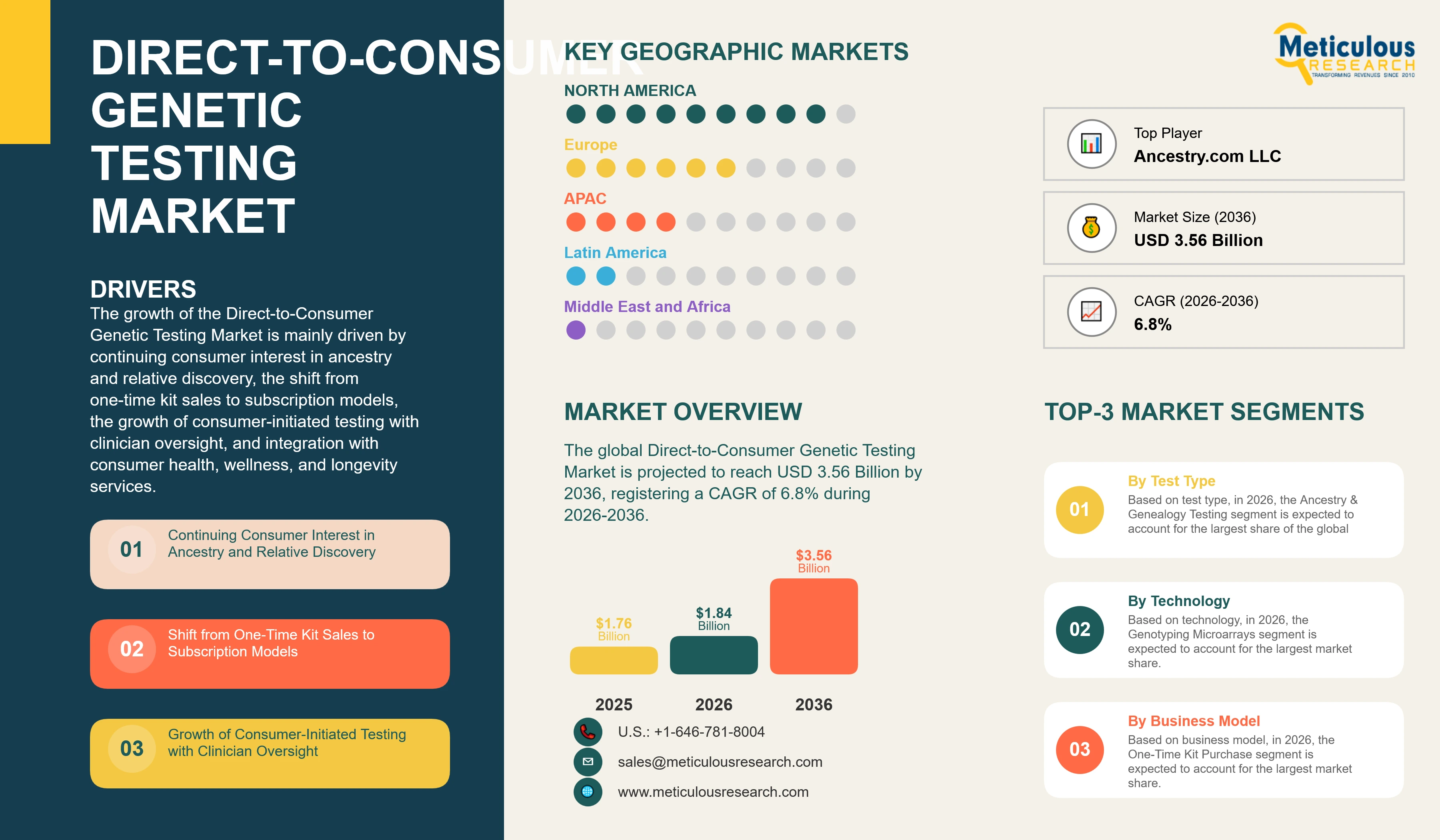
The global Direct-to-Consumer Genetic Testing Market was valued at USD 1.76 billion in 2025. This market is expected to reach USD 3.56 billion by 2036 from an estimated USD 1.84 billion in 2026, registering a CAGR of 6.8% during the forecast period (2026-2036).
- Published
- Oct 2026
- Pages
- 367
- Format
- PDF + Excel
- Report ID
- MRHC - 1042370
- Base year
- 2025
- 2025 · BASELINE
- $1.76B
- 2036
- $3.56B
- CAGR 2026–2036
- 6.8%
2025 baseline · 2026–2036 forecast at 6.8% CAGR · hover a bar for the value
Key highlights
The global Direct-to-Consumer Genetic Testing Market is projected to reach USD 3.56 billion by 2036, driven by ancestry demand, subscription business models, consumer-initiated clinician-ordered testing, and integration with consumer health services.
Database growth continues, led decisively by one provider. According to database tracking published in March 2026, AncestryDNA was approaching 30 million DNA kits and remained larger than all other genealogical databases combined, 23andMe held just under 14 million, down from approximately 15 million in October 2024, MyHeritage held 9.6 million kits available for genealogical matching, and FamilyTreeDNA held just under 1.8 million autosomal kits, with most companies showing steady growth and the market considered not yet saturated.
The sector has undergone a structural shock and restructuring. In June 2025, a U.S. bankruptcy court approved the sale of substantially all 23andMe assets for USD 305 million to TTAM Research Institute, a nonprofit founded by company co-founder Anne Wojcicki, following a Chapter 11 filing in late March 2025 and a bidding contest in which Regeneron had agreed to pay USD 256 million; court documents cited approximately 13 million customers, and TTAM committed to honour existing privacy policies, including allowing users to delete data and opt out of research.
North America is expected to account for the largest market share in 2026, supported by consumer familiarity, genealogical interest, and the concentration of established providers, while Asia-Pacific is projected to register the fastest growth during the forecast period.
By test type, Ancestry & Genealogy Testing is expected to account for the largest market share in 2026, whereas Pharmacogenomic & Medication Response Testing is projected to witness the fastest growth through 2036, as consumers seek actionable results that affect clinical decisions rather than informational reports.
Report summary
| Particulars | Details |
|---|---|
| Forecast Period | 2026-2036 |
| Base Year | 2025 |
| Estimated Year | 2026 |
| CAGR (Value) | 6.8% |
| Format | PDF, Excel & Cloud Portal · 367 pages |
| Market Size (Value) in 2026 | USD 1.84 Billion |
| Market Size (Value) in 2036 | USD 3.56 Billion |
| Segments Covered | By Test Type: Ancestry & Genealogy Testing, Health Predisposition Testing, Carrier Status Testing, Pharmacogenomic & Medication Response Testing, Nutrition, Fitness & Wellness Testing, Trait & Other Testing. By Technology: Genotyping Microarrays, Targeted Sequencing Panels, Whole-Genome & Whole-Exome Sequencing. By Distribution Channel: Online Direct Sales, Retail Pharmacy & Store Channels, Telehealth & Clinician-Mediated Channels, Employer & Insurer Channels. By Business Model: One-Time Kit Purchase, Subscription & Service-Based Models. By End User: Individual Consumers, Employers & Insurers, Research & Pharmaceutical Partners. |
| Countries Covered | North America: U.S., Canada. Europe: U.K., Ireland, Germany, Nordic Countries, France, Rest of Europe. Asia-Pacific: China, Japan, South Korea, India, Australia, Rest of Asia-Pacific. Latin America: Brazil, Mexico, Rest of Latin America. Middle East & Africa: Saudi Arabia, UAE, Rest of Middle East & Africa. |
| Key Companies | Ancestry.com LLC, 23andMe (TTAM Research Institute), MyHeritage Ltd, FamilyTreeDNA (Gene by Gene, Ltd.), Nebula Genomics, Laboratory Corporation of America Holdings, Quest Diagnostics Incorporated, Myriad Genetics, Inc., Fulgent Genetics, Inc., and Everlywell, Inc. |
Report overview
Segments covered: test type, technology, distribution channel, business model, end user.
The growth of this market is mainly driven by continuing consumer interest in ancestry and relative discovery, which remains the largest and most durable source of demand; the shift of business models from one-time kit sales toward subscription services that generate recurring revenue; the expansion of consumer-initiated testing conducted with clinician oversight, which allows health-related results to be delivered within a regulated pathway; and the integration of genetic results with broader consumer health, wellness, and longevity services. In addition, the growth of pharmacogenomic and carrier reports ordered by consumers, the expansion of consumer genetic testing in Asia-Pacific and the Middle East, the use of consumer databases in research partnerships, and the growing availability of consumer whole-genome sequencing are further supporting the growth of this market, although growth is substantially slower than in the period before 2020 and the market now operates under greater privacy scrutiny.
The Direct-to-Consumer Genetic Testing Market, also referred to as the DTC genetic testing market, consumer genomics market, or at-home DNA testing market, comprises genetic tests that consumers purchase and initiate themselves, rather than tests ordered by a clinician as part of medical care. The market includes ancestry and genealogy testing, including relative matching and ethnicity estimation; health predisposition reports covering common disease risk and selected pathogenic variants; carrier status reports; pharmacogenomic reports on medication response; nutrition, fitness, and wellness reports; trait and non-clinical curiosity reports; and consumer whole-genome and whole-exome sequencing. The market also includes consumer-initiated testing in which the consumer selects and pays for the test while a clinician reviews the order and results, a model that allows health claims to be made within a regulated pathway. The market ecosystem extends from consumer genomics companies, genealogy platforms, and laboratories to retail and online channels, telehealth providers, employers and insurers offering tests as benefits, pharmaceutical companies entering research partnerships, and the regulators and state legislatures that govern consumer genetic data.
This market differs fundamentally from clinical genetic testing in who decides and who pays. A consumer selects the test, pays out of pocket, and receives results without a clinical indication, which means demand responds to marketing, price, and curiosity rather than to medical necessity or reimbursement. That makes the market cyclical in a way clinical testing is not, and the last decade has demonstrated both the upside and the downside of that dynamic, with very rapid growth through the late 2010s followed by a sharp contraction as the addressable population of curious first-time buyers was substantially exhausted.
Ancestry remains the anchor of the market. According to database tracking published in March 2026, AncestryDNA was approaching 30 million DNA kits and remained larger than all other genealogical databases combined, 23andMe held just under 14 million, down from approximately 15 million in October 2024, MyHeritage held 9.6 million kits available for genealogical matching, and FamilyTreeDNA held just under 1.8 million autosomal kits, with most companies showing steady growth and the market considered not yet saturated. The scale and distribution of these databases matter commercially, because the value of relative matching increases with database size, which gives the largest provider a position competitors cannot easily contest, and because a large database is itself an asset for research partnerships and for subscription services built on records and family trees.
The sector has been through a severe structural shock. In June 2025, a U.S. bankruptcy court approved the sale of substantially all 23andMe assets for USD 305 million to TTAM Research Institute, a nonprofit founded by company co-founder Anne Wojcicki, following a Chapter 11 filing in late March 2025 and a bidding contest in which Regeneron had agreed to pay USD 256 million; court documents cited approximately 13 million customers, and TTAM committed to honour existing privacy policies, including allowing users to delete data and opt out of research. The credential stuffing attack disclosed by 23andMe in 2023, together with the subsequent bankruptcy, is associated with a decline in its database from approximately 15 million kits in October 2024 to just under 14 million by March 2026, the only major genealogical database to contract over the period. The practical consequence is that the market now operates under conditions in which consumers, regulators, and state attorneys general treat consumer genetic data as requiring protections comparable to health data, and in which the commercial fragility of a one-time-purchase business model has been publicly demonstrated.
Privacy regulation has tightened in response. In 2026, several U.S. states advanced genetic privacy legislation: South Dakota enacted SB 49, regulating the practices of direct-to-consumer genetic testing companies, with effect from July 1, 2026; Utah enacted HB 182, regulating access to genetic sequencing information by foreign adversaries, with its effective date delayed to January 1, 2028; and Wisconsin AB 673 was passed by the legislature but vetoed on March 27, 2026, while bills remained pending in Connecticut, Rhode Island, West Virginia, Illinois, and California. These laws impose consent, disclosure, deletion, and in some proposals data ownership requirements on consumer genetic testing companies, and several create private rights of action or attorney general enforcement with per-violation penalties. Compliance across a patchwork of state requirements is now a material operating cost, and providers must design consent and deletion capability into their products rather than adding it later.
Business models have shifted in response to both pressures. One-time kit sales generate no recurring revenue and leave a company dependent on acquiring new customers indefinitely, which is why providers have moved toward subscriptions covering records access, periodic new reports, health monitoring, and family tree services. Consumer-initiated testing with clinician oversight has also grown, because it allows health-related results to be offered with a clinical pathway for interpretation and follow-up, which addresses both regulatory exposure and the criticism that consumer health reports are delivered without support. In the second quarter of 2026, Guardant Health, Inc. reported screening revenue of USD 52.9 million on approximately 66,000 Shield blood-based cancer screening tests, compared with approximately 16,000 a year earlier, and raised full-year guidance to 270,000-285,000 tests, illustrating the growth of clinician-ordered consumer-initiated screening that competes with unregulated consumer health reports.
The market includes genealogy-led providers such as Ancestry and MyHeritage, consumer genomics companies including 23andMe under TTAM Research Institute and FamilyTreeDNA, consumer sequencing providers such as Nebula Genomics, wellness and nutrition-focused providers, and laboratories and telehealth companies offering consumer-initiated testing with clinician oversight. Participants compete on database size and matching value, breadth and perceived usefulness of reports, price and promotional cadence, subscription value, brand trust and privacy credibility, regulatory positioning for health claims, and the quality of the consumer experience.
At the same time, the market faces substantial challenges, including the maturity of the ancestry opportunity in its core markets, the erosion of consumer trust following breaches and bankruptcy, the regulatory limits on health claims made without clinician involvement, the clinical limitations of the arrays most providers use, which do not detect many pathogenic variants and cannot be relied on to exclude risk, the cost of compliance across a widening patchwork of state laws, and the difficulty of converting a one-time purchase into a durable customer relationship. As a result, providers that combine credible privacy practice, recurring-revenue models, actionable rather than merely interesting results, and a defensible regulatory pathway for health claims are expected to capture the largest share of growth over the forecast period.
Report infographic
Market dynamics
15 factors across 5 forcesContinuing Consumer Interest in Ancestry and Relative Discovery
Continuing consumer interest in ancestry and relative discovery is a major factor driving the Direct-to-Consumer Genetic Testing Market, and remains its most durable demand source. According to database tracking published in March 2026, AncestryDNA was approaching 30 million DNA kits and remained larger than all other genealogical databases combined, 23andMe held just under 14 million, down from approximately 15 million in October 2024, MyHeritage held 9.6 million kits available for genealogical matching, and FamilyTreeDNA held just under 1.8 million autosomal kits, with most companies showing steady growth and the market considered not yet saturated. Ancestry testing has a quality that health testing lacks, in that its value increases over time as more people join the database and more relatives become discoverable, which means a customer tested years ago continues to receive new information without purchasing anything further.
That dynamic supports subscription conversion. A consumer who has found relatives has reason to maintain access to records, trees, and matching, which is why genealogy-led providers have been more successful than health-led providers at establishing recurring revenue. The observation that the market has not yet reached saturation, despite a decade of testing, indicates that demand in this category persists even after the initial wave of adoption.
Shift from One-Time Kit Sales to Subscription Models
The shift from one-time kit sales toward subscription models is significantly driving the commercial sustainability of the market. A business dependent on one-time purchases must acquire new customers continuously to maintain revenue, and when the pool of first-time buyers contracts, revenue falls sharply, which is the dynamic that contributed to the 23andMe bankruptcy. In June 2025, a U.S. bankruptcy court approved the sale of substantially all 23andMe assets for USD 305 million to TTAM Research Institute, a nonprofit founded by company co-founder Anne Wojcicki, following a Chapter 11 filing in late March 2025 and a bidding contest in which Regeneron had agreed to pay USD 256 million; court documents cited approximately 13 million customers, and TTAM committed to honour existing privacy policies, including allowing users to delete data and opt out of research.
Subscriptions covering historical records, periodic new reports, health monitoring, and family tree services convert a single transaction into a continuing relationship, stabilize revenue, and justify continued investment in content. This shift is expected to be the principal determinant of which providers remain viable over the forecast period, and it changes the market from one measured in kits sold toward one measured in active subscribers.
Growth of Consumer-Initiated Testing with Clinician Oversight
The growth of consumer-initiated testing with clinician oversight is an important driver of demand. In this model a consumer selects and pays for a test while a clinician reviews the order and the results, which allows health-related testing to be offered with a regulated pathway for interpretation, counseling, and follow-up. In the second quarter of 2026, Guardant Health, Inc. reported screening revenue of USD 52.9 million on approximately 66,000 Shield blood-based cancer screening tests, compared with approximately 16,000 a year earlier, and raised full-year guidance to 270,000-285,000 tests, illustrating the growth of clinician-ordered consumer-initiated screening that competes with unregulated consumer health reports. The model addresses the central criticism of consumer health testing, that results with clinical consequences are delivered without professional support, and it allows providers to offer tests that would not be permitted as unsupervised consumer products.
Integration with Consumer Health, Wellness, and Longevity Services
Integration with consumer health, wellness, and longevity services supports market growth. Genetic results are increasingly offered as a component of broader consumer health services rather than as a standalone product, combined with laboratory biomarkers, wearable data, nutrition guidance, and telehealth consultations. This positioning gives a genetic test a continuing role in a service the consumer uses repeatedly, improves retention, and allows providers to charge for a service rather than for a single test, which is commercially more attractive than the kit model.
Table of contents
13 chapters · 139 sections · 367 pages · click to expandSegmental analysis
| Segment | Largest share (2026) | Fastest growth (2026–2036) |
|---|---|---|
| By Test Type | Ancestry & Genealogy Testing | Pharmacogenomic & Medication Response Testing |
| By Technology | Genotyping Microarrays | Whole-Genome & Whole-Exome Sequencing |
| By Distribution Channel | Online Direct Sales | Telehealth & Clinician-Mediated Channels |
| By Business Model | One-Time Kit Purchase | Subscription & Service-Based Models |
| By End User | Individual Consumers | Research & Pharmaceutical Partners |
By Test Type
- Direct-to-Consumer Genetic Testing Market Analysis by Test Type
- The Ancestry & Genealogy Testing segment is expected to account for the largest share of the global Direct-to-Consumer Genetic Testing Market.
- The large share of this segment is mainly due to the scale of established ancestry databases, with the largest approaching 30 million kits, the self-reinforcing value of relative matching as databases grow, the absence of regulatory constraint on genealogical claims, and the success of genealogy providers in converting testers into subscribers to records and tree services.
- However, the Pharmacogenomic & Medication Response Testing segment is projected to register the highest CAGR during the forecast period.
- The rapid growth of this segment is attributed to consumer preference for results that affect a decision rather than results that are merely informative, the relevance of medication response information to commonly prescribed drugs, and the suitability of this category to consumer-initiated testing with clinician oversight, which gives the result a pathway into prescribing.
By Technology
- Direct-to-Consumer Genetic Testing Market Analysis by Technology
- The Genotyping Microarrays segment is expected to account for the largest share of the market.
- The large share of this segment is mainly due to the low cost per sample of array genotyping, which supports the consumer price points and promotional discounting on which the market depends, its suitability for ancestry inference and relative matching, which require many common markers rather than complete sequence, and the array-based construction of the large established databases.
- However, the Whole-Genome & Whole-Exome Sequencing segment is projected to register the highest CAGR during the forecast period.
- The rapid growth of this segment is attributed to falling sequencing costs, the ability to generate new reports from a single sequencing event as knowledge advances, which supports subscription relationships, and the clinical limitation of arrays, which cannot detect much of the variation that consumers seeking health information are interested in.
By Distribution Channel
- Direct-to-Consumer Genetic Testing Market Analysis by Distribution Channel
- The Online Direct Sales segment is expected to account for the largest share of the market.
- The large share of this segment is mainly due to the origin of the market in online kit sales, the dependence of consumer genetic testing on digital marketing and promotional pricing, the delivery of results through online accounts, and the integration of purchase with the genealogical and matching services that follow.
- However, the Telehealth & Clinician-Mediated Channels segment is projected to register the highest CAGR during the forecast period.
- The rapid growth of this segment is attributed to the shift of health-related consumer testing into consumer-initiated models with clinician review, the regulatory advantages of that pathway for health claims, and the integration of genetic testing into broader telehealth and consumer health services.
By Business Model
- Direct-to-Consumer Genetic Testing Market Analysis by Business Model
- The One-Time Kit Purchase segment is expected to account for the largest share of the market.
- The large share of this segment is mainly due to the historical structure of the market, in which revenue was recognized on kit sale, and the continuing prevalence of one-time purchase for ancestry, wellness, and trait testing bought as a gift or on promotion.
- However, the Subscription & Service-Based Models segment is projected to register the highest CAGR during the forecast period.
- The rapid growth of this segment is attributed to the commercial necessity of recurring revenue, demonstrated by the failure of a kit-dependent business model at a leading provider, the suitability of records, matching, and periodic reinterpretation to subscription, and the integration of genetic results into continuing consumer health services.
By End User
- Direct-to-Consumer Genetic Testing Market Analysis by End User
- The Individual Consumers segment is expected to account for the largest share of the market, since the market is defined by consumer purchase and payment.
- The large share of this segment reflects out-of-pocket purchase of ancestry, health, wellness, and trait testing by individuals, frequently as gifts and frequently in response to promotional pricing.
- However, the Research & Pharmaceutical Partners segment is projected to register the highest CAGR during the forecast period.
- The rapid growth of this segment is attributed to the value of large consented consumer genetic databases linked to self-reported phenotype for target discovery and cohort identification, and to the interest pharmaceutical companies have shown in these assets, demonstrated by the USD 256 million that Regeneron agreed to pay for most 23andMe assets before the nonprofit bid prevailed at USD 305 million.
Geographic analysis
North America
Largest shareIn 2026, North America is expected to account for the largest share of the global Direct-to-Consumer Genetic Testing Market. The large share of this region is mainly attributed to high consumer familiarity with genetic testing, strong genealogical interest associated with immigration history, the concentration of established providers and the largest databases, and willingness to pay out of pocket for non-reimbursed health and wellness services. In 2026, several U.S. states advanced genetic privacy legislation: South Dakota enacted SB 49, regulating the practices of direct-to-consumer genetic testing companies, with effect from July 1, 2026; Utah enacted HB 182, regulating access to genetic sequencing information by foreign adversaries, with its effective date delayed to January 1, 2028; and Wisconsin AB 673 was passed by the legislature but vetoed on March 27, 2026, while bills remained pending in Connecticut, Rhode Island, West Virginia, Illinois, and California. At the same time, this is the region where the maturity of the ancestry opportunity is most pronounced.
Europe
Europe is expected to account for a significant share of the market, supported by genealogical interest in the U.K., Ireland, and the Nordic countries, and by the presence of MyHeritage, which holds 9.6 million kits available for matching. Growth is constrained relative to North America by stricter data protection under the General Data Protection Regulation, by national restrictions in several countries on genetic testing performed without medical supervision, and by lower consumer willingness to pay out of pocket where health systems are publicly funded.
Asia-Pacific
Fastest growthAsia-Pacific is projected to register the highest CAGR during the forecast period. The growth of this region is driven by very low current penetration, rising disposable income and health awareness in China, Japan, South Korea, India, and Australia, stronger relative consumer interest in wellness, nutrition, and pharmacogenomic reporting than in genealogy, improved reference data for non-European ancestries, and the growth of domestic providers serving local languages and payment preferences.
Latin America
Latin America and the Middle East & Africa are expected to account for smaller shares of the market. In Latin America, interest in admixture and ancestry reporting is high in Brazil and Mexico, though constrained by price sensitivity, while in the Middle East, consumer interest in carrier and consanguinity-related testing and rising disposable income in Gulf countries are expected to support growth.
Competitive landscape
The global Direct-to-Consumer Genetic Testing Market is concentrated in ancestry, where the largest database exceeds all competitors combined, and fragmented in health, wellness, and nutrition testing, where numerous smaller providers operate with limited differentiation. The provider base has restructured substantially following the bankruptcy and sale of a leading consumer genomics company. Participants compete on database size and matching value, breadth and perceived usefulness of reports, price and promotional cadence, subscription value, brand trust and privacy credibility, regulatory positioning for health claims, and consumer experience.
Participants are converting kit purchasers into subscribers, extending into clinician-mediated health testing, strengthening privacy and deletion capability in response to state legislation, expanding into under-penetrated regions, and pursuing research partnerships that monetize consented databases. Recent developments include the approval in June 2025 of the sale of substantially all 23andMe assets to TTAM Research Institute for USD 305 million, the continuing growth of AncestryDNA toward 30 million kits as reported in March 2026, and the enactment of South Dakota SB 49 regulating direct-to-consumer genetic testing practices with effect from July 1, 2026.
The report provides a comprehensive competitive assessment of the leading organizations operating in the global Direct-to-Consumer Genetic Testing Market. The key players profiled in the report include Ancestry.com LLC (U.S.), 23andMe (TTAM Research Institute) (U.S.), MyHeritage Ltd (Israel), FamilyTreeDNA (Gene by Gene, Ltd.) (U.S.), Nebula Genomics (U.S.), Laboratory Corporation of America Holdings (U.S.), Quest Diagnostics Incorporated (U.S.), Myriad Genetics, Inc. (U.S.), Fulgent Genetics, Inc. (U.S.), and Everlywell, Inc. (U.S.).
- Ancestry.com LLC
- 23andMe (TTAM Research Institute)
- MyHeritage Ltd
- Nebula Genomics
- Laboratory Corporation of America Holdings
- Quest Diagnostics Incorporated
- Myriad Genetics, Inc.
- Fulgent Genetics, Inc.
- Everlywell, Inc
Expert perspectives
The Direct-to-Consumer Genetic Testing Market has passed through its reckoning. A leading brand with approximately 13 million customers entered Chapter 11 and was sold for USD 305 million, its database contracted while every major competitor grew, and 27 states and the District of Columbia went to court over the transfer of consumer genetic data. What remains is a smaller, slower-growing, but more honestly constituted market, in which the binding constraint is no longer consumer curiosity but the ability to earn recurring revenue and to hold genetic data in a way consumers and regulators accept.
Three structural changes are expected to shape the market through 2036. First, the measure of the market is shifting from kits sold to subscribers retained, which advantages providers with records, matching, and content worth paying for repeatedly and disadvantages those selling a single informational report. Second, health-related consumer testing is expected to move progressively into clinician-mediated pathways, because that is where health claims can be made and acted on. Third, privacy capability is becoming a regulated product requirement rather than a policy statement, which raises the cost of operating and favours scale.
For companies planning entry or expansion, the most defensible positions over the forecast period are likely to be found in subscription services built on matching and records, pharmacogenomic and other actionable reporting delivered with clinician oversight, consumer sequencing with ongoing reinterpretation, integration into broader consumer health services, and expansion in under-penetrated regions of Asia-Pacific and the Middle East. For established providers, the principal priorities are subscription conversion, demonstrable privacy practice, and avoiding the regulatory exposure that unsupervised health claims attract.
Overall, the market is expected to grow moderately rather than rapidly, well below its pre-2020 trajectory, with ancestry testing, genotyping arrays, online direct sales, one-time kit purchases, and individual consumers in North America providing the core of demand, and pharmacogenomic reporting, sequencing, telehealth and clinician-mediated channels, subscription models, research partners, and Asia-Pacific providing the fastest growth.
Customer perspectives
Insights gathered during primary interviews with consumer genomics product leaders, clinical geneticists, and consumer health channel managers operating in this market highlight where priorities are shifting. The following perspectives reflect recurring themes raised across these discussions.
“This reflects the shift toward recurring revenue models.”
“This indicates the downstream burden of consumer testing on clinical services.”
“This points to privacy credibility as a purchase determinant.”
Frequently asked questions
The global Direct-to-Consumer Genetic Testing Market is estimated at USD 1.84 billion in 2026.
Cite this report
Meticulous Research. (2026). Direct-to-Consumer Genetic Testing Market - Global Opportunity Analysis And Industry Forecasts (2026-2036) (Report No. MRHC - 1042370). Meticulous Market Research Pvt. Ltd. https://www.meticulousresearch.com/product/direct-to-consumer-genetic-testing-market-7053