
Digital Rehabilitation Market (2026-2036)
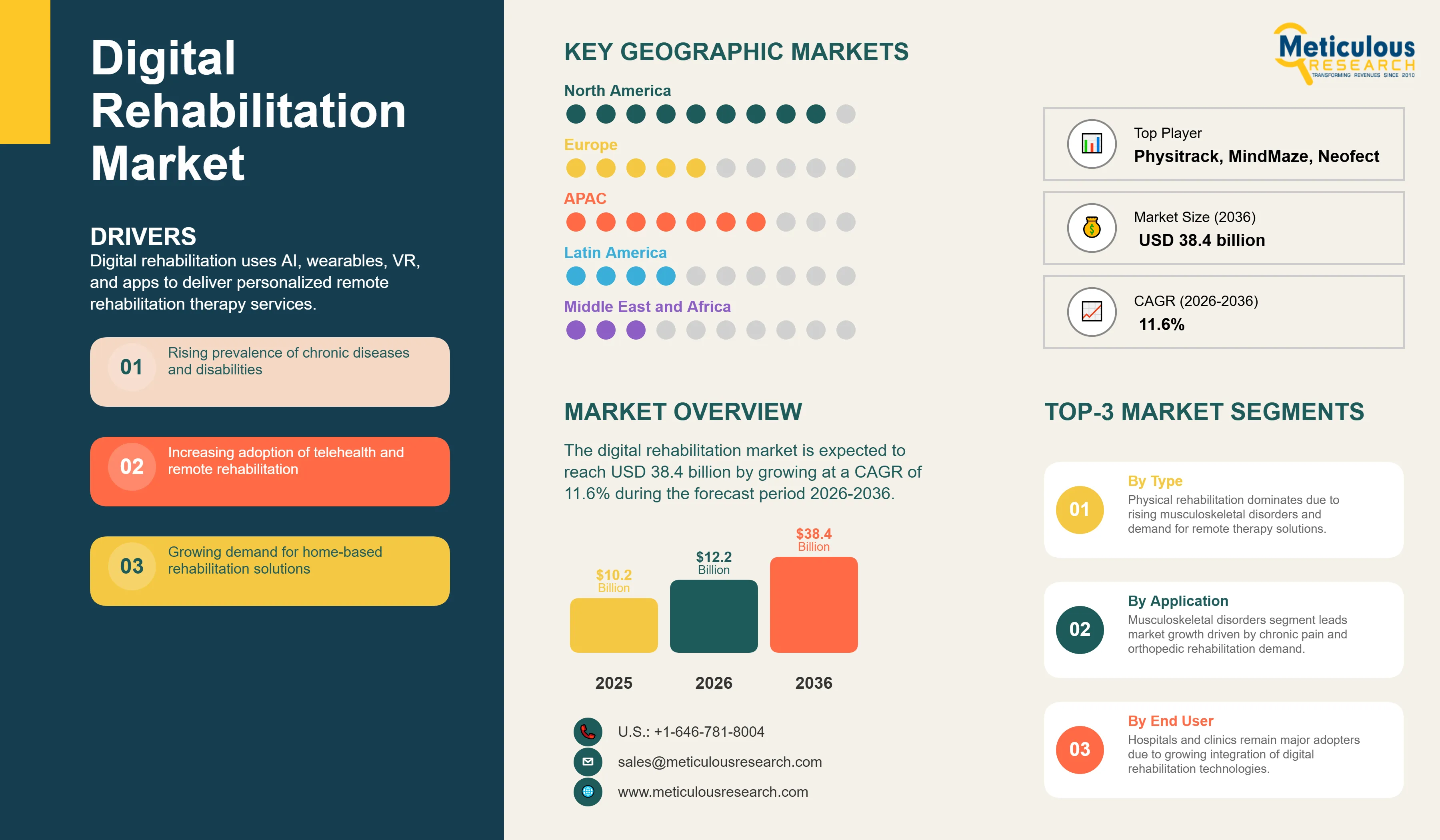
The global digital rehabilitation market was valued at USD 10.2 billion in 2025. This market is expected to reach USD 38.4 billion by 2036 from an estimated USD 12.8 billion in 2026, growing at a CAGR of 11.6% during the forecast period 2026-2036.
- Published
- May 2026
- Pages
- 278
- Format
- PDF + Excel
- Report ID
- MRHC - 1041969
- Base year
- 2025
- 2025 · BASELINE
- $10.20B
- 2036
- $38.40B
- CAGR 2026–2036
- 11.6%
2025 baseline · 2026–2036 forecast at 11.6% CAGR · hover a bar for the value
Key highlights
The global digital rehabilitation market is projected to reach USD 38.4 billion by 2036.
The market is expected to grow at a CAGR of 11.6% during the forecast period 2026-2036.
The global market for digital rehabilitation was valued at USD 10.2 billion in 2025 and is estimated to reach USD 12.8 billion in 2026.
North America is expected to dominate the global digital rehabilitation market with the largest market share in 2026, while Asia-Pacific is projected to register the highest CAGR during the forecast period.
By therapy type, the physical rehabilitation segment is expected to hold the largest share of the market in 2026, while the cognitive rehabilitation segment is projected to register the highest CAGR during the forecast period.
By technology type, the tele-rehabilitation platforms segment is expected to hold the largest share in 2026, while the VR/AR-based rehabilitation systems segment is projected to register the highest CAGR during the forecast period.
By delivery mode, the home-based rehabilitation segment is expected to hold the largest share in 2026 and is also projected to register the highest CAGR during the forecast period.
By application, the musculoskeletal disorders segment is expected to hold the largest share in 2026, while the neurological disorders segment is projected to register the highest CAGR during the forecast period.
By end user, the hospitals and clinics segment is expected to hold the largest share in 2026, while the home care settings segment is projected to register the highest CAGR during the forecast period.
Report summary
| Particulars | Details |
|---|---|
| Market Size by 2036 | USD 38.4 Billion |
| Market Size in 2026 | USD 12.8 Billion |
| Market Size in 2025 | USD 10.2 Billion |
| Revenue Growth Rate (2026-2036) | CAGR of 11.6% |
| Format | PDF, Excel & Cloud Portal · 278 pages |
| Dominating Therapy Type | Physical Rehabilitation |
| Fastest Growing Therapy Type | Cognitive Rehabilitation |
| Dominating Technology Type | Tele-rehabilitation Platforms |
| Fastest Growing Technology Type | VR/AR-based Rehabilitation Systems |
| Dominating Delivery Mode | Home-based Rehabilitation |
| Fastest Growing Delivery Mode | Home-based Rehabilitation |
| Dominating Application | Musculoskeletal Disorders |
| Fastest Growing Application | Neurological Disorders (Stroke) |
| Dominating End User | Hospitals & Clinics |
| Fastest Growing End User | Home Care Settings |
| Dominating Geography | North America |
| Fastest Growing Geography | Asia-Pacific |
| Base Year | 2025 |
| Forecast Period | 2026 to 2036 |
Report overview
Segments covered: therapy type, technology type, delivery mode, application, end user.
According to the World Health Organization's World Report on Disability, approximately 1.3 billion people globally, representing 16% of the world's population, live with some form of significant disability and many of these individuals require rehabilitation services at some point in their lives. The WHO further estimates that more than 2.4 billion people globally live with a health condition that could benefit from rehabilitation, yet the majority lack access to adequate rehabilitation care, establishing both the scale of clinical need and the commercial opportunity for digital solutions that extend rehabilitation access.
Report infographic
Market dynamics
7 factors across 3 forcesRising Prevalence of Chronic Diseases and Disabilities
According to the WHO's World Report on Disability, approximately 1.3 billion people globally live with significant disability, and more than 2.4 billion people have health conditions that would benefit from rehabilitation. The prevalence of the conditions that most commonly require rehabilitation is growing: according to the American Heart Association's 2025 Heart Disease and Stroke Statistics Update, approximately 795,000 Americans experience a new stroke each year, with the majority requiring rehabilitation for motor, cognitive, or speech deficits. The American Academy of Orthopaedic Surgeons reported that musculoskeletal conditions affect over 150 million Americans and result in over 130 million physician visits annually according to their 2025 data, with post-surgical and chronic pain rehabilitation representing very large and growing rehabilitation service demands. The global aging population trend, with the WHO projecting that the number of people aged 60 and above will reach 2.1 billion by 2050, will sustain long-term rehabilitation demand growth as older adults have higher rates of stroke, joint replacement, and functional decline requiring rehabilitation.
Increasing Adoption of Telehealth and Remote Care
The telehealth expansion triggered by the COVID-19 pandemic permanently elevated the baseline of digital care delivery in healthcare systems globally, and rehabilitation was one of the most actively adopted telehealth modalities. According to the American Hospital Association's 2025 Telehealth Report, telehealth utilization in the United States remained at levels multiple times above pre-pandemic baselines in 2024, with physical therapy and rehabilitation representing one of the highest-volume telehealth service categories. The CMS's extension of telehealth reimbursement for rehabilitation therapy through the Consolidated Appropriations Act 2023 and subsequent extensions, which maintained the expanded Medicare coverage for telehealth PT, OT, and speech therapy that was introduced as pandemic emergency measures, provided the reimbursement foundation that digital rehabilitation companies needed to build commercially sustainable business models in the U.S. market. European healthcare systems have similarly expanded telerehabilitation coverage through national digital health strategies, with Germany's Digital Care Act and France's digital health strategy both including telerehabilitation as covered services.
Table of contents
13 chapters · 154 sections · 278 pages · click to expandSegmental analysis
| Segment | Largest share (2026) | Fastest growth (2026–2036) |
|---|---|---|
| By Therapy Type | Physical Rehabilitation | Cognitive rehabilitation |
| By Technology Type | Tele-rehabilitation Platforms | VR/AR-based rehabilitation systems |
| By Delivery Mode | Home-based Rehabilitation | Home-based Rehabilitation to Hold the Largest Share and |
| By Application | Musculoskeletal Disorders | Neurological disorders |
| By End User | Hospitals & Clinics | Home care settings |
By Therapy Type
- Physical Rehabilitation to Hold the Largest Share
- The physical rehabilitation segment is expected to account for the largest share of the global digital rehabilitation market.
- Physical rehabilitation for musculoskeletal conditions, post-surgical recovery, and neurological motor deficits represents by far the largest rehabilitation service category by patient volume globally, and the digital physical therapy market has been validated commercially by the large-scale employer deployment of Hinge Health and Sword Health programs reaching tens of millions of employees.
- According to Hinge Health's 2025 employer benefits data, musculoskeletal conditions are the leading driver of U.S. employer healthcare costs at approximately USD 380 billion annually, making digital physical therapy the highest-value digital rehabilitation investment for payers and employers.
- However, the cognitive rehabilitation segment is projected to register the highest CAGR during the forecast period.
- The growing global prevalence of dementia, traumatic brain injury, stroke-related cognitive deficits, and the emerging recognition of post-COVID cognitive impairment as a significant and lasting condition in a substantial proportion of COVID-19 survivors are all driving growing demand for cognitive rehabilitation.
- According to Alzheimer's Disease International's World Alzheimer Report 2024, approximately 55 million people (can rise to 139 million by 2050) globally live with dementia, with 10 million new cases diagnosed annually, establishing cognitive rehabilitation as one of the fastest-growing rehabilitation need categories and driving investment in digital cognitive therapy platforms.
By Technology Type
- Tele-rehabilitation Platforms to Hold the Largest Share
- The tele-rehabilitation platforms segment is expected to account for the largest share of the global digital rehabilitation market.
- Tele-rehabilitation platforms that enable video-based therapist consultation, exercise prescription, home exercise program delivery, and patient-therapist communication represent the most broadly deployed digital rehabilitation technology, having been rapidly adopted by rehabilitation providers during the COVID-19 pandemic and sustained at high utilization rates by both therapist preference and patient demand since.
- Physitrack, Sword Health's clinical platform, and Hinge Health's provider tools are all tele-rehabilitation platform examples with large commercial deployments.
- However, the VR/AR-based rehabilitation systems segment is projected to register the highest CAGR during the forecast period.
- The combination of growing clinical evidence from randomized controlled trials, FDA clearances for specific VR rehabilitation indications, and the rapidly declining cost of VR hardware is driving accelerating adoption of VR rehabilitation systems in neurological and orthopedic rehabilitation settings.
- The 2025 meta-analysis in the Journal of NeuroEngineering and Rehabilitation confirming VR superiority over conventional therapy for stroke upper limb rehabilitation at matched therapy time is a key evidence foundation for growing clinical and payer acceptance of VR rehabilitation investment.
By Delivery Mode
- Home-based Rehabilitation to Hold the Largest Share and Grow the Fastest
- The home-based rehabilitation segment is expected to account for the largest share of the global digital rehabilitation market and is also projected to register the highest CAGR during the forecast period, making it the dominant segment on both measures simultaneously.
- Home-based digital rehabilitation is the application that most directly and uniquely exploits the value proposition of digital technology: extending therapy access to patients who cannot or prefer not to attend clinic-based sessions.
- According to the American Hospital Association's 2025 data, home-based care continues to grow as both patients and payers recognize the cost and convenience advantages of managing rehabilitation in the home environment.
- Hinge Health's and Sword Health's multi-billion dollar commercial valuations are built entirely on home-based digital rehabilitation delivered to employees' homes without requiring any clinic visit for the majority of their patient population.
- Clinic-based digital rehabilitation, where digital technologies including VR systems, robotic rehabilitation devices, and AI-powered motion analysis are deployed within clinical rehabilitation facilities, represents a complementary segment that benefits from the clinical environment's ability to support more complex technology deployments and more intensive supervision.
- Hybrid models that combine initial clinic-based assessment and setup with ongoing home-based digital monitoring are expected to become the mainstream delivery approach for complex rehabilitation programs as the evidence base and reimbursement infrastructure for digital rehabilitation matures.
By Application
- Musculoskeletal Disorders to Hold the Largest Share
- The musculoskeletal disorders segment is expected to account for the largest share of the global digital rehabilitation market.
- MSK conditions including back pain, osteoarthritis, rotator cuff injuries, and post-joint-replacement recovery represent the highest-volume rehabilitation indication category globally, and the large-scale commercial validation of digital MSK rehabilitation through employer-funded Hinge Health and Sword Health programs has established this as the most commercially mature digital rehabilitation application.
- According to Hinge Health's 2025 employer data, MSK conditions affect approximately 1 in 3 U.S. adults and account for the largest single category of employer healthcare costs.
- However, the neurological disorders segment, particularly stroke rehabilitation, is projected to register the highest CAGR during the forecast period.
- The very large global stroke incidence, with the American Heart Association's 2025 update documenting approximately 795,000 new U.S. strokes annually and the WHO estimating approximately 12 million stroke events globally per year, combined with the growing clinical evidence for VR and AI-assisted neurological rehabilitation superiority over conventional care, is driving rapid investment and adoption in digital neurological rehabilitation.
- The 2025 Journal of NeuroEngineering and Rehabilitation meta-analysis confirming VR efficacy in stroke rehabilitation is a key driver of neurological application adoption.
By End User
- Hospitals & Clinics to Hold the Largest Share
- The hospitals and clinics segment is expected to account for the largest share of the global digital rehabilitation market.
- Hospitals and healthcare systems represent the largest institutional purchasers of digital rehabilitation platforms and devices because they serve the broadest patient population across all rehabilitation indications and are the primary entry point for patients requiring rehabilitation following surgery, stroke, injury, or acute illness.
- Hospital systems are also the leading adopters of VR rehabilitation systems and robotic rehabilitation devices due to the capital investment involved.
- Major hospital systems including Mayo Clinic, Cleveland Clinic, and the NHS have all announced digital rehabilitation strategy programs that incorporate multiple digital rehabilitation technologies.
- However, the home care settings segment is projected to register the highest CAGR during the forecast period.
- The sustained shift of rehabilitation care toward home settings, supported by telehealth reimbursement infrastructure, patient preference for home-based care, and payer preference for lower-cost care settings, is driving home care as the fastest-growing end user category.
- According to the CMS's 2025 Home Health Agency Data, home health visits incorporating rehabilitation therapy grew at above-average rates in 2024, and the integration of digital rehabilitation platforms into home health agency workflows is a growing commercial priority for digital rehabilitation companies.
Geographic analysis
North America
Largest shareIn 2026, North America is expected to account for the largest share of the global digital rehabilitation market. The United States is the world's most commercially advanced digital rehabilitation market, home to the leading digital MSK rehabilitation companies Hinge Health and Sword Health, and benefiting from the most developed telehealth reimbursement infrastructure of any major healthcare system. According to the American Hospital Association's 2025 Telehealth Report, telehealth utilization in the U.S. remained at levels multiple times above pre-pandemic baselines in 2024, providing the access and billing infrastructure through which digital rehabilitation is delivered and reimbursed. The CMS's extension of telehealth coverage for rehabilitation therapy services provides the Medicare reimbursement framework that enables digital rehabilitation providers to serve the large and growing U.S. older adult population. The U.S. employer health benefits market represents a particularly large and growing digital rehabilitation procurement channel, with major self-insured employers including large technology, financial, and manufacturing companies integrating digital MSK programs into their health benefits offerings through partnerships with Hinge Health, Sword Health, and competing platforms. According to the International Foundation of Employee Benefit Plans' 2025 survey, digital musculoskeletal rehabilitation was the most commonly adopted digital health benefit among large U.S. employers in 2024.
Asia-Pacific
Fastest growthHowever, the Asia-Pacific digital rehabilitation market is expected to grow at the fastest CAGR during the forecast period. Asia-Pacific has the world's largest aging population by absolute number and carries a very large rehabilitation service demand that is substantially unmet by conventional clinic-based rehabilitation systems. According to the WHO's Global Rehabilitation Needs Assessment 2024, Asia-Pacific has the world's largest rehabilitation need gap, with a very large proportion of people who need rehabilitation unable to access it due to geographic distance, cost, and workforce shortages. Japan's exceptional aging demographics, with 29% of its population aged 65 and above per the Statistics Bureau of Japan's 2025 data, and its well-developed national health insurance system that is progressively covering digital health services, make Japan a strong early-adopter market for digital geriatric rehabilitation. China is investing heavily in digital health infrastructure through its Healthy China 2030 initiative, which specifically addresses the need to expand rehabilitation services through digital means to address the country's growing chronic disease and disability burden. South Korea's advanced digital health ecosystem and high smartphone penetration create favorable conditions for mobile rehabilitation app adoption, and Australia's significant digital health investment through its My Health Record infrastructure and National Telehealth initiatives supports digital rehabilitation growth.
Competitive landscape
- Reflexion Health (U.S.)
- Hinge Health (U.S.)
- Sword Health (U.S.)
- Kaia Health (Germany/U.S.)
- RehabGuru · Australia
- Physitrack (UK/Australia)
- MIRA Rehab (UK)
- MindMaze · Switzerland
- Hocoma AG · Switzerland
- Ekso Bionics (U.S.)
- Neofect (South Korea/U.S.)
- Tyromotion GmbH · Austria
- Bioness Inc. (U.S.)
- Motek Medical · Netherlands
Frequently asked questions
The global digital rehabilitation market is expected to reach USD 38.4 billion by 2036 from an estimated USD 12.8 billion in 2026, at a CAGR of 11.6% during the forecast period 2026-2036.
Cite this report
Meticulous Research. (2026). Digital Rehabilitation Market - Global Opportunity Analysis and Industry Forecast (2026-2036) (Report No. MRHC - 1041969). Meticulous Market Research Pvt. Ltd. https://www.meticulousresearch.com/product/digital-rehabilitation-market-6652