
Digital Front Door Market (2026-2036)
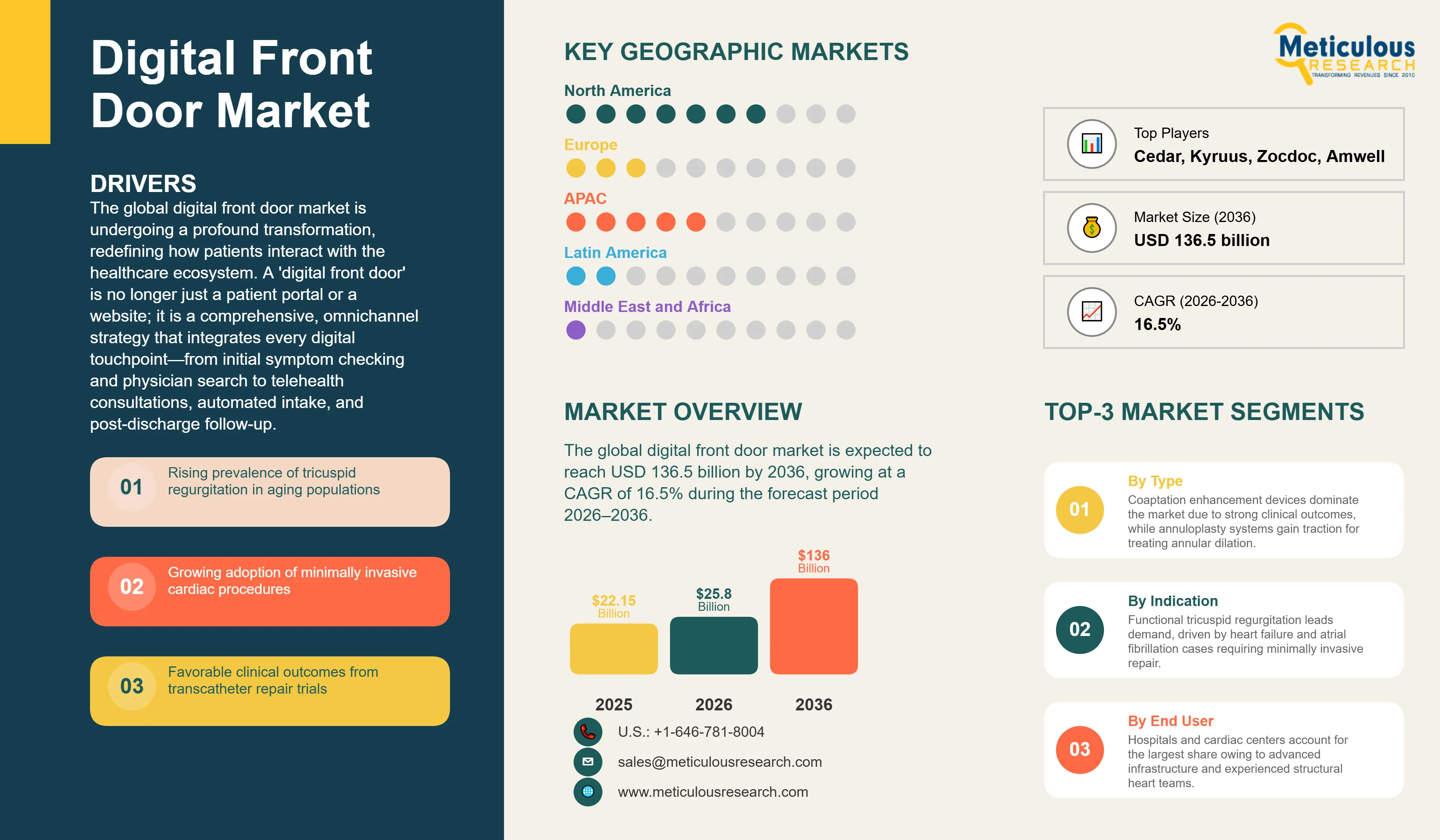
The global digital front door market was valued at USD 25.8 billion in 2026. This market is expected to reach USD 136.5 billion by 2036, growing at a CAGR of 16.5% during the forecast period 2026–2036.
- Published
- Jun 2026
- Pages
- 283
- Format
- PDF + Excel
- Report ID
- MRHC - 1042018
- Base year
- 2025
- 2026 · ESTIMATED
- $25.80B
- 2036
- $136.5B
- CAGR 2026–2036
- 16.5%
2025 baseline · 2026–2036 forecast at 16.5% CAGR · hover a bar for the value
Key highlights
The global digital front door market is projected to reach USD 136.5 billion by 2036.
The market is expected to grow at a CAGR of 16.5% during the forecast period 2026–2036.
Patient retention improves significantly for organizations with a robust digital front door strategy.
Telehealth is projected to account for 25–30% of all medical visits in the U.S. by 2026.
North America holds the largest market share of this market in 2026.
Healthcare Providers hold the largest share of the market, focusing on patient acquisition and operational efficiency.
Asia-Pacific is the fastest-growing region, with a CAGR of over 15% driven by mobile-first healthcare populations.
Digital self-scheduling and automated intake can significantly reduce administrative workload, often improving staff efficiency by approximately 10–30% depending on clinic size and implementation maturity.
A majority of healthcare consumers now expect digital experiences comparable to retail and banking, including seamless scheduling, payments, and access to care information.
Report summary
| Particulars | Details |
|---|---|
| Base Year | 2025 |
| Estimated Year | 2026 |
| Forecast Period | 2026–2036 |
| Market Size (2026) | USD 25.80 billion |
| Market Size (2036) | USD 136.50 billion |
| CAGR (2026–2036) | 16.5% |
| Format | PDF, Excel & Cloud Portal · 283 pages |
| Segments Covered | By Component · By Technology: Telehealth, Intake, AI Chatbots, CRM · By Deployment Mode · By End User: Providers, Payers, Pharma |
| Key Companies | Epic Systems Corporation (U.S.), Oracle Corporation (Cerner) (U.S.), Salesforce, Inc. (U.S.), Microsoft Corporation (U.S.), GE Healthcare (U.S.), Philips Healthcare, GetWellNetwork, Inc. (U.S.), Phreesia, Inc. (U.S.), Cedar (U.S.), Kyruus (U.S.), Zocdoc (U.S.), Amwell (U.S.), Teladoc Health, Inc. (U.S.), Luma Health (U.S.), QliqSOFT, Inc. (U.S.), Notable Health (U.S.), Stericycle, Inc. (Communication Solutions) (U.S.), Wolters Kluwer (U.S.), Religent (U.S.), Healthgrades (U.S.) |
Report overview
Segments covered: component, technology, deployment mode, end user.
The global digital front door market is undergoing a profound transformation, redefining how patients interact with the healthcare ecosystem. A 'digital front door' is no longer just a patient portal or a website; it is a comprehensive, omnichannel strategy that integrates every digital touchpoint—from initial symptom checking and physician search to telehealth consultations, automated intake, and post-discharge follow-up. By 2026, this market has become the cornerstone of 'healthcare consumerism,' as patients increasingly demand digital convenience comparable to retail, banking, and travel. The shift from episodic, reactive care to continuous, proactive engagement is the primary catalyst driving health systems to consolidate their fragmented digital tools into a single, unified entry point.
The urgency of this transformation is underscored by changing consumer expectations and operational pressures. A majority of healthcare consumers now expect mobile-first access, including the ability to self-schedule appointments and pay bills online. For healthcare providers, the digital front door is a critical tool for combating staffing shortages and operational inefficiencies. Automated intake and self-scheduling tools can significantly reduce administrative staff workload, allowing personnel to focus on high-value patient care. Furthermore, organizations with a robust digital front door strategy report meaningful improvements in patient retention and reduced appointment no-show rates, directly impacting the financial sustainability of health systems.
Technological convergence is a key theme in 2026. Telehealth, once a standalone service, is now fully integrated into the digital front door, serving as a primary gateway for outpatient care. Virtual visits are projected to account for a significant and growing share of all outpatient encounters globally in 2026. This integration is supported by AI-driven symptom checkers and chatbots that utilize natural language processing (NLP) to triage patients effectively, ensuring they are routed to the right level of care whether it be a virtual consultation, an urgent care visit, or home-based monitoring. The proliferation of mobile health (mHealth) applications, with billions of users worldwide, further cements the digital front door as the primary interface for the modern patient.
Geographically, North America remains the leading market, holding an significant share in 2026, driven by mature healthcare IT infrastructure and high consumer demand for digital access. However, the Asia-Pacific region is emerging as the fastest-growing market, with a projected CAGR exceeding 15–20% through the next decade. This growth is fueled by a 'mobile-first' population and massive government-led digital health transformations in China and India. As healthcare systems globally pivot toward value-based care, the digital front door serves as the essential infrastructure for managing population health and ensuring equitable, convenient access to medical services.
Report infographic
Market dynamics
6 factors across 5 forcesThe rise of healthcare consumerism is
the most significant driver for the digital front door market. Patients now view themselves as consumers who demand the same level of digital convenience in healthcare as they experience in retail and banking. This includes mobile-first access, real-time communication, and transparent billing. Additionally, the global healthcare staffing crisis is forcing organizations to automate administrative tasks. Digital front doors provide the self-service tools necessary to handle registration, scheduling, and triage without human intervention. The continued proliferation of telehealth also drives demand, as a unified digital entry point is required to manage the transition between virtual and in-person care seamlessly.
Table of contents
12 chapters · 106 sections · 283 pages · click to expandSegmental analysis
| Segment | Largest share (2026) | Fastest growth (2026–2036) |
|---|---|---|
| By Component | Software | Services |
| By End User | Providers | Healthcare Payers |
By Component
- Software Leads, Services Grow Fast
- The Software segment is expected to hold the largest share.
- This segment encompasses the core patient-facing applications, including patient portals, mobile apps, AI chatbots, and self-scheduling engines, which are the primary drivers of digital engagement.
- The Services segment is projected to witness the fastest growth.
- As health systems move from simple portals to complex, integrated omnichannel strategies, the demand for consulting, custom implementation, and ongoing support and maintenance services is increasing significantly.
By End User
- Providers Lead, Payers Growing Fast
- The Healthcare Providers segment is expected to hold the largest share.
- Hospitals and physician groups are the primary architects of the digital patient journey, using these platforms to acquire new patients and improve operational efficiency.
- The Healthcare Payers segment is projected to witness the fastest growth.
- Insurance companies are increasingly adopting digital front door strategies to improve member engagement, promote wellness programs, and steer members toward lower-cost, high-quality virtual care options.
Geographic analysis
North America
Largest shareNorth America is expected to hold the largest share of the global Digital Front Door market in 2026, driven by a highly mature healthcare IT ecosystem, strong adoption of EHR-based patient engagement tools, and rising demand for consumer-grade healthcare experiences. The region accounts for roughly 40–50% of global market value across most industry estimates, supported by widespread deployment of platforms such as Epic Systems, Oracle Health (Cerner), and Salesforce.
Europe
Europe remains a significant market, supported by regulatory and interoperability initiatives such as the European Health Data Space (EHDS), which is accelerating the standardization of digital health access and patient data exchange.
Asia-Pacific
Fastest growthAsia-Pacific is projected to be the fastest-growing region over the forecast period, driven by rapid digital health adoption, expanding healthcare infrastructure, and mobile-first populations in countries such as China and India. Overall, the market is characterized by strong platform consolidation, with major players including Epic Systems, Oracle Health, Microsoft, Salesforce, and Teladoc Health shaping the global competitive landscape
Competitive landscape
- Epic Systems Corporation (U.S.)
- Oracle Corporation (Cerner) (U.S.)
- Salesforce, Inc. (U.S.)
- Microsoft Corporation (U.S.)
- GE Healthcare (U.S.)
- Philips Healthcare · Netherlands
- GetWellNetwork, Inc. (U.S.)
- Phreesia, Inc. (U.S.)
- Cedar (U.S.)
- Kyruus (U.S.)
- Zocdoc (U.S.)
- Amwell (U.S.)
- Teladoc Health, Inc. (U.S.)
- Luma Health (U.S.)
- QliqSOFT, Inc. (U.S.)
- Notable Health (U.S.)
- Stericycle, Inc. (Communication Solutions) (U.S.)
- Wolters Kluwer (U.S.)
- Religent (U.S.)
- Healthgrades (U.S.)
Frequently asked questions
The market is projected to reach USD 136.5 billion by 2036, growing at a CAGR of 16.5% from 2026 to 2036.
Cite this report
Meticulous Research. (2026). Digital Front Door Market - Global Opportunity Analysis and Industry Forecast (2026-2036) (Report No. MRHC - 1042018). Meticulous Market Research Pvt. Ltd. https://www.meticulousresearch.com/product/digital-front-door-market-6701