Cell and Gene Therapy Analytical Testing Market (2026-2036)
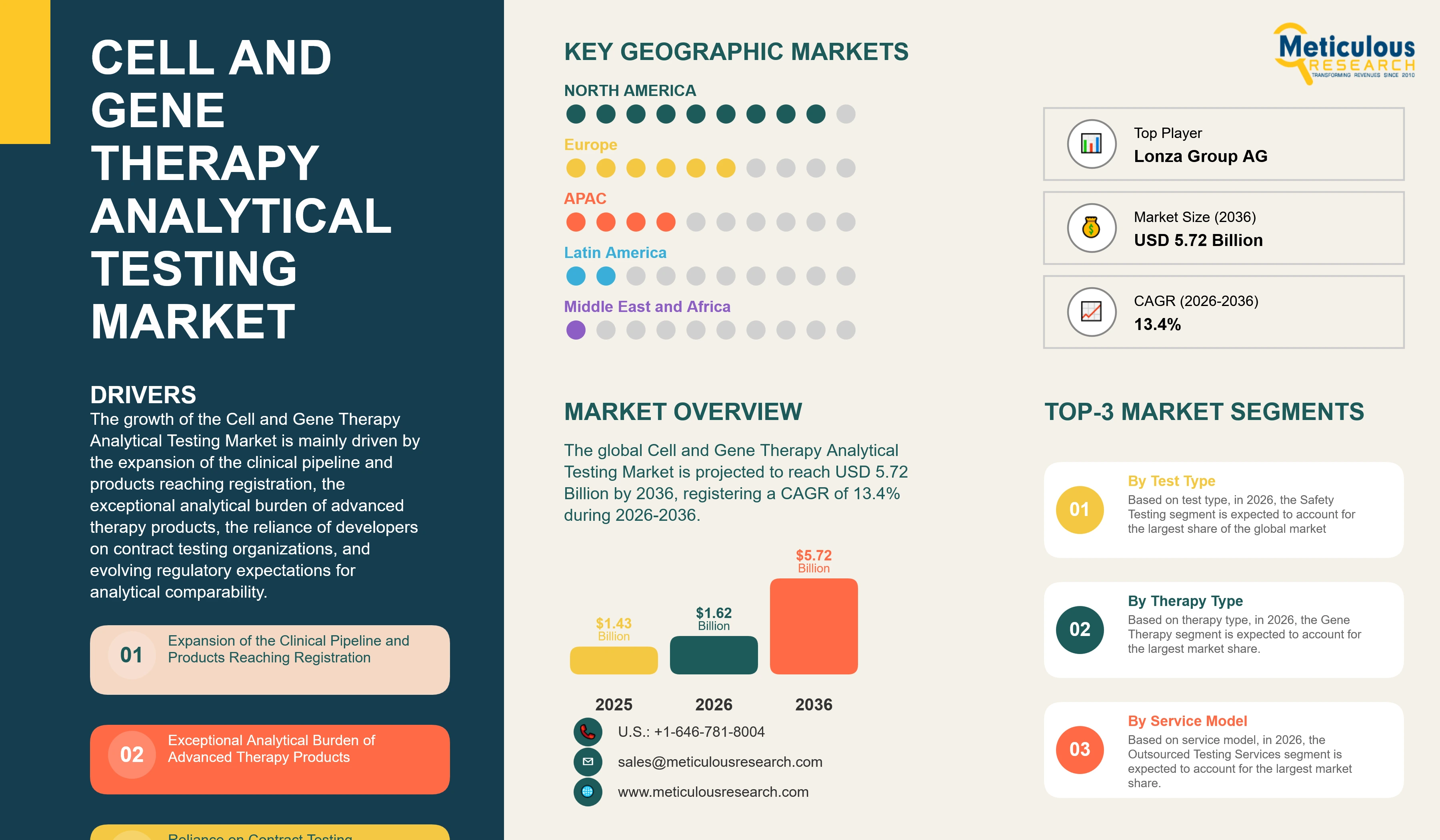
The global Cell and Gene Therapy Analytical Testing Market was valued at USD 1.43 billion in 2025. This market is expected to reach USD 5.72 billion by 2036 from an estimated USD 1.62 billion in 2026, registering a CAGR of 13.4% during the forecast period (2026-2036).
- Published
- Oct 2026
- Pages
- 367
- Format
- PDF + Excel
- Report ID
- MRHC - 1042372
- Base year
- 2025
- 2025 · BASELINE
- $1.43B
- 2036
- $5.72B
- CAGR 2026–2036
- 13.4%
2025 baseline · 2026–2036 forecast at 13.4% CAGR · hover a bar for the value
Key highlights
The global Cell and Gene Therapy Analytical Testing Market is projected to reach USD 5.72 billion by 2036, driven by pipeline expansion, commercial lot release, outsourcing to contract testing organizations, and the analytical demands of genome-editing therapies.
The pipeline reaching registration is substantial. According to a pipeline assessment published in January 2026, six cell and gene therapy products had been submitted to the U.S. Food and Drug Administration (FDA) with prescription drug user fee act dates falling in 2026, covering allogeneic T-cell immunotherapy for haematological malignancies, Duchenne muscular dystrophy cardiomyopathy, glycogen storage disease type Ia, Sanfilippo A syndrome, recurrent respiratory papillomatosis, and multiple myeloma, with a further 18 products anticipated in 2027, of which 12 were in Phase 3.
Regulatory expectations are being restructured rather than relaxed. In May 2026, the FDA Center for Biologics Evaluation and Research issued final guidance that removed the fixed requirement for three process performance qualification lots for process validation of cell and gene therapy products, permitted concurrent validation and release, and allowed investigational lots to be released against broader interim acceptance criteria where justified, with final specifications generally established by licensure.
North America is expected to account for the largest market share in 2026, supported by the concentration of developers, regulatory activity, and testing capacity, while Asia-Pacific is projected to register the fastest growth during the forecast period.
By test type, Safety Testing is expected to account for the largest market share in 2026, whereas Potency & Functional Testing is projected to witness the fastest growth through 2036, as regulators press for assays that measure the biological activity responsible for clinical effect rather than surrogate attributes.
Report summary
| Particulars | Details |
|---|---|
| Forecast Period | 2026-2036 |
| Base Year | 2025 |
| Estimated Year | 2026 |
| CAGR (Value) | 13.4% |
| Format | PDF, Excel & Cloud Portal · 367 pages |
| Market Size (Value) in 2026 | USD 1.62 Billion |
| Market Size (Value) in 2036 | USD 5.72 Billion |
| Segments Covered | By Test Type: Safety Testing (Sterility & Mycoplasma Testing, Endotoxin Testing, Adventitious Agent & Viral Safety Testing, Replication-Competent Virus Testing), Potency & Functional Testing, Identity Testing, Purity & Impurity Testing (Process Residual Testing, Empty and Full Capsid Analysis, Vector Copy Number & Aggregate Analysis), Genome-Editing Specific Analysis, Stability & Comparability Testing. By Therapy Type: Cell Therapy (Autologous Cell Therapy, Allogeneic Cell Therapy), Gene Therapy (Viral Vector-Based Therapy, Non-Viral Gene Therapy), Genome-Edited Therapy, Other Advanced Therapies. By Development Phase: Preclinical & Early Clinical, Late Clinical, Commercial & Post-Approval. By Service Model: Outsourced Testing Services (Routine Release & Quality Control Testing, Method Development & Validation Services, Characterization & Comparability Studies), In-House Testing. By End User: Cell & Gene Therapy Developers (Large Pharmaceutical Companies, Small & Mid-Sized Biotechnology Companies), Contract Development & Manufacturing Organizations, Academic & Hospital Manufacturing Units, Other End Users. |
| Countries Covered | North America: U.S., Canada. Europe: Germany, U.K., Switzerland, France, Netherlands, Italy, Rest of Europe. Asia-Pacific: China, Japan, South Korea, India, Australia, Rest of Asia-Pacific. Latin America: Brazil, Mexico, Rest of Latin America. Middle East & Africa: Saudi Arabia, UAE, Rest of Middle East & Africa. |
| Key Companies | Charles River Laboratories International, Inc., Laboratory Corporation of America Holdings, WuXi AppTec Co., Ltd., Lonza Group AG, SGS SA, Eurofins Scientific SE, Sartorius AG, Thermo Fisher Scientific Inc., Merck KGaA, and Bio-Techne Corporation. |
Report overview
Segments covered: test type, therapy type, development phase, service model, end user.
The growth of this market is mainly driven by the expansion of the cell and gene therapy clinical pipeline and the increasing number of products reaching registration and commercial supply, each of which requires a validated panel of release and characterization assays; the exceptional analytical burden of these products, which are biologically complex, produced in small batches, and in many cases administered as a single irreversible dose; the reliance of developers on contract testing organizations because the required assays and accredited facilities are costly to establish in house; and regulatory expectations for potency, safety, identity, and purity testing that continue to evolve. In addition, the growth of genome-editing therapies requiring specialized off-target and editing-efficiency analysis, the extension of testing from clinical into commercial lot release, the adoption of rapid and automated methods that shorten release timelines for products with very short shelf lives, and regulatory flexibility that rewards well-designed analytical comparability packages are further supporting the growth of this market.
The Cell and Gene Therapy Analytical Testing Market, also referred to as the cell and gene therapy quality control testing market, advanced therapy analytical services market, or cell and gene therapy characterization and release testing market, comprises the testing services, assay development, and validation work through which cell and gene therapy products are characterized, released, and monitored for stability. The market includes safety testing, covering sterility, mycoplasma, endotoxin, adventitious virus, replication-competent virus and lentivirus, and residual host cell DNA and protein; potency and functional testing, including cell killing, transduction, transgene expression, and biological activity assays; identity testing, including cell phenotyping, vector identity, and genetic identity; purity and impurity testing, covering process residuals, empty and full capsid ratio, aggregates, and vector copy number; genome-editing specific analysis, including on-target editing efficiency and off-target assessment; and stability, comparability, and extractables and leachables testing. The market covers testing performed for raw materials and starting materials, in-process control, drug substance and drug product release, and post-approval monitoring. The market ecosystem extends from contract testing organizations, contract development and manufacturing organizations, and specialist assay developers to cell and gene therapy developers, academic and hospital manufacturing units, instrument and reagent suppliers, and the regulators that set release expectations.
Analytical testing occupies a larger share of the cost and timeline of a cell and gene therapy than of any conventional biologic. These products are living or genetically active materials whose critical quality attributes are difficult to measure, batches are frequently produced for a single patient and consumed within days, and the clinical consequence of releasing a defective lot is severe and often irreversible. A conventional biologic batch may serve thousands of patients and tolerate a long release testing window, whereas an autologous cell therapy batch serves one patient who may be waiting in hospital, which inverts the usual relationship between analytical thoroughness and turnaround time.
Pipeline growth sets the scale of demand. According to a pipeline assessment published in January 2026, six cell and gene therapy products had been submitted to the U.S. Food and Drug Administration (FDA) with prescription drug user fee act dates falling in 2026, covering allogeneic T-cell immunotherapy for haematological malignancies, Duchenne muscular dystrophy cardiomyopathy, glycogen storage disease type Ia, Sanfilippo A syndrome, recurrent respiratory papillomatosis, and multiple myeloma, with a further 18 products anticipated in 2027, of which 12 were in Phase 3. In July 2026, the FDA expanded the approval of CASGEVY, the first CRISPR-based gene-editing therapy, to children aged two years and older with sickle cell disease or transfusion-dependent beta thalassemia, with the therapy available at more than 75 authorized treatment centres in the U.S. Each product entering registration requires a validated release panel, comparability data covering every manufacturing change made during development, and a stability programme, and each product that reaches market generates recurring release testing for every commercial lot thereafter.
The regulatory framework is being actively restructured. In May 2026, the FDA Center for Biologics Evaluation and Research issued final guidance that removed the fixed requirement for three process performance qualification lots for process validation of cell and gene therapy products, permitted concurrent validation and release, and allowed investigational lots to be released against broader interim acceptance criteria where justified, with final specifications generally established by licensure. In June 2026, the FDA issued draft guidance permitting sponsors of genome-editing products to leverage public knowledge, such as published literature, and platform knowledge, such as data generated with a shared vector or editing system, in place of repeating studies, provided the sponsor justifies the applicability of the data being leveraged and discusses a leveraging proposal with the agency. These developments do not reduce analytical expectations; they redistribute them. Removing a fixed lot requirement and permitting knowledge leveraging place greater weight on the quality of the analytical data a sponsor presents, because flexibility is granted on the basis of demonstrated comparability and justified applicability rather than on a prescribed number of runs. The practical effect is to increase the value of well-designed assays and robust characterization while reducing the volume of repetitive confirmatory work.
Potency has become the central analytical problem of the field. Regulators expect a potency assay to measure the biological activity responsible for the intended clinical effect, which for a gene therapy may mean transgene expression and functional protein activity, for a cell therapy may mean target cell killing or differentiation capacity, and for a genome-editing product may mean editing efficiency at the intended locus. These assays are difficult to develop, frequently cell-based and therefore variable, and must be qualified and validated to support release, which makes potency assay development among the most commonly outsourced and most expensive analytical activities in the field.
Outsourcing is the norm rather than the exception. Establishing the full analytical panel for a cell or gene therapy requires accredited facilities, specialized instrumentation, validated methods, and personnel experienced in advanced therapy testing, which few developers can justify building for a single programme. In the second quarter of 2026, Charles River Laboratories International, Inc. reported Discovery and Safety Assessment segment revenue of USD 606.5 million, down 1.9% year over year with organic growth of 0.2%, and raised its full-year organic revenue growth guidance to between 0.0% and 1.0%, indicating stabilization in outsourced testing demand after a period of contraction. In the first half of 2026, Lonza Group AG reported sales of CHF 3.4 billion, up 16.0% at constant exchange rates, with all business platforms growing at double-digit rates, raised its full-year CORE EBITDA margin guidance to 33-34%, and continued capital investment including cell and gene therapy facilities. Contract testing organizations and contract development and manufacturing organizations therefore capture most of the spending, and the stabilization of outsourced testing demand after a period of contraction is relevant to the near-term trajectory of the market.
Raw material and starting material testing is an underappreciated component. Plasmids, viral vectors, cell banks, media, enzymes, and other ancillary materials must themselves be characterized and qualified, and the quality grade of these inputs determines much of the analytical burden downstream. In the second quarter of 2026, Maravai LifeSciences reported revenue of USD 51.4 million, up 8.5% year over year, with its TriLink nucleic acid production business growing 11.5% on demand for good manufacturing practice consumables used in clinical trials, and opened a good manufacturing practice enzyme manufacturing facility. The shift of input suppliers toward good manufacturing practice grades and documented characterization reduces some testing obligations for developers while creating testing demand at the supplier.
The market includes contract testing organizations and contract development and manufacturing organizations such as Charles River Laboratories, Labcorp, WuXi AppTec, Lonza, SGS, Eurofins Scientific, and Sartorius, together with instrument, reagent, and assay providers including Thermo Fisher Scientific, Merck KGaA, Bio-Techne, and Revvity, and specialist providers of genome-editing and vector analysis. Participants compete on assay breadth and the ability to supply a complete release panel, regulatory experience and inspection history, turnaround time, capacity and geographic footprint, method development and validation capability, and the ability to support a programme from early development through commercial supply.
At the same time, the market faces substantial challenges, including the difficulty of developing potency assays that are both biologically meaningful and sufficiently reproducible for release, the tension between analytical thoroughness and the very short shelf life of autologous products, the limited availability of reference materials and standards for advanced therapies, variability between testing laboratories, shortages of personnel experienced in advanced therapy analytics, and the commercial fragility of the developer base, in which programme discontinuations remove testing demand abruptly. As a result, providers that combine complete release panels, demonstrated regulatory success, rapid turnaround, and the capability to carry a programme from first-in-human through commercial release are expected to capture the largest share of growth over the forecast period.
Report infographic
Market dynamics
15 factors across 5 forcesExpansion of the Clinical Pipeline and Products Reaching Registration
The expansion of the clinical pipeline and the number of products reaching registration is a major factor driving the Cell and Gene Therapy Analytical Testing Market. According to a pipeline assessment published in January 2026, six cell and gene therapy products had been submitted to the U.S. Food and Drug Administration (FDA) with prescription drug user fee act dates falling in 2026, covering allogeneic T-cell immunotherapy for haematological malignancies, Duchenne muscular dystrophy cardiomyopathy, glycogen storage disease type Ia, Sanfilippo A syndrome, recurrent respiratory papillomatosis, and multiple myeloma, with a further 18 products anticipated in 2027, of which 12 were in Phase 3. A product progressing from first-in-human studies to registration accumulates analytical obligations at every stage, including method development, qualification, validation, comparability across manufacturing changes, and stability, and the testing associated with a registration filing substantially exceeds that required during early development.
Products reaching market convert project-based testing into recurring demand. In July 2026, the FDA expanded the approval of CASGEVY, the first CRISPR-based gene-editing therapy, to children aged two years and older with sickle cell disease or transfusion-dependent beta thalassemia, with the therapy available at more than 75 authorized treatment centres in the U.S. Every commercial lot requires release testing, every manufacturing site or process change requires comparability, and post-approval commitments frequently include extended stability and monitoring, which means an approved product generates analytical demand for as long as it is supplied.
Exceptional Analytical Burden of Advanced Therapy Products
The exceptional analytical burden of advanced therapy products is significantly driving market growth. These products are biologically complex and incompletely characterized, their critical quality attributes are difficult to measure, and the panel required for release is broader than for conventional biologics, covering sterility and adventitious agent safety, replication competence, residual process materials, vector characteristics, identity, and biological potency. For genome-editing products, on-target efficiency and off-target assessment add a further analytical dimension with no equivalent in conventional biologics.
Batch economics intensify the burden. A conventional biologic batch is large and serves many patients, so testing cost per dose is small and a long release window is acceptable. An autologous cell therapy batch serves one patient, which means the full analytical panel is applied to a single dose and must be completed within days. The result is that analytical testing represents a far higher proportion of cost of goods for advanced therapies than for any other product class.
Reliance on Contract Testing Organizations
The reliance of developers on contract testing organizations is an important driver of demand. Establishing the analytical capability for an advanced therapy requires accredited facilities, specialized instrumentation, validated methods, and experienced personnel, which represents a fixed investment few developers can justify for a single programme, particularly among the small and mid-sized biotechnology companies that constitute much of the pipeline. In the second quarter of 2026, Charles River Laboratories International, Inc. reported Discovery and Safety Assessment segment revenue of USD 606.5 million, down 1.9% year over year with organic growth of 0.2%, and raised its full-year organic revenue growth guidance to between 0.0% and 1.0%, indicating stabilization in outsourced testing demand after a period of contraction. Outsourcing converts that fixed investment into a variable cost and gives developers access to regulatory experience they would otherwise have to acquire.
Evolving Regulatory Expectations and Analytical Comparability Requirements
Evolving regulatory expectations and analytical comparability requirements support market growth. In May 2026, the FDA Center for Biologics Evaluation and Research issued final guidance that removed the fixed requirement for three process performance qualification lots for process validation of cell and gene therapy products, permitted concurrent validation and release, and allowed investigational lots to be released against broader interim acceptance criteria where justified, with final specifications generally established by licensure. In June 2026, the FDA issued draft guidance permitting sponsors of genome-editing products to leverage public knowledge, such as published literature, and platform knowledge, such as data generated with a shared vector or editing system, in place of repeating studies, provided the sponsor justifies the applicability of the data being leveraged and discusses a leveraging proposal with the agency. Where a sponsor is permitted to validate with fewer qualification lots or to leverage platform data, the justification rests on analytical evidence, which means the quality and defensibility of characterization data becomes the determinant of regulatory flexibility. Comparability packages supporting manufacturing changes, site transfers, and scale-up are consequently a growing source of analytical work.
Table of contents
13 chapters · 156 sections · 367 pages · click to expandSegmental analysis
| Segment | Largest share (2026) | Fastest growth (2026–2036) |
|---|---|---|
| By Test Type | Safety Testing | Potency & Functional Testing |
| By Therapy Type | Gene Therapy | Genome-Edited Therapy |
| By Development Phase | Late Clinical | Commercial & Post-Approval |
| By Service Model | Outsourced Testing Services | Outsourced Testing Services |
| By End User | Cell & Gene Therapy Developers | Contract Development & Manufacturing Organizations |
By Test Type
- Cell and Gene Therapy Analytical Testing Market Analysis by Test Type
- Safety Testing is further segmented into Sterility & Mycoplasma Testing, Endotoxin Testing, Adventitious Agent & Viral Safety Testing, and Replication-Competent Virus Testing, while Purity & Impurity Testing is further segmented into Process Residual Testing, Empty and Full Capsid Analysis, and Vector Copy Number & Aggregate Analysis.
- The Safety Testing segment is expected to account for the largest share of the global Cell and Gene Therapy Analytical Testing Market.
- The large share of this segment is mainly due to the application of sterility, mycoplasma, endotoxin, adventitious agent, and replication competence testing to every batch regardless of product type or development stage, the regulatory requirement for these tests at raw material, in-process, and release points, and the breadth of the viral safety panel applied to vector-based products.
- However, the Potency & Functional Testing segment is projected to register the highest CAGR during the forecast period.
- The rapid growth of this segment is attributed to regulatory insistence that potency reflect the biological activity responsible for clinical effect rather than a surrogate attribute, the product-specific nature of these assays, which prevents reuse between programmes, the cost and complexity of developing and validating cell-based functional assays, and the frequency with which potency assay deficiencies delay regulatory approval.
By Therapy Type
- Cell and Gene Therapy Analytical Testing Market Analysis by Therapy Type
- Cell Therapy is further segmented into Autologous Cell Therapy and Allogeneic Cell Therapy, while Gene Therapy is further segmented into Viral Vector-Based Therapy and Non-Viral Gene Therapy.
- Other Advanced Therapies include tissue-engineered products and oncolytic viruses.
- The Gene Therapy segment is expected to account for the largest share of the market.
- The large share of this segment is mainly due to the breadth of the analytical panel required for vector-based products, which includes vector identity, empty and full capsid ratio, vector copy number, replication competence, residual host cell DNA and protein, and transgene expression, and the number of vector-based products in clinical development and reaching registration for rare disease indications.
- However, the Genome-Edited Therapy segment is projected to register the highest CAGR during the forecast period.
- The rapid growth of this segment is attributed to the approval and expanding use of CRISPR-based therapy, the number of editing programmes advancing through clinical development, and the additional analytical requirements specific to editing, including on-target efficiency, off-target assessment, and characterization of structural consequences, which have no equivalent in conventional gene therapy.
By Development Phase
- Cell and Gene Therapy Analytical Testing Market Analysis by Development Phase
- The Late Clinical segment is expected to account for the largest share of the market.
- The large share of this segment is mainly due to the concentration of analytical work in the period preceding registration, when methods must be validated rather than merely qualified, comparability must be demonstrated across every manufacturing change made during development, and stability programmes must be established, which together represent the heaviest analytical investment in a product lifecycle.
- However, the Commercial & Post-Approval segment is projected to register the highest CAGR during the forecast period.
- The rapid growth of this segment is attributed to the growing number of approved products requiring release testing for every commercial lot, the expansion of approved products into new patient populations and geographies, and post-approval commitments covering extended stability and monitoring, which convert project-based testing into recurring demand.
By Service Model
- Cell and Gene Therapy Analytical Testing Market Analysis by Service Model
- Outsourced Testing Services are further segmented into Routine Release & Quality Control Testing, Method Development & Validation Services, and Characterization & Comparability Studies.
- The Outsourced Testing Services segment is expected to account for the largest share of the market and is also projected to register the highest CAGR during the forecast period.
- This is mainly due to the fixed investment required to establish accredited advanced therapy analytical capability, which few developers can justify for a single programme, the concentration of regulatory experience among specialist providers, and the prevalence of small and mid-sized developers in the pipeline who outsource by necessity rather than by choice.
- The In-House Testing segment is expected to retain a meaningful position among large pharmaceutical companies with multiple programmes, among hospital and academic manufacturing units performing testing alongside production, and for in-process controls that must be performed at the point of manufacture.
By End User
- Cell and Gene Therapy Analytical Testing Market Analysis by End User
- Cell & Gene Therapy Developers are further segmented into Large Pharmaceutical Companies and Small & Mid-Sized Biotechnology Companies.
- The Cell & Gene Therapy Developers segment is expected to account for the largest share of the market.
- The large share of this segment reflects their position as the parties responsible for product quality and regulatory submission, and therefore as the ultimate purchasers of analytical testing, whether performed internally or contracted out.
- However, the Contract Development & Manufacturing Organizations segment is projected to register the highest CAGR during the forecast period.
- The rapid growth of this segment is attributed to the integration of manufacturing and analytical services, under which a contract manufacturer performs or procures testing as part of a bundled offering, the investment of these organizations in cell and gene therapy capacity, and the preference of developers for a single partner carrying both manufacturing and quality responsibility.
- In the first half of 2026, Lonza Group AG reported sales of CHF 3.4 billion, up 16.0% at constant exchange rates, with all business platforms growing at double-digit rates, raised its full-year CORE EBITDA margin guidance to 33-34%, and continued capital investment including cell and gene therapy facilities.
Geographic analysis
North America
Largest shareIn 2026, North America is expected to account for the largest share of the global Cell and Gene Therapy Analytical Testing Market. The large share of this region is mainly attributed to the concentration of cell and gene therapy developers and clinical programmes, the volume of regulatory activity and the influence of FDA expectations on analytical practice worldwide, the presence of major contract testing organizations including Charles River Laboratories and Labcorp, and the number of approved products generating commercial release testing. In May 2026, the FDA Center for Biologics Evaluation and Research issued final guidance that removed the fixed requirement for three process performance qualification lots for process validation of cell and gene therapy products, permitted concurrent validation and release, and allowed investigational lots to be released against broader interim acceptance criteria where justified, with final specifications generally established by licensure.
Europe
Europe is expected to account for a significant share of the market, supported by advanced therapy medicinal product development across the region, established contract testing capability including Lonza, SGS, Eurofins Scientific, and Sartorius, national advanced therapy manufacturing centres, and the regulatory framework for advanced therapy medicinal products, which imposes its own characterization and release expectations. Academic and hospital manufacturing units are more prominent in the European market than in North America, which shapes the service models that providers offer.
Asia-Pacific
Fastest growthAsia-Pacific is projected to register the highest CAGR during the forecast period. The growth of this region is driven by the rapid expansion of cell and gene therapy development in China, Japan, and South Korea, the scale of chimeric antigen receptor T-cell development in China in particular, substantial government investment in advanced therapy capability, the growth of regional contract testing and manufacturing capacity including WuXi AppTec, and the cost advantage of performing analytical work in the region for programmes developed elsewhere.
Latin America
Latin America and the Middle East & Africa are expected to account for smaller shares of the market. In Latin America, clinical activity in Brazil is expected to support modest demand, while in the Middle East, investment in advanced therapy capability and treatment centres in Gulf countries, including for haemoglobinopathies prevalent in the region, is expected to support growth from a small base.
Competitive landscape
The global Cell and Gene Therapy Analytical Testing Market is moderately concentrated among large contract testing organizations and contract development and manufacturing organizations, with specialist providers occupying positions in particular assay categories such as potency development, vector characterization, and genome-editing analysis. Participants compete on assay breadth and the ability to supply a complete release panel, regulatory experience and inspection history, turnaround time, capacity and geographic footprint, method development and validation capability, and the ability to carry a programme from early development through commercial supply.
Participants are investing in advanced therapy analytical capacity, developing rapid methods for short shelf-life products, building potency and genome-editing analytical expertise, and integrating testing with manufacturing services. Recent market context includes the raising of full-year margin guidance by Lonza following 16.0% constant currency sales growth in the first half of 2026 with continued cell and gene therapy facility investment, the stabilization of outsourced testing demand reported by Charles River Laboratories, and the issuance by the FDA of revised process validation guidance in May 2026 and knowledge leveraging draft guidance in June 2026.
The report provides a comprehensive competitive assessment of the leading companies operating in the global Cell and Gene Therapy Analytical Testing Market. The key players profiled in the report include Charles River Laboratories International, Inc. (U.S.), Laboratory Corporation of America Holdings (U.S.), WuXi AppTec Co., Ltd. (China), Lonza Group AG (Switzerland), SGS SA (Switzerland), Eurofins Scientific SE (Luxembourg), Sartorius AG (Germany), Thermo Fisher Scientific Inc. (U.S.), Merck KGaA (Germany), and Bio-Techne Corporation (U.S.).
- Charles River Laboratories International, Inc.
- Laboratory Corporation of America Holdings
- WuXi AppTec Co., Ltd.
- Lonza Group AG
- SGS SA
- Eurofins Scientific SE
- Sartorius AG
- Thermo Fisher Scientific Inc.
- Merck KGaA
- Bio-Techne Corporation
Expert perspectives
The Cell and Gene Therapy Analytical Testing Market is one of the few segments of the advanced therapy economy whose growth does not depend on any individual product succeeding. Every programme must be tested, whether it reaches market or not, and every approved product must be tested for as long as it is supplied. With six products carrying 2026 regulatory decision dates, eighteen more anticipated in 2027, and the first CRISPR therapy extended to children aged two and older, the volume of analytical work is set by the pipeline rather than by its success rate. The binding constraint is not demand but the ability to develop defensible potency assays and to complete a full panel within the clinical timeline of a product that may be administered days after manufacture.
Three structural changes are expected to shape the market through 2036. First, regulatory expectations are shifting from prescribed activity toward data-justified flexibility, as the removal of the fixed three-lot validation requirement and the permission to leverage platform knowledge both illustrate, which raises the value of analytical depth and reduces repetitive confirmatory work. Second, the revenue mix is expected to shift from project-based clinical testing toward recurring commercial release as the approved product base grows, improving predictability for providers. Third, potency and genome-editing analytics are expected to remain the scarcest and most valuable capabilities in the market.
For companies planning entry or expansion, the most defensible positions over the forecast period are likely to be found in potency and functional assay development, genome-editing specific analytics, rapid and automated methods for short shelf-life products, integrated manufacturing and analytical offerings, and capacity in Asia-Pacific where development activity is growing fastest. For established providers, the principal priorities are building the regulatory track record that sponsors select on, shortening turnaround without compromising defensibility, and managing capacity against a developer base whose programme decisions are volatile.
Overall, the market is expected to grow strongly, with safety testing, gene therapy products, late clinical phase work, outsourced service models, and therapy developers in North America providing the core of demand, and potency and functional testing, genome-edited therapies, commercial and post-approval release, contract development and manufacturing organizations, and Asia-Pacific providing the fastest growth.
Customer perspectives
Insights gathered during primary interviews with analytical development leaders, quality control heads, and regulatory affairs directors at cell and gene therapy developers highlight where priorities are shifting. The following perspectives reflect recurring themes raised across these discussions.
“This reflects potency as the critical analytical bottleneck.”
“This indicates turnaround time as a clinical rather than commercial constraint.”
“This points to analytical depth replacing prescribed activity.”
Frequently asked questions
The global Cell and Gene Therapy Analytical Testing Market is estimated at USD 1.62 billion in 2026.
Cite this report
Meticulous Research. (2026). Cell and Gene Therapy Analytical Testing Market - Global Opportunity Analysis And Industry Forecasts (2026-2036) (Report No. MRHC - 1042372). Meticulous Market Research Pvt. Ltd. https://www.meticulousresearch.com/product/cell-and-gene-therapy-analytical-testing-market-7055