
Carbon Capture Technologies Market (2026-2036)
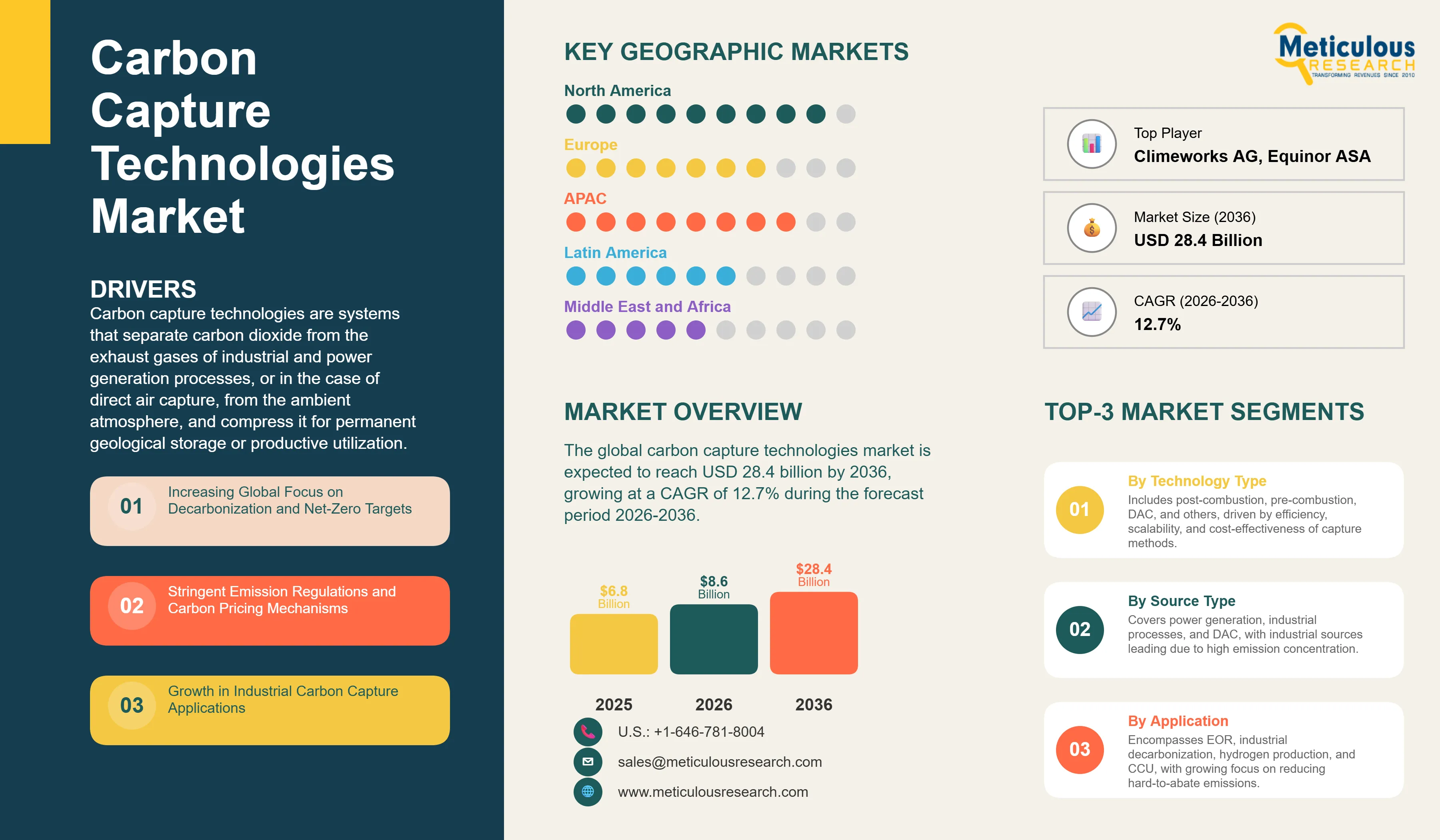
The global carbon capture technologies market was valued at USD 6.8 billion in 2025. This market is expected to reach USD 28.4 billion by 2036 from an estimated USD 8.6 billion in 2026, growing at a CAGR of 12.7% during the forecast period 2026-2036.
- Published
- May 2026
- Pages
- 290
- Format
- PDF + Excel
- Report ID
- MR-1960
- Base year
- 2025
- 2025 · BASELINE
- $6.80B
- 2036
- $28.40B
- CAGR 2026–2036
- 12.7%
2025 baseline · 2026–2036 forecast at 12.7% CAGR · hover a bar for the value
Key highlights
The global carbon capture technologies market is projected to reach USD 28.4 billion by 2036.
The market is expected to grow at a CAGR of 12.7% during the forecast period 2026-2036.
The global market for carbon capture technologies was valued at USD 6.8 billion in 2025 and is estimated to reach USD 8.6 billion in 2026.
North America is expected to dominate the global carbon capture technologies market with the largest market share in 2026, while Asia-Pacific is projected to register the highest CAGR during the forecast period.
By technology type, the post-combustion capture segment is expected to hold the largest share of the market in 2026, while the direct air capture segment is projected to register the highest CAGR during the forecast period.
By source type, the industrial processes segment is expected to hold the largest share in 2026, while the direct air capture segment is projected to register the highest CAGR during the forecast period.
By application, the industrial decarbonization segment is expected to hold the largest share in 2026, while the blue hydrogen production segment is projected to register the highest CAGR during the forecast period.
By end-use industry, the oil and gas segment is expected to hold the largest share in 2026, while the cement segment is projected to register the highest CAGR during the forecast period.
By deployment type, the onshore projects segment is expected to hold the largest share in 2026, while the offshore projects segment is projected to register the highest CAGR during the forecast period.
By capture capacity, the small-scale segment is expected to hold the largest share in 2026, while the large-scale segment is projected to register the highest CAGR during the forecast period.
Report summary
| Particulars | Details |
|---|---|
| Market Size by 2036 | USD 28.4 Billion |
| Market Size in 2026 | USD 8.6 Billion |
| Market Size in 2025 | USD 6.8 Billion |
| Revenue Growth Rate (2026-2036) | CAGR of 12.7% |
| Format | PDF, Excel & Cloud Portal · 290 pages |
| Dominating Technology Type | Post-Combustion Capture (Amine-Based) |
| Fastest Growing Technology Type | Direct Air Capture (DAC) |
| Dominating Source Type | Industrial Processes |
| Fastest Growing Source Type | Direct Air Capture |
| Dominating Application | Industrial Decarbonization |
| Fastest Growing Application | Blue Hydrogen Production |
| Dominating End-Use Industry | Oil & Gas |
| Fastest Growing End-Use Industry | Cement |
| Dominating Deployment Type | Onshore Projects |
| Fastest Growing Deployment Type | Offshore Projects |
| Dominating Capture Capacity | Small-Scale (<1 MtCO2/year) |
| Fastest Growing Capture Capacity | Large-Scale (>5 MtCO2/year) |
| Dominating Geography | North America |
| Fastest Growing Geography | Asia-Pacific |
| Base Year | 2025 |
| Forecast Period | 2026 to 2036 |
Report overview
Segments covered: technology type, application, end-use industry.
According to the IEA's Carbon Capture, Utilisation and Storage 2024 report, global operational CCS capacity stood at approximately 50 million tonnes of CO2 per year (MtCO2/year) across all operating facilities by the end of 2024, with a pipeline of new projects under development that would more than double this capacity. The IEA states in its Net Zero by 2050 roadmap that carbon capture must scale to capture approximately 1 billion tonnes of CO2 per year by 2030 to stay on track for net-zero, meaning the current installed capacity represents less than 5% of what is needed, underscoring the enormous scale of deployment required and the commercial opportunity this represents.
Carbon capture technologies are systems that separate carbon dioxide from the exhaust gases of industrial and power generation processes, or in the case of direct air capture, from the ambient atmosphere, and compress it for permanent geological storage or productive utilization. Post-combustion capture, the most commercially mature approach, passes flue gas through a liquid amine solvent that chemically absorbs CO2, which is then released by heating the solvent and compressed for transport. Pre-combustion capture converts fuel into a hydrogen-CO2 mixture before combustion and separates the CO2 before the remaining hydrogen is burned. Direct air capture pulls CO2 directly from the open atmosphere using large fans and chemical contactors, producing negative emissions when combined with permanent storage.
The market is growing because global energy-related CO2 emissions reached a record 37.8 billion tonnes in 2024 according to the IEA's CO2 Emissions from Energy Combustion and Industrial Processes 2025 report, and the scientific consensus documented in the IPCC's Sixth Assessment Report confirms that all credible pathways to limiting warming to 1.5 or 2 degrees Celsius require carbon capture and removal at significant scale. The U.S. Inflation Reduction Act, signed in 2022 but producing commercial deployment effects from 2024 onward, increased the Section 45Q tax credit for captured and permanently stored CO2 to USD 85 per tonne for industrial point source capture and USD 180 per tonne for direct air capture, levels that make a large number of projects financially viable that were previously uneconomical. The number of CCS projects in the global development pipeline reached 628 projects across all development stages in 2024 according to the Global CCS Institute's 2024 Status of CCS Report, up from 392 in 2022, demonstrating the accelerating commercial momentum.
Two opportunities are defining the near-term growth phase. Blue hydrogen production by steam methane reforming with CCS is the lowest-cost route to large-scale low-carbon hydrogen supply in most markets and is driving CCS investments at natural gas processing and hydrogen production facilities globally. The IEA's Global Hydrogen Review 2024 notes that over 40 large-scale low-carbon hydrogen projects with integrated CCS are in active development globally. The second opportunity is the Norwegian Northern Lights project, which became the world's first open-access CO2 transport and storage infrastructure in 2024, injecting CO2 captured from European industrial sources into subsea geological formations under the North Sea. This shared infrastructure model, where multiple industrial emitters can pipe CO2 to a common transport and storage hub, significantly reduces the per-project CCS investment cost and is the commercial model that most major European CCS cluster programs are following.
Report infographic
Market dynamics
7 factors across 3 forcesIncreasing Global Focus on Decarbonization and Net-Zero Targets
Global energy-related CO2 emissions reached a record 37.8 billion tonnes in 2024 according to the IEA's CO2 Emissions from Energy Combustion and Industrial Processes 2025 report, and industrial process emissions add further CO2 that is not attributable to energy combustion but to chemical reactions in cement, steel, and chemical manufacturing. The IPCC's Sixth Assessment Report, the most comprehensive scientific assessment of climate change, concludes that virtually all pathways compatible with limiting warming to 1.5 degrees Celsius involve significant deployment of carbon capture and carbon dioxide removal technologies. The IEA's Net Zero by 2050 Roadmap states that approximately 1 billion tonnes of CO2 per year must be captured by 2030 across all CCS and DAC applications to remain on track. Against the approximately 50 MtCO2/year of current operational capacity documented in the IEA's CCUS 2024 report, this represents a more than thirty-fold scale-up requirement in less than a decade, establishing the scale of the commercial opportunity with clarity.
Government Incentives and Funding for CCS/CCUS Projects
Government financial support for carbon capture has expanded substantially in the major emitting economies since 2022. The U.S. Inflation Reduction Act's Section 45Q credit at USD 85 per tonne for geological storage and USD 180 per tonne for DAC storage, combined with the U.S. Department of Energy's USD 3.5 billion DAC hub program announced in 2023, represent the most generous set of carbon capture incentives in any country globally. The UK government's industrial Carbon Capture business model, announced in 2024 as part of its Track-1 CCS cluster program, provides revenue support contracts for the East Coast Cluster and HyNet projects covering the commercial risk of CO2 transport and storage operations. The European Innovation Fund, which has funded multiple CCS and DAC demonstration projects with grants from EU emissions trading revenues, provides project-level support across member states. Canada's investment tax credit for carbon capture, announced in Budget 2022 and expanded in subsequent budgets, covers up to 50% of eligible CCS capital costs for direct air capture and 37.5% for most other applications.
Table of contents
14 chapters · 169 sections · 290 pages · click to expandSegmental analysis
| Segment | Largest share (2026) | Fastest growth (2026–2036) |
|---|---|---|
| By Technology Type | Post-Combustion | Direct air capture |
| By Application | Industrial Decarbonization | Blue hydrogen production |
By Technology Type
- Post-Combustion Capture to Dominate
- The post-combustion capture segment is expected to account for the largest share of the global carbon capture technologies market.
- Amine-based post-combustion capture is the most commercially proven and most widely deployed carbon capture technology, with decades of operational experience in natural gas processing, ammonia production, and the most advanced large-scale power station CCS projects.
- According to the Global CCS Institute's 2024 Status of CCS Report, the majority of the approximately 50 MtCO2/year of current global operational CCS capacity uses amine or solvent-based post-combustion or natural gas processing capture technology, establishing this as the dominant category by installed capacity.
- However, the direct air capture segment is projected to register the highest CAGR during the forecast period, driven by the combination of very large government funding support, the growing corporate voluntary carbon market for permanent removal credits, and the irreplaceable role of DAC as the only scalable technology capable of directly removing previously emitted CO2 from the atmosphere when combined with permanent geological storage.
By Application
- Industrial Decarbonization to Hold the Largest Share
- The industrial decarbonization segment is expected to account for the largest share of the global carbon capture technologies market.
- Cement, steel, and chemical manufacturing collectively account for a large fraction of global industrial CO2 emissions and are recognized as hard-to-abate sectors where CCS is one of the only viable pathways to deep decarbonization.
- The cement industry's particular urgency is confirmed by the fact that Heidelberg Materials' Brevik plant in Norway became the world's first full-scale cement CCS facility in 2024, and the industry's multiple global CCS project announcements in 2024 and 2025 reflect growing commercial investment in this application.
- However, the blue hydrogen production segment is projected to register the highest CAGR during the forecast period, driven by the growing global hydrogen economy requiring large-scale low-carbon hydrogen supply and by the very competitive cost position of blue hydrogen relative to green hydrogen at current electrolyzer costs and electricity prices.
- The IEA's Global Hydrogen Review 2024 identifies blue hydrogen as the primary near-term supply pathway for low-carbon hydrogen at the scale required for industrial decarbonization applications.
Geographic analysis
North America
Largest shareIn 2026, North America is expected to account for the largest share of the global market for carbon capture technologies. The United States has the world's most favorable policy environment for commercial CCS deployment following the Inflation Reduction Act, with the 45Q tax credit at USD 85 per tonne for geological storage and USD 180 per tonne for DAC creating a revenue certainty that project developers in no other country currently enjoy at equivalent levels. According to the Global CCS Institute's 2024 Status of CCS Report, the United States hosts the largest number of CCS projects in active development of any country globally, with particularly strong activity in the Gulf Coast, Midwest, and Great Plains regions where existing industrial infrastructure and favorable geology combine with IRA financial incentives. The U.S. DOE's Regional DAC Hub program, which allocated USD 3.5 billion to hub projects in Texas, Louisiana, and other states in 2023, is specifically designed to prove DAC at commercial scale. Canada complements the North American market through its investment tax credits for CCS and several large-scale CCS projects in Alberta's oil sands and industrial sectors.
Asia-Pacific
Fastest growthHowever, the Asia-Pacific carbon capture technologies market is expected to grow at the fastest CAGR during the forecast period. Japan has made CCS a central element of its Green Transformation (GX) strategy, committing USD 150 billion over ten years to clean energy technologies with CCS specifically identified as a priority, and the Japanese government has published a CCS roadmap targeting 12 MtCO2/year of domestic and international CCS capacity by 2030. South Korea's Carbon Neutral 2050 strategy includes CCS at industrial facilities, and the government has been supporting CCS pilot projects at cement and steel plants. China's national carbon neutrality by 2060 commitment and its very large coal power and industrial base create enormous long-term CCS potential, and according to the IEA's CCUS 2024 report, China's CCS project activity increased significantly in 2023 and 2024 with several new industrial CCS projects announced. Australia's CCS program is anchored by the Gorgon LNG CCS project and a government commitment to developing CO2 storage hubs for industrial exports of CO2 from Japan and other Asian countries.
Competitive landscape
- Shell plc (UK/Netherlands)
- ExxonMobil Corporation (U.S.)
- Aker Carbon
Frequently asked questions
The global carbon capture technologies market is expected to reach USD 28.4 billion by 2036 from an estimated USD 8.6 billion in 2026, at a CAGR of 12.7% during the forecast period 2026-2036.
Cite this report
Meticulous Research. (2026). Carbon Capture Technologies Market - Global Opportunity Analysis and Industry Forecast (2026-2036) (Report No. MR-1960). Meticulous Market Research Pvt. Ltd. https://www.meticulousresearch.com/product/carbon-capture-technologies-market-6643