
Brain-Computer Interface (BCI) Market (2026-2036)
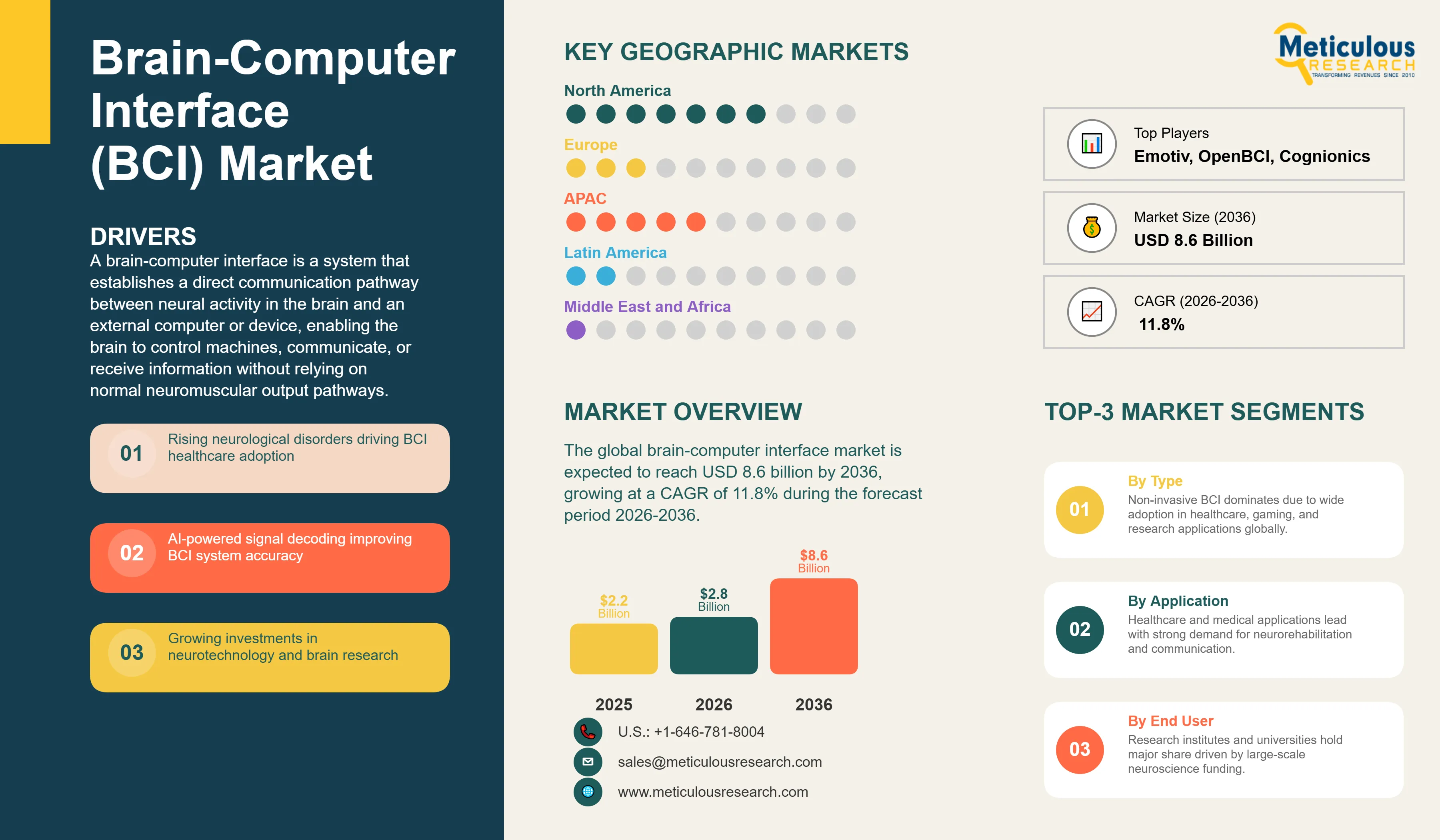
The global brain-computer interface market was valued at USD 2.2 billion in 2025. This market is expected to reach USD 8.6 billion by 2036 from an estimated USD 2.8 billion in 2026, growing at a CAGR of 11.8% during the forecast period 2026-2036.
- Published
- May 2026
- Pages
- 278
- Format
- PDF + Excel
- Report ID
- MRHC - 1041971
- Base year
- 2025
- 2025 · BASELINE
- $2.20B
- 2036
- $8.60B
- CAGR 2026–2036
- 11.8%
2025 baseline · 2026–2036 forecast at 11.8% CAGR · hover a bar for the value
Key highlights
The global BCI market is projected to reach USD 8.6 billion by 2036.
The market is expected to grow at a CAGR of 11.8% during the forecast period 2026-2036.
The global market for BCI was valued at USD 2.2 billion in 2025 and is estimated to reach USD 2.8 billion in 2026.
North America is expected to dominate the global BCI market with the largest market share in 2026, while Asia-Pacific is projected to register the highest CAGR during the forecast period.
By type, the non-invasive BCI segment is expected to hold the largest share of the market in 2026, while the invasive BCI segment is projected to register the highest CAGR during the forecast period.
By component, the hardware segment is expected to hold the largest share in 2026, while the software (AI and signal processing) segment is projected to register the highest CAGR during the forecast period.
By technology, the EEG-based BCI segment is expected to hold the largest share in 2026, while the intracortical BCI segment is projected to register the highest CAGR during the forecast period.
By application, the healthcare and medical applications segment is expected to hold the largest share in 2026, while the gaming and entertainment segment is projected to register the highest CAGR during the forecast period.
By end user, the research institutes and universities segment is expected to hold the largest share in 2026, while the hospitals and clinics segment is projected to register the highest CAGR during the forecast period.
Report summary
| Particulars | Details |
|---|---|
| Market Size by 2036 | USD 8.6 Billion |
| Market Size in 2026 | USD 2.8 Billion |
| Market Size in 2025 | USD 2.2 Billion |
| Revenue Growth Rate (2026-2036) | CAGR of 11.8% |
| Format | PDF, Excel & Cloud Portal · 278 pages |
| Dominating BCI Type | Non-invasive BCI |
| Fastest Growing BCI Type | Invasive BCI |
| Dominating Component | Hardware |
| Fastest Growing Component | Software (AI & Signal Processing) |
| Dominating Technology | EEG-based BCI |
| Fastest Growing Technology | Intracortical BCI |
| Dominating Application | Healthcare & Medical (Neurorehabilitation) |
| Fastest Growing Application | Gaming & Entertainment |
| Dominating End User | Research Institutes & Universities |
| Fastest Growing End User | Hospitals & Clinics |
| Dominating Geography | North America |
| Fastest Growing Geography | Asia-Pacific |
| Base Year | 2025 |
| Forecast Period | 2026 to 2036 |
Report overview
Segments covered: type, component, technology, end user.
According to the World Health Organization's Neurological Disorders Report 2024, neurological conditions are now the leading cause of disability and the second leading cause of death globally, affecting approximately 3 billion people, establishing the clinical imperative driving medical BCI development. Simultaneously, a wave of well-funded neurotechnology startups and the entry of major technology companies into the BCI space is creating a parallel consumer and defense BCI development ecosystem that could eventually dwarf the medical application market in commercial scale.
A brain-computer interface is a system that establishes a direct communication pathway between neural activity in the brain and an external computer or device, enabling the brain to control machines, communicate, or receive information without relying on normal neuromuscular output pathways. In a medical BCI, electrodes detect the electrical signals generated by neurons firing in specific brain regions associated with intended movement or communication, a computer decodes these patterns in real time and translates them into commands that drive a cursor, robotic arm, or speech synthesizer. In a non-invasive consumer BCI, sensors worn on the scalp detect brainwave patterns associated with attention, cognitive states, or imagined actions, enabling hands-free device control, neurofeedback training, or gaming applications that respond to the user's mental state.
The market is growing because two historically separate strands of BCI development, the clinical strand pursuing FDA-approved devices for paralyzed patients and the commercial strand pursuing consumer neurotechnology, are both advancing rapidly and beginning to generate commercial revenues that justify the investment. On the clinical side, Neuralink's PRIME study, which enrolled its first human participant in January 2024 and demonstrated that the participant could control a computer cursor and play online chess using only neural signals decoded by the implanted device, represents the most visible demonstration of intracortical BCI clinical progress in the technology's history. Synchron's Stentrode device, which can be implanted via a catheter through blood vessels without open brain surgery, reached a milestone of enabling an ALS patient to independently control a smartphone and computer according to Synchron's 2025 clinical update publications, providing a less invasive clinical pathway with significant commercial scalability.
According to the BRAIN Initiative's 2025 progress report published by the National Institutes of Health, the U.S. federal government has invested over USD 3 billion in brain research and neurotechnology development since the BRAIN Initiative was launched in 2013, and this sustained research investment is generating scientific advances in electrode materials, signal processing algorithms, and wireless transmission that are progressively improving the performance and longevity of both invasive and non-invasive BCI systems. The NIH's investment has been complemented by significant private investment. According to PitchBook's 2025 neurotechnology investment tracker, neurotechnology startups globally attracted over USD 2.3 billion in venture capital investment in 2024, with BCI companies representing a large share of this total.
Report infographic
Market dynamics
7 factors across 3 forcesRising Prevalence of Neurological Disorders
According to the WHO's Neurological Disorders Report 2024, neurological conditions are the leading cause of disability globally and the second leading cause of death, affecting approximately 3 billion people. The American Heart Association's 2025 Heart Disease and Stroke Statistics update estimates approximately 12 million stroke events occur globally each year, with millions resulting in permanent disability. Amyotrophic lateral sclerosis, which causes progressive motor neuron degeneration leading to complete paralysis while cognitive function is preserved, creates some of the most compelling clinical BCI use cases: individuals with advanced ALS who have lost all voluntary motor function can regain communication and device control capability through BCI systems, and the ALS Association's 2025 data estimates approximately 450,000 people worldwide are living with ALS at any time, representing the most immediate and clinically validated market for invasive medical BCI. Spinal cord injury, affecting approximately 500,000 new cases annually according to the WHO's 2024 estimate, creates additional clinical need for BCI-assisted movement and communication restoration.
Advancements in Neurotechnology and AI
The AI and machine learning revolution is transforming the signal processing capability of BCI systems, enabling real-time decoding of neural signals with accuracy and speed that was impossible with conventional signal processing algorithms. Deep learning models trained on large neural recording datasets can decode intended speech, movement, and cognitive states from EEG and intracortical recordings with significantly higher accuracy than the linear discriminant analysis and support vector machine algorithms that dominated the field five years ago. According to a landmark study published in Nature in 2024 from the Chang Laboratory at UCSF, a brain-computer interface combining intracortical recording with a large language model decoder enabled a woman with ALS who had been unable to speak for 18 years to communicate at approximately 78 words per minute with a 25% error rate, a speed and accuracy unprecedented in BCI communication history. This demonstration of AI-enhanced BCI performance is accelerating both clinical translation and commercial investment across the BCI ecosystem.
Table of contents
13 chapters · 160 sections · 278 pages · click to expandSegmental analysis
| Segment | Largest share (2026) | Fastest growth (2026–2036) |
|---|---|---|
| By BCI Type | Non-invasive BCI | Invasive BCI |
| By Component | Hardware | Software |
| By Technology | EEG-based BCI | Intracortical BCI |
| By Application | Healthcare & Medical | Gaming and entertainment |
| By End User | Research Institutes & Universities | Hospitals and clinics |
By BCI Type
- Non-invasive BCI to Hold the Largest Share
- The non-invasive BCI segment is expected to account for the largest share of the global BCI market.
- Non-invasive BCI systems, primarily EEG-based consumer headsets and research-grade EEG systems, represent the largest current revenue category because they are commercially deployable without surgical procedures, have established research and consumer market channels, and serve a much broader range of applications across healthcare research, consumer neurotechnology, and accessibility devices.
- Emotiv's commercial headset range, research-grade systems from Compumedics, ANT Neuro, and g.tec medical engineering, and the OpenBCI open-source hardware ecosystem collectively represent a substantial installed base of non-invasive BCI systems in research institutions, clinical settings, and consumer markets globally.
- However, the invasive BCI segment is projected to register the highest CAGR during the forecast period.
- Neuralink's and Synchron's high-profile clinical demonstrations in 2024 and 2025, the FDA Breakthrough Device Designations received by both companies, and the expanding PRIME and Synchron clinical studies are generating rapidly growing clinical interest in invasive BCI for paralysis, ALS, and locked-in syndrome applications.
- The UCSF Nature 2024 study demonstrating 78 words per minute BCI-assisted speech from an ALS patient is a landmark performance demonstration that is compelling neurologists and neurosurgeons to consider invasive BCI as a realistic near-term clinical tool for their most severely affected patients, driving a growing pipeline of clinical center preparations for invasive BCI program development.
By Component
- Hardware to Hold the Largest Share
- The hardware segment is expected to account for the largest share of the global BCI market.
- EEG amplifiers and electrode systems, research-grade EEG headsets, and implantable neural recording arrays collectively represent the highest value product category, with hardware being the foundational enabling component of every BCI system.
- Nihon Kohden, Compumedics, and Brain Products GmbH are established EEG hardware suppliers with large installed bases in clinical and research settings globally.
- However, the software segment, particularly AI and machine learning algorithms, is projected to register the highest CAGR during the forecast period.
- The signal decoding algorithms that translate raw neural signals into meaningful commands and communications are where the most active innovation and value creation in the BCI field is currently occurring.
- AI-powered neural decoders are achieving performance improvements that hardware advances alone cannot deliver, and the commercial value of proprietary decoding algorithms is increasingly being recognized by investors and acquirers as the key differentiating asset in competitive BCI platforms.
By Technology
- EEG-based BCI to Hold the Largest Share
- The EEG-based BCI segment, noted as the largest in the TOC itself, is expected to account for the largest share of the global BCI market.
- EEG is the most widely deployed neural recording technology for BCI applications because it is non-invasive, requires no surgery, has decades of established clinical and research use infrastructure, and supports a broad range of applications from medical neurofeedback to consumer gaming.
- The very large installed base of EEG systems in clinical neurophysiology departments, neurology research laboratories, and university psychology departments provides EEG-based BCI with the broadest existing user community of any neural recording technology.
- However, the intracortical BCI segment is projected to register the highest CAGR during the forecast period, driven by the commercial and clinical momentum of Neuralink and Synchron.
- The Nature 2024 UCSF BCI speech decoding study and Neuralink's first human participant results together demonstrate that intracortical recording quality is sufficient for genuinely transformative clinical applications in paralysis and ALS, creating a strong clinical pull for this technology that is expected to drive rapid adoption in specialized clinical BCI centers through the forecast period.
By Application
- Healthcare & Medical Applications to Hold the Largest Share
- The healthcare and medical applications segment is expected to account for the largest share of the global BCI market.
- Medical BCI applications including neurorehabilitation, assistive communication for ALS and locked-in syndrome patients, and brain-controlled prosthetics represent the most commercially established BCI category with the most extensive clinical evidence base and the clearest reimbursement pathways.
- The NeuroPace RNS System, an FDA-approved closed-loop neuromodulation device for drug-resistant epilepsy, and the range of EEG neurofeedback systems used in ADHD and anxiety treatment represent the established revenue base of the medical BCI market.
- The expanding clinical trial programs of Neuralink, Synchron, and Precision Neuroscience are adding very high-value invasive BCI systems to this growing clinical market.
- However, the gaming and entertainment segment is projected to register the highest CAGR during the forecast period.
- The convergence of improving non-invasive BCI signal quality, the rapidly growing gaming and AR/VR markets, and the interest of major technology companies in BCI-enhanced immersive experiences is creating strong commercial momentum in gaming and consumer BCI.
- According to Newzoo's Global Games Market Report 2025, the global games market reached approximately USD 182 billion in 2024, representing a very large commercial base for even a small BCI hardware and software penetration.
By End User
- Research Institutes & Universities to Hold the Largest Share
- The research institutes and universities segment is expected to account for the largest share of the global BCI market.
- University research laboratories and public research institutes represent the foundational customer base for BCI technology, having driven the majority of BCI hardware and software procurement over the past two decades.
- The large number of academic BCI research programs globally, supported by funding from the NIH BRAIN Initiative, the EU Human Brain Project, and national research councils, collectively generate very large research equipment procurement across EEG systems, amplifiers, electrode arrays, and signal processing software.
- According to the NIH's 2025 BRAIN Initiative progress report, the initiative has funded over 3,000 individual research projects at universities and research institutions across the U.S. since its inception, creating a large and sustained research equipment demand base.
- However, the hospitals and clinics segment is projected to register the highest CAGR during the forecast period.
- The transition of BCI technology from research to clinical application is the defining commercial trend in the BCI market, driven by FDA-approved and investigational BCI systems demonstrating clinical efficacy in epilepsy, paralysis, and stroke rehabilitation.
- As Neuralink and Synchron expand their clinical study programs to additional clinical sites, and as BCI-assisted neurorehabilitation systems gain broader clinical validation and reimbursement coverage, the hospital and clinic procurement of BCI systems is expected to grow at above-average rates from a currently smaller commercial base than research institutions.
Geographic analysis
North America
Largest shareIn 2026, North America is expected to account for the largest share of the global BCI market. The United States is the world's most advanced BCI development and commercialization market, home to Neuralink, Synchron, Precision Neuroscience, Kernel, Emotiv's North American operations, Blackrock Neurotech, NeuroPace, and Cognionics, collectively the most significant concentration of BCI commercial development globally. According to the NIH's 2025 BRAIN Initiative progress report, the U.S. government has invested over USD 3 billion in brain research and neurotechnology since 2013, providing the research infrastructure from which commercial BCI ventures are emerging. The FDA's Breakthrough Device Designation program has been particularly active in BCI, having granted designations to both Neuralink's N1 implant and Synchron's Stentrode, and the FDA's Digital Health Center of Excellence has been engaging actively with BCI developers on regulatory pathways. According to PitchBook's 2025 neurotechnology investment data, North American BCI companies captured the largest share of global neurotechnology venture capital investment in 2024, reflecting investor confidence in the U.S. BCI commercialization ecosystem. The U.S. Department of Defense's DARPA has been one of the most consistent long-term funders of BCI research and development, with programs including the Neural Engineering System Design and Restoring Active Memory programs generating significant BCI technology advances with commercial spin-off potential. BCI Market by Region: North America Leading by Share, Asia-Pacific by Growth
Asia-Pacific
Fastest growthHowever, the Asia-Pacific BCI market is expected to grow at the fastest CAGR during the forecast period. China has made neurotechnology a national research priority, with the China Brain Project, launched in 2021 as China's equivalent of the U.S. BRAIN Initiative with a planned investment of approximately CNY 30 billion over 15 years, specifically targeting BCI development as a strategic technology area. According to China's Ministry of Science and Technology's 2025 progress communications, Chinese academic institutions and companies including BrainCo and NeuroXess are advancing both non-invasive consumer BCI and implantable medical BCI programs. BrainCo developed a non-invasive EEG headband originally for educational focus monitoring and has expanded into prosthetic limb control applications. NeuroXess received approval from China's National Medical Products Administration for its SEAMACS BCI system in 2024, making it one of the first implantable BCI systems to receive regulatory approval in China. Japan's strong neuromedical device industry and South Korea's advanced consumer electronics ecosystem both contribute to Asia-Pacific's growing BCI market momentum.
Europe
Europe is a technically advanced BCI market with strong academic research programs and several leading BCI hardware companies. g.tec medical engineering in Austria has developed a comprehensive BCI research and clinical platform suite used by hundreds of research and clinical institutions globally, and is also developing HDSEMG and Unicorn series consumer-accessible BCI systems. Brain Products GmbH in Germany is a leading EEG amplifier and BCI research equipment supplier with a large global research customer base. ANT Neuro in the Netherlands provides clinical and research EEG and BCI systems. Switzerland's academic BCI research programs at EPFL and ETH Zurich are among the most cited in the international BCI research literature. The EU's Horizon Europe program continues to fund BCI research projects across European universities, maintaining Europe's research leadership in specific BCI technology areas including neural decoding algorithms and biocompatible electrode materials.
Competitive landscape
- Neuralink Corporation (U.S.)
- Blackrock Neurotech (U.S.)
- Synchron Inc. (U.S./Australia)
- Emotiv Inc. (U.S./Australia)
- NextMind/Snap Inc. (U.S./France)
- Brain Products GmbH · Germany
- NeuroPace Inc. (U.S.)
- OpenBCI (U.S.)
- Compumedics Limited · Australia
- Nihon Kohden Corporation · Japan
- ANT Neuro · Netherlands
- Bitbrain Technologies · Spain
- Cognionics Inc. (U.S.)
- Kernel Inc. (U.S.)
Frequently asked questions
The global BCI market is expected to reach USD 8.6 billion by 2036 from an estimated USD 2.8 billion in 2026, at a CAGR of 11.8% during the forecast period 2026-2036.
Cite this report
Meticulous Research. (2026). Brain-Computer Interface (BCI) Market - Global Opportunity Analysis and Industry Forecast (2026-2036) (Report No. MRHC - 1041971). Meticulous Market Research Pvt. Ltd. https://www.meticulousresearch.com/product/brain-computer-interface-market-6654