Automotive Steel Sheet Market (2026-2036)
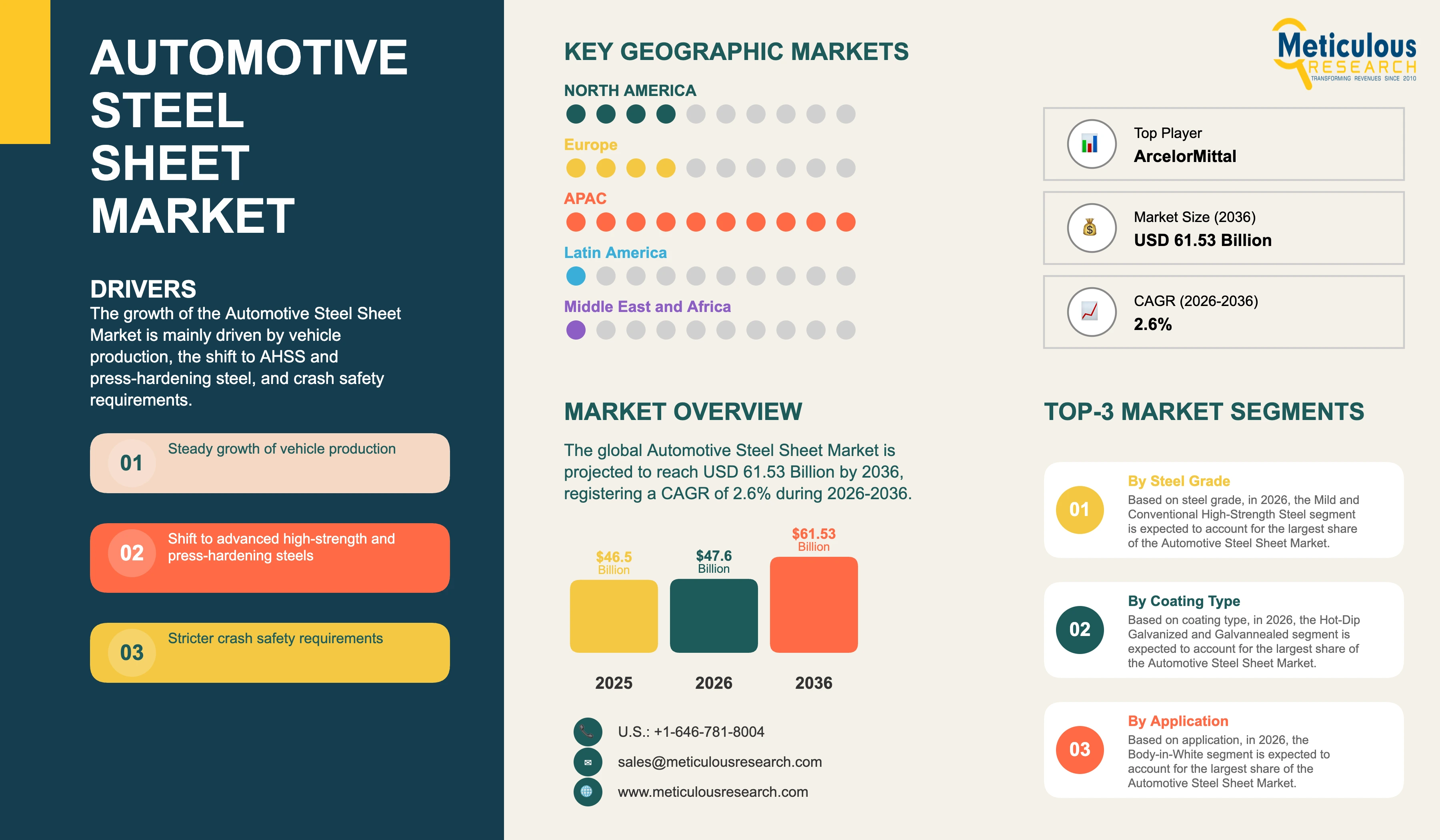
The global automotive steel sheet market was valued at USD 46.50 billion in 2025. This market is expected to reach USD 61.53 billion by 2036 from an estimated USD 47.60 billion in 2026, registering a CAGR of 2.6% during the forecast period (2026-2036).
- Published
- Nov 2026
- Pages
- 270
- Format
- PDF + Excel
- Report ID
- MRAUTO - 1042895
- Base year
- 2025
- 2025 · BASELINE
- $46.50B
- 2036
- $61.53B
- CAGR 2026–2036
- 2.6%
2025 baseline · 2026–2036 forecast at 2.6% CAGR · hover a bar for the value
Key highlights
Nippon Steel's 2.0 GPa-class aluminized hot-stamping steel sheet, which offers excellent resistance to hydrogen embrittlement, has been adopted for underbody reinforcement parts in Nissan's all-new ELGRAND, according to Nippon Steel's October 2026 announcement. An overseas vehicle maker has also applied the steel sheet to upper-body reinforcement parts, according to Nippon Steel, showing the move to ever stronger press-hardening steels.
A WorldAutoSteel study published in May 2026 found that greater use of advanced high-strength steels in a front body structure could reduce the number of parts by 34% and lower piece cost by 10%, according to WorldAutoSteel, the automotive group of the World Steel Association. The study combined hot-stamped and cold-stamped advanced high-strength steels into larger single parts.
ArcelorMittal produced 55.6 million tons of crude steel in 2025 and has more than three million tons of steel that directly serve every vehicle maker and Tier 1 supplier in North America, according to ArcelorMittal. Its Fortiform third-generation advanced high-strength steels for cold stamping have tensile strengths of 980, 1,050, and 1,180 MPa.
Purem by Eberspächer started series production of high-strength steel battery housings in China at volumes of more than 100,000 units per year from the second half of 2026, according to Eberspächer. The company states that higher-strength steel allows thinner walls, resulting in housings that are lighter than aluminium equivalents and cheaper to produce.
ArcelorMittal Nippon Steel India launched a new production line at Hazira, Gujarat, to produce advanced high-strength steel for the automotive sector in 2026, according to the company, reflecting the fast growth of vehicle production and steel quality requirements in India.
Leading suppliers include ArcelorMittal, Baoshan Iron & Steel, Nippon Steel, POSCO, JFE Steel, Hyundai Steel, Cleveland-Cliffs, thyssenkrupp Steel Europe, voestalpine, and Tata Steel. Press-hardening steel is the fastest-growing steel grade, and battery enclosures and EV components is the fastest-growing application, as vehicle makers use high-strength steel to protect batteries at low cost. Japanese and Korean steel makers, such as JFE Steel, POSCO, and Hyundai Steel, are also expanding their ranges of advanced high-strength steels.
By steel grade, mild and conventional high-strength steel accounts for the largest share of 55.0% in 2026, while press-hardening steel registers the highest CAGR.
By coating type, hot-dip galvanized and galvannealed accounts for the largest share in 2026, while zinc-magnesium and aluminum-silicon coated registers the highest CAGR.
By application, body-in-white accounts for the largest share in 2026, while battery enclosures and EV components register the highest CAGR.
By vehicle type, passenger cars account for the larger share of 76.0% in 2026 and also register the higher CAGR.
By geography, Asia-Pacific accounts for the largest share of 52.0% in 2026, while Asia-Pacific registers the highest CAGR of 3.4%.
Report summary
| Particulars | Details |
|---|---|
| Base Year | 2025 |
| Estimated Year | 2026 |
| Forecast Period | 2026-2036 |
| Market Size in 2025 | USD 46.50 billion |
| Market Size in 2026 | USD 47.60 billion |
| Market Size by 2036 | USD 61.53 billion |
| CAGR (2026-2036) | 2.6% |
| Format | PDF, Excel & Cloud Portal · 270 pages |
| Largest Segment by Steel Grade (2026) | Mild and Conventional High-Strength Steel (55.0%) |
| Largest Segment by Vehicle Type (2026) | Passenger Cars (76.0%) |
| Largest Region (2026) | Asia-Pacific (52.0%) |
| Fastest-Growing Region | Asia-Pacific (CAGR 3.4%) |
| Companies Profiled | 10 companies and other companies |
| Segments Covered | Steel Grade, Coating Type, Application, Vehicle Type, Geography |
| Countries Covered | U.S., Canada, Mexico, Germany, France, U.K., Spain, Italy, Sweden, Czech Republic, Poland, Slovakia, Hungary, Romania, Rest of Europe, China, Japan, South Korea, India, Thailand, Indonesia, Malaysia, Vietnam, Taiwan, Australia, Rest of Asia-Pacific, Brazil, Argentina, Chile, Colombia, Rest of Latin America, Turkey, Morocco, South Africa, Saudi Arabia, UAE, Israel, Rest of Middle East & Africa |
Report overview
Segments covered: steel grade, coating type, application, vehicle type.
Automotive steel sheet is flat-rolled steel, supplied as coils or cut blanks, that vehicle makers and parts makers stamp, roll-form, or hot-stamp into body panels, structural parts, closures, chassis parts, and battery enclosures. It includes mild and conventional high-strength steel, advanced high-strength steel, such as dual-phase, transformation-induced plasticity, complex-phase, and third-generation grades, and press-hardening steel for hot stamping, supplied uncoated or with zinc, zinc-magnesium-aluminum, or aluminum-silicon coatings that protect against corrosion. Steel sheet remains the most widely used material in vehicle bodies, accounting for the majority of body-in-white weight in most vehicles produced today.
The growth of this market is mainly driven by steady growth of global vehicle production, especially in Asia-Pacific, the shift from mild steel to advanced high-strength steel and press-hardening steel, which allow lighter and safer body structures and sell at higher prices, stricter crash safety requirements, the use of steel in electric vehicle battery enclosures and battery protection structures, and the growing use of advanced coatings, such as zinc-magnesium-aluminum and aluminum-silicon coatings. In addition, low-carbon steel produced with electric arc furnaces and direct reduced iron is creating a new premium segment for vehicle makers with climate targets. However, competition from aluminium and composites, volatile steel prices, overcapacity and trade disputes, and slower vehicle production in Europe are expected to restrain the growth of this market to some extent.
Steel sheet has been the main material for vehicle bodies for more than a century, and it still accounts for the majority of body-in-white weight in most vehicles. Over the past three decades, steel makers have developed a wide range of high-strength and advanced high-strength steels that allow vehicle makers to use thinner sheets while improving crash performance, which has helped steel compete with aluminium and composites. Today, a typical vehicle body combines mild steel for outer panels and parts that need deep drawing, high-strength and advanced high-strength steels for structural parts, and press-hardening steels for the safety cage, such as pillars, roof rails, and door rings, which must resist intrusion in crashes.
This report covers the global automotive steel sheet market, including mild and conventional high-strength steel, advanced high-strength steel, and press-hardening steel, supplied as hot-dip galvanized and galvannealed, uncoated cold-rolled and hot-rolled, zinc-magnesium-aluminum and aluminum-silicon coated, and electrogalvanized sheet, used in body-in-white, chassis and suspension, closures, battery enclosures and EV components, and other applications, in passenger cars and commercial vehicles. The market is valued at the selling price of steel sheet supplied by steel makers and service centers to vehicle makers and parts makers. The market is analyzed by steel grade, coating type, application, vehicle type, and geography. Electrical steel for motors, steel bars, tubes, wires, and forgings are not included.
Advanced high-strength steels have become one of the most important growth segments for steel makers. These steels use special chemistry and heat treatment to create microstructures that combine high strength with good formability, allowing vehicle makers to reduce weight and improve crash performance. Third-generation advanced high-strength steels, such as ArcelorMittal's Fortiform, offer strengths above 1,000 MPa while remaining formable in cold stamping, according to ArcelorMittal. Press-hardening steels, which are heated, formed, and cooled in the die, reach strengths of 1,500 MPa to 2,000 MPa and are used in the most critical safety parts. Nippon Steel's 2.0 GPa-class aluminized hot-stamping steel is an example of the latest generation, according to Nippon Steel.
The growth of electric vehicles is creating several new uses for automotive steel sheet beyond the traditional body structure. Battery enclosures must protect the battery against side impacts, underbody impacts, and intrusion, and some vehicle makers use high-strength and press-hardening steel for battery frames, protection plates, and complete battery housings because of its low cost, strength, and fire resistance. Purem by Eberspächer's high-strength steel battery housing, produced in China at volumes of more than 100,000 units per year from the second half of 2026, is an example, according to Eberspächer. Electric vehicles also use steel in rocker reinforcements and cross members that protect the battery.
The market is led by large integrated steel makers with dedicated automotive businesses, research centers, and galvanizing lines. ArcelorMittal is one of the largest suppliers of automotive steel worldwide, with operations in Europe, the Americas, and India. Baoshan Iron & Steel is the largest supplier in China, Nippon Steel and JFE Steel are the leading suppliers in Japan, and POSCO and Hyundai Steel are the leading suppliers in South Korea, with operations abroad. Cleveland-Cliffs is a leading supplier in the U.S., thyssenkrupp Steel Europe and voestalpine are major suppliers in Europe, and Tata Steel supplies vehicle makers in India and Europe. Nippon Steel's acquisition of U.S. Steel in 2025 also strengthened its position in North America.
The push to cut carbon emissions is changing how the steel industry produces automotive steel sheet. Traditional steel production in blast furnaces produces large amounts of carbon dioxide, and steel accounts for a large share of the carbon footprint of vehicle materials. Steel makers are investing in electric arc furnaces, which use scrap and direct reduced iron, and in other low-carbon routes, and are offering low-carbon steel products to vehicle makers. ArcelorMittal, for example, supplies high-recycled-content steel made with renewable electricity from its electric arc furnace in Sestao, Spain, for Daimler Truck's reECONIC project, according to ArcelorMittal. However, high energy prices and slow progress in green hydrogen have slowed some decarbonization projects in Europe.
In 2026, mild and conventional high-strength steel accounts for the largest share of the market by steel grade, while press-hardening steel is the fastest-growing steel grade. Hot-dip galvanized and galvannealed sheet accounts for the largest share by coating type, while zinc-magnesium-aluminum and aluminum-silicon coated sheet is the fastest-growing coating type. Body-in-white accounts for the largest share by application, while battery enclosures and EV components is the fastest-growing application. Passenger cars account for the largest share by vehicle type and are also the fastest-growing vehicle type. Asia-Pacific accounts for the largest share of the market and is also the fastest-growing region.
Market growth over the forecast period will depend on vehicle production, the shift to higher-strength grades and advanced coatings, steel prices, competition from aluminium and other materials, the use of steel in electric vehicle battery enclosures, trade policies, and the development of low-carbon steel. Because steel sheet is a large and mature market, value growth will be modest, but the mix will shift toward higher-value grades, coatings, and low-carbon products. Overall, the market is expected to grow slightly faster than vehicle production through 2036.
Passenger cars are expected to account for the largest share of 76.0% of the market in 2026 and are also projected to register the higher CAGR, driven by passenger car production in Asia-Pacific and higher-value steel grades.
Asia-Pacific is expected to account for the largest share of 52.0% of the market in 2026, mainly due to China's large vehicle and steel production and the large vehicle production of Japan, South Korea, and India.
Asia-Pacific is also projected to register the highest CAGR of 3.4% during the forecast period, driven by vehicle production growth in China, India, and Southeast Asia and rising safety standards.
The report profiles 10 companies, including ArcelorMittal, Baoshan Iron & Steel, Nippon Steel, POSCO, JFE Steel, Hyundai Steel, Cleveland-Cliffs, thyssenkrupp Steel Europe, voestalpine, and Tata Steel.
Press-hardening steel is heated, formed, and cooled in the die, which gives it very high strength of 1,500 MPa to 2,000 MPa or more. It is used in pillars, roof rails, door rings, and battery protection parts to resist crash intrusion.
Aluminium has replaced steel in some parts, especially in premium and electric vehicles, but steel remains the main body material in most vehicles because of its low cost, and new high-strength grades keep it competitive on weight.
Report infographic
Market dynamics
17 factors across 5 forcesSteady growth of vehicle production
Steel sheet is used in every vehicle, and demand is closely linked to vehicle production. Global vehicle production is expected to grow steadily over the forecast period, led by China, India, and Southeast Asia, while production in Europe and North America is expected to grow more slowly. New vehicle plants built by Chinese vehicle makers in Southeast Asia, Europe, Latin America, and the Middle East, and growing vehicle production in India, create new demand for automotive steel sheet in these regions, often supplied by local steel makers or by steel makers that build new galvanizing and processing lines nearby.
ArcelorMittal Nippon Steel India's new advanced high-strength steel line at Hazira, Gujarat, launched in 2026, reflects this trend, according to the company. As vehicle production grows in Asia-Pacific and other emerging regions, demand for steel sheet is expected to grow steadily, although value growth will also depend on steel prices. Asia-Pacific is the largest and fastest-growing region in this market, supported by vehicle production in China and India.
Shift to advanced high-strength and press-hardening steels
Vehicle makers are steadily replacing mild steel with advanced high-strength steel and press-hardening steel in body structures to reduce weight and improve crash performance. These grades allow thinner sheets, which saves weight, and they sell at higher prices per ton than mild steel, which raises the value of steel per vehicle even as total steel weight falls. A WorldAutoSteel study published in May 2026 found that greater use of advanced high-strength steels in a front body structure could reduce the number of parts by 34% and lower piece cost by 10%, according to WorldAutoSteel.
Steel makers continue to develop stronger grades, such as third-generation advanced high-strength steels for cold stamping and 2.0 GPa press-hardening steels. Nippon Steel's 2.0 GPa-class aluminized hot-stamping steel, which resists hydrogen embrittlement, has been adopted in Nissan's all-new ELGRAND, according to Nippon Steel. Press-hardening steel is the fastest-growing steel grade in this market, and advanced high-strength steel is also growing much faster than mild steel.
Stricter crash safety requirements
Crash safety standards and rating programs, such as Euro NCAP, the U.S. Insurance Institute for Highway Safety, and China's C-NCAP, continue to add tougher tests, such as small overlap frontal impacts, side pole impacts, and heavier side impact barriers that simulate SUVs. To meet these tests, vehicle makers need stronger safety cages that resist intrusion, which increases the use of press-hardening steel in pillars, roof rails, door rings, and rocker reinforcements. Laser-welded tailored blanks that combine different grades and thicknesses in one part also help vehicle makers place strength where it is needed.
Electric vehicles add new safety requirements, as the battery must be protected from intrusion in side and underbody impacts. Steel's high strength and low cost make it attractive for battery protection structures. These safety requirements support steady demand for advanced high-strength and press-hardening steels over the forecast period and raise the value of steel per vehicle.
Use of steel in electric vehicle battery enclosures
Electric vehicle battery enclosures were initially dominated by aluminium, but steel is gaining share because of its low cost, high strength, fire resistance, and easier recycling. High-strength and press-hardening steels allow thin, light enclosure walls, and steel's higher melting point provides better protection in a battery fire. Purem by Eberspächer states that its high-strength steel battery housings are lighter than aluminium equivalents, cheaper to produce, and lower in manufacturing carbon footprint, according to Eberspächer.
Several Chinese vehicle makers use steel battery enclosures and battery protection plates, and European and North American suppliers are developing steel solutions to reduce cost. Battery enclosures and EV components is the fastest-growing application in this market, supported by the growth of electric vehicles and the cost advantage of steel, especially in mass-market electric vehicles where cost pressure is strongest.
Advanced coatings and low-carbon steel
Steel makers are offering advanced coatings that improve corrosion protection and processing. Zinc-magnesium-aluminum coatings provide better corrosion protection than conventional zinc coatings with thinner layers, which saves zinc and improves weldability, and they are increasingly used in body and chassis parts. Aluminum-silicon coatings are used on press-hardening steel to prevent scaling during hot stamping and provide corrosion protection, and new coatings, such as Nippon Steel's aluminized coating for 2.0 GPa steel, improve resistance to hydrogen embrittlement, according to Nippon Steel. At the same time, steel makers are introducing low-carbon steel products made with electric arc furnaces, high scrap content, and renewable electricity, which vehicle makers with climate targets increasingly request and in some cases pay a premium for. ArcelorMittal's high-recycled-content steel made with renewable electricity in Sestao, Spain, used in Daimler Truck's reECONIC project, is an example, according to ArcelorMittal. Zinc-magnesium-aluminum and aluminum-silicon coated sheet is the fastest-growing coating type in this market, and low-carbon steel is expected to become an important source of value growth over the forecast period, especially in Europe, where carbon pricing and vehicle makers' climate commitments are strongest.
Table of contents
12 chapters · 178 sections · 270 pages · click to expandSegmental analysis
| Segment | Largest share (2026) | Fastest growth (2026–2036) |
|---|---|---|
| By Steel Grade | Hot-dip galvanized and galvannealed | Zinc-magnesium and aluminum-silicon coated |
By Steel Grade
- The hot-dip galvanized and galvannealed segment is expected to account for the largest share of the automotive steel sheet market, while the zinc-magnesium and aluminum-silicon coated segment is projected to register the highest CAGR during the forecast period.
- The body-in-white segment is expected to account for the largest share of the automotive steel sheet market, while the battery enclosures and EV components segment is projected to register the highest CAGR during the forecast period.
Geographic analysis
Asia-Pacific
Largest shareIn 2026, Asia-Pacific is expected to account for the largest share of 52.0% of the global automotive steel sheet market. The large share of this region is mainly due to China's position as the largest vehicle and steel producer in the world, the large vehicle production of Japan, South Korea, and India, the presence of leading automotive steel makers, such as Baoshan Iron & Steel, Nippon Steel, JFE Steel, POSCO, Hyundai Steel, and Tata Steel, and Chinese vehicle makers' use of steel in battery enclosures. China is the largest market in the region, followed by Japan, India, and South Korea. Asia-Pacific is also projected to register the highest CAGR of 3.4% during the forecast period. The rapid growth of this region is mainly driven by continued growth of vehicle production in China and India, the expansion of vehicle production in Southeast Asia, including plants built by Chinese vehicle makers, rising safety standards, such as Bharat NCAP, which increase the use of advanced high-strength steel, and investments in automotive steel capacity, such as ArcelorMittal Nippon Steel India's new advanced high-strength steel line at Hazira. India is expected to be one of the fastest-growing countries in the market. Japan and South Korea remain important for high-value grades, as their steel makers supply domestic vehicle makers and export advanced steels to vehicle plants abroad.
Europe
Europe accounts for a significant share of the market, supported by the large production of vehicles by European vehicle makers, the early adoption of advanced high-strength steels, press-hardening steels, and zinc-magnesium-aluminum coatings, strict crash safety requirements, and strong demand for low-carbon steel. Germany is the largest market in the region, followed by France, Spain, and the Czech Republic. ArcelorMittal, thyssenkrupp Steel Europe, voestalpine, and Tata Steel are major suppliers in the region. However, slower vehicle production, high energy costs, and competition from aluminium in premium vehicles limit growth, although new EU trade measures are expected to support European steel makers. Eastern European countries, such as Poland, Slovakia, Hungary, and Romania, are important production hubs for vehicles and stamped parts, which supports steel demand in those countries.
North America
North America accounts for a significant share of the market, supported by the large production of SUVs and pickup trucks, which use large amounts of steel, strict crash tests by the Insurance Institute for Highway Safety, and tariffs that favor local steel supply. The U.S. is the largest market in the region, followed by Mexico and Canada, where vehicle production is closely linked to the U.S. market. Cleveland-Cliffs, ArcelorMittal, and Nippon Steel, which acquired U.S. Steel in 2025, are major suppliers in the region. Mexico's large vehicle production for the U.S. market also makes it an important market for automotive steel sheet, supplied by local steel makers and imports.
Latin America
Latin America and the Middle East and Africa account for smaller shares, with Brazil, Turkey, and Morocco the main markets, supported by local vehicle production and exports to Europe.
Competitive landscape
The global automotive steel sheet market includes large integrated steel makers with dedicated automotive businesses, research centers, and coating lines, regional steel makers that serve local vehicle makers, and steel service centers and blank suppliers that process coils into blanks and tailored blanks. The market is concentrated in each region among a few large steel makers, especially for advanced high-strength and press-hardening steels, which require advanced production lines, metallurgical expertise, and long qualification with vehicle makers.
ArcelorMittal is one of the largest suppliers of automotive steel worldwide, with its Fortiform third-generation advanced high-strength steels and press-hardening steels, according to ArcelorMittal. Baoshan Iron & Steel is the largest supplier in China, Nippon Steel and JFE Steel are leading suppliers in Japan, with Nippon Steel's 2.0 GPa-class aluminized hot-stamping steel adopted by Nissan, according to Nippon Steel, and POSCO and Hyundai Steel are leading suppliers in South Korea. Cleveland-Cliffs is a leading supplier in the U.S., thyssenkrupp Steel Europe and voestalpine are major suppliers in Europe, and Tata Steel supplies vehicle makers in India and Europe.
Companies in this market compete mainly on product range, strength and formability of grades, coating technology, surface quality, technical support, price, delivery reliability, carbon footprint, and long-term relationships with vehicle makers. Key strategies in this market include developing third-generation advanced high-strength steels and higher-strength press-hardening steels, expanding zinc-magnesium-aluminum coating capacity, offering low-carbon steel, building capacity in growing markets, such as India, and acquiring steel makers to expand regional presence.
Recent competitive activity in this market has mainly focused on new high-strength grades, low-carbon steel, and capacity in growing markets. Nippon Steel's 2.0 GPa-class aluminized hot-stamping steel was adopted in Nissan's all-new ELGRAND in October 2026, according to Nippon Steel. ArcelorMittal Nippon Steel India launched a new advanced high-strength steel line at Hazira in 2026, according to the company, and ArcelorMittal showcased its latest automotive steels at the Great Designs in Steel symposium in May 2026, according to ArcelorMittal.
We expect competition to increase over the forecast period as Chinese steel makers expand advanced grades and exports, as trade measures reshape regional supply, and as low-carbon steel becomes a key factor in supplier selection. Steel makers with strong advanced high-strength and press-hardening steel portfolios, advanced coatings, low-carbon production routes, and local capacity in major vehicle-producing regions are expected to strengthen their positions.
Some of the key players operating in the automotive steel sheet market are ArcelorMittal S.A., Baoshan Iron & Steel Co., Ltd., Nippon Steel Corporation, POSCO, JFE Steel Corporation, Hyundai Steel Company, Cleveland-Cliffs Inc., thyssenkrupp Steel Europe AG, voestalpine AG, and Tata Steel Limited, among others.
- —
Nippon Steel's 2.0 GPa aluminized hot-stamping steel was adopted in Nissan's all-new ELGRAND in October 2026, and ArcelorMittal Nippon Steel India launched a new advanced high-strength steel line at Hazira in 2026.
- ArcelorMittal S.A.
- Baoshan Iron & Steel Co., Ltd.
- Nippon Steel Corporation
- POSCO
- JFE Steel Corporation
- Hyundai Steel Company
- Cleveland-Cliffs Inc.
- Tata Steel Limited
Expert perspectives
Automotive steel sheet is a large and mature market, but it is far from static. Steel makers continue to develop stronger, more formable grades and better coatings that allow steel to compete with aluminium on weight while keeping its cost advantage, and electric vehicles are creating new uses for steel in battery enclosures and protection structures.
Over the forecast period, the market is expected to grow at a CAGR of 2.6%, from USD 47.60 billion in 2026 to USD 61.53 billion in 2036. Growth will be driven by steady vehicle production growth, the shift to advanced high-strength and press-hardening steels, stricter crash safety requirements, the use of steel in battery enclosures, and advanced coatings and low-carbon steel. Competition from aluminium and volatile steel prices, overcapacity, and trade disputes will limit growth to some extent.
Among the market segments, mild and conventional high-strength steel is the largest steel grade, while press-hardening steel grows fastest. Hot-dip galvanized and galvannealed sheet is the largest coating type, while zinc-magnesium-aluminum and aluminum-silicon coated sheet grows fastest. Body-in-white is the largest application, while battery enclosures and EV components grows fastest. Passenger cars are the largest vehicle type and also grow fastest. Asia-Pacific is the largest region and is also the fastest-growing region.
In our view, the mix shift toward higher-value grades and coatings is more important for steel makers than volume growth. A vehicle that uses less steel by weight but more press-hardening and advanced high-strength steel can be worth more to steel makers than an older vehicle with more mild steel, which supports value growth even if steel weight per vehicle falls. Steel makers with strong product development and technical support will capture most of this value, while steel makers that compete mainly on price for mild steel will face continued margin pressure.
We also see battery enclosures as an important battleground between steel and aluminium. Steel's cost, strength, and fire resistance make it attractive for mass-market electric vehicles, and the success of programs such as Purem by Eberspächer's steel housings in China could encourage wider adoption. Low-carbon steel will also become a key factor in supplier selection, especially in Europe, where vehicle makers face pressure to cut supply chain emissions.
Overall, we believe that the automotive steel sheet market will grow modestly over the forecast period from 2026 to 2036, with press-hardening steel, advanced coatings, battery enclosures and EV components, passenger cars, and Asia-Pacific providing the fastest growth. Companies with strong high-strength steel portfolios, advanced coatings, low-carbon production, and local capacity close to vehicle makers will be best positioned to capture this growth.
Customer perspectives
“The new 2.0 GPa hot-stamping steel let us make the underbody reinforcements thinner and lighter while passing the latest crash tests. Resistance to hydrogen cracking was the key.”
“A high-strength steel battery housing costs less than aluminium and holds up better in a fire. For our mass-market models, steel makes the most sense.”
“Because our climate targets cover purchased materials, we now need low-carbon steel. We have signed supply deals for steel made in electric arc furnaces, even though it costs a bit more.”
Frequently asked questions
The global automotive steel sheet market was valued at USD 46.50 billion in 2025, down from USD 47.80 billion in 2024 because of lower steel prices, and is estimated at USD 47.60 billion in 2026. The market includes mild, advanced high-strength, and press-hardening steel sheet.
The global automotive steel sheet market is expected to reach USD 61.53 billion by 2036, driven by vehicle production, the shift to advanced high-strength and press-hardening steels, crash safety requirements, and steel battery enclosures.
The market is expected to register a CAGR of 2.6% from 2026 to 2036, with the fastest growth in press-hardening steel, advanced coatings, battery enclosures and EV components, passenger cars, and Asia-Pacific.
Market growth is mainly driven by steady vehicle production growth, the shift to advanced high-strength and press-hardening steels, stricter crash safety requirements, the use of steel in electric vehicle battery enclosures, and advanced coatings and low-carbon steel.
Competition from aluminium and other lightweight materials and volatile steel prices, overcapacity, and trade disputes restrain growth, while formability, hydrogen embrittlement, and joining of high-strength steels and the cost of decarbonization are key challenges.
Key growth opportunities include steel battery enclosures and protection structures, low-carbon steel for vehicle makers with climate targets, giga-stamping and large integrated steel parts, and growth in India, Southeast Asia, and other emerging markets.
Mild and conventional high-strength steel is expected to account for the largest share of 55.0% of the market in 2026, while press-hardening steel is projected to register the highest CAGR, driven by tougher crash tests.
In 2026, the hot-dip galvanized and galvannealed segment is expected to account for the largest share of the automotive steel sheet market, while the zinc-magnesium and aluminum-silicon coated segment is projected to register the highest CAGR during the forecast period.
In 2026, the body-in-white segment is expected to account for the largest share of the automotive steel sheet market, while the battery enclosures and EV components segment is projected to register the highest CAGR during the forecast period.
Passenger cars are expected to account for the largest share of 76.0% of the market in 2026 and are also projected to register the higher CAGR, driven by passenger car production in Asia-Pacific and higher-value steel grades.
Asia-Pacific is expected to account for the largest share of 52.0% of the market in 2026, mainly due to China's large vehicle and steel production and the large vehicle production of Japan, South Korea, and India.
Asia-Pacific is also projected to register the highest CAGR of 3.4% during the forecast period, driven by vehicle production growth in China, India, and Southeast Asia and rising safety standards.
The report profiles 10 companies, including ArcelorMittal, Baoshan Iron & Steel, Nippon Steel, POSCO, JFE Steel, Hyundai Steel, Cleveland-Cliffs, thyssenkrupp Steel Europe, voestalpine, and Tata Steel.
Nippon Steel's 2.0 GPa aluminized hot-stamping steel was adopted in Nissan's all-new ELGRAND in October 2026, and ArcelorMittal Nippon Steel India launched a new advanced high-strength steel line at Hazira in 2026.
Press-hardening steel is heated, formed, and cooled in the die, which gives it very high strength of 1,500 MPa to 2,000 MPa or more. It is used in pillars, roof rails, door rings, and battery protection parts to resist crash intrusion.
Aluminium has replaced steel in some parts, especially in premium and electric vehicles, but steel remains the main body material in most vehicles because of its low cost, and new high-strength grades keep it competitive on weight.
Cite this report
Meticulous Research. (2026). Automotive Steel Sheet Market - Global Opportunity Analysis and Industry Forecast (2026-2036) (Report No. MRAUTO - 1042895). Meticulous Market Research Pvt. Ltd. https://www.meticulousresearch.com/product/automotive-steel-sheet-market-7578