Automotive NVH Materials Market (2026-2036)
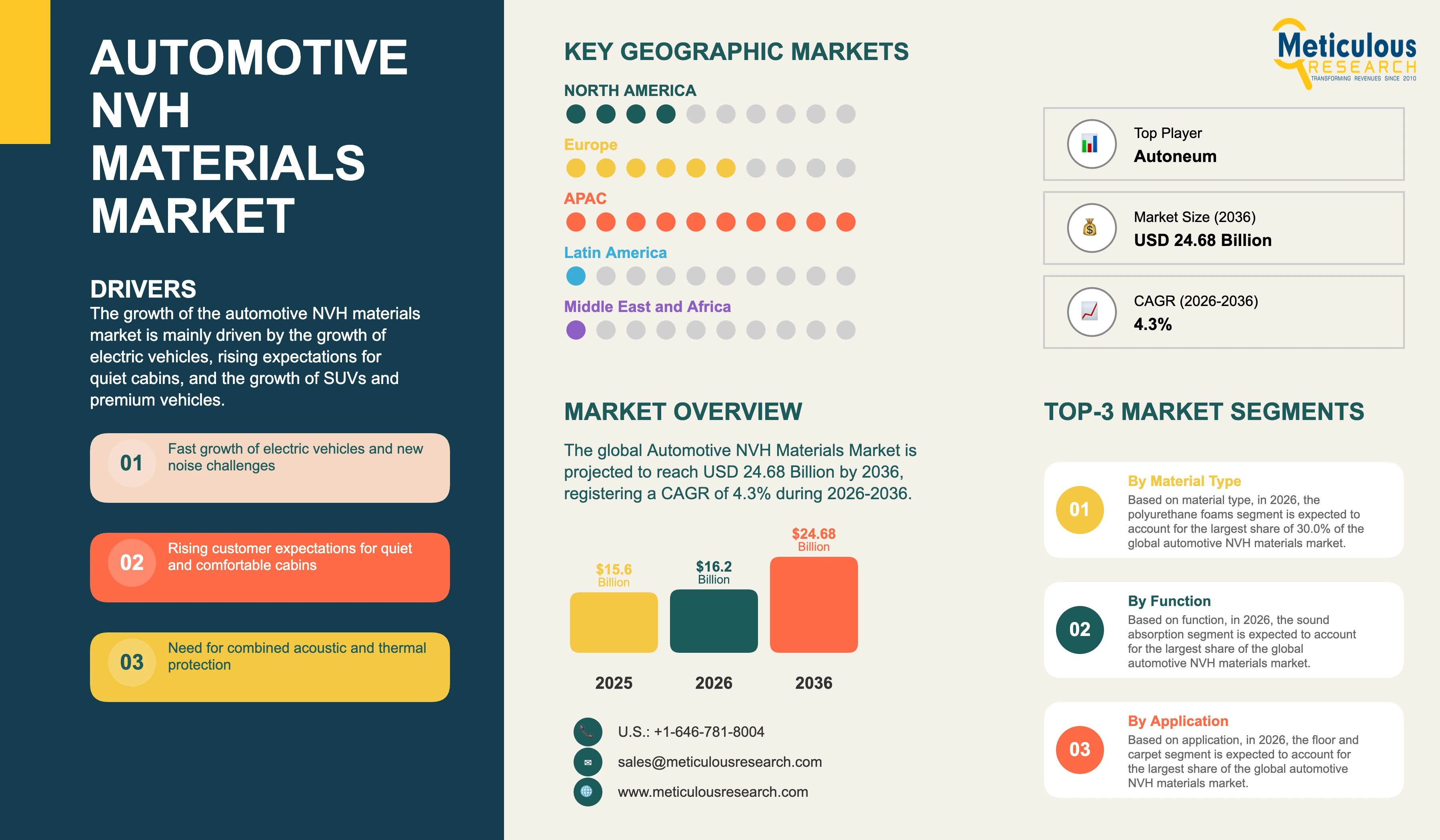
The global automotive NVH materials market was valued at USD 15.60 billion in 2025. This market is expected to reach USD 24.68 billion by 2036 from an estimated USD 16.20 billion in 2026, registering a CAGR of 4.3% during the forecast period (2026-2036).
- Published
- Nov 2026
- Pages
- 263
- Format
- PDF + Excel
- Report ID
- MRAUTO - 1042863
- Base year
- 2025
- 2025 · BASELINE
- $15.60B
- 2036
- $24.68B
- CAGR 2026–2036
- 4.3%
2025 baseline · 2026–2036 forecast at 4.3% CAGR · hover a bar for the value
Key highlights
Autoneum, a global leader in automotive acoustic and thermal management, reported 2025 revenue of CHF 2,290.6 million, or CHF 2,393.3 million in local currencies, up 2.3%, according to Autoneum. Its Asia revenue grew by 73.9% in local currencies to CHF 326.4 million, driven by two acquisitions in China, including a majority stake in Jiangsu Huanyu Group.
Autoneum agreed in November 2026 to acquire France's Trèves Group, a supplier of automotive acoustic and thermal insulation, interior trim, and trunk solutions, for up to €64 million, according to Just Auto. Trèves employs about 4,600 people at 26 production sites in 15 countries and generated about €720 million in revenue in 2025, and the combined company is expected to have pro forma revenue of more than CHF 2.9 billion in 2026.
Global electric car sales grew by 20% to more than 20 million units in 2025, accounting for one in four new cars sold, according to the IEA. Electric vehicles lack engine noise, which makes road noise, wind noise, and the high-pitched whine of electric motors and gearboxes more noticeable, increasing the need for NVH materials in floors, wheel arches, and around electric drive units.
Vehicle makers are moving from heavy bitumen damping pads to lighter liquid-applied sound deadeners that are sprayed by robots, and from heavy barrier layers to lighter multi-layer absorber systems, to reduce weight while keeping acoustic performance.
Recycled PET fibers, recycled cotton, and other recycled materials are increasingly used in automotive NVH parts, as vehicle makers set targets for recycled content and lower carbon footprints. Autoneum, Adler Pelzer, Trèves, and other suppliers offer acoustic parts made largely from recycled fibers.
Leading suppliers include Autoneum, Adler Pelzer Group, Trèves Group, Sika, Henkel, 3M, BASF, Dow, Huntsman, Nitto Denko, Freudenberg Performance Materials, Zhuzhou Times New Material, and Ningbo Tuopu Group. Its business groups in Europe and North America generated CHF 1,057.1 million and CHF 805.8 million in revenue, respectively, in 2025, according to the company.
By material type, polyurethane foams account for the largest share of 30.0% in 2026, while liquid-applied sound deadeners register the highest CAGR.
By function, sound absorption accounts for the largest share in 2026, while combined acoustic and thermal protection registers the highest CAGR.
By application, floor and carpet accounts for the largest share in 2026, while battery and e-drive encapsulation registers the highest CAGR.
By propulsion type, internal combustion engine vehicles account for the largest share of 52.0% in 2026, while battery electric vehicles register the highest CAGR.
By geography, Asia-Pacific accounts for the largest share of 46.0% in 2026, while Asia-Pacific registers the highest CAGR of 5.5%.
Report summary
| Particulars | Details |
|---|---|
| Forecast Period | 2026-2036 |
| Base Year | 2025 |
| Estimated Year | 2026 |
| CAGR (Value) | 4.3% |
| Format | PDF, Excel & Cloud Portal · 263 pages |
| Market Size (Value) in 2025 | USD 15.60 billion |
| Market Size (Value) in 2026 | USD 16.20 billion |
| Market Size (Value) by 2036 | USD 24.68 billion |
| Largest Segment by Material Type (2026) | Polyurethane Foams (30.0%) |
| Largest Segment by Propulsion Type (2026) | Internal Combustion Engine Vehicles (52.0%) |
| Largest Region (2026) | Asia-Pacific (46.0%) |
| Fastest-Growing Region | Asia-Pacific (CAGR 5.5%) |
| Key Companies | 13 companies and other companies |
| Segments Covered | Material Type, Function, Application, Propulsion Type, Geography |
| Countries Covered | U.S., Canada, Germany, France, Spain, Italy, U.K., Sweden, Czech Republic, Slovakia, Poland, Hungary, Romania, Belgium, Rest of Europe, China, Japan, India, South Korea, Thailand, Indonesia, Malaysia, Vietnam, Taiwan, Australia, Rest of Asia-Pacific, Mexico, Brazil, Argentina, Colombia, Chile, Rest of Latin America, Turkey, Morocco, South Africa, Saudi Arabia, Egypt, Iran, Rest of Middle East & Africa |
Report overview
Segments covered: material type, function, application, propulsion type.
Automotive NVH (noise, vibration, and harshness) materials are the foams, fibrous materials, nonwovens, barrier layers, damping materials, and sprayable sound deadeners used to absorb sound, block noise, and reduce vibration in vehicles. They are used in floors and carpets, dash panels, engine bays, underbodies, doors, roofs, pillars, trunks, wheel arches, and, in electric vehicles, around battery packs and electric drive units.
The growth of this market is mainly driven by the fast growth of electric vehicles, which are much quieter than combustion engine vehicles and make road, wind, and electric motor noise more noticeable, rising customer expectations for quiet and comfortable cabins, the growth of premium vehicles and SUVs, stricter vehicle exterior noise rules, and the need for materials that combine acoustic and thermal protection for battery packs and electric motors. In addition, the shift to lighter and more sustainable materials, such as recycled fibers and sprayable sound deadeners, is creating new demand. However, the need to reduce vehicle weight and cost, volatile raw material prices, and the loss of some engine bay insulation in electric vehicles are expected to restrain the growth of this market to some extent.
Noise, vibration, and harshness are key measures of vehicle comfort and quality. Noise comes from the engine or electric motor, gearbox, tires, road, wind, and auxiliary systems, such as pumps and fans, and enters the cabin through the air and through the vehicle structure. Vibration comes from the powertrain, road, and wheels and is transmitted through the body. Vehicle makers use NVH materials to absorb sound waves, block sound from entering the cabin, and damp vibrations in body panels, so that occupants experience a quiet and comfortable ride.
This report covers the global automotive NVH materials market, including polyurethane foams, fibrous materials and nonwovens, rubber and EVA barrier layers, bitumen-based damping materials, liquid-applied sound deadeners, and other materials used in passenger cars and commercial vehicles. The market is valued at the selling price of NVH materials and of molded and cut NVH parts made from these materials, such as carpet underlays, dash insulators, wheel arch liners, headliner absorbers, and battery and motor encapsulations. The market is analyzed by material type, function, application, propulsion type, and geography. Anti-vibration rubber mounts, bushings, and dampers used in the chassis and powertrain are not included.
NVH materials work in three main ways to keep noise and vibration away from occupants. Sound absorbers, such as polyurethane foams and fibrous felts, convert sound energy into heat inside their porous structure, reducing echoes and noise levels in the cabin and engine bay. Sound barriers, such as heavy layers of EVA or rubber, block sound from passing through panels, especially in the dash and floor. Vibration dampers, such as bitumen pads and liquid-applied sound deadeners, reduce the vibration of thin metal panels, which would otherwise act like loudspeakers. Many modern NVH parts combine several of these functions in one multi-layer part.
A typical passenger car contains 20 to 40 kilograms of NVH materials, depending on vehicle size and class. Premium vehicles use more and higher-performing materials to achieve very low noise levels, while lower-priced vehicles use fewer materials to save cost. NVH parts are designed specifically for each vehicle model using acoustic simulation and testing, and NVH suppliers work closely with vehicle makers from the early stages of design.
The market includes specialist acoustic part makers, such as Autoneum, Adler Pelzer Group, and Trèves Group, makers of damping materials, sealants, and adhesives, such as Sika, Henkel, and 3M, chemical companies that supply polyurethane systems and foams, such as BASF, Dow, and Huntsman, and makers of nonwovens and specialty materials, such as Freudenberg Performance Materials and Nitto Denko. Chinese suppliers, such as Zhuzhou Times New Material and Ningbo Tuopu Group, have grown quickly with Chinese vehicle production. The industry is consolidating, as shown by Autoneum's acquisitions in China and its planned acquisition of Trèves.
Electric vehicles are changing NVH requirements and the mix of materials vehicle makers use. Without engine noise, other sounds become more noticeable, including tire and road noise, wind noise, and the high-frequency whine of electric motors, gearboxes, and power electronics. Vehicle makers are using more NVH materials in floors, wheel arches, and around electric drive units to address these sounds. Battery packs also need materials that combine acoustic and thermal protection, and some NVH materials also provide fire protection. At the same time, electric vehicles do not need as much engine bay insulation, which reduces demand in that area.
In 2026, polyurethane foams account for the largest share of the market by material type, while liquid-applied sound deadeners are the fastest-growing material type. Sound absorption accounts for the largest share by function, while combined acoustic and thermal protection is the fastest-growing function. Floor and carpet applications account for the largest share by application, while battery and e-drive encapsulation is the fastest-growing application. Internal combustion engine vehicles account for the largest share by propulsion type, while battery electric vehicles are the fastest-growing propulsion type. Asia-Pacific accounts for the largest share of the market and is also the fastest-growing region.
Market growth over the forecast period will depend on global vehicle production, the pace of electric vehicle adoption, customer expectations for cabin comfort, and the balance between NVH performance and weight and cost. Raw material prices, such as those for polyurethane chemicals, polymers, and fibers, will also affect the market. Overall, the growth of electric vehicles and rising comfort expectations are expected to drive steady growth in NVH material content per vehicle, especially in Asia-Pacific.
Internal combustion engine vehicles are expected to account for the largest share of 52.0% of the market in 2026, while battery electric vehicles are projected to register the highest CAGR, driven by the need to control road and motor noise in quiet cabins.
Asia-Pacific is expected to account for the largest share of 46.0% of the market in 2026, mainly due to China's large vehicle and electric vehicle production and the focus of Chinese vehicle makers on quiet cabins.
Asia-Pacific is also projected to register the highest CAGR of 5.5% during the forecast period, driven by vehicle and electric vehicle growth in China, India, and Southeast Asia and rising comfort expectations.
The report profiles 13 companies, including Autoneum, Adler Pelzer, Trèves, Sika, Henkel, 3M, BASF, Dow, Huntsman, Nitto Denko, Freudenberg Performance Materials, Zhuzhou Times New Material, and Ningbo Tuopu Group.
Electric vehicles lack engine noise, which makes road, wind, and electric motor noise more noticeable, so vehicle makers add more floor, wheel arch, and e-drive insulation, while needing less engine bay insulation.
Liquid-applied sound deadeners are sprayed by robots only where needed, replacing heavy bitumen pads placed by hand, which reduces weight and labor costs while improving damping performance.
Report infographic
Market dynamics
17 factors across 5 forcesFast growth of electric vehicles and new noise challenges
Electric vehicles are much quieter than combustion engine vehicles at low speeds because they have no engine noise, but this makes other noises more noticeable to occupants. Road and tire noise, wind noise, and the high-frequency whine of electric motors, reduction gearboxes, and inverters can be annoying in a quiet cabin. Electric vehicles also tend to be heavier and use larger tires, which can increase road noise. Vehicle makers are therefore adding NVH materials in floors, wheel arches, doors, and around electric drive units to keep cabins quiet.
Global electric car sales grew by 20% to more than 20 million units in 2025, according to the IEA. As electric vehicle production grows, demand for NVH materials designed for electric vehicles is expected to grow faster than the overall market. Battery electric vehicles are the fastest-growing propulsion type in this market, and battery and e-drive encapsulation is the fastest-growing application, as vehicle makers wrap electric motors and gearboxes in acoustic materials.
Rising customer expectations for quiet and comfortable cabins
Customers increasingly see a quiet cabin as a sign of quality, and vehicle makers compete on noise levels in reviews and advertising. This is true not only for premium vehicles but also for mass-market vehicles, as customers in China and other markets expect high comfort levels. Vehicle makers are setting lower noise targets for new models and using more and better NVH materials to meet them.
Chinese vehicle makers in particular have raised the bar for cabin comfort, offering quiet and well-equipped vehicles at competitive prices. This is pushing global vehicle makers to improve NVH performance in their own vehicles. Rising comfort expectations increase the amount and value of NVH materials per vehicle, supporting market growth even where vehicle production grows slowly.
Growth of SUVs and premium vehicles
SUVs and premium vehicles use more NVH materials than small cars because they are larger, have more surface area to insulate, and are expected to offer higher comfort. SUVs have become the most popular vehicle type in many markets, including the U.S., Europe, and China, and the share of premium vehicles is growing in emerging markets as incomes rise. Larger wheels and tires on SUVs also increase road noise, requiring more insulation in wheel arches and floors.
This shift in vehicle mix increases the average amount of NVH materials per vehicle. Premium and electric SUVs, in particular, use multi-layer absorbers, heavy barriers, acoustic glass, and extensive underbody and wheel arch insulation to achieve very low noise levels. NVH suppliers with strong engineering capabilities benefit from this trend, as premium vehicles need more complex and higher-value parts.
Need for combined acoustic and thermal protection
Electric vehicle battery packs and electric drive units need protection from heat and cold to operate efficiently and safely, and some materials can provide both acoustic and thermal protection at the same time. Battery packs may use insulation to keep the battery warm in cold weather and to slow the spread of heat in a thermal runaway event, while electric motors and gearboxes may be wrapped in materials that reduce both noise and heat losses.
Combining acoustic and thermal functions in one material saves space, weight, and cost compared with separate materials. NVH suppliers, such as Autoneum, Adler Pelzer, and Trèves, which describe themselves as specialists in both acoustic and thermal management, are developing these combined solutions. Combined acoustic and thermal protection is the fastest-growing function in this market.
Stricter vehicle noise regulations
Regulations in Europe and other regions set limits on the exterior noise that vehicles can make when driving, and these limits have become stricter over time under UNECE rules. To meet these limits, vehicle makers use NVH materials in the engine bay, underbody, and wheel arches to reduce the noise that escapes from the vehicle. At the same time, electric vehicles must make artificial sounds at low speeds to warn pedestrians, which changes how vehicle makers manage noise in and around the vehicle. Commercial vehicles, such as trucks and buses, also face exterior noise limits and are adding NVH materials to meet them. These regulations support demand for NVH materials, especially in Europe, where rules are strictest. As other regions adopt similar rules, demand for exterior noise reduction materials is expected to grow, and NVH suppliers that can help vehicle makers meet both interior comfort targets and exterior noise limits with light materials are expected to gain business.
Table of contents
12 chapters · 179 sections · 263 pages · click to expandSegmental analysis
| Segment | Largest share (2026) | Fastest growth (2026–2036) |
|---|---|---|
| By Material Type | Sound absorption | Combined acoustic and thermal protection |
By Material Type
- The sound absorption segment is expected to account for the largest share of the automotive NVH materials market, while the combined acoustic and thermal protection segment is projected to register the highest CAGR during the forecast period.
- The floor and carpet segment is expected to account for the largest share of the automotive NVH materials market, while the battery and e-drive encapsulation segment is projected to register the highest CAGR during the forecast period.
Geographic analysis
Asia-Pacific
Largest shareIn 2026, Asia-Pacific is expected to account for the largest share of 46.0% of the global automotive NVH materials market. The large share of this region is mainly due to China's position as the largest vehicle producer in the world, China's leadership in electric vehicle production, the high comfort expectations of Chinese vehicle buyers and the focus of Chinese vehicle makers on quiet cabins, the large vehicle production of Japan, India, and South Korea, and the presence of leading suppliers, such as Zhuzhou Times New Material, Ningbo Tuopu Group, and Nitto Denko, as well as global suppliers with plants in the region. Autoneum has expanded in China through two acquisitions, according to Autoneum. Asia-Pacific is also projected to register the highest CAGR of 5.5% during the forecast period. The rapid growth of this region is mainly driven by continued growth of vehicle and electric vehicle production in China, the fast growth of vehicle production in India, the growth of vehicle production in Indonesia, Vietnam, Thailand, and Malaysia, including by Chinese electric vehicle makers, and rising comfort expectations in emerging Asian markets. Autoneum's Asia revenue grew by 73.9% in local currencies in 2025, according to Autoneum, which shows the importance of the region for NVH suppliers.
Europe
Europe accounts for a significant share of the market, supported by the production of premium and electric vehicles with high NVH requirements, strict exterior noise rules under UNECE regulations, strong demand for recycled and sustainable materials, and the presence of leading suppliers, such as Autoneum, Adler Pelzer, Trèves, Sika, Henkel, BASF, and Freudenberg Performance Materials. Autoneum generated revenue of CHF 1,057.1 million in Europe in 2025, according to Autoneum. However, slow growth of vehicle production in Western Europe is expected to limit growth in the region, and suppliers are consolidating to improve their positions. Autoneum's planned acquisition of Trèves, a French supplier with 26 plants in 15 countries, will make it an even larger player in Europe. European vehicle makers are also among the leaders in using recycled fibers and lower-carbon materials in acoustic parts, which supports demand for new materials in the region.
North America
North America accounts for a large share of the market, supported by the production of large pickup trucks and SUVs that use many NVH materials, high comfort expectations, and the presence of Autoneum, Adler Pelzer, 3M, Dow, Huntsman, and other suppliers. Autoneum generated revenue of CHF 805.8 million in North America in 2025, according to Autoneum.
Latin America
Latin America and the Middle East & Africa account for smaller shares, with growth supported by vehicle production in Brazil, Mexico, Argentina, Turkey, and Morocco and new plants built by Chinese vehicle makers in Brazil and Turkey. Large pickup trucks and SUVs in North America use more NVH materials per vehicle than smaller cars, which supports high content per vehicle in the region. Growing electric vehicle production in Mexico and Brazil is expected to add demand for floor and e-drive insulation over the forecast period.
Competitive landscape
The global automotive NVH materials market includes specialist acoustic part makers, makers of damping materials, sealants, and adhesives, chemical companies that supply polyurethane systems and foams, and makers of nonwovens and specialty materials. The acoustic parts market is moderately concentrated, with a few large global suppliers and many regional suppliers, while the materials market includes large chemical companies with broad product ranges.
Autoneum is the global market and technology leader in automotive acoustic and thermal management, with 2025 revenue of CHF 2,290.6 million, according to Autoneum. Adler Pelzer Group and Trèves Group are other major acoustic part makers, and Autoneum agreed to acquire Trèves in November 2026. Sika, Henkel, and 3M supply damping materials, sealants, and adhesives, BASF, Dow, and Huntsman supply polyurethane systems, and Freudenberg Performance Materials and Nitto Denko supply nonwovens and specialty materials. Zhuzhou Times New Material and Ningbo Tuopu Group are leading Chinese suppliers.
Companies in this market compete on acoustic performance, weight, cost, engineering support for new vehicle programs, global production close to vehicle plants, and the use of recycled and sustainable materials. Key strategies include developing solutions for electric vehicles, such as e-drive encapsulation and combined acoustic and thermal protection, lighter materials, such as liquid-applied sound deadeners and multi-layer absorbers, recycled materials, expanding in Asia-Pacific, and consolidating through acquisitions.
Recent competitive activity in the automotive NVH materials market has focused on consolidation and expansion in Asia. Autoneum acquired a majority stake in Jiangsu Huanyu Group and another company in China, and in November 2026 it agreed to acquire Trèves for up to €64 million, creating a combined company with pro forma revenue of more than CHF 2.9 billion, according to Just Auto. Suppliers are also launching new solutions for electric vehicles and recycled materials.
We expect competition and consolidation to continue over the forecast period as suppliers seek scale, as Chinese suppliers expand abroad, and as vehicle makers push for lower prices and lighter materials. Suppliers with strong engineering capabilities, global production networks, and solutions for electric vehicles and sustainability are expected to strengthen their positions, while weaker suppliers may be acquired or restructured.
Some of the key players operating in the automotive NVH materials market are Autoneum Holding AG, Adler Pelzer Group, Trèves Group, Sika AG, Henkel AG & Co. KGaA, 3M Company, BASF SE, Dow Inc., Huntsman Corporation, Nitto Denko Corporation, Freudenberg Performance Materials, Zhuzhou Times New Material Technology Co., Ltd., and Ningbo Tuopu Group Co., Ltd., among others.
- —
Autoneum reported 2025 revenue of CHF 2,290.6 million with strong growth in Asia after two acquisitions in China, and in November 2026 it agreed to acquire Trèves Group for up to €64 million, creating a company with more than CHF 2.9 billion in pro forma revenue.
- Autoneum Holding AG
- Adler Pelzer Group
- Trèves Group
- Sika AG
- Henkel AG & Co. KGaA
- 3M Company
- BASF SE
- Dow Inc.
- Huntsman Corporation
- Nitto Denko Corporation
- Freudenberg Performance Materials
- Zhuzhou Times New Material Technology Co., Ltd.
- Ningbo Tuopu Group Co., Ltd.
Expert perspectives
NVH materials are essential for vehicle comfort and quality, and their importance is growing as electric vehicles make cabins quieter and expose new sources of noise. The market is closely linked to vehicle production, but NVH content per vehicle is rising as customers expect quieter cabins and as electric vehicles need new solutions for road noise, motor whine, and battery insulation.
Over the forecast period, the market is expected to grow at a CAGR of 4.3%, from USD 16.20 billion in 2026 to USD 24.68 billion in 2036. Growth will be driven by the growth of electric vehicles, rising comfort expectations, the growth of SUVs and premium vehicles, the need for combined acoustic and thermal protection, and stricter vehicle noise rules.
Among the market segments, polyurethane foams are the largest material type, while liquid-applied sound deadeners grow fastest. Sound absorption is the largest function, while combined acoustic and thermal protection grows fastest. Floor and carpet applications are the largest application, while battery and e-drive encapsulation grows fastest. Internal combustion engine vehicles are the largest propulsion type, while battery electric vehicles grow fastest. Asia-Pacific is both the largest and the fastest-growing region, at a CAGR of 5.5%.
In our view, the shift to electric vehicles is a net positive for NVH materials. While electric vehicles need less engine bay insulation, they need more insulation in floors, wheel arches, and around electric drive units, as well as combined acoustic and thermal solutions for batteries. NVH suppliers that develop effective and light solutions for electric vehicles are expected to gain share.
We also see weight and cost pressure as a key challenge, which is driving the shift from heavy barriers and bitumen pads to lighter absorbers and liquid-applied sound deadeners. Consolidation in the industry, led by Autoneum, is likely to continue as suppliers seek scale and access to Chinese vehicle makers. Suppliers that can combine strong engineering with low costs and sustainable materials will be best placed to win business. We also expect more partnerships between acoustic part makers and chemical companies to develop new lightweight and recycled materials, as well as much stronger ties with Chinese vehicle makers to win new electric vehicle programs.
Overall, we believe the automotive NVH materials market will grow steadily over the forecast period, with liquid-applied sound deadeners, combined acoustic and thermal protection, battery and e-drive encapsulation, battery electric vehicles, and Asia-Pacific providing the fastest growth. Companies with strong acoustic engineering, lightweight and sustainable materials, and strong positions with Chinese and global vehicle makers will be best positioned to capture this growth.
Customer perspectives
“Our customers expect a very quiet cabin, even in our lower-priced models. Without engine noise, the motor whine and road noise stand out, so we now wrap the e-drive and add more floor and wheel arch insulation.”
“We are replacing bitumen pads with sprayed sound deadeners in our new paint shop. It saves weight and labor, and the damping is better where we need it.”
“Our trucks still use a lot of foam and barrier in the dash and floor, and our battery packs need insulation that does both acoustic and thermal work.”
Frequently asked questions
The global automotive NVH materials market was valued at USD 15.60 billion in 2025, up from USD 15.15 billion in 2024, and is estimated at USD 16.20 billion in 2026. The market includes foams, fibrous materials, barrier layers, damping materials, and sprayable sound deadeners and the NVH parts made from them.
The global automotive NVH materials market is expected to reach USD 24.68 billion by 2036, driven by the growth of electric vehicles, rising comfort expectations, the growth of SUVs and premium vehicles, and the need for combined acoustic and thermal protection.
The market is expected to register a CAGR of 4.3% from 2026 to 2036, with the fastest growth in liquid-applied sound deadeners, combined acoustic and thermal protection, battery and e-drive encapsulation, battery electric vehicles, and Asia-Pacific.
Market growth is mainly driven by the fast growth of electric vehicles and new noise challenges, rising expectations for quiet cabins, the growth of SUVs and premium vehicles, the need for combined acoustic and thermal protection, and stricter vehicle noise rules.
Pressure to reduce vehicle weight and cost and volatile raw material prices and less engine bay insulation restrain growth, while balancing acoustic performance, weight, and cost and industry consolidation and financial pressure are key challenges.
Key growth opportunities include battery and e-drive encapsulation, liquid-applied sound deadeners and lightweight damping, recycled and sustainable NVH materials, and growth in Asia-Pacific and with Chinese vehicle makers.
Polyurethane foams are expected to account for the largest share of 30.0% of the market in 2026, while liquid-applied sound deadeners are projected to register the highest CAGR, driven by weight savings and automation.
In 2026, the sound absorption segment is expected to account for the largest share of the automotive NVH materials market, while the combined acoustic and thermal protection segment is projected to register the highest CAGR during the forecast period.
In 2026, the floor and carpet segment is expected to account for the largest share of the automotive NVH materials market, while the battery and e-drive encapsulation segment is projected to register the highest CAGR during the forecast period.
Internal combustion engine vehicles are expected to account for the largest share of 52.0% of the market in 2026, while battery electric vehicles are projected to register the highest CAGR, driven by the need to control road and motor noise in quiet cabins.
Asia-Pacific is expected to account for the largest share of 46.0% of the market in 2026, mainly due to China's large vehicle and electric vehicle production and the focus of Chinese vehicle makers on quiet cabins.
Asia-Pacific is also projected to register the highest CAGR of 5.5% during the forecast period, driven by vehicle and electric vehicle growth in China, India, and Southeast Asia and rising comfort expectations.
The report profiles 13 companies, including Autoneum, Adler Pelzer, Trèves, Sika, Henkel, 3M, BASF, Dow, Huntsman, Nitto Denko, Freudenberg Performance Materials, Zhuzhou Times New Material, and Ningbo Tuopu Group.
Autoneum reported 2025 revenue of CHF 2,290.6 million with strong growth in Asia after two acquisitions in China, and in November 2026 it agreed to acquire Trèves Group for up to €64 million, creating a company with more than CHF 2.9 billion in pro forma revenue.
Electric vehicles lack engine noise, which makes road, wind, and electric motor noise more noticeable, so vehicle makers add more floor, wheel arch, and e-drive insulation, while needing less engine bay insulation.
Liquid-applied sound deadeners are sprayed by robots only where needed, replacing heavy bitumen pads placed by hand, which reduces weight and labor costs while improving damping performance.
Cite this report
Meticulous Research. (2026). Automotive NVH Materials Market - Global Opportunity Analysis and Industry Forecast (2026-2036) (Report No. MRAUTO - 1042863). Meticulous Market Research Pvt. Ltd. https://www.meticulousresearch.com/product/automotive-nvh-materials-market-7546