Automotive E-Fuses and Solid-State Power Switching Market (2026-2036)
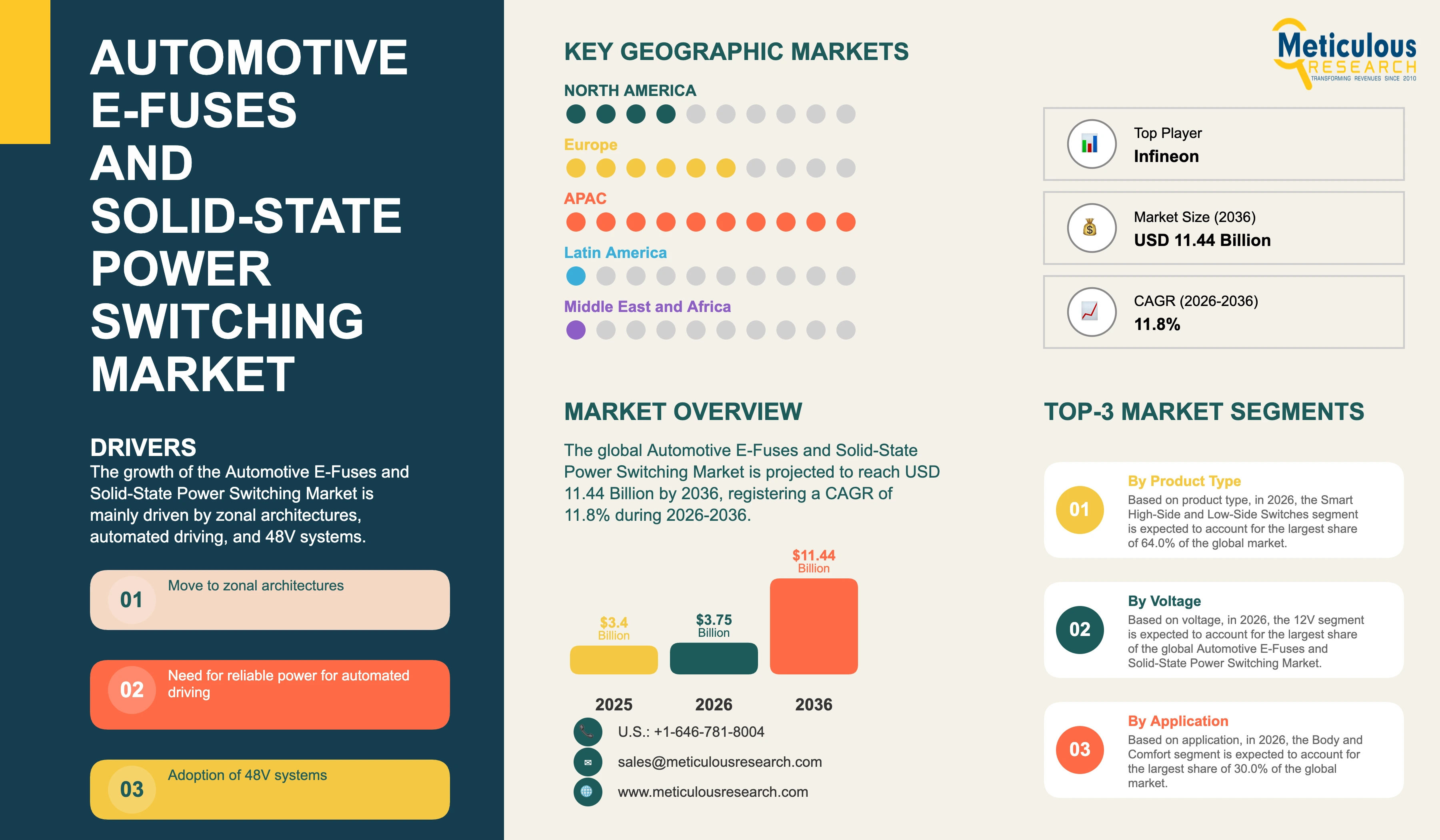
The global automotive e-fuses and solid-state power switching market was valued at USD 3.40 billion in 2025. This market is expected to reach USD 11.44 billion by 2036 from an estimated USD 3.75 billion in 2026, registering a CAGR of 11.8% during the forecast period (2026-2036).
- Published
- Nov 2026
- Pages
- 280
- Format
- PDF + Excel
- Report ID
- MRAUTO - 1042881
- Base year
- 2025
- 2025 · BASELINE
- $3.40B
- 2036
- $11.44B
- CAGR 2026–2036
- 11.8%
2025 baseline · 2026–2036 forecast at 11.8% CAGR · hover a bar for the value
Key highlights
Infineon launched the SPOC Wire Guard BTS80009, a 12V automotive eFuse with an SPI interface that combines a protected high-side switch with integrated wire protection, software configurability, and advanced diagnostics, as the first member of a new smart power switch family, according to Infineon. Four variants cover currents up to 34.5A, and three further variants are planned by the end of 2026.
Infineon points to fail-operational power supply requirements for automated driving, from level 2++ up to level 5, as a key driver of demand for automotive eFuses, as these systems must keep critical loads powered even when a fault occurs elsewhere in the vehicle.
STMicroelectronics introduced the VNF1248F automotive e-fuse MOSFET controller, part of its STi2Fuse family of smart switches for wire harness protection and dynamic power distribution, according to STMicroelectronics. The device is suitable for 12V, 24V, and 48V systems and handles power distribution in zonal vehicle electrical architectures, as well as general fuse and relay replacement.
Tesla's Cybertruck, launched in 2023, uses a 48V low-voltage architecture, and several other vehicle makers are developing 48V and zonal architectures that rely on electronic power distribution with e-fuses and smart switches instead of traditional fuse boxes.
Global electric car sales topped 20 million units in 2025, according to the IEA, and the IEA expects sales of about 23 million units in 2026. Electric vehicles use more electronic loads and high-voltage systems than combustion engine vehicles, which increases the content of smart switches, e-fuses, and solid-state switches per vehicle. Many new electric vehicle platforms are also the first to adopt zonal architectures.
Leading suppliers include Infineon, STMicroelectronics, NXP Semiconductors, Texas Instruments, onsemi, Renesas, ROHM, Toshiba, Littelfuse, and Nexperia. eFuse ICs are the fastest-growing product type, and zonal and power distribution is the fastest-growing application, as vehicle makers replace fuse boxes and relays with zone controllers in new platforms. 48V devices are the fastest-growing voltage segment. Body and comfort is the largest application today, led by body control modules.
By product type, smart high-side and low-side switches account for the largest share of 64.0% in 2026, while eFuse ICs register the highest CAGR.
By voltage, 12V accounts for the largest share in 2026, while 48V registers the highest CAGR.
By application, body and comfort accounts for the largest share of 30.0% in 2026, while zonal and power distribution registers the highest CAGR.
By propulsion type, internal combustion engine vehicles account for the largest share in 2026, while battery electric vehicles register the highest CAGR.
By geography, Asia-Pacific accounts for the largest share of 48.0% in 2026, while Asia-Pacific registers the highest CAGR of 12.8%.
Report summary
| Particulars | Details |
|---|---|
| Base Year | 2025 |
| Estimated Year | 2026 |
| Forecast Period | 2026-2036 |
| Market Size in 2025 | USD 3.40 billion |
| Market Size in 2026 | USD 3.75 billion |
| Market Size by 2036 | USD 11.44 billion |
| CAGR (2026-2036) | 11.8% |
| Format | PDF, Excel & Cloud Portal · 280 pages |
| Largest Segment by Product Type (2026) | Smart High-Side and Low-Side Switches (64.0%) |
| Largest Segment by Application (2026) | Body and Comfort (30.0%) |
| Largest Region (2026) | Asia-Pacific (48.0%) |
| Fastest-Growing Region | Asia-Pacific (CAGR 12.8%) |
| Companies Profiled | 10 companies and other companies |
| Segments Covered | Product Type, Voltage, Application, Propulsion Type, Geography |
| Countries Covered | U.S., Canada, Germany, France, U.K., Spain, Italy, Czech Republic, Poland, Hungary, Romania, Sweden, Austria, Netherlands, Rest of Europe, China, Japan, South Korea, India, Thailand, Indonesia, Malaysia, Vietnam, Philippines, Taiwan, Australia, Rest of Asia-Pacific, Mexico, Brazil, Argentina, Colombia, Chile, Rest of Latin America, Turkey, Morocco, South Africa, Saudi Arabia, UAE, Israel, Rest of Middle East & Africa |
Report overview
Segments covered: product type, voltage, application, propulsion type.
Automotive e-fuses and solid-state power switches are semiconductor devices that switch and protect electrical loads in vehicles, replacing or supplementing traditional melting fuses and electromechanical relays. They include smart high-side and low-side switches with built-in protection and diagnostics, eFuse ICs that cut power within microseconds when they detect a fault and can be reset and configured by software, and high-voltage solid-state switches and relays used in 400V and 800V systems.
The growth of this market is mainly driven by the move to zonal electrical architectures and software-defined vehicles, which replace fuse boxes and relays with smart power distribution controlled by software, the growing number of electronic loads and control units in vehicles, the need for reliable and redundant power supply for driver assistance and automated driving, the adoption of 48V low-voltage systems, which require new protection devices, and the growth of electric vehicles, which use solid-state switching in high-voltage systems. In addition, the need to reduce wiring harness weight and cost is encouraging vehicle makers to use e-fuses, which allow thinner wires. However, the higher cost of e-fuses compared with melting fuses, the long development cycles of new electrical architectures, and price pressure on semiconductors are expected to restrain the growth of this market to some extent.
Every vehicle uses many fuses and relays to protect wires and switch electrical loads, such as lights, motors, heaters, pumps, and control units. Traditional melting fuses protect wires by melting when current is too high, but they must be replaced after a fault, they react slowly, and they require thicker wires to allow for their tolerances. Electromechanical relays switch loads but are large, wear out over time, and cannot provide diagnostics. Smart semiconductor switches and e-fuses replace these parts with devices that switch quickly, protect wires precisely, report their status, and can be reset and controlled by software.
This report covers the global automotive e-fuses and solid-state power switching market, including smart high-side and low-side switches, eFuse ICs, and high-voltage solid-state switches and relays, for 12V, 48V, and high-voltage (400V and 800V) systems, used in body and comfort, zonal and power distribution, lighting, powertrain and battery management, and ADAS and chassis applications, in internal combustion engine, hybrid, and battery electric vehicles. The market is valued at the selling price of these semiconductor devices and modules supplied to vehicle makers and their suppliers. The market is analyzed by product type, voltage, application, propulsion type, and geography. Traditional melting fuses, electromechanical relays and contactors, and discrete MOSFETs sold without integrated protection are not included.
Smart high-side and low-side switches, such as Infineon's PROFET family, have been used in vehicles for many years to switch loads, such as lights and motors, with built-in protection against short circuits and overheating. eFuse ICs go further by protecting the wire as well as the load, using precise current sensing and wire protection models to cut power within microseconds when a fault occurs, and allowing the protection level to be set by software. This allows vehicle makers to use thinner and lighter wires and to replace fuse boxes with electronic power distribution units.
The move to zonal architectures is the main driver of change in this market. In traditional vehicles, power is distributed through a central fuse box and many relays, with long wires to each load. In zonal architectures, power is distributed through zone controllers placed around the vehicle, which use e-fuses and smart switches to protect and switch the loads in their zone. This reduces wiring, allows software control of power, and supports software-defined vehicles. Vehicle makers in Europe, China, North America, and Asia are introducing zonal architectures in new vehicle platforms.
High-voltage solid-state switching is also growing as electric vehicles move to higher voltages. Electric vehicles use contactors and pyrotechnic fuses to connect and disconnect the high-voltage battery, and solid-state switches and relays are starting to replace or supplement these parts in some applications, such as battery disconnect, pre-charge, and auxiliary high-voltage loads. Solid-state switches are faster, quieter, and longer-lasting than mechanical contactors, and they can provide diagnostics, although they are more costly and generate more heat at high current.
The market is served by leading automotive semiconductor companies, such as Infineon, STMicroelectronics, NXP Semiconductors, Texas Instruments, onsemi, Renesas, ROHM, Toshiba, and Nexperia, together with circuit protection specialists, such as Littelfuse. These companies supply devices to tier-one suppliers that build zone controllers, power distribution units, and body control modules, and increasingly work directly with vehicle makers that design their own electrical architectures. Infineon and STMicroelectronics are among the leaders in smart power switches and eFuses.
In 2026, smart high-side and low-side switches account for the largest share of the market by product type, while eFuse ICs are the fastest-growing product type. 12V devices account for the largest share by voltage, while 48V devices are the fastest-growing voltage segment. Body and comfort applications account for the largest share by application, while zonal and power distribution applications are the fastest-growing application. Internal combustion engine vehicles account for the largest share by propulsion type, while battery electric vehicles are the fastest-growing propulsion type. Asia-Pacific accounts for the largest share of the market and is also the fastest-growing region.
Market growth over the forecast period will depend on the pace of zonal architecture adoption, the number of electronic loads per vehicle, the adoption of 48V systems, the growth of electric vehicles and automated driving, and semiconductor price trends. Price pressure will limit growth in value per device, but rising content per vehicle is expected to drive strong growth in market value. Overall, the shift from fuses and relays to software-controlled power distribution is expected to be one of the most important changes in vehicle electrical systems through 2036.
Body and comfort applications are expected to account for the largest share of 30.0% of the market in 2026, while zonal and power distribution applications are projected to register the highest CAGR and become the largest application by 2036.
Asia-Pacific is expected to account for the largest share of 48.0% of the market in 2026, mainly due to China's large vehicle production and the fast adoption of new electrical architectures by Chinese vehicle makers.
Asia-Pacific is also projected to register the highest CAGR of 12.8% during the forecast period, driven by zonal architecture adoption in China and rising electronic content in India and Southeast Asia.
The report profiles 10 companies, including Infineon, STMicroelectronics, NXP Semiconductors, Texas Instruments, onsemi, Renesas, ROHM, Toshiba, Littelfuse, and Nexperia.
A smart switch switches a load and protects it against short circuits and overheating, while an eFuse also protects the wire using precise current sensing and wire models, reacts within microseconds, and can be configured by software.
This report covers semiconductor-based e-fuses and solid-state power switches for vehicles only. Traditional melting fuses and broader electric and electronic fuse markets are covered in separate reports.
Report infographic
Market dynamics
17 factors across 5 forcesMove to zonal architectures and software-defined vehicles
Vehicle makers are moving from distributed electrical architectures, with many separate control units and a central fuse box, to zonal architectures, in which zone controllers placed around the vehicle handle power distribution and data for their area. Zonal architectures reduce wiring length and weight, simplify assembly, and allow central software to control and update vehicle functions. They are a key part of software-defined vehicles, which can gain new features through over-the-air updates.
Zone controllers use e-fuses and smart switches to protect and switch loads, replacing traditional fuses and relays. This increases the number of smart semiconductor switches per vehicle and creates a new market for eFuse ICs. STMicroelectronics' VNF1248F e-fuse controller is designed for power distribution in zonal architectures, according to STMicroelectronics. Zonal and power distribution applications are the fastest-growing application in this market.
Growing number of electronic loads and control units
Vehicles contain a growing number of electronic loads, such as electric motors for seats, windows, mirrors, and tailgates, LED lighting, heaters, pumps, fans, displays, sensors, and control units. Each load must be switched and protected, and many need diagnostics to detect faults. Smart switches provide switching, protection, and diagnostics in a single device, which saves space and improves reliability compared with relays and fuses.
Electric vehicles add further loads, such as electric pumps, valves, and heaters for battery and cabin thermal management. Premium vehicles and SUVs have many comfort features that require switching, such as heated and ventilated seats, power tailgates, and ambient lighting. As the number of loads grows, the number of smart switches and e-fuses per vehicle increases, which supports market growth across all vehicle types.
Need for reliable power for automated driving
Driver assistance and automated driving systems, such as automatic emergency braking, lane keeping, and higher levels of automated driving, depend on a reliable power supply to sensors, computers, steering, and braking. A fault in one part of the electrical system must not cut power to these critical systems. Infineon points to fail-operational requirements from level 2++ through level 5 automation as a driver of demand for automotive eFuses.
eFuses can isolate a fault within microseconds and keep the rest of the power network running, which supports redundant and fail-operational power supply designs. Vehicle makers are adding redundant power paths and smart power distribution for safety-critical loads, which increases demand for eFuses and smart switches with functional safety features. ADAS and chassis applications are a fast-growing application segment in this market, supported by the spread of driver assistance features to mainstream vehicles.
Adoption of 48V low-voltage systems
Several vehicle makers are moving from 12V to 48V low-voltage systems, which reduce current, allow thinner and lighter wires, and better support high-power loads, such as electric steering, active suspension, and heaters. Tesla's Cybertruck uses a 48V low-voltage architecture, and other vehicle makers are developing 48V systems for future platforms. Mild hybrid vehicles also use 48V systems, which are widely used in Europe and are growing in China and India.
48V systems require new protection devices, as traditional fuses and relays designed for 12V are less suitable at 48V because of arcing risks when switching. Smart switches and e-fuses designed for 48V, such as STMicroelectronics' VNF1248F, which supports 12V, 24V, and 48V systems, meet this need. 48V devices are the fastest-growing voltage segment in this market.
Growth of electric vehicles and high-voltage systems
Electric vehicles use more smart switches and e-fuses than combustion engine vehicles, as they have more electronic loads, such as thermal management pumps, valves, and heaters, and they need precise control of power to save energy. Global electric car sales topped 20 million units in 2025, according to the IEA. Electric vehicles also have high-voltage systems that use contactors, pyrotechnic fuses, and, increasingly, solid-state switches and relays for battery disconnect, pre-charge, and auxiliary loads. Solid-state switches offer faster switching, longer life, and diagnostics, which support safety and battery management. As electric vehicle production grows and high-voltage systems move to 800V, demand for high-voltage solid-state switches and relays is expected to grow, and battery electric vehicles are the fastest-growing propulsion type in this market. Electric vehicle makers also often adopt new electrical architectures faster than traditional vehicle makers, which further increases e-fuse and smart switch content per vehicle.
Table of contents
12 chapters · 182 sections · 280 pages · click to expandSegmental analysis
| Segment | Largest share (2026) | Fastest growth (2026–2036) |
|---|---|---|
| By Product Type | 12V | 48V |
By Product Type
- The 12V segment is expected to account for the largest share of the automotive e-fuses and solid-state power switching market, while the 48V segment is projected to register the highest CAGR during the forecast period.
- The internal combustion engine vehicles segment is expected to account for the largest share of the automotive e-fuses and solid-state power switching market, while the battery electric vehicles segment is projected to register the highest CAGR during the forecast period.
Geographic analysis
Asia-Pacific
Largest shareIn 2026, Asia-Pacific is expected to account for the largest share of 48.0% of the global automotive e-fuses and solid-state power switching market. The large share of this region is mainly due to China's position as the largest vehicle and electric vehicle producer in the world, the fast adoption of new electrical architectures and electronic features by Chinese vehicle makers, the large vehicle production of Japan, South Korea, and India, and the presence of semiconductor suppliers, such as Renesas, ROHM, and Toshiba in Japan, together with the large Asian operations of Infineon, STMicroelectronics, NXP, Texas Instruments, and onsemi. Chinese semiconductor companies are also developing automotive smart switches and e-fuses, supported by government policies that encourage local semiconductor supply. India and Southeast Asia are growing markets as vehicle production and electronic content per vehicle rise. Asia-Pacific is also projected to register the highest CAGR of 12.8% during the forecast period. The rapid growth of this region is mainly driven by continued growth of vehicle and electric vehicle production in China, the fast adoption of zonal architectures and software-defined vehicle platforms by Chinese vehicle makers, the growth of vehicle production and electronic content in India and Southeast Asia, and the growth of electric vehicles in South Korea and Japan. Chinese vehicle makers are among the fastest to introduce new electrical architectures, which supports demand for e-fuses and smart switches. Japan and South Korea are also gradually adopting zonal architectures in new electric vehicle platforms from Toyota, Hyundai, and other vehicle makers.
Europe
Europe accounts for a significant share of the market, supported by the production of premium vehicles with many electronic features, the early development of zonal architectures by European vehicle makers and tier-one suppliers, strict safety rules that require advanced driver assistance systems, and the presence of leading semiconductor suppliers, such as Infineon, STMicroelectronics, NXP, and Nexperia. Germany is the largest market in the region, supported by vehicle makers such as Volkswagen, BMW, and Mercedes-Benz and suppliers such as Bosch, Continental, and Aptiv, followed by France, Spain, Italy, and Central and Eastern European countries, such as the Czech Republic, Poland, Hungary, and Romania, which are important locations for vehicle, wiring harness, and electronic module production.
North America
North America accounts for a significant share of the market, supported by the production of pickup trucks and SUVs with many electronic features, the early adoption of 48V and zonal architectures by Tesla and other vehicle makers, and the presence of semiconductor suppliers, such as Texas Instruments and onsemi, and circuit protection specialist Littelfuse. Mexico is an important production location for wiring harnesses and electronic modules supplied to vehicle plants in the U.S. and Mexico.
Latin America
Latin America and the Middle East & Africa account for small shares, with growth supported by vehicle production in Brazil, Argentina, Turkey, and Morocco and the rising electronic content of vehicles sold in these markets, as more models offer driver assistance and comfort features.
Competitive landscape
The global automotive e-fuses and solid-state power switching market is led by large automotive semiconductor companies with broad power product portfolios, together with circuit protection specialists and Chinese semiconductor companies. The market is relatively concentrated, as a few European, U.S., and Japanese suppliers hold strong positions in smart switches and e-fuses, and vehicle makers and tier-one suppliers value long-term supply, functional safety support, and complete product families.
Infineon is one of the leading suppliers of smart power switches and e-fuses, with its PROFET smart high-side switch family and its new SPOC Wire Guard eFuse family. STMicroelectronics offers smart switches and e-fuses, including its STi2Fuse family. NXP Semiconductors, Texas Instruments, onsemi, Renesas, ROHM, Toshiba, and Nexperia offer smart switches, eFuse ICs, and related devices, while Littelfuse supplies circuit protection and solid-state switching products for vehicles, including high-voltage applications. Many of these companies also supply microcontrollers and other devices used in zone controllers, which helps them offer complete solutions.
Companies in this market compete on on-resistance and power losses, protection speed and accuracy, diagnostics, functional safety, standby power, package size, cost, software tools, and long-term supply. Key strategies include developing complete eFuse and smart switch families for zonal architectures, 48V devices, and high-voltage solid-state switches, providing software and reference designs, working with vehicle makers and tier-one suppliers on new architectures, and expanding production capacity.
Recent competitive activity has focused on products for zonal architectures and software-defined vehicles. Infineon launched its SPOC Wire Guard BTS80009 eFuse with software configurability and integrated wire protection, with further variants planned by the end of 2026, according to Infineon, and STMicroelectronics introduced its VNF1248F e-fuse controller for 12V, 24V, and 48V zonal power distribution, according to STMicroelectronics.
We expect competition in this market to increase over the forecast period as more semiconductor suppliers develop eFuse ICs, as Chinese semiconductor companies expand in automotive power switches, and as vehicle makers adopt zonal and 48V architectures. Suppliers with complete product families, strong software and functional safety support, low-loss technology, and close relationships with vehicle makers are expected to strengthen their positions, while Chinese suppliers are likely to gain share in China, supported by local vehicle makers and government policies.
Some of the key players operating in the automotive e-fuses and solid-state power switching market are Infineon Technologies AG, STMicroelectronics N.V., NXP Semiconductors N.V., Texas Instruments Incorporated, onsemi, Renesas Electronics Corporation, ROHM Co., Ltd., Toshiba Electronic Devices & Storage Corporation, Littelfuse, Inc., and Nexperia B.V., among others.
- —
Infineon launched its SPOC Wire Guard BTS80009 eFuse with software configurability and integrated wire protection, and STMicroelectronics introduced its VNF1248F e-fuse controller for 12V, 24V, and 48V zonal power distribution.
- Texas Instruments
- Renesas
- ROHM
- Toshiba
- Nexperia
Expert perspectives
Automotive e-fuses and solid-state power switching are at the center of the shift from traditional fuses and relays to software-controlled power distribution. While smart high-side and low-side switches are already widely used, the adoption of zonal architectures, software-defined vehicles, 48V systems, and automated driving is creating fast growth for eFuse ICs and new types of solid-state switches.
Over the forecast period, the market is expected to grow at a CAGR of 11.8%, from USD 3.75 billion in 2026 to USD 11.44 billion in 2036. Growth will be driven by the move to zonal architectures and software-defined vehicles, the growing number of electronic loads, the need for reliable power for automated driving, the adoption of 48V systems, and the growth of electric vehicles and high-voltage systems.
Among the market segments, smart high-side and low-side switches are the largest product type, while eFuse ICs grow fastest. 12V devices are the largest voltage segment, while 48V devices grow fastest. Body and comfort is the largest application, while zonal and power distribution grows fastest. Internal combustion engine vehicles are the largest propulsion type, while battery electric vehicles grow fastest. Asia-Pacific is both the largest and the fastest-growing region, at a CAGR of 12.8%.
In our view, zonal architectures will drive the most important change in this market over the next decade. As vehicle makers replace fuse boxes and relays with zone controllers, the number of e-fuses per vehicle will rise sharply, and zonal and power distribution will become the largest application. Semiconductor suppliers that offer complete eFuse families, software, and functional safety support will gain the most, as vehicle makers prefer to standardize on a few suppliers for each platform.
We also see 48V systems and high-voltage solid-state switching as important growth areas for semiconductor suppliers and module makers. 48V adoption will require new protection devices, and solid-state switches will gradually replace some contactors and pyrotechnic fuses in electric vehicle battery systems. Chinese vehicle makers, which are among the fastest in the world to adopt new architectures, will be a key and growing source of demand and a growing base for Chinese semiconductor suppliers.
Overall, we firmly believe that the automotive e-fuses and solid-state power switching market will grow strongly over the forecast period, with eFuse ICs, 48V devices, zonal and power distribution applications, battery electric vehicles, and Asia-Pacific providing the fastest growth. Companies with complete product families, low-loss technology, strong software and safety support, and close relationships with vehicle makers will be best positioned to capture this growth, while cost pressure and long architecture development cycles remain the main risks.
Customer perspectives
“Our new platform replaces the fuse box with zone controllers. eFuses let us use thinner wires and set protection in software for each vehicle version.”
“Chinese vehicle makers want zonal designs on every new platform. We need eFuses and smart switches with low standby current and strong diagnostics.”
“Body control modules still use dozens of smart switches for seats, windows, and lights. That volume is not going away soon.”
Frequently asked questions
The global automotive e-fuses and solid-state power switching market was valued at USD 3.40 billion in 2025, up from USD 3.00 billion in 2024, and is estimated at USD 3.75 billion in 2026. The market includes smart switches, eFuse ICs, and high-voltage solid-state switches for vehicles.
The global automotive e-fuses and solid-state power switching market is expected to reach USD 11.44 billion by 2036, driven by zonal architectures, software-defined vehicles, 48V systems, automated driving, and electric vehicles.
The market is expected to register a CAGR of 11.8% from 2026 to 2036, with the fastest growth in eFuse ICs, 48V devices, zonal and power distribution applications, battery electric vehicles, and Asia-Pacific.
Market growth is mainly driven by the move to zonal architectures and software-defined vehicles, the growing number of electronic loads, the need for reliable power for automated driving, the adoption of 48V systems, and the growth of electric vehicles and high-voltage systems.
The higher cost compared with fuses and relays and the long development cycles of new electrical architectures restrain growth, while thermal management and power losses and software, functional safety, and cybersecurity complexity are key challenges.
Key growth opportunities include eFuse ICs for zone controllers and power distribution units, 48V smart switches and protection devices, solid-state switching for high-voltage battery systems, and fail-operational power for automated driving.
Smart high-side and low-side switches are expected to account for the largest share of 64.0% of the market in 2026, while eFuse ICs are projected to register the highest CAGR, driven by zonal architectures.
In 2026, the 12V segment is expected to account for the largest share of the automotive e-fuses and solid-state power switching market, while the 48V segment is projected to register the highest CAGR during the forecast period.
Body and comfort applications are expected to account for the largest share of 30.0% of the market in 2026, while zonal and power distribution applications are projected to register the highest CAGR and become the largest application by 2036.
In 2026, the internal combustion engine vehicles segment is expected to account for the largest share of the automotive e-fuses and solid-state power switching market, while the battery electric vehicles segment is projected to register the highest CAGR during the forecast period.
Asia-Pacific is expected to account for the largest share of 48.0% of the market in 2026, mainly due to China's large vehicle production and the fast adoption of new electrical architectures by Chinese vehicle makers.
Asia-Pacific is also projected to register the highest CAGR of 12.8% during the forecast period, driven by zonal architecture adoption in China and rising electronic content in India and Southeast Asia.
The report profiles 10 companies, including Infineon, STMicroelectronics, NXP Semiconductors, Texas Instruments, onsemi, Renesas, ROHM, Toshiba, Littelfuse, and Nexperia.
Infineon launched its SPOC Wire Guard BTS80009 eFuse with software configurability and integrated wire protection, and STMicroelectronics introduced its VNF1248F e-fuse controller for 12V, 24V, and 48V zonal power distribution.
A smart switch switches a load and protects it against short circuits and overheating, while an eFuse also protects the wire using precise current sensing and wire models, reacts within microseconds, and can be configured by software.
This report covers semiconductor-based e-fuses and solid-state power switches for vehicles only. Traditional melting fuses and broader electric and electronic fuse markets are covered in separate reports.
Cite this report
Meticulous Research. (2026). Automotive E-Fuses and Solid-State Power Switching Market - Global Opportunity Analysis and Industry Forecast (2026-2036) (Report No. MRAUTO - 1042881). Meticulous Market Research Pvt. Ltd. https://www.meticulousresearch.com/product/automotive-e-fuses-solid-state-power-switching-market-7564