
Algae Products Market (2024-2031)
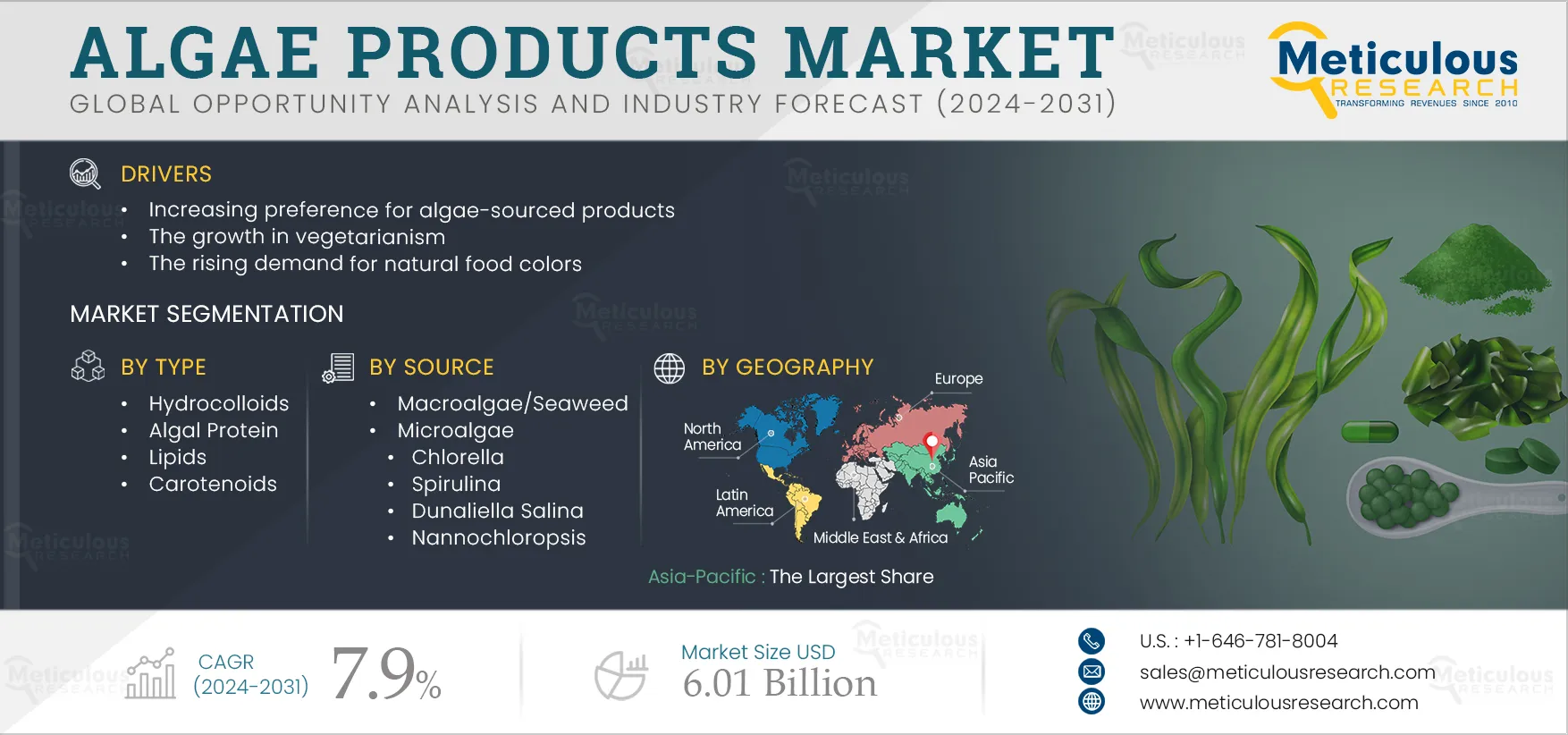
The Algae Products Market was valued at $3.28 billion in 2023. This market is expected to reach $6.01 billion by 2031, from an estimated $3.53 billion in 2024, at a CAGR of 7.9% during the forecast period 2024-2031. Algae Products Market Size & Forecast The growth of the algae products market is driven
- Published
- Jan 2024
- Pages
- 417
- Format
- PDF + Excel
- Report ID
- MRFB - 10455
- Base year
- 2023
- 2023 · BASELINE
- $3.28B
- 2031
- $6.01B
- CAGR 2024–2031
- 7.9%
2023 baseline · 2024–2031 forecast at 7.9% CAGR · hover a bar for the value
Key highlights
By Type: In 2024, the Hydrocolloids Segment to Dominate the Algae Products Market
By Source: In 2024, the Macroalgae/Seaweed Segment to Dominate the Algae Products Market
By Form: In 2024, the Dry Segment to Dominate the Algae Products Market
By Application: The Food & Beverage Segment to Witness Highest Demand During the Forecast Period
Report summary
| Particulars | Details |
|---|---|
| Number of Pages | 417 |
| Format | |
| Forecast Period | 2024–2031 |
| Base Year | 2023 |
| CAGR (Value) | 7.9% |
| Market Size (Value) | USD 6.01 Billion by 2031 |
| Market Size (Volume) | 509,648.6 Tons by 2031 |
| Segments Covered | By Type · Hydrocolloids · Carrageenan · Alginate · Agar · Other Hydrocolloids · Algal Protein · Lipids · Carotenoids · Astaxanthin · Beta Carotene · Lutein · Other Carotenoids · By Source · Macroalgae/Seaweed · Red Seaweed · Brown Seaweed · Green Seaweed · Microalgae · Spirulina · Chlorella · Dunaliella Salina · Haematococcus Pluvialis · Nannochloropsis · Other Microalgae Sources · By Fom · Dry · Liquid · By Application · Food & Beverage · Food · Dairy · Bakery & Confectionary · Other Food Products · Beverages · Nutraceuticals · Cosmetics · Skin Care · Hair Care · Other Cosmetics Products · Animal Feed · Other Applications |
| Countries Covered | North America (U.S., Canada), Europe (Germany, France, U.K., Italy, Spain, Rest of Europe), Asia-Pacific (China, Japan, India, South Korea, Australia, Rest of Asia-Pacific), Latin America (Brazil, Mexico, Argentina, Chile, Rest of Latin America), and Middle East & Africa |
| Key Companies | Algatechnologies Ltd. (A Part of Solabia Group) (Israel), BASF SE (Germany), BDI BioLife Science GmbH (Austria), Bluetec Naturals Co., Ltd (China), Cargill, Incorporated (U.S.), Cyanotech Corporation (U.S.), DIC Corporation (Japan), Lyxia Corporation (a subsidiary of Shenzhen Qianhai Xiaozao Technology Co., Ltd.)(U.S.), Seagrass Tech Private Limited (India), Tianjin Norland Biotech Co., Ltd. (China), Ingredion Incorporated (U.S.), HISPANAGAR S.A. (Spain), COMPAñIA ESPAñOLA DE ALGAS MARINAS S A (Spain), W Hydrocolloids, Inc. (Philippines), SNAP Natural & Alginate Products Pvt. Ltd. (India), and Harsha Enterprises (India) |
Report overview
Segments covered: type, source, form, application. Regions: North America, Europe, Asia-Pacific, Latin America.
The growth of the algae products market is driven by consumers’ increasing preference for algae-sourced products, the growth in vegetarianism, the rising demand for natural food colors, and the rapid growth of the nutraceuticals industry.However, complexities in algae production and low awareness regarding the benefits of algae restrain the growth of this market. Furthermore, the growing demand for biofuels is expected to generate growth opportunities for the players operating in this market. However, the risk of algae contamination is a major challenge impacting market growth. Additionally, the increasing adoption of algae products is a prominent trend in the algae products market.
Report infographic
Market dynamics
4 factors across 3 forcesConsumers' Increasing Preference for Algae-sourced Products
Consumers are becoming increasingly conscious of the environmental impacts of their choices and are actively seeking sustainable products. Algae-sourced products offer a range of benefits, including being rich in nutrients, having a low carbon footprint, and being easily renewable. As a result, the demand for algae-based foods, cosmetics, and biofuels, among other products, is on the rise. This trend is expected to continue in the coming years as more people recognize the potential of algae as a sustainable solution. Algae are one of the best sources of omega-3 fatty acids, which have anti-aging properties and offer several benefits, such as preventing heart disease and healing atherosclerosis. Linolenic acid, alphalinolenic acid, eicosapentaenoic acid (EPA), and docosahexaenoic acid (DHA) are natural omega-3 fatty acids. Spirulina is considered a prominent microalga due to its higher production of long-chain polyunsaturated fatty acids, phenolic compounds, volatile compounds, sterols, proteins, amino acids, peptides, vitamins, polysaccharides, and pigments compared to other algae. It contains 15.8% lipids and 4.9% omega-3 fatty acids by weight. Thus, the high nutrient content and benefits of spirulina are boosting the demand for spirulina based products.
The benefits of algae are driving the demand for algae-based products, encouraging manufacturers to focus on the development and production of algae-based ingredients and products. For instance, in May 2023, Corbion N.V. (Netherlands) launched AlgaVia, an algal product rich in omega-3 and omega-9 fatty acids for dietary supplement applications. Thus, the benefits of algae ingredients and food & beverage product manufacturers’ increasing focus on the development and production of algae-based products are driving demand among consumers, supporting the growth of the global algae products market.
Growth in Vegetarianism
Algae are rich in protein and vitamins, making them an excellent food/dietary supplement for vegetarians and vegans. Algae also have antioxidant and anti-inflammatory properties and help regulate the immune system. Their high content of complete vegetable proteins, vitamins, calcium, and iron has increased the popularity of algae products among vegetarians and vegans. Algae also contain essential amino acids (compounds that are the building blocks of proteins). Research has shown that dried spirulina contains 70% protein by weight, almost three times more protein than beef.
In recent years, there has been rapid growth in vegetarianism and veganism due to consumers’ increasing health & environmental awareness and compassion for animals. Moreover, vegan diets are generating interest among consumers. According to The Vegan Society, in 2023, approximately 700,000 people participated in the Veganuary campaign, wherein people only eat vegan foods during the month of January. In comparison, there were 692,000 participants in 2022, 582,000 participants in 2021, and 400,000 participants in 2020. Thus, increasing vegetarianism and veganism are expected to boost the demand for algae products, driving the growth of this market.
Table of contents
12 chapters · 194 sections · 417 pages · click to expandSegmental analysis
| Segment | Largest share (2024) | Fastest growth (2024–2031) |
|---|---|---|
| By Type | Hydrocolloids | Algal protein |
| By Source | Macroalgae/Seaweed | — |
| By Form | Dry | — |
| By Application | Food & beverage | Cosmetics |
By Type
- The Hydrocolloids Segment to Dominate the Algae Products Market
- The hydrocolloids segment is expected to account for the largest share of 51.1% of the global algae products market.
- The large market share of this segment can be attributed to factors such as the increasing consumption of seaweed-based products, the growing demand for biofuels, the rising demand for natural and plant-based ingredients, and the increasing demand for hydrocolloids from various industries.
- However, the algal protein segment is projected to witness the highest growth rate of 12.8% during the forecast period of 2024–2031 due to the growing vegan population, increasing demand for naturally derived or sustainably sourced ingredients, rising application in the food & beverages industry, growing gym going population, and growing awareness regarding fitness among consumers.
By Source
- The macroalgae/seaweed segment is expected to account for the larger share of 73.8% of the global algae products market.
- The large market share of this segment can be attributed to the abundant availability of seaweed as raw materials, driven by the increasing production of seaweed and growing awareness of the health benefits associated with seaweed products.
- Furthermore, the active components derived from seaweeds serve various purposes, acting as antioxidants, antibacterial and whitening agents, anti-aging solutions, and anti-acne treatments, contributing significantly to the growth of the seaweed products market.
- However, this segment is also projected to register the highest CAGR of 8.2% during the forecast period of 2024–2031.
By Form
- The Dry Segment to Dominate the Algae Products Market
- The dry algae products segment is expected to account for the larger share of 72.1% of the global algae products market.
- The large market share of this segment is attributed to the longer shelf-life and ease of transportation and storage of dry algae products compared to liquid algae products and the increasing use of algae powder in the food, cosmetic, and feed industries.
- However, this segment is also projected to register the highest CAGR of 8.3% during the forecast period of 2024–2031.
By Application
- The Food & Beverage Segment to Witness Highest Demand During the Forecast Period
- The food & beverage segment is expected to account for the largest share of 33.9% of the global algae products market.
- The large market share of this segment can be attributed to the increasing consumer preference for foods and beverages containing natural ingredients like hydrocolloids, carotenoids, and algae protein.
- Furthermore, the rapid growth in population, heightened awareness of the health benefits associated with algae products, shifts in lifestyle patterns toward healthier eating habits, rising demand for functional foods and food additives, and an increase in disposable incomes are anticipated to further fuel the growth of this segment.
- However, the cosmetics segment is projected to register the highest CAGR of 9.4% during the forecast period of 2024–2031.
- The growth of this segment is driven by the rapidly growing global cosmetic industry, the increasing demand for vegan skincare products, and the rising awareness about the health benefits of organic cosmetic products.
Geographic analysis
Asia-Pacific
Largest shareIn 2024, Asia-Pacific is expected to account for the largest share of 39.2% of the global algae products market, followed by North America and Europe. Asia-Pacific algae products market is estimated to be worth USD 1.38 billion in 2024. The large share of this market is mainly attributed to the increasing demand for natural ingredients in the rapidly growing food and beverage, nutraceuticals, cosmetic, and animal feed industries. In addition, the presence of a large number of stakeholders engaged in providing algae products for these industries due to the availability of raw materials, favorable climatic conditions for algae production, and cheap labor availability supports the growth of this market. Several government initiatives to promote the cultivation and usage of algae in several industries and the growing demand for healthy food products are further expected to boost the Asia-Pacific algae products market.
Europe
Fastest growthHowever, Europe is slated to register the highest CAGR of 10.8% during the forecast period of 2024–2031, mainly due to the rapidly increasing acceptance of algae products in the food and beverage industry, rising health & wellness trends, growing reluctance towards the usage of synthetic food colors, and growing demand for algae products from the cosmetic and nutraceutical industries.
Competitive landscape
- September 2023
BDI BioLife Science GmbH (Austria) plans to offer its products in Australia and New Zealand through its exclusive agent and distributor, Trapeze Associates.
- August 2022
BASF Venture Capital GmbH (Germany), the corporate venture company of BASF SE, and Aqua-Spark (Netherlands), a Dutch investment fund focusing on the global aquaculture industry, are investing in Sea6 Energy Pvt. Ltd. (India) as part of a Series B round. This investment aims to develop an integrated approach to cultivating and utilizing red seaweed as biomass and products. With this investment, Sea6 Energy completed its Series B transaction of USD 18.5 million (INR 1,402 million).
- July 2021
W Hydrocolloids, Inc. (Philippines) launched two new products, Ricogel 84668 for plant-based burgers and Ricogel 88150 for food applications like marmalade, dulce de leche, and yogurt.
- February 2021
Algatechnologies Ltd. (a part of Solabia Group) (Israel) launched microencapsulated cold water-dispersible powder containing 2.5% natural astaxanthin extracted from Haematococcus pluvialis microalgae, suitable for use in ready-to-mix supplements, drinks, and suspensions, including sports drinks.
- Algatechnologies Ltd. (A Part of Solabia Group) · Israel
- BASF SE · Germany
- BDI BioLife Science GmbH · Austria
- Bluetec Naturals Co., Ltd · China
- Cargill, Incorporated (U.S.)
- Cyanotech Corporation (U.S.)
- DIC Corporation · Japan
- Seagrass Tech Private Limited · India
- Tianjin Norland Biotech Co., Ltd. · China
- Ingredion Incorporated (U.S.)
- HISPANAGAR S.A. · Spain
- COMPAñIA ESPAñOLA DE ALGAS MARINAS S A · Spain
- W Hydrocolloids, Inc. · Philippines
- SNAP Natural & Alginate Products Pvt. Ltd. · India
- Harsha Enterprises · India
Frequently asked questions
Algae products refer to a class of photosynthetic organisms mainly found in marine and freshwater habitats and are used in several industries for various purposes. The development of alternative protein sources like algae is a key trend in gaining popularity in the algae products market. Also, emerging alternative protein sources such as algae help achieve a more reasonable and resilient food system.
Hydrocolloids, carotenoids, lipids, and algae protein are the major algal products extensively used in industries such as food and beverages, nutraceuticals, cosmetics, and animal feed. The most frequently used algae extracts in these industries are derived from seaweed, chlorella, spirulina, Dunaliella salina, and Haematococcus Pluvialis.
The algae products market in this report consists of the revenue from all types of algae products, such as hydrocolloids, carotenoids, lipids, and algae protein. The algae products market study provides valuable insights and market size and forecast in terms of both value and volume by type and country/region. However, the algae products market study provides valuable insights and market size and forecast only in terms of value for segmentation based on form and application.
Cite this report
Meticulous Research. (2024). Algae Products Market - Global Opportunity Analysis and Industry Forecast (2024-2031) (Report No. MRFB - 10455). Meticulous Market Research Pvt. Ltd. https://www.meticulousresearch.com/product/algae-products-market-3579