Resources
About Us

Airway Clearance Devices Market Size, Share & Trends Analysis by Product Type, Application, End User, and Geography - Global Opportunity Analysis and Industry Forecast (2026-2036)
Report ID: MRHC - 1042073 Pages: 290 Jun-2026 Formats*: PDF Category: Healthcare Delivery: 24 to 72 Hours Download Free Sample Report
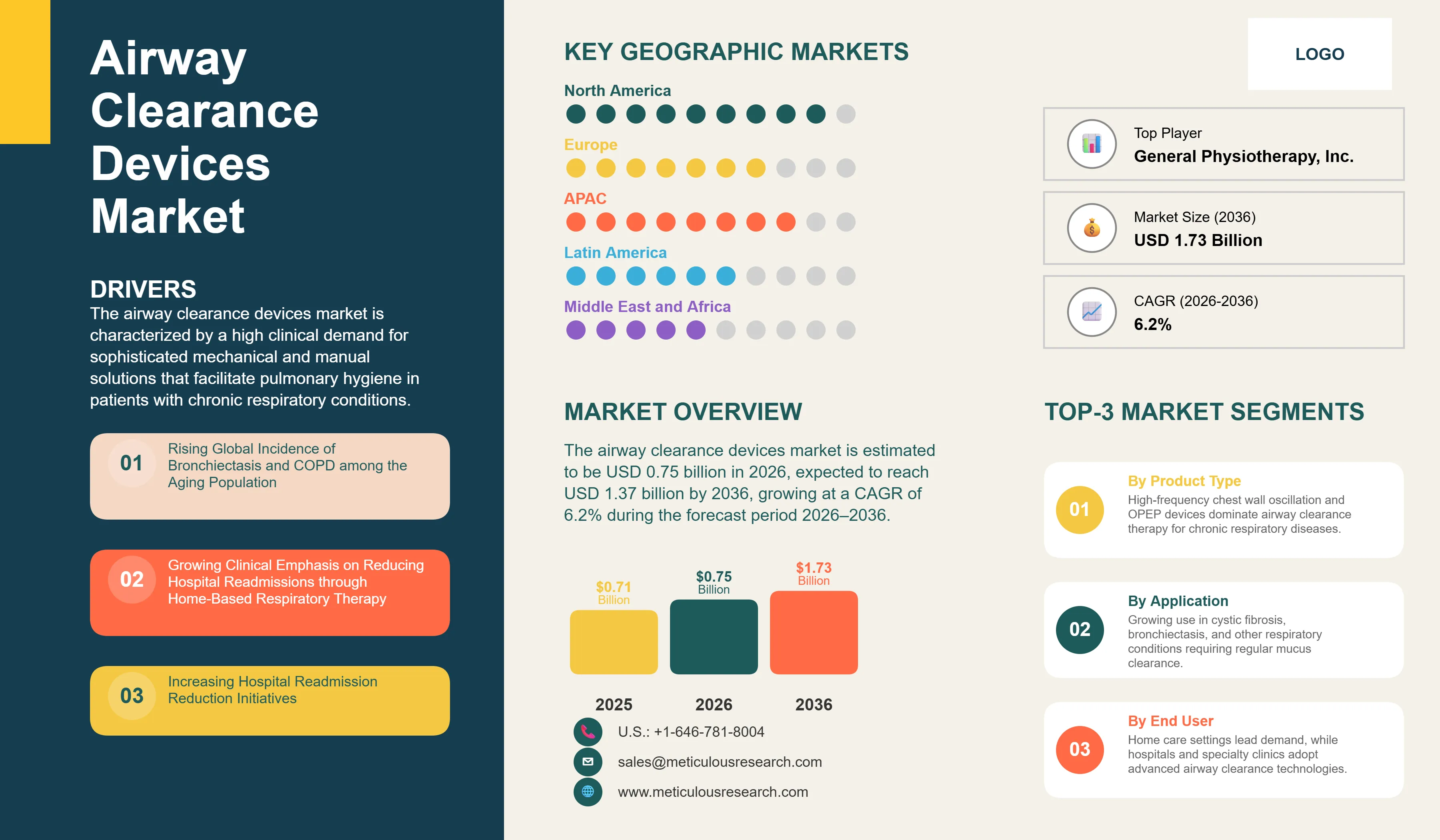
The global airway clearance devices market is estimated to be USD 0.75 billion in 2026. This market is expected to reach USD 1.37 billion by 2036, growing at a CAGR of 6.2% during the forecast period 2026–2036.
 Click here to: Get Free Sample Pages of this Report
The global airway clearance devices market is characterized by a high clinical demand for sophisticated mechanical and manual solutions that facilitate pulmonary hygiene in patients with chronic respiratory conditions. As a cornerstone of respiratory therapy, airway clearance involves the use of specialized devices to mobilize and evacuate excessive bronchial secretions, thereby preventing recurrent infections and preserving lung function. The market is primarily driven by the high global prevalence of cystic fibrosis and bronchiectasis, conditions that necessitate daily, lifelong airway clearance regimens. Additionally, the rising incidence of Chronic Obstructive Pulmonary Disease (COPD) and neuromuscular disorders is broadening the clinical application of these devices beyond traditional patient groups. Technological advancements, such as 'smart' connected vests and portable OPEP devices, are significantly enhancing patient adherence and allowing for remote monitoring by clinical teams. Clinical guidelines from the American Thoracic Society (ATS) and the European Respiratory Society (ERS) continue to emphasize the importance of standardized airway clearance protocols in managing chronic obstructive lung diseases. As the industry focuses on developing user-friendly, portable, and cost-effective solutions for home-based therapy, the market is expected to witness sustained growth, particularly in emerging economies where respiratory care infrastructure is rapidly modernizing, ensuring consistent market expansion through 2036.
Drivers: Increasing Prevalence of Chronic Respiratory Diseases and the Shift Toward Home-Based Care
The growth of the global airway clearance devices market is primarily driven by the rising global burden of chronic obstructive lung diseases and the increasing clinical emphasis on long-term pulmonary maintenance in home care settings.
Rising Global Incidence of Bronchiectasis and COPD among the Aging Population
A major driver for the market is the rising global incidence of bronchiectasis and chronic obstructive pulmonary disease (COPD), particularly among the aging population. According to the World Health Organization, COPD affects approximately 392 million people worldwide and was responsible for approximately 3.5 million deaths in 2021, making it one of the leading causes of mortality globally. The burden of chronic respiratory diseases is expected to increase further as the global population ages; according to the United Nations, the population aged 65 years and older is projected to reach nearly 1.6 billion by 2050. These conditions often lead to impaired mucociliary clearance and chronic secretion retention, necessitating regular airway clearance therapy to prevent acute exacerbations and hospital readmissions. Furthermore, growing clinical recognition of bronchiectasis as a distinct chronic respiratory disease is driving earlier diagnosis and increased adoption of specialized airway clearance systems. This demographic shift toward an older, more respiratory-vulnerable population is ensuring sustained demand for both manual and mechanical airway clearance solutions across developed and emerging healthcare markets.
Growing Clinical Emphasis on Reducing Hospital Readmissions through Home-Based Respiratory Therapy
The market is significantly driven by the global healthcare trend toward reducing hospital readmissions for chronic respiratory patients through intensive home-based therapy. Healthcare providers are increasingly prescribing user-friendly airway clearance devices, such as HFCWO vests and OPEP devices, to be used as part of a daily maintenance regimen. This shift is supported by clinical data demonstrating that consistent airway clearance reduces the frequency of pulmonary exacerbations and improves overall quality of life. The development of portable and connected devices that allow for remote adherence monitoring is further encouraging this transition to home care, making it a critical driver for market expansion.
Restraints: High Cost of Advanced Mechanical Systems and Challenges in Long-Term Patient Adherence
Despite their clinical efficacy, the airway clearance devices market faces challenges related to the high initial cost of mechanical systems and the difficulties in maintaining consistent patient adherence to daily therapy.
Prohibitive Initial Cost of High-Frequency Chest Wall Oscillation (HFCWO) Systems
A major restraint for the market is the high initial cost of advanced mechanical systems, particularly HFCWO vests, which can be prohibitive for patients in resource-limited settings or those without comprehensive insurance coverage. While these devices offer superior clinical benefits for certain patient groups, their high price point limits their broader adoption in emerging markets. This cost barrier often leads to a reliance on less expensive, albeit sometimes less effective, manual clearance techniques. The persistent challenge of securing adequate reimbursement and demonstrating cost-effectiveness to healthcare payers remains a significant hurdle for manufacturers aiming to expand their reach globally.
Difficulties in Maintaining Consistent Long-Term Patient Adherence to Daily Clearance Regimens
The market is also impacted by the challenge of maintaining consistent long-term patient adherence to daily airway clearance therapy. Daily regimens can be time-consuming and burdensome for patients, particularly children and those with multiple comorbidities, leading to 'treatment fatigue' and reduced compliance over time. Poor adherence directly impacts clinical outcomes and can lead to a perceived lack of device efficacy, potentially restraining the market's growth. Manufacturers are attempting to address this through the development of more comfortable, quieter, and 'smarter' devices with gamification and tracking features, but ensuring lifelong compliance remains a fundamental clinical and market challenge.
Opportunities: Integration of Smart Connected Technologies and the Expansion of Respiratory Care in Emerging Markets
Future growth opportunities in the airway clearance devices market are centered on the digitalization of respiratory therapy and the expansion of specialized care in rapidly developing economies.
Development of Smart Connected Devices for Remote Adherence Monitoring and Personalized Therapy
There is a significant opportunity for market growth driven by the integration of smart, connected technologies into airway clearance devices. Wireless connectivity and dedicated mobile applications allow for real-time tracking of therapy adherence and performance data, which can be shared directly with clinical teams. This data-driven approach enables personalized therapy adjustments and early intervention in case of declining adherence or lung function. Manufacturers that can provide integrated digital health platforms alongside their hardware are well-positioned to lead the premium market segment. This trend toward 'connected respiratory care' represents a high-growth opportunity for industry leaders looking to differentiate their offerings.
Rapid Expansion of Specialized Respiratory Care Infrastructure in the Asia-Pacific Region
The rapid expansion of specialized respiratory care infrastructure in the Asia-Pacific region represents a major opportunity. Countries like China and India are making significant investments in modernizing their healthcare systems to address the rising burden of chronic obstructive lung diseases. Growing awareness of advanced airway clearance techniques among clinicians and patients is accelerating the demand for both manual and mechanical solutions. Manufacturers that can provide cost-effective, durable, and user-friendly devices tailored for these markets are likely to lead the next phase of global market expansion, capitalizing on the high volume of patients in these populous regions.
Increasing Clinical Preference for Portable and Lightweight Airway Clearance Solutions
A prominent trend in 2026 is the increasing clinical and patient preference for portable and lightweight airway clearance solutions. Manufacturers are focusing on developing HFCWO vests with smaller, battery-operated generators and more ergonomic designs that allow for greater patient mobility during therapy. This trend is particularly evident in the pediatric segment and among active adults who require therapy while traveling. The shift toward portability is enhancing the usability of these devices and supporting their integration into the daily lives of patients, aligning with the global clinical emphasis on improving patient quality of life and treatment adherence.
Growing Adoption of Multi-Modality Therapy Combining Mechanical and Manual Techniques
The market is witnessing an increasing trend toward multi-modality therapy, where mechanical devices like HFCWO are used in combination with manual techniques or OPEP devices. Clinicians are increasingly recognizing that a combination of different clearance mechanisms can be more effective for certain patients, particularly those with complex secretion management needs. This trend is encouraging manufacturers to provide a broader range of compatible devices and specialized training for clinicians on how to integrate these modalities effectively. This holistic approach to airway clearance is driving the demand for comprehensive respiratory care portfolios and specialized clinical support services.
Analysis by Product Type
Based on product type, the high-frequency chest wall oscillation (HFCWO) devices segment is expected to hold the largest share of the global airway clearance devices market in 2026. This leadership is substantiated by its status as the gold standard for long-term therapy in patients with cystic fibrosis and bronchiectasis. The high clinical efficacy and ease of use in home care settings ensure its dominant market position. However, the oscillating positive expiratory pressure (OPEP) devices segment is projected to register the highest CAGR during the forecast period. The cost-effectiveness, portability, and increasing clinical validation of OPEP devices for managing COPD and stable bronchiectasis are driving their rapid adoption, particularly in emerging markets and for patient-centric home therapy.
Analysis by Application
By application, the cystic fibrosis segment is expected to hold the largest share in 2026, due to the mandatory, lifelong requirement for daily airway clearance therapy and well-established clinical protocols. However, the bronchiectasis segment is projected to register the highest CAGR during the forecast period. The increasing diagnostic rates and growing recognition of bronchiectasis prevalence among the aging population and COPD patients are significantly boosting the demand for specialized airway clearance devices in this patient group.
Analysis by End User
By end user, the home care settings segment is expected to hold the largest share in 2026, as airway clearance therapy is primarily a daily, long-term maintenance treatment performed at home. However, the hospitals & specialty clinics segment is projected to register the highest CAGR during the forecast period. The increasing adoption of advanced mechanical clearance systems for acute exacerbation management and the integration of 'smart' connected devices for remote clinician monitoring are facilitating rapid growth in this segment.
Geographic Analysis: North America's Market Dominance and Asia-Pacific's Rapid Respiratory Care Expansion
Largest Share: North America
North America is expected to dominate the global airway clearance devices market in 2026. This leading position is attributed to its advanced healthcare infrastructure, high prevalence of cystic fibrosis and bronchiectasis, and favorable reimbursement policies for mechanical airway clearance systems. Data from the Cystic Fibrosis Foundation and the CDC indicates a high level of patient access to specialized respiratory care and high adoption rates of HFCWO therapy in the U.S., which is a major factor driving the high regional market valuation and the consistent demand for premium respiratory devices in the U.S. and Canada.
Fastest Growing: Asia-Pacific
The Asia-Pacific region is projected to witness the fastest growth in the global airway clearance devices market, with a CAGR of 7-10% during the forecast period. This rapid expansion is driven by the rapidly increasing prevalence of COPD and bronchiectasis, improving healthcare access, and rising disposable income. Reports from the World Health Organization (WHO) and regional respiratory societies highlight a significant increase in the burden of chronic obstructive lung diseases across APAC, directly translating into higher procurement of both manual and mechanical airway clearance solutions in countries like China and India.
The global airway clearance devices market is characterized by a moderate degree of consolidation, with a few major medical technology leaders dominating the HFCWO and OPEP segments. Competition is primarily focused on improving the portability, comfort, and connectivity of devices to enhance patient adherence and long-term outcomes. Key players are investing heavily in R&D to develop 'smart' vests with integrated mobile apps and data analytics to capture the growing digital respiratory care market. Strategic developments often involve acquisitions of specialized respiratory device firms and partnerships with patient advocacy groups like the Cystic Fibrosis Foundation to validate new therapy protocols. Furthermore, there is a growing focus on providing comprehensive respiratory care solutions that integrate airway clearance with other therapies like nebulization. Manufacturers are also increasingly focusing on robust patient training programs and long-term technical support to ensure the successful implementation and consistent performance of their systems in home care settings, which is critical for maintaining market leadership in this specialized field.
Baxter International Inc. (Hill-Rom) (US), Koninklijke Philips N.V. (Netherlands), Tactile Medical (Tactile Systems Technology, Inc.) (US), ResMed Inc. (US), Electromed, Inc. (US), Monaghan Medical Corporation (US), Smiths Medical (acquired by ICU Medical) (US), D R Burton Healthcare LLC (US), Allergan (AbbVie Inc.) (US), PARI Medical Holding GmbH (Germany), Thayer Medical (US), InCourage (Respiratory Technologies, Inc.) (US), Vortran Medical Technology (US), General Physiotherapy, Inc. (US), Arizant Healthcare (3M Company) (US), International Biophysics Corporation (US), Bird & Cronin, LLC (US), MGC Diagnostics Corporation (US), Allied Healthcare Products, Inc. (US), Vyaire Medical, Inc. (US)
The global market is estimated at USD 0.75 billion in 2026, with a projected growth to USD 1.37 billion by 2036, at a CAGR of 6.2%.
Primary drivers include the rising prevalence of chronic respiratory diseases like bronchiectasis and the shift toward home-based respiratory care.
Major restraints include the high initial cost of mechanical systems and the challenges in maintaining consistent long-term patient adherence.
Opportunities lie in the integration of smart connected technologies and the expansion of respiratory care infrastructure in emerging markets.
HFCWO devices are expected to hold the largest share as the gold standard for long-term airway clearance therapy.
OPEP devices are projected to grow at the fastest CAGR, driven by their cost-effectiveness and increasing clinical validation.
Cystic fibrosis is expected to hold the largest share due to the mandatory, lifelong requirement for daily airway clearance.
North America is expected to dominate the market due to its advanced infrastructure and high prevalence of cystic fibrosis.
Asia-Pacific is projected to witness the fastest growth, fueled by the rapidly increasing prevalence of COPD and improving healthcare access.
Key trends include the shift toward portable lightweight devices and the increasing adoption of multi-modality therapy.
























Published Date: Aug-2026
Published Date: Jun-2026
Published Date: Feb-2026
Published Date: Jan-2025
Published Date: Jan-2025
Please enter your corporate email id here to view sample report.
Subscribe to get the latest industry updates


