Robotics Motors and Actuators Market (2026-2036)
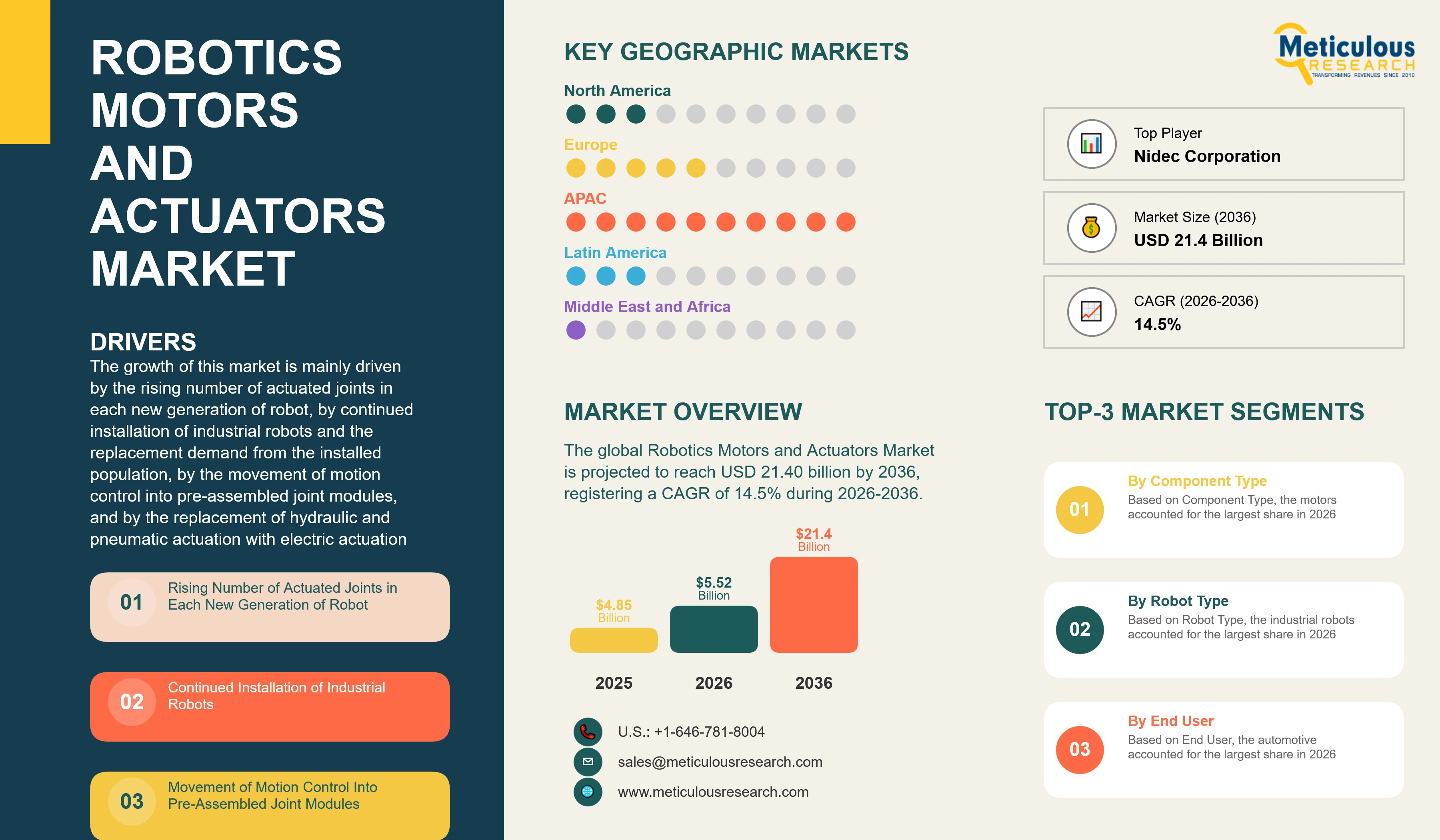
The global Robotics Motors and Actuators Market was valued at USD 4.85 billion in 2025. This market is expected to reach USD 21.40 billion by 2036 from an estimated USD 5.52 billion in 2026, registering a CAGR of 14.5% during the forecast period (2026-2036).
- Published
- Nov 2026
- Pages
- 379
- Format
- PDF + Excel
- Report ID
- MRAD - 1042419
- Base year
- 2025
- 2025 · BASELINE
- $4.85B
- 2036
- $21.40B
- CAGR 2026–2036
- 14.5%
2025 baseline · 2026–2036 forecast at 14.5% CAGR · hover a bar for the value
Key highlights
The global Robotics Motors and Actuators Market is valued at USD 5.52 billion in 2026 and is projected to reach USD 21.40 billion by 2036, at a CAGR of 14.5%.
Based on component type, the motors segment is expected to account for the largest share of the market in 2026, while the actuators segment is projected to register the highest CAGR during the forecast period.
Based on actuation technology, the electric segment is expected to account for the largest share of the market in 2026 and is also projected to register the highest CAGR during the forecast period.
Based on robot type, the industrial robots segment is expected to account for the largest share of the market in 2026, while the humanoid robots segment is projected to register the highest CAGR during the forecast period.
Based on power rating, the 100 W to 1 kW segment is expected to account for the largest share of the market in 2026, while the below 100 W segment is projected to register the highest CAGR during the forecast period.
Based on end-use industry, the automotive segment is expected to account for the largest share of the market in 2026, while the logistics and warehousing segment is projected to register the highest CAGR during the forecast period.
Based on geography, Asia-Pacific is expected to account for the largest share of the market in 2026, while North America is projected to register the highest CAGR during the forecast period.
Report summary
| Particulars | Details |
|---|---|
| Base Year | 2025 |
| Estimated Year | 2026 |
| Forecast Period | 2026-2036 |
| Market Size in 2025 | USD 4.85 billion |
| Market Size in 2026 | USD 5.52 billion |
| Market Size by 2036 | USD 21.40 billion |
| CAGR (2026-2036) | 14.5% |
| Format | PDF, Excel & Cloud Portal · 379 pages |
| Largest Segment by Component Type (2026) | Motors |
| Fastest-growing Segment by Component Type | Actuators |
| Largest and Fastest-growing Segment by Actuation Technology | Electric |
| Largest Segment by Robot Type (2026) | Industrial Robots |
| Fastest-growing Segment by Robot Type | Humanoid Robots |
| Largest Segment by Power Rating (2026) | 100 W to 1 kW |
| Fastest-growing Segment by End-Use Industry | Logistics and Warehousing |
| Largest Region (2026) | Asia-Pacific |
| Fastest-growing Region | North America |
| Segments Covered | Component Type, Actuation Technology, Robot Type, Power Rating, End-Use Industry, Geography |
| Company Naming Basis | Registered legal entity, with group capability attributed to its owner |
| Number of Companies Profiled | 20, plus other companies |
Report overview
Segments covered: component type, actuation technology, robot type, power rating, end-use industry.
The robotics motors and actuators market covers the electric motors and the rotary and linear actuators that produce motion in robots, including servo motors, stepper motors, brushless direct current motors, frameless torque motors, linear motors, rotary and linear actuators, integrated joint modules and gripper actuators, supplied to industrial, service, humanoid, mobile and surgical robot manufacturers. The growth of this market is driven by the number of actuated joints in each new generation of robot, by continued installation of industrial robots, by the movement of motion control into pre-assembled joint modules, and by the replacement of hydraulic and pneumatic actuation with electric actuation.
The number of actuators in each robot is rising, and this market therefore grows faster than the robot market it supplies. A six-axis industrial arm requires six actuated joints, while a humanoid robot requires tens of them in the limbs, torso and hands, so unit demand per robot built increases even where the number of robots built does not. The forecast therefore rests on actuator content per robot as much as on robot volume.
Since April 2025 China has required an export licence for the magnet materials these motors depend on, and that requirement sits two steps upstream of the motor itself. Since April 2025 China has required an export licence, reviewed case by case for each shipment, for seven medium and heavy rare earth elements, namely samarium, gadolinium, terbium, dysprosium, lutetium, scandium and yttrium, together with all their metals, oxides, alloys, compounds and permanent magnet materials. Terbium and dysprosium are the elements that give sintered neodymium iron boron magnets their resistance to high operating temperatures, which is the property a robot servo motor depends on, so the licensing requirement applies to the most important component in the product rather than to a peripheral input, and a motor manufacturer holds an approval exposure on the single most expensive input it buys.
A robot moves because each of its joints contains a motor, a gear reduction stage, a position feedback device and a drive that controls them. The products in this market are the motors that produce the torque and the actuators that package a motor with its reduction and feedback into a single unit ready to be bolted into a joint. The distinction matters commercially, because a robot manufacturer buying a motor still has to design the joint around it, while one buying an integrated actuator is buying the joint itself, and the value captured by the supplier differs accordingly. A motor typically represents a fraction of the delivered cost of a finished joint, and the remainder sits in the reduction stage, the feedback device and the assembly work, which is the value an integrated supplier captures and a motor supplier does not.
The International Federation of Robotics recorded 542,076 industrial robot installations worldwide in 2024 and an operational stock of 4,663,698 units, up 9%. China accounted for 295,045 of those installations, about 54% of the global total, and held 2,027,190 units of operational stock, about 43% of the global stock. Japan followed with 44,453 installations, the United States with 34,164, the Republic of Korea with 30,596 and Germany with 26,982, and the top five markets together took 431,240 units, close to 80% of global installations. Installations in Asia and Australia reached 401,665 units in 2024 and rose 5%, while Europe took 85,006 units and fell 8% and the Americas took 50,077 units and fell 10%. Demand for these components is therefore more concentrated than the global totals suggest, and it follows a small number of national robot industries rather than manufacturing activity in general. The three largest national markets alone accounted for more than two thirds of installations in that year.
An articulated industrial arm has six actuated joints and a SCARA robot has four, while a humanoid robot has tens of actuated joints distributed through the legs, arms, torso, neck and hands, many of them small and torque dense. A single humanoid therefore consumes several times the actuator content of an industrial arm, and unit demand for these components rises faster than robot volume does. The effect is largest in the hands and wrists, where many small joints replace what a single gripper previously performed, and a hand built for general manipulation can require more actuators than the entire arm carrying it.
Since April 2025 China has required an export licence, reviewed case by case for each shipment, for seven medium and heavy rare earth elements, namely samarium, gadolinium, terbium, dysprosium, lutetium, scandium and yttrium, together with all their metals, oxides, alloys, compounds and permanent magnet materials. Sintered neodymium iron boron magnets rely on terbium and dysprosium to hold their magnetic properties at the temperatures a loaded servo motor reaches, so the licence requirement reaches the central component of the product. A motor manufacturer outside China therefore needs an approved shipment for each consignment of magnet material, and the approval is discretionary, which makes inventory planning and quoted lead times less reliable than the production process itself would allow.
Ministry of Commerce Notice 2025 No. 61 of 9 October 2025 extended control to foreign-manufactured items in which Chinese-origin controlled rare earths account for 0.1% or more of the value of the item, and to items produced outside China using Chinese technologies for rare earth extraction, smelting separation, metal smelting, magnetic material manufacturing or secondary resource recycling. That extension is suspended for one year and the suspension expires on 10 November 2026. If that extension resumes, a motor manufactured outside China would fall under Chinese export control where the controlled Chinese-origin rare earth content reaches a tenth of one percent of the value of the motor, which is a threshold most servo motors would meet. The date is therefore a specific and near term event for every manufacturer in this market rather than a general trade risk.
Under the schedule set out in the United States Trade Representative four-year review of Section 301 duties, permanent magnets carry a 25% rate applying from 2026. A manufacturer importing magnets into the United States therefore pays the higher rate from 2026, while a manufacturer exporting from China faces the licensing requirement, so magnet sourcing carries either a cost exposure or an approval exposure depending on the direction of the shipment.
Manufacturers have responded by qualifying magnet grades that use less terbium and dysprosium, redesigning motors to run cooler so that lower grades suffice, and in some product lines moving to ferrite or to reluctance and induction designs that use no rare earth magnets at all. Each of these choices costs performance per unit of mass, which is a greater problem in the humanoid and mobile applications where mass is the limiting factor than in stationary industrial robots, so substitution proceeds unevenly across the product range rather than across the industry as a whole.
Suppliers also increasingly sell a joint module containing motor, harmonic or cycloidal reduction, brake, encoder and drive electronics in one housing, which shortens development time for the robot manufacturer and raises the value per joint for the component supplier. The gearbox rather than the motor sets the precision and stiffness of the joint, so this favours suppliers that already hold the reduction gear technology, and it has drawn gear manufacturers into direct competition with motor manufacturers. Robot manufacturers that previously purchased motors and gearboxes separately and designed the joint themselves are increasingly buying the assembled joint instead, which moves both engineering work and margin to the supplier.
The 10 November 2026 expiry noted above is capable of changing the cost and availability of magnet material for every manufacturer at the same time, and the forecast assumes continued access under the licensing regime that applies today. Actuator content per robot also depends on humanoid and mobile robot production reaching volume, and those programmes are at an earlier stage of commercialisation than industrial robots, so the segment carrying the fastest growth is also the segment whose volumes are least certain.
Report infographic
Market dynamics
21 factors across 5 forcesRising Number of Actuated Joints in Each New Generation of Robot
An articulated industrial arm has six actuated joints and a SCARA robot has four, while a humanoid robot has tens distributed through the legs, arms, torso, neck and hands. A single humanoid therefore consumes several times the actuator content of an industrial arm, and unit demand for these components rises even where the number of robots built does not. This is why this market grows faster than robot installations alone would support and why demand is moving towards compact, torque dense and low power products. It also means a slowdown in industrial robot installations does not translate directly into a slowdown in this market, because content per unit continues to rise through the period, and the driver can be assessed from robot design rather than from capital spending. That makes it a more stable demand signal than the order intake most component markets depend on.
Continued Installation of Industrial Robots
The International Federation of Robotics recorded 542,076 industrial robot installations worldwide in 2024 and an operational stock of 4,663,698 units, up 9%, which means the installed population consuming spare and replacement motors is now substantially larger than the annual build. China accounted for 295,045 of those installations, about 54% of the global total, and held 2,027,190 units of operational stock, about 43% of the global stock. Japan followed with 44,453 installations, the United States with 34,164, the Republic of Korea with 30,596 and Germany with 26,982, and the top five markets together took 431,240 units, close to 80% of global installations. Demand in this market is therefore both new build demand and service demand, since an operational stock of that size generates replacement requirements independent of how many new robots are installed in any year. It is also geographically concentrated, because the five largest markets took close to 80% of installations, so a supplier without a position in those national robot industries is addressing a small part of the market whatever its product capability. Replacement demand is also less sensitive to economic conditions than new build, because a robot in production has to be repaired regardless of whether the plant is investing.
Movement of Motion Control Into Pre-Assembled Joint Modules
Suppliers increasingly sell a module containing motor, harmonic or cycloidal reduction, brake, encoder and drive electronics in one housing, which shortens development time for the robot manufacturer and removes the joint design work it would otherwise carry. This raises the revenue a supplier captures from each joint well above the price of a motor alone, and it favours suppliers holding the reduction gear technology, because the gearbox rather than the motor determines the precision and stiffness the joint achieves. It has also changed the sales process, since a module is specified once for a robot platform rather than negotiated component by component, and a module specified into a platform generally remains in it for the production life of that platform. Each design win is therefore worth considerably more than a single order, and losing one removes the supplier from that platform for several years.
Replacement of Hydraulic and Pneumatic Actuation With Electric Actuation
Electric actuators provide position control, repeatability and energy reporting that hydraulic and pneumatic systems cannot match, and they remove the compressor, the fluid handling and the leakage that accompany those systems. Demand for conversion is therefore strongest in food processing, electronics assembly and cleanroom applications where contamination matters, and in plants where energy consumption is measured, and it converts existing installed positions rather than requiring new robot sales. Conversion follows equipment replacement schedules and requirements on hygiene and energy reporting rather than capital investment cycles, and it generally proceeds line by line within a plant, which spreads the demand over several years per site. Pneumatic systems are usually the first to be converted, because the compressed air supply they depend on is among the largest energy costs in a plant.
Table of contents
13 chapters · 161 sections · 379 pages · click to expandGeographic analysis
Asia-Pacific
Largest shareIn 2026, Asia-Pacific is expected to account for the largest share of the market. The large share of this region is mainly due to the concentration of robot production and installation, with installations in Asia and Australia reaching 401,665 units in 2024 and rising 5%, and with China accounting for 295,045 of those installations, about 54% of the global total, and held 2,027,190 units of operational stock, about 43% of the global stock. Japan followed with 44,453 installations, the United States with 34,164, the Republic of Korea with 30,596 and Germany with 26,982, and the top five markets together took 431,240 units, close to 80% of global installations.
North America
Fastest growthHowever, North America is projected to register the highest CAGR during the forecast period. Installations in the Americas fell 10% to 50,077 units in 2024, so growth begins from a reduced base, and the rapid growth expected in this region is attributed to investment in domestic electronics and vehicle assembly capacity, to the concentration of humanoid robot development programmes in the United States, and to logistics automation in large distribution networks. Growth is tempered by the 25% rate applying to permanent magnets from 2026, which raises the cost of imported magnet material for manufacturers supplying this region.
Europe
Europe occupies a position built on machine building rather than on robot installation volume. Installations in the region fell 8% to 85,006 units in 2024, with Germany taking 26,982 of them, and demand for these components is weighted towards machine builders and system integrators supplying specialised production equipment rather than towards high volume robot assembly. The region holds a strong position in reduction gears, linear motion components and drive electronics, which supports suppliers of integrated joint modules more than suppliers of motors alone.
Latin America
Latin America and the Middle East & Africa remain smaller positions concentrated in vehicle assembly, food processing and logistics facilities operated by international groups. Procurement in both regions generally follows the specifications set by the parent organisation or by the system integrator supplying the line, which means these markets are addressed through the same supplier relationships that serve the plants in Asia-Pacific, Europe and North America rather than through separate local selling. Growth in both regions therefore tracks the investment decisions of those international groups rather than local industrial activity.
Competitive landscape
Japanese motor and reduction gear manufacturers hold the strongest positions in this market, because the precision reduction gears that determine joint accuracy are concentrated among a small number of them. European automation and drive groups supply motors, actuators and drive electronics alongside wider factory equipment and reach customers through machine builders. Robot manufacturers produce motors and actuators for their own machines and in several cases sell them externally, and Chinese motor and drive manufacturers supply the domestic robot industry at lower cost and are expanding into export markets.
Access to magnet material separates suppliers more than performance does, because export licensing applies to the heavy rare earths robot servo motors depend on and a supplier able to ship reliably holds an advantage that specification alone does not create. Ownership of the reduction gear technology matters for the same reason the module is replacing the component, since the gearbox rather than the motor sets the precision and stiffness of a joint and the move to integrated modules rewards suppliers holding both. The ability to qualify alternative magnet grades in advance also separates suppliers, because requalification takes longer than a licensing delay lasts.
A supplier selling a complete joint module competes with motor manufacturers, reduction gear manufacturers and drive electronics suppliers at the same time, and the robot manufacturer that previously bought three components from three suppliers now buys one assembly from one. This has drawn gear manufacturers towards motors and motor manufacturers towards gears, and it has raised the value at stake in each design win well above the price of the parts.
Key players operating in the global Robotics Motors and Actuators Market are Nidec Corporation (Japan), Harmonic Drive Systems Inc. (Japan), Nabtesco Corporation (Japan), Yaskawa Electric Corporation (Japan), Mitsubishi Electric Corporation (Japan), Oriental Motor Co., Ltd. (Japan), THK Co., Ltd. (Japan), Siemens AG (Germany), Robert Bosch GmbH (Germany), Schaeffler AG (Germany), Festo SE & Co. KG (Germany), Dr. Fritz Faulhaber GmbH & Co. KG (Germany), maxon international ag (Switzerland), ABB Ltd (Switzerland), Regal Rexnord Corporation (U.S.), Moog Inc. (U.S.), Parker-Hannifin Corporation (U.S.), Delta Electronics, Inc. (Taiwan), Shenzhen Inovance Technology Co., Ltd. (China), and Estun Automation Co., Ltd. (China).
Companies are identified at registered legal entity level, and capability held within a group is attributed to the entity that owns it. Bosch Rexroth is not listed separately, because it is held by Robert Bosch GmbH, and Kollmorgen is not listed separately, because it is held by Regal Rexnord Corporation. The companies profiled were verified as active in the supply of motors or actuators for robot applications as of October 2026. Magnet material producers without a motor or actuator product, reduction gear manufacturers without a motor or actuator offering, drive and controller suppliers without a motor or actuator product, encoder and sensor manufacturers, and robot manufacturers that build motors solely for internal use without external sale were excluded.
- Nidec Corporation
- Harmonic Drive Systems Inc.
- Nabtesco Corporation
- Yaskawa Electric Corporation
- Mitsubishi Electric Corporation
- Oriental Motor Co., Ltd.
- THK Co., Ltd.
- Siemens AG
- Robert Bosch GmbH
- Schaeffler AG
- Festo SE
- Dr. Fritz Faulhaber GmbH
- ABB Ltd
- Regal Rexnord Corporation
- Moog Inc.
- Parker-Hannifin Corporation
- Delta Electronics, Inc.
- Shenzhen Inovance Technology Co., Ltd.
- Estun Automation Co., Ltd.
Expert perspectives
Robot installation volume is the usual basis for assessing this market, and it understates both the growth and the risk. Actuator content per robot is rising, because a humanoid requires tens of actuated joints against six in an articulated arm, so unit demand for these components grows faster than robot volume does. The product is also a magnet product before it is a motion product. Since April 2025 China has required an export licence, reviewed case by case for each shipment, for seven medium and heavy rare earth elements, namely samarium, gadolinium, terbium, dysprosium, lutetium, scandium and yttrium, together with all their metals, oxides, alloys, compounds and permanent magnet materials, and terbium and dysprosium are what allow sintered neodymium iron boron magnets to hold their properties at the temperatures a loaded servo motor reaches. Under the schedule set out in the United States Trade Representative four-year review of Section 301 duties, permanent magnets carry a 25% rate applying from 2026. The binding constraint is therefore shifting from motor engineering to access to magnet material and the ability to qualify designs that need less of it.
The joint is expected to continue consolidating into a single supplied module through 2036, which raises the value per design win and rewards suppliers holding both motor and reduction gear technology. The product mix is expected to continue moving towards units below 100 W, because the growth in actuator count is concentrated in hands and fine manipulators rather than in large axes. Magnet sourcing is expected to continue separating suppliers, since a manufacturer with qualified lower rare earth grades can quote lead times that a competitor dependent on licensed shipments cannot. Lead time reliability is becoming a commercial differentiator in a market that previously competed on torque and precision.
For companies planning entry or expansion, the strongest position to take is in integrated joint modules for humanoid and mobile robots, because those developers need tens of joints and lack the mechanical engineering depth to design each one, and the module captures several times the value of a motor sale. Replacement demand from an operational stock of 4,663,698 industrial robots offers more predictable volume at higher margin than original equipment supply. Buyers should establish which magnet grades a supplier has already qualified and under what licensing route the material is shipped, because those determine delivery reliability more than the published specification does.
Ministry of Commerce Notice 2025 No. 61 of 9 October 2025 extended control to foreign-manufactured items in which Chinese-origin controlled rare earths account for 0.1% or more of the value of the item, and to items produced outside China using Chinese technologies for rare earth extraction, smelting separation, metal smelting, magnetic material manufacturing or secondary resource recycling. That extension is suspended for one year and the suspension expires on 10 November 2026, and if that extension resumes a motor manufactured outside China would fall under Chinese export control where controlled Chinese-origin rare earth content reaches a tenth of one percent of the value of the motor, a threshold most servo motors would meet. Humanoid and mobile robot programmes carry the fastest growth in actuator content but their build volumes are neither published nor stable, so capacity committed to compact high torque modules is committed against forecasts that cannot be verified, and the tooling is specific to those products rather than transferable to industrial lines.
Overall, the core of demand through the forecast period will continue to sit in electric servo motors rated between 100 W and 1 kW supplied to industrial robot manufacturers for automotive applications across Asia-Pacific, while the fastest growth will come from integrated actuators and joint modules, units below 100 W, humanoid robots, logistics and warehousing applications and North American installations.
Customer perspectives
Head of Mechanical Engineering, Industrial Robot Manufacturer
This perspective confirms that export licensing on magnet material has become a design consideration rather than a procurement one. It supports the conclusion that the ability to qualify alternative magnet grades in advance separates suppliers, because requalification takes longer than a licensing delay lasts.
Vice President of Hardware, Humanoid Robot Developer
This perspective identifies actuator count and development time as the reasons humanoid developers buy integrated modules rather than components. It supports the conclusion that integrated joint modules and units below 100 W are the fastest-growing parts of this market and that value per joint in modules is several times that of a motor sale.
Maintenance Manager, Automotive Body Shop
This perspective confirms that the installed robot population generates replacement demand independent of new robot sales. It supports the conclusion that replacement supply to an operational stock of 4,663,698 industrial robots is a distinct opportunity, reached through maintenance organisations rather than through the design win process, with availability of long specified parts as the deciding factor.
Frequently asked questions
The market was valued at USD 4.85 billion in 2025 and is estimated at USD 5.52 billion in 2026.
Cite this report
Meticulous Research. (2026). Robotics Motors and Actuators Market - Global Opportunity Analysis and Industry Forecasts (2026-2036) (Report No. MRAD - 1042419). Meticulous Market Research Pvt. Ltd. https://www.meticulousresearch.com/product/robotics-motors-actuators-market-7102