AI in Clinical Workflow Market (2026-2036)
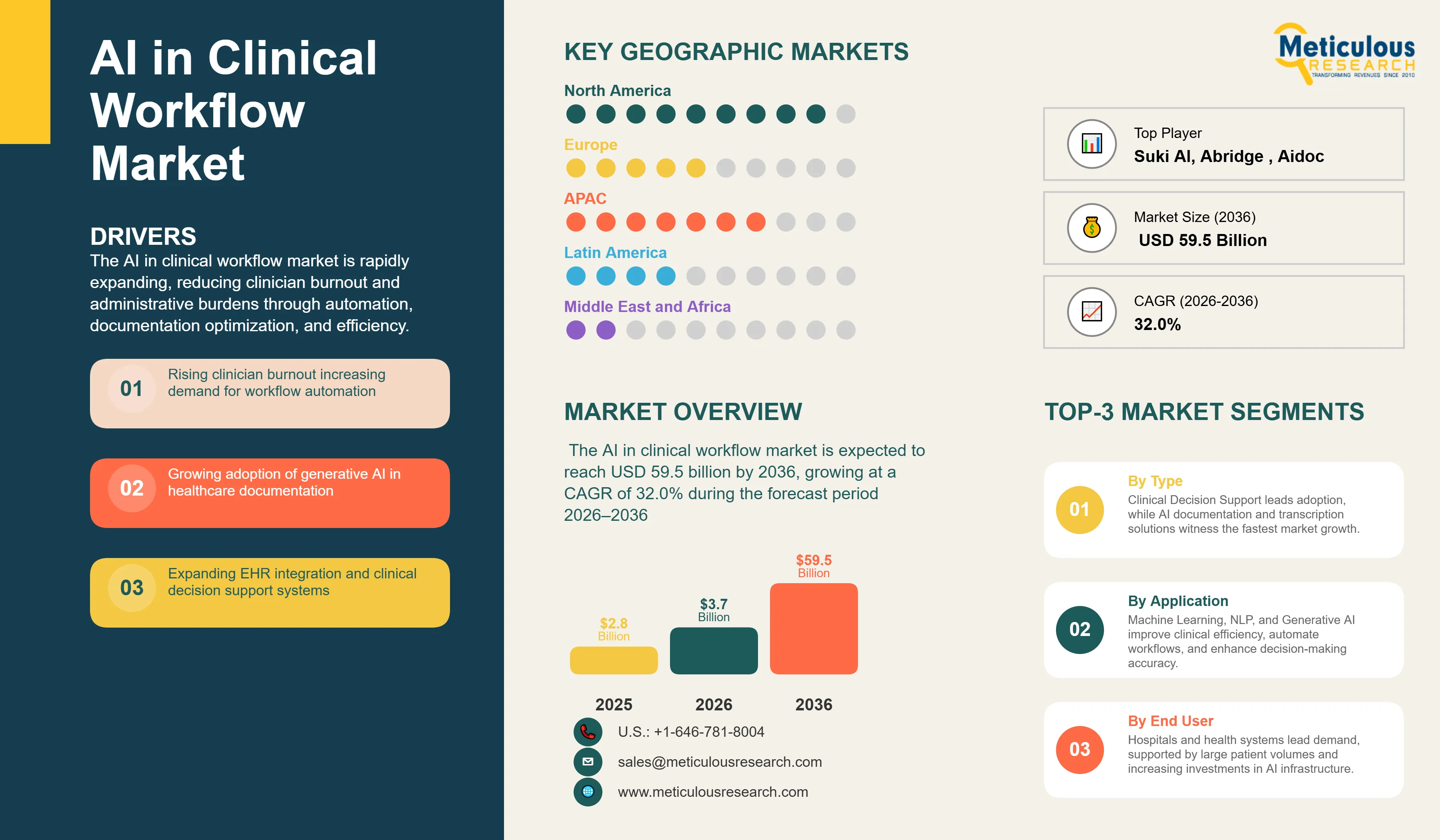
The global AI in clinical workflow market was valued at USD 3.7 billion in 2026. This market is expected to reach USD 59.5 billion by 2036, growing at a CAGR of 32.0% during the forecast period 2026–2036.
- Published
- Jun 2026
- Pages
- 290
- Format
- PDF + Excel
- Report ID
- MRHC - 1042012
- Base year
- 2025
- 2026 · ESTIMATED
- $3.70B
- 2036
- $59.50B
- CAGR 2026–2036
- 32.0%
2025 baseline · 2026–2036 forecast at 32.0% CAGR · hover a bar for the value
Key highlights
The global AI in clinical workflow market is projected to reach USD 59.5 billion by 2036.
The market is expected to grow at a CAGR of 32.0% during the forecast period 2026–2036.
The global market is estimated at USD 3.7 billion in 2026.
Clinician burnout affects over 40% of physicians, primarily due to administrative documentation burdens.
AI-powered ambient clinical intelligence can reduce medical documentation time by 50-70%.
The Clinical Decision Support (CDS) segment currently holds the largest share of the market.
Clinical Documentation & Transcription is projected to be the fastest-growing solution segment.
North America leads the global market, supported by early adoption and robust AI infrastructure.
Asia-Pacific is the fastest-growing region, driven by massive investments in healthcare digitalization.
Report summary
| Particulars | Details |
|---|---|
| Base Year | 2025 |
| Estimated Year | 2026 |
| Forecast Period | 2026–2036 |
| Market Size (2026) | USD 3.70 billion |
| Market Size (2036) | USD 59.50 billion |
| CAGR (2026–2036) | 32.0% |
| Format | PDF, Excel & Cloud Portal · 290 pages |
| Key Companies | Microsoft Corporation, NVIDIA Corporation, Oracle Corporation, Epic Systems Corporation |
Report overview
The global AI in clinical workflow market is entering a phase of exponential expansion, redefining the operational and clinical standards of modern healthcare delivery. At its core, this market addresses the growing crisis of clinician burnout and systemic inefficiencies across healthcare systems. According to the American Medical Association (AMA), approximately 45% of physicians report at least one symptom of burnout, while studies indicate that clinicians spend nearly two hours on documentation and administrative activities for every hour of direct patient care. The widespread adoption of electronic health records (EHRs) has intensified administrative workloads, creating significant demand for AI-driven workflow automation. Artificial intelligence, particularly advances in Generative AI and Natural Language Processing (NLP), is emerging as a transformative solution by automating documentation, streamlining administrative tasks, enhancing diagnostic accuracy, and improving patient throughput.
The integration of AI into clinical workflows is no longer a peripheral innovation but a fundamental necessity for sustainable healthcare. The market's growth is fueled by the rapid adoption of ambient clinical intelligence, which uses AI to listen to patient-clinician encounters and automatically generate structured medical notes. Clinical studies have shown that these tools can reduce documentation time by as much as 50-70%, directly translating into more patient-facing time and improved quality of care. Furthermore, the rise of AI-powered Clinical Decision Support (CDS) systems is enabling personalized medicine at scale, providing clinicians with real-time, evidence-based recommendations for diagnosis and treatment planning based on massive datasets that exceed human cognitive capacity.
The technological ecosystem of the AI in clinical workflow market is characterized by a convergence of Big Tech players and specialized healthcare AI startups. Companies like Microsoft (through Nuance), Google Health, and NVIDIA are providing the foundational infrastructure and large language models (LLMs) specifically tuned for medical terminology. Simultaneously, a vibrant startup ecosystem is developing point solutions for administrative automation, such as prior authorization, patient scheduling, and revenue cycle management (RCM). These solutions are increasingly being integrated directly into major EHR platforms like Epic and Cerner, creating a seamless user experience that minimizes disruption to established clinical routines.
Geographically, North America remains the primary revenue driver, accounting for a significant portion of the global market share. This dominance is due to the early adoption of digital health technologies in the U.S., a robust regulatory framework for AI-enabled medical devices, and a high concentration of leading AI research institutions. However, the Asia-Pacific region is projected to witness the fastest growth, with countries like China and India investing heavily in AI to overcome shortages in clinical staff and improve healthcare access for their massive populations. As clinical AI continues to demonstrate a clear Return on Investment (ROI)—with some hospitals reporting a 15-20% increase in operational efficiency—the market is poised for sustained, long-term growth across all global regions.
Report infographic
Market dynamics
7 factors across 5 forcesThe primary driver for the AI
in clinical workflow market is the urgent need to mitigate clinician burnout and address growing healthcare workforce shortages. According to the World Health Organization (WHO), the world is projected to face a shortage of approximately 10 million healthcare workers by 2030, with the greatest gaps occurring in low- and middle-income countries. Simultaneously, physicians spend nearly two hours on administrative and documentation activities for every one hour of direct patient care, contributing significantly to burnout and reduced productivity. According to the American Medical Association (AMA), approximately 45% of physicians report at least one symptom of burnout, highlighting the need for workflow automation solutions.
Furthermore, the rapid advancement in Generative
AI and Large Language Models (LLMs) has made medical transcription and summarization significantly more accurate and reliable. The rising volume and complexity of healthcare data also necessitate the use of AI to synthesize information and provide actionable insights at the point of care, improving both clinical outcomes and operational efficiency.
Table of contents
12 chapters · 115 sections · 290 pages · click to expandSegmental analysis
| Segment | Largest share (2026) | Fastest growth (2026–2036) |
|---|---|---|
| By Solution Type | CDS | Clinical Documentation & Transcription |
| By Specialty | Radiology | Primary Care |
By Solution Type
- CDS to Hold Largest Share
- The Clinical Decision Support (CDS) segment is expected to hold the largest share of the market.
- This dominance is due to the established use of AI for diagnostic image analysis, drug interaction alerts, and treatment planning across major medical specialties like radiology and oncology.
- The Clinical Documentation & Transcription segment is projected to register the fastest CAGR during the forecast period.
- This growth is driven by the explosive demand for ambient clinical intelligence to combat clinician burnout.
- The ability of Generative AI to accurately summarize complex patient encounters in real-time is a 'game-changer' for healthcare providers, leading to rapid and widespread adoption.
By Specialty
- Radiology to Lead the Market
- The Radiology segment is expected to hold the largest share of the market.
- Radiology was the first specialty to broadly adopt AI for automated image interpretation and workflow prioritization.
- The high volume of diagnostic imaging data makes it an ideal environment for AI-driven optimization.
- The Primary Care segment is projected to witness the fastest growth during the forecast period.
- Primary care clinicians face the highest administrative burden and the greatest volume of patient interactions.
- AI solutions that can streamline documentation, triage, and routine patient communication offer immense value in this setting, driving rapid market expansion.
Geographic analysis
North America
Largest shareNorth America is expected to hold the largest share of the global AI in clinical workflow market in 2026, driven by a robust digital health ecosystem and high adoption of AI in the United States. The region accounts for a significant portion of the global share, supported by the presence of major technology firms and a favorable regulatory environment for AI-enabled medical software. Key companies operating in the North American market include Microsoft (Nuance), Google Health, and Epic Systems.
Asia-Pacific
Fastest growthAsia-Pacific is projected to witness the fastest growth during the forecast period. Countries like China and India are investing heavily in healthcare AI to address shortages in clinical staff and improve care delivery for their large populations. The rapid expansion of digital health infrastructure and a rising number of AI startups in the region present significant opportunities for growth. Key companies operating in the Asia-Pacific market include Philips Healthcare, Siemens Healthineers, and various emerging domestic AI providers.
Competitive landscape
- Microsoft Corporation
- NVIDIA Corporation
- Oracle Corporation
- Epic Systems Corporation
Frequently asked questions
The market is projected to reach USD 59.5 billion by 2036, growing at a CAGR of 32.0% from 2026 to 2036.
Cite this report
Meticulous Research. (2026). AI in Clinical Workflow Market - Global Opportunity Analysis and Industry Forecast (2026-2036) (Report No. MRHC - 1042012). Meticulous Market Research Pvt. Ltd. https://www.meticulousresearch.com/product/ai-in-clinical-workflow-market-6696