Aerospace Precision Machining Services Market (2026-2036)
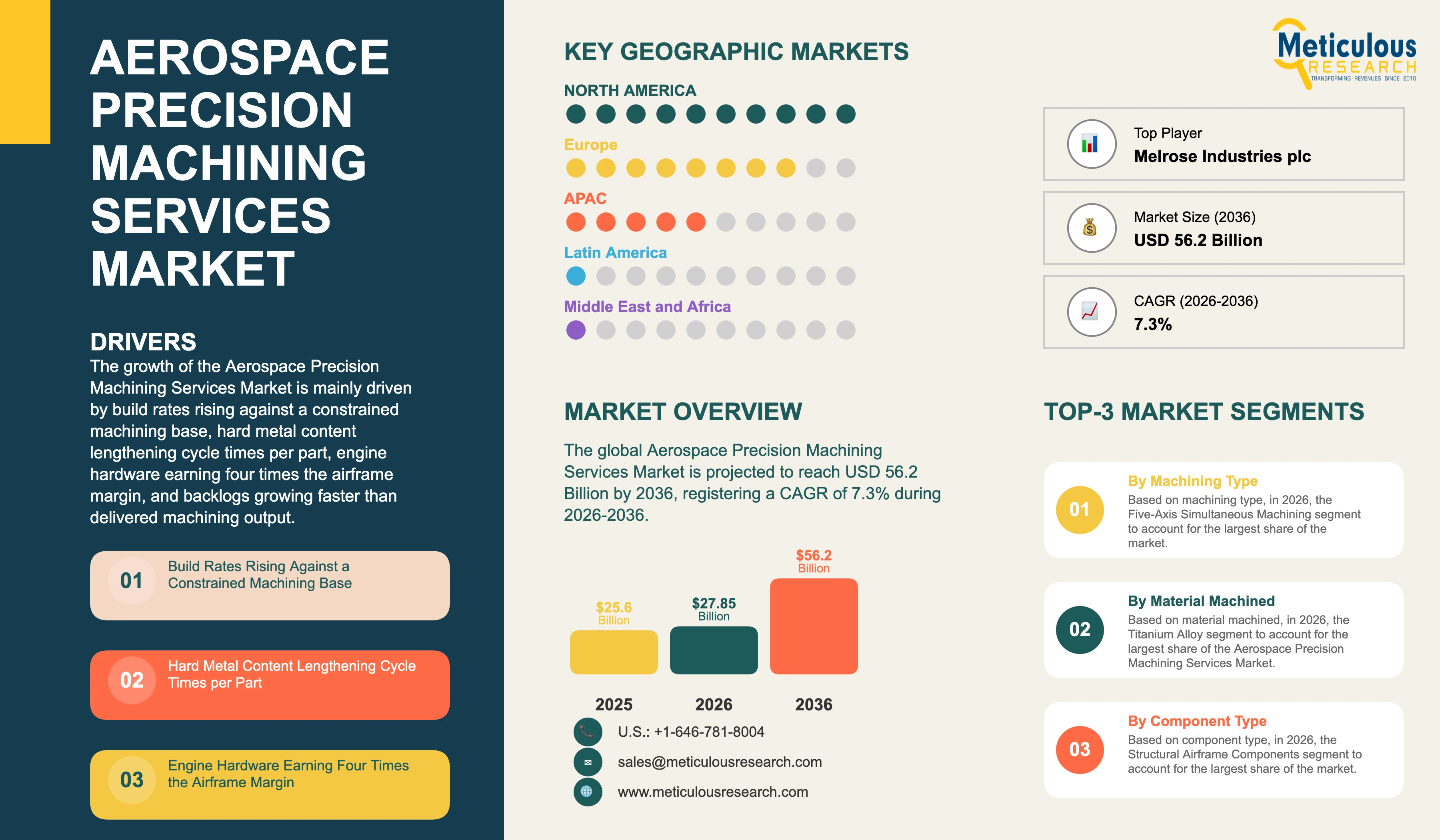
The global Aerospace Precision Machining Services Market was valued at USD 25.60 billion in 2025. This market is expected to reach USD 56.20 billion by 2036 from an estimated USD 27.85 billion in 2026, registering a CAGR of 7.3% during the forecast period (2026-2036).
- Published
- Nov 2026
- Pages
- 280
- Format
- PDF + Excel
- Report ID
- MRAD - 1042835
- Base year
- 2025
- 2025 · BASELINE
- $25.60B
- 2036
- $56.20B
- CAGR 2026–2036
- 7.3%
2025 baseline · 2026–2036 forecast at 7.3% CAGR · hover a bar for the value
Key highlights
The global Aerospace Precision Machining Services Market is projected to reach USD 56.20 billion by 2036, driven by build rates rising against a constrained machining base, hard metal content lengthening cycle times, engine hardware earning four times the airframe margin, and backlogs growing faster than delivered output.
North America is expected to account for the largest market share in 2026 and is also projected to register the fastest growth during the forecast period, supported by the concentration of airframe and engine final assembly in the region together with the largest installed base of qualified five-axis and hard metal machining capacity.
By machining type, Five-Axis Simultaneous Machining are expected to account for the largest market share, whereas Electrical Discharge and Non-Conventional Machining are projected to witness the fastest growth through 2036.
By material machined, Titanium Alloy are expected to account for the largest market share, whereas Nickel-Base Superalloy are projected to witness the fastest growth through 2036.
By component type, Structural Airframe Components are expected to account for the largest market share, whereas Engine Rotating and Static Hardware are projected to witness the fastest growth through 2036.
GKN Aerospace reported Engines revenue of GBP 1, 632 million in 2025, up 15% on a like-for-like basis at an adjusted operating margin of 31.9%, against Airframes revenue of GBP 1,957 million, up 3% like-for-like at a margin of 8.0%.
Group revenue reached GBP 3, 589 million, up 8% like-for-like, with adjusted operating profit of GBP 647 million, up 23%, while capital expenditure fell to GBP 94 million from GBP 123 million, or 0.9 times depreciation of owned assets against 1.1 times in 2024.
The same results name a supply chain that continues to hold back original equipment build rates, with Airframes civil revenue down 2% like-for-like on supply chain issues affecting manufacturer production rates.
Rate readiness investment is being targeted rather than spread, with machining and inspection capability added for single aisle work at the Filton site and F-35 canopy capacity expanded at Garden Grove for completion in the second half of 2027.
Ducommun recorded 2025 revenue of USD 824.7 million, up 4.9%, with Structural Systems at USD 362.0 million, up 1.9%, against a year-end backlog of USD 1,202.9 million from USD 1,060.8 million and a commercial aerospace backlog of USD 477.6 million from USD 415.9 million.
Magellan Aerospace reported 2025 revenue of CAD 1, 044.7 million, up 10.9%, with gross margin rising to 13.9% from 11.4% and purchases of property, plant and equipment of CAD 51.0 million against CAD 36.1 million, while naming skilled labor shortages as a continuing concern.
Boeing completed the acquisition of Spirit AeroSystems on 8 December 2025, bringing approximately 15,000 employees across five sites into the company, with Belfast operations running as Short Brothers, a Boeing Company and Spirit Defense remaining a non-integrated subsidiary of Boeing Defense, Space & Security.
Warburg Pincus and Berkshire Partners completed the acquisition of Triumph Group on 24 July 2025, moving a major machining and engineered components supplier into private ownership.
Report summary
| Particulars | Details |
|---|---|
| Forecast Period | 2026-2036 |
| Base Year | 2025 |
| Estimated Year | 2026 |
| CAGR (Value) | 7.3% |
| Format | PDF, Excel & Cloud Portal · 280 pages |
| CAGR (Volume) | 4.2% |
| Market Size (Value) in 2026 | USD 27.85 billion |
| Market Size (Value) in 2036 | USD 56.20 billion |
| Market Size (Volume) in 2026 | 486.00 million machining hours sold |
| Market Size (Volume) in 2036 | 735.00 million machining hours |
| Average Selling Price, 2026 | USD 57.30 per machining hour |
| Average Selling Price, 2036 | USD 76.46 per machining hour |
| Segments Covered | By Machining Type: Five-Axis Simultaneous Machining, Three- and Four-Axis Milling, Turning and Mill-Turn, Grinding and Finishing Operations, Electrical Discharge and Non-Conventional Machining, Other Operations. By Material Machined: Titanium Alloy, Nickel-Base Superalloy, Aluminum Alloy, Steel and Stainless Steel, Composite and Other Materials. By Component Type: Structural Airframe Components, Engine Rotating and Static Hardware, Landing Gear and Actuation Components, Systems and Accessory Components, Other Components. By End Use: Commercial Aviation, Defense and Military Aviation, Space and Launch, Business and General Aviation, Other End Uses. |
| Countries Covered | U.S.; Canada; France; Germany; U.K.; Italy; China; India; Japan; South Korea; Mexico; Brazil |
| Key Companies | Melrose Industries plc, Howmet Aerospace Inc., Precision Castparts Corp., Triumph Group, Inc., Magellan Aerospace Corporation, and Ducommun Incorporated |
Report overview
Segments covered: machining type, material machined, component type, end use.
The growth of this market is mainly driven by build rates rising against a machining base where sector capital expenditure sits below depreciation, hard metal content lengthening cycle times per part, engine hardware earning an adjusted operating margin of 31.9% against 8.0% on airframe work, and order backlogs growing faster than delivered machining output. However, factors such as capital expenditure of 0.9 times depreciation across the largest machining suppliers, skilled machinist and programmer shortages, special process approval that fixes where a given part can be cut, and customer destocking that separates supplier shipments from aircraft build are expected to restrain the growth of this market to some extent.
The Aerospace Precision Machining Services Market comprises contract precision machining of metal and composite aerospace components supplied to airframers, engine manufacturers and tier suppliers, taken at the machining supplier gate with volume expressed as machining hours sold. The market includes Five-Axis Simultaneous Machining, Three- and Four-Axis Milling, Turning and Mill-Turn, Grinding and Finishing Operations, and Electrical Discharge and Non-Conventional Machining, performed on titanium alloy, nickel-base superalloy, aluminum alloy, steel and stainless steel, for structural airframe components, engine rotating and static hardware, landing gear and actuation components, and systems and accessory components, across commercial aviation, defense and military aviation, space and launch, and business and general aviation. Captive machining performed inside airframe and engine manufacturers for their own assemblies, machine tools and cutting tools sold as capital or consumables, raw mill product, forgings and castings purchased for machining, assembly and integration work, and standalone inspection and special process services fall outside the scope.
A machined aerospace component is defined as much by the hours required to cut it as by its geometry, because a structural rib or an engine casing is produced by removing the majority of a forging or plate on a qualified machine with a qualified program and fixture. Capacity is therefore measured in spindle hours rather than in parts, and the constraint on output is the availability of approved machines, programs and operators rather than the availability of customer demand.
The evidence that capacity rather than demand sets output appears in the published results. GKN Aerospace named a supply chain that continues to hold back original equipment build rates, with Airframes civil revenue down 2% like-for-like on supply chain issues affecting manufacturer production rates, while Ducommun grew Structural Systems revenue 1.9% to USD 362.0 million against a year-end backlog that rose to USD 1,202.9 million from USD 1,060.8 million. Orders are accumulating faster than they are being cut.
Investment is not closing that gap at the pace the order book implies. GKN Aerospace capital expenditure fell to GBP 94 million in 2025 from GBP 123 million, equal to 0.9 times depreciation of owned assets against 1.1 times in 2024, and Magellan Aerospace raised purchases of property, plant and equipment to CAD 51.0 million from CAD 36.1 million while holding capital asset purchase commitments at CAD 27.1 million against CAD 30.9 million. Spending below the rate of asset consumption at one supplier and modest absolute additions at another leave the installed base of spindles growing slowly while the delivery schedule rises.
Where the capacity does go is selective rather than general. GKN Aerospace added machining and inspection capability for single aisle work at the Filton site and is expanding F-35 canopy capacity at Garden Grove for completion in the second half of 2027, and Ducommun shut down its Monrovia performance center while restructuring charges fell to USD 2.2 million from USD 6.4 million. Suppliers are concentrating hours onto fewer sites and onto the platforms that will absorb them rather than adding breadth.
Margin explains which hours they choose. GKN Aerospace reported Engines revenue of GBP 1,632 million, up 15% like-for-like at an adjusted operating margin of 31.9%, against Airframes revenue of GBP 1,957 million, up 3% like-for-like at 8.0%, and Ducommun lifted gross margin to a record 26.9% from 25.1%. Engine rotating and static hardware in nickel-base superalloy and titanium earns roughly four times the margin of structural airframe machining on comparable equipment, which is why Engine Rotating and Static Hardware is projected to grow at 9.4% and Nickel-Base Superalloy at 10.2% while structural work holds the larger share.
Ownership of that capacity is changing at the same time. Boeing completed the acquisition of Spirit AeroSystems on 8 December 2025, taking approximately 15,000 employees across five sites with Belfast operations running as Short Brothers, a Boeing Company and Spirit Defense remaining a non-integrated subsidiary of Boeing Defense, Space & Security, and Warburg Pincus and Berkshire Partners completed the acquisition of Triumph Group on 24 July 2025. Value grows ahead of volume throughout the forecast period at 7.3% against 4.2%, because the rate per machining hour rises with hard metal content faster than the hours themselves can be added.
North America is expected to account for the largest share of this market in 2026 at 40.0%, supported by Boeing final assembly, the largest concentration of engine manufacture and the deepest installed base of qualified five-axis and hard metal machining capacity.
Europe accounts for 30.0% of this market in 2026 and is projected to grow at 6.6%. The region carries Airbus final assembly alongside the engine and aerostructure work packages that consume machining hours beforehand, and GKN Aerospace reported group revenue of GBP 3,589 million in 2025 with Engines at GBP 1,632 million at a 31.9% margin and Airframes at GBP 1,957 million at 8.0%. Investment is selective rather than broad, with machining and inspection capability added for single aisle work at Filton while group capital expenditure fell to GBP 94 million from GBP 123 million. France, Germany, the United Kingdom and Italy hold most regional volume.
The Middle East & Africa region holds 3.5% of this market in 2026 with projected growth of 8.6%, concentrated in maintenance and repair machining at the Gulf hub carriers and in offset-driven manufacturing established alongside defense procurement, where hours are contracted before equipment is installed. Latin America holds 5.5% with projected growth of 8.2%, with Mexico accounting for most regional volume through machining and special process capacity in the Querétaro and Chihuahua clusters supplying North American assembly, and Brazilian demand following regional jet manufacture.
Some of the key players operating in the aerospace precision machining services market are Melrose Industries plc, Howmet Aerospace Inc., Precision Castparts Corp., Triumph Group, Inc., Magellan Aerospace Corporation, and Ducommun Incorporated, among others.
Key strategies include acquiring approved machining footprints rather than commissioning and qualifying new equipment, as in the Spirit AeroSystems and Triumph Group transactions; qualifying for engine rotating and static hardware to move from the 8.0% margin pool to the 31.9% one without replacing the asset base; concentrating hours onto fewer performance centers, as Ducommun did in shutting down Monrovia while lifting gross margin to a record 26.9%; and establishing capacity in India and Mexico at a lower cost base for structural work.
Report infographic
Market dynamics
20 factors across 4 forcesBuild Rates Rising Against a Constrained Machining Base
The Federal Aviation Administration raised the Boeing 737 MAX production cap from 38 to 42 aircraft a month in October 2025, Boeing delivered 600 commercial airplanes and Airbus 793 during the year, and GKN Aerospace named a supply chain that continues to hold back original equipment build rates over the same period. Machining hours cannot be added at the speed a rate increase is announced, because a qualified machine, program, fixture and first article article approval stand between an order and a delivered part. Rates per machining hour rise when demand exceeds available spindles, which is what carries value growth of 7.3% against hour growth of 4.2% in this market. Suppliers holding approved capacity therefore capture the rate increase twice, once in hours sold and once in the price of those hours.
Hard Metal Content Lengthening Cycle Times per Part
Titanium alloy and nickel-base superalloy are cut at a fraction of the surface speed achievable in aluminum, and a structural part machined from a titanium forging consumes several times the spindle hours of an equivalent aluminum part. Composite primary structure raises titanium content in the metallic parts that attach to it, and engine thrust growth raises superalloy content in hot section hardware. Titanium Alloy holds the largest material share of this market at 34.0% in 2026 and Nickel-Base Superalloy is projected to grow fastest at 10.2%. Because the hours per part rise with the material rather than with the aircraft count, machining demand grows faster than deliveries even on a flat build rate.
Engine Hardware Earning Four Times the Airframe Margin
GKN Aerospace reported Engines revenue of GBP 1,632 million in 2025, up 15% on a like-for-like basis at an adjusted operating margin of 31.9%, against Airframes revenue of GBP 1,957 million, up 3% like-for-like at a margin of 8.0%. Engine rotating and static hardware is machined on comparable equipment to structural work, so the gap reflects the difficulty of the material, the tolerance and the qualification rather than any difference in the asset base. Suppliers consequently direct scarce spindle hours toward engine work, and Engine Rotating and Static Hardware is projected to be the fastest-growing component type in this market at 9.4%. The same reasoning pulls capacity away from structural airframe machining, which is part of why airframe suppliers report backlog rising faster than output.
Backlog Growing Faster Than Delivered Machining Output
Ducommun grew 2025 revenue 4.9% to USD 824.7 million with Structural Systems up 1.9% to USD 362.0 million, while year-end backlog rose to USD 1,202.9 million from USD 1,060.8 million and commercial aerospace backlog rose to USD 477.6 million from USD 415.9 million. Airbus closed 2025 with a year-end record backlog of 8,754 aircraft, including a record widebody backlog of 1,124. Work accumulating on the books faster than it is being cut gives machining suppliers visibility that supports capacity investment and pricing at the same time. It also means the forecast rests on contracted work rather than on projected demand, which lowers the volume risk a supplier carries when committing to new equipment.
Defense and Space Programs Competing for the Same Spindles
Boeing recorded 131 defense, space and security deliveries in 2025, GKN Aerospace is expanding F-35 canopy capacity at Garden Grove for completion in the second half of 2027, and Spirit Defense continues as a non-integrated subsidiary of Boeing Defense, Space & Security following the 8 December 2025 completion of the Spirit AeroSystems acquisition. Defense and space hardware is cut on the same five-axis machines and by the same approved operators as commercial work. Space and Launch is projected to be the fastest-growing end use in this market at 12.4% and Defense and Military Aviation grows ahead of commercial aviation. Because these programs carry schedule commitments and in many cases domestic sourcing requirements, they take priority on constrained capacity and tighten commercial availability further.
Table of contents
12 chapters · 140 sections · 280 pages · click to expandSegmental analysis
| Segment | Largest share (2026) | Fastest growth (2026–2036) |
|---|---|---|
| By Machining Type | Five-Axis Simultaneous Machining | Electrical Discharge and Non-Conventional Machining |
| By Material Machined | Titanium Alloy | Nickel-Base Superalloy |
| By Component Type | Structural Airframe Components | Engine Rotating and Static Hardware |
| By End use | Commercial Aviation | Space and Launch |
| Other segments | Titanium Alloy | — |
By Machining Type
- Five-Axis Simultaneous Machining are expected to account for the largest share of the global Aerospace Precision Machining Services Market.
- The large share of this segment is mainly due to the geometry of monolithic structural parts, engine casings and blade forms that cannot be produced in fewer axes, and the higher rate per hour such work commands against simpler milling and turning operations.
- However, Electrical Discharge and Non-Conventional Machining are projected to register the highest CAGR during the forecast period.
- The rapid growth of this segment is attributed to the growth of cooling features, blisks and other forms that cannot be cut with a rotating tool, together with the spread of these processes into hard metal engine hardware where conventional cutting is limited by tool life.
- Five-Axis Simultaneous Machining are expected to account for the largest market share in 2026.
- Electrical Discharge and Non-Conventional Machining are projected to register the highest CAGR during the forecast period, owing to the growth of cooling features, blisks and other forms that cannot be cut with a rotating tool, together with the spread of these processes into hard metal engine hardware where conventional cutting is limited by tool life.
- Nickel-Base Superalloy are projected to register the highest CAGR during the forecast period, owing to engine thrust growth raising superalloy content in hot section hardware, the tool life and process control such work demands, and the adjusted operating margin of 31.9% that engine machining earned in 2025 against 8.0% on airframe work.
- Engine Rotating and Static Hardware are projected to register the highest CAGR during the forecast period, owing to the margin available on hard metal engine work, which directs scarce spindle hours toward it, together with engine build supporting record narrowbody and widebody deliveries and aftermarket demand that follows flying hours.
- Space and Launch are projected to register the highest CAGR during the forecast period, owing to the move of launch vehicle and satellite manufacture to repeating production, which places recurring demand for hard metal machining on the same five-axis capacity that commercial and defense work competes for.
By Material Machined
- Titanium Alloy are expected to account for the largest market share.
- The large share of this segment is mainly due to the spindle hours consumed per part at the low surface speeds titanium permits, combined with rising titanium content on the metallic parts that attach to composite primary structure.
- However, Nickel-Base Superalloy are projected to register the highest CAGR during the forecast period.
- The rapid growth of this segment is attributed to engine thrust growth raising superalloy content in hot section hardware, the tool life and process control such work demands, and the adjusted operating margin of 31.9% that engine machining earned in 2025 against 8.0% on airframe work.
By Component Type
- Structural Airframe Components are expected to account for the largest market share.
- The large share of this segment is mainly due to the number and size of machined frames, ribs, spars, bulkheads and fittings in a fuselage and wing, which consume more hours in aggregate than any other component class even at a lower rate per hour.
- However, Engine Rotating and Static Hardware are projected to register the highest CAGR during the forecast period.
- The rapid growth of this segment is attributed to the margin available on hard metal engine work, which directs scarce spindle hours toward it, together with engine build supporting record narrowbody and widebody deliveries and aftermarket demand that follows flying hours.
By End use
- Commercial Aviation are expected to account for the largest market share.
- The large share of this segment is mainly due to combined Airbus and Boeing deliveries of 793 and 600 aircraft respectively in 2025 and a record Airbus year-end backlog of 8,754 aircraft, which commit machining hours on a contracted schedule.
- However, Space and Launch are projected to register the highest CAGR during the forecast period.
- The rapid growth of this segment is attributed to the move of launch vehicle and satellite manufacture to repeating production, which places recurring demand for hard metal machining on the same five-axis capacity that commercial and defense work competes for.
Other segments
- Titanium Alloy are expected to account for the largest market share in 2026.
- Structural Airframe Components are expected to account for the largest market share in 2026.
- Commercial Aviation are expected to account for the largest market share in 2026.
Geographic analysis
North America
Largest shareNorth America holds the largest share of this market in 2026 at 40.0% and is projected to grow at 6.4%. The United States carries Boeing final assembly, the largest concentration of engine manufacture and the deepest installed base of qualified five-axis and hard metal machining capacity, with Boeing delivering 600 commercial airplanes and 131 defense, space and security products in 2025. Ownership of regional capacity is changing, with Boeing completing the acquisition of Spirit AeroSystems on 8 December 2025 including commercial and aftermarket operations in Wichita, Dallas and Tulsa, and Warburg Pincus and Berkshire Partners completing the acquisition of Triumph Group on 24 July 2025. Each transfer moves hours out of the merchant pool or into private hands, which tightens what remains contestable while regional demand rises. Canadian demand follows regional jet, engine component and defense work. Mexico accounts for most regional volume, with aerospace machining and special process capacity concentrated in the Querétaro and Chihuahua clusters supplying North American assembly, and Brazilian demand following regional jet manufacture and its supplier base. Proximity to final assembly removes the freight and lead time that Asian capacity carries, and because approval attaches to the part number and the process source rather than to the country, accredited capacity in the region competes directly for North American work at a lower cost base.
Europe
Europe accounts for 30.0% of this market in 2026 with projected growth of 6.6%. The region carries Airbus final assembly alongside the engine and aerostructure work packages that consume machining hours before final assembly, and GKN Aerospace reported group revenue of GBP 3,589 million in 2025 with Engines at GBP 1,632 million and Airframes at GBP 1,957 million. Investment is being directed selectively rather than broadly, with machining and inspection capability added for single aisle work at Filton while group capital expenditure fell to GBP 94 million from GBP 123 million. France, Germany, the United Kingdom and Italy hold most regional volume, and the record Airbus backlog of 8,754 aircraft commits regional hours through the forecast period.
Asia-Pacific
Fastest growthAsia-Pacific represents 21.0% of this market in 2026 and is projected to be the fastest-growing region at 9.4%. India is projected to be the fastest-growing country in this market at 12.0%, with Magellan Aerospace signing a memorandum of understanding with Aequs to explore a fifty-fifty sand casting facility in India to meet capacity demands in the growing aerospace industry. China holds the largest regional volume across domestic programs and work package manufacture. Japan is projected to be the slowest-growing country at 5.0%, where structural and engine work packages are long established and hours track the platforms already supplied. South Korean capacity serves aerostructures, engine components and defense programs. Asia-Pacific is projected to register the highest CAGR at 9.4%, on work package transfer and capacity build-out in the region, with India projected to be the fastest-growing country at 12.0%.
Latin America
Latin America holds 5.5% of this market in 2026 and is projected to grow at 8.2%.
Middle East & Africa
The Middle East & Africa region accounts for 3.5% of this market in 2026 and is projected to grow at 8.6% from a small base. Demand is concentrated in maintenance and repair machining at the Gulf hub carriers and in offset-driven manufacturing established alongside defense procurement programs. Because new capacity in the region is built to serve specific platforms and offset commitments rather than the merchant market, regional hours are contracted before the equipment is installed and contribute little to general availability.
Competitive landscape
The global Aerospace Precision Machining Services Market is fragmented, with competition among tier one integrated aerostructure and engine component suppliers, independent precision machining groups and regional contract machine shops. Market participants compete primarily on qualified five-axis and hard metal capability, approved capacity and delivery performance against rate changes, special process and inspection accreditation, programming and fixturing capability on new part numbers, and cost per machining hour.
acquiring approved machining footprints rather than commissioning new equipment, qualifying for engine rotating and static hardware to reach the higher margin pool, concentrating hours onto fewer performance centers to raise utilization, and establishing capacity in India and Mexico at a lower cost base
The report provides a comprehensive competitive assessment of the leading companies operating in the global Aerospace Precision Machining Services Market. The key players profiled in the report include Melrose Industries plc (U.K.), Howmet Aerospace Inc. (U.S.), Precision Castparts Corp. (U.S.), Triumph Group, Inc. (U.S.), Magellan Aerospace Corporation (Canada), and Ducommun Incorporated (U.S.).
- Melrose Industries plc
- Howmet Aerospace Inc.
- Precision Castparts Corp.
- Triumph Group, Inc.
- Magellan Aerospace Corporation
- Ducommun Incorporated
Expert perspectives
Order books in this market are growing faster than parts are being cut, and the published results show it plainly. Ducommun lifted Structural Systems revenue 1.9% in 2025 while year-end backlog rose to USD 1,202.9 million from USD 1,060.8 million, and GKN Aerospace recorded Airframes civil revenue down 2% like-for-like on supply chain issues affecting manufacturer production rates. Demand is not the variable that determines output in this market, available qualified spindle hours are, and a supplier selling capacity rather than parts is selling the scarcer thing.
Capital spending is not responding at the pace the backlog would justify. GKN Aerospace capital expenditure fell to GBP 94 million from GBP 123 million, equal to 0.9 times depreciation of owned assets against 1.1 times a year earlier, and the additions that were made went to single aisle machining and inspection at Filton and to F-35 canopy capacity completing in the second half of 2027. Spending below asset consumption while deliveries rise will hold the rate per machining hour firm through the forecast period, which is why value grows at 7.3% against hours at 4.2%.
The 31.9% adjusted operating margin on engine work against 8.0% on airframe work is the most important number in this market, because both are produced on comparable equipment by comparable people. What separates them is the material, the tolerance and the qualification, so a supplier that invests in superalloy process capability moves between the two pools without replacing its asset base. Engine Rotating and Static Hardware growing at 9.4% and Nickel-Base Superalloy at 10.2% show where the industry is directing its scarce hours, and structural airframe machining is where price competition and regional capacity in Mexico and India will concentrate instead.
Customer perspectives
“Our order book is not the problem and it has not been for three years. The problem is that a new five-axis machine is eighteen months to arrive and another year before it is proving out parts to a customer approval, and I cannot find the programmer to run it. So when a customer asks for more rate, what I am really quoting is a queue position.”
“We moved a package of superalloy casings last year and it took nine months before the new source was shipping, because the program, the fixture and the first article all had to be approved on their machines. There is capacity sitting idle elsewhere in the industry that is of no use to us, because it is not approved for our part numbers.”
“The commercial reality is that structural work and engine work compete for the same spindles inside our own plants, and the engine parts earn several times the margin. Nobody is going to put a scarce machine on an aluminum rib when it could be cutting a superalloy casing, so our structural capacity is where we look at Mexico and India.”
Frequently asked questions
The global Aerospace Precision Machining Services Market is estimated at USD 27.85 billion in 2026.
The market is projected to reach USD 56.20 billion by 2036.
The market is expected to grow at a CAGR of 7.3% during 2026-2036.
Growth is driven by build rates rising against a constrained machining base, hard metal content lengthening cycle times, engine work earning an adjusted operating margin of 31.9% against 8.0% on airframe work, backlogs growing faster than delivered output, and defense and space programs competing for the same five-axis capacity.
Ducommun grew Structural Systems revenue 1.9% to USD 362.0 million in 2025 while year-end backlog rose to USD 1,202.9 million from USD 1,060.8 million. GKN Aerospace reported Airframes civil revenue down 2% like-for-like on supply chain issues affecting manufacturer production rates.
GKN Aerospace reported Engines at an adjusted operating margin of 31.9% against 8.0% for Airframes in 2025. Both are produced on comparable equipment, so the difference reflects the material, the tolerance and the qualification.
GKN Aerospace capital expenditure fell to GBP 94 million in 2025 from GBP 123 million, equal to 0.9 times depreciation of owned assets against 1.1 times in 2024. Magellan Aerospace raised purchases of property, plant and equipment to CAD 51.0 million from CAD 36.1 million.
The principal challenges are capital expenditure at 0.9 times depreciation across the largest suppliers, skilled machinist and programmer shortages, special process and first article approval that fixes where a part can be cut, customer destocking, and vertical integration by airframers.
Emerging technologies include five-axis simultaneous machining, tooling strategies for titanium and superalloys, electrical discharge and non-conventional machining, adaptive machining with in-process measurement, automation and pallet systems, and near-net additive preforms.
Supply requires aerospace quality management system certification, accreditation of special process sources, and first article inspection and source approval against a named facility, machine class, program and fixture. Defense and space work adds export control and domestic sourcing requirements.
Five-Axis Simultaneous Machining are expected to account for the largest market share in 2026.
Electrical Discharge and Non-Conventional Machining are projected to register the highest CAGR during the forecast period, owing to the growth of cooling features, blisks and other forms that cannot be cut with a rotating tool.
Titanium Alloy are expected to account for the largest market share in 2026.
Nickel-Base Superalloy are projected to register the highest CAGR during the forecast period, owing to engine thrust growth raising superalloy content in hot section hardware and the margin on engine machining.
Structural Airframe Components are expected to account for the largest market share in 2026.
Engine Rotating and Static Hardware are projected to register the highest CAGR during the forecast period, owing to the margin available on hard metal engine work and engine build supporting record deliveries.
Commercial Aviation are expected to account for the largest market share in 2026.
Space and Launch are projected to register the highest CAGR during the forecast period, owing to the move of launch vehicle and satellite manufacture to repeating production.
North America is expected to account for the largest share of this market in 2026 at 40.0%, supported by Boeing final assembly, the largest concentration of engine manufacture and the deepest installed base of qualified machining capacity.
Asia-Pacific is projected to register the highest CAGR at 9.4%, on work package transfer and capacity build-out in the region, with India projected to be the fastest-growing country at 12.0%.
Europe accounts for 30.0% of this market in 2026 and is projected to grow at 6.6%. The region carries Airbus final assembly alongside engine and aerostructure work packages, with France, Germany, the United Kingdom and Italy holding most regional volume.
The Middle East & Africa region holds 3.5% of this market in 2026 with projected growth of 8.6%, while Latin America holds 5.5% with projected growth of 8.2%. Mexico accounts for most Latin American volume through the Querétaro and Chihuahua clusters.
Key players include Melrose Industries plc, Howmet Aerospace Inc., Precision Castparts Corp., Triumph Group, Inc., Magellan Aerospace Corporation, and Ducommun Incorporated, among others.
Key strategies include acquiring approved machining footprints rather than commissioning new equipment, qualifying for engine rotating and static hardware to reach the higher margin pool, concentrating hours onto fewer performance centers, and establishing capacity in India and Mexico at a lower cost base.
Cite this report
Meticulous Research. (2026). Aerospace Precision Machining Services Market - Global Opportunity Analysis and Industry Forecast (2026-2036) (Report No. MRAD - 1042835). Meticulous Market Research Pvt. Ltd. https://www.meticulousresearch.com/product/aerospace-precision-machining-services-market-7518