Resources
About Us

Hyperscale Data Centers Market by Component (Solutions, Services), Power Capacity (20 MW–50 MW, 50 MW–100 MW, 100 MW–150 MW, 150 MW and Above), End User, and Geography — Global Opportunity Analysis and Industry Forecast to 2036
Report ID: MRSE - 1041714 Pages: 399 Mar-2026 Formats*: PDF Category: Semiconductor and Electronics Delivery: 2 to 4 Hours Download Free Sample Report
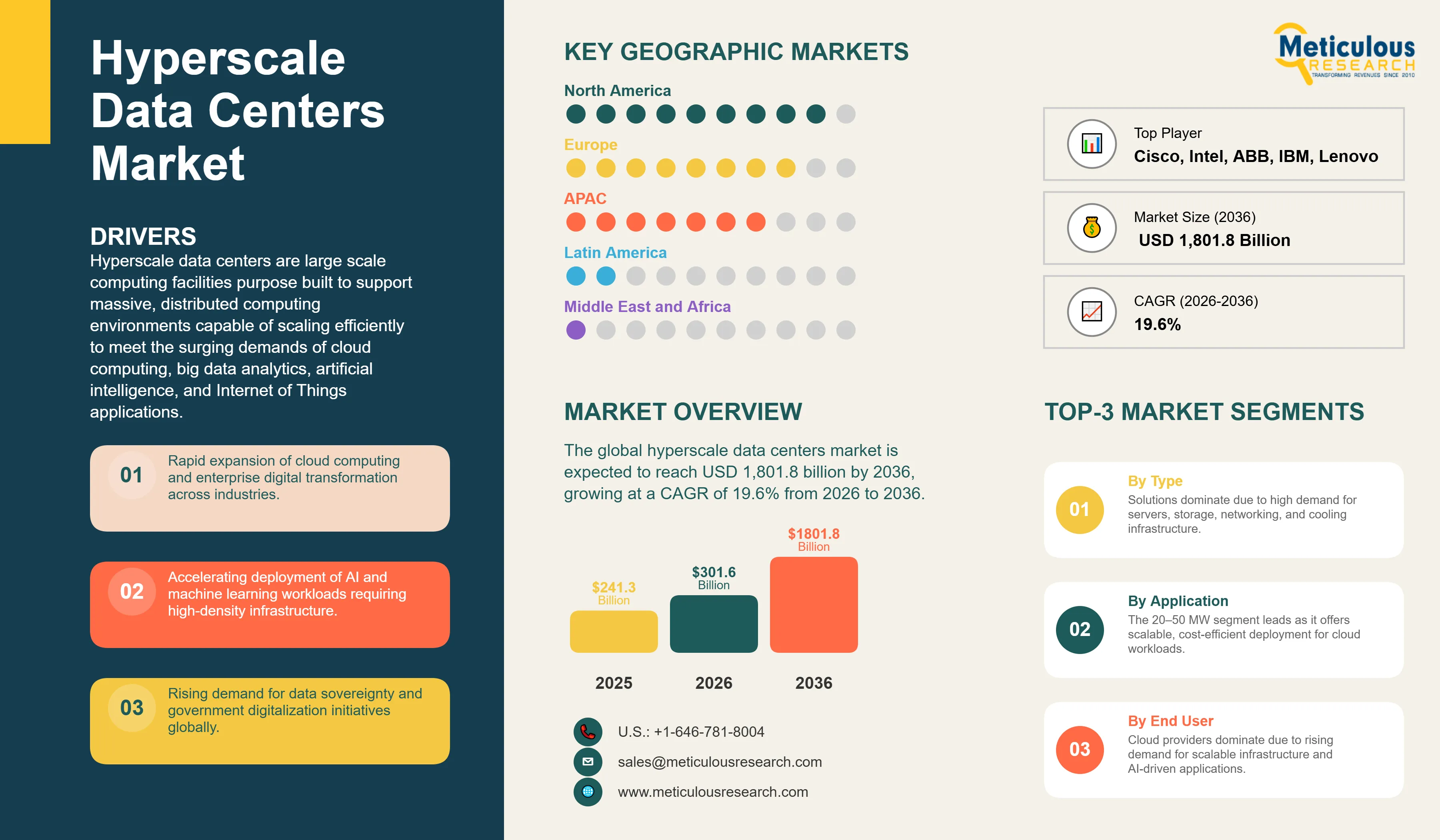
The global hyperscale data centers market was valued at USD 241.3 billion in 2025. This market is expected to reach USD 1,801.8 billion by 2036 from USD 301.6 billion in 2026, growing at a CAGR of 19.6% from 2026 to 2036.
Hyperscale data centers are large-scale computing facilities purpose-built to support massive, distributed computing environments capable of scaling efficiently to meet the growing demands of cloud computing, big data analytics, artificial intelligence, and Internet of Things applications. These facilities are distinguished by their ability to scale horizontally across vast floor spaces often exceeding 10,000 square feet and housing 5,000 or more servers while rigorously optimizing power usage effectiveness, cooling efficiency, and operational costs. Architecturally, hyperscale facilities leverage advanced technologies including software-defined networking, virtualization, containerization, edge computing integration, and automated infrastructure management to deliver the high performance, reliability, and flexibility that major cloud providers, social media platforms, e-commerce giants, and large enterprises require.
Key factors driving the growth of the overall hyperscale data center market include the rapid expansion of cloud computing and enterprise digital transformation, the increasing deployment of artificial intelligence and machine learning workloads, growing government mandates around data sovereignty, and the global rollout of 5G infrastructure. The number of large data centers operated by hyperscale providers increased to 1,297 worldwide as of the third quarter of 2025, nearly tripling since early 2018, while global public cloud spending reached approximately USD 679 billion in 2024, reflecting the reliance of enterprises on cloud-native, multi-cloud, and hybrid architectures. At the same time, AI training and inference workloads are reshaping facility design standards, pushing rack power densities to 40–100+ kW per rack compared with 5–15 kW for traditional CPU-based configurations, and driving both the pace and scale of hyperscale infrastructure investment.
Furthermore, the hyperscale data centers market is driven by various factors such as the large-scale AI infrastructure buildout, hyperscale expansion into emerging economies across Asia-Pacific, the Middle East, and Latin America, and the rapid commercialization of advanced liquid cooling and AI-driven operations management technologies. The collective capital expenditure of the top five hyperscalers, Amazon, Microsoft, Alphabet, Meta, and Oracle, is poised to exceed USD 600 billion in 2026, with around 75% directed toward AI-centric infrastructure, indicating strong investment levels that are expected to drive growth of the hyperscale data center market during the forecast period.
Click here to: Get Free Sample Pages of this Report
Rapid Expansion of Cloud Computing and Enterprise Digital Transformation
Increasing adoption of cloud computing remains the key driver of the growth of the hyperscale data center market. As enterprises across banking, telecommunications, healthcare, and manufacturing increasingly rely on cloud-native applications, multi-cloud strategies, and hybrid architectures, the need for large-scale, highly available, and geographically distributed infrastructure continues to grow.
Global public cloud spending reached around USD 679 billion in 2024 and is projected to reach nearly USD 723 billion in 2025, indicating a steady shift in enterprise IT spending toward cloud-based services. The three leading cloud providers, such as Amazon Web Services, Microsoft Azure, and Google Cloud, together account for about 58% of global hyperscale data center capacity and continue to expand their infrastructure to meet rising demand.
The enterprise segment is expected to dominate the hyperscale data center market. Organizations in regulated and capital-intensive industries are increasingly adopting hyperscale environments to modernize legacy systems, improve operational agility, and strengthen cybersecurity. Multi-cloud strategies are now standard among large enterprises, driving sustained demand for both colocation facilities and cloud provider infrastructure.
Accelerating Deployment of AI and Machine Learning Workloads
The rapid deployment of artificial intelligence (AI) and machine learning (ML) workloads is another factor driving the growth of the overall hyperscale data center market. The growing use of large language models, generative AI, deep learning, and high-performance computing is significantly increasing requirements for compute density, power capacity, and advanced cooling systems compared to traditional cloud workloads. This shift is reshaping data center design and accelerating investments in hyperscale data center infrastructure. Major strategic initiatives further drive this momentum. The Stargate Project, backed by OpenAI, Oracle, and SoftBank, deployed initial capacity at its Abilene, Texas site, in September 2025 and targets up to USD 500 billion in total investment across 10 GW of capacity over four years globally. Meanwhile, Microsoft has committed around USD 80 billion toward AI-enabled data center capacity in FY2025 alone.
According to the International Energy Agency, global electricity consumption from accelerated servers, primarily driven by AI workloads, is projected to grow at around 30% annually under the base case scenario. These workloads are expected to account for nearly half of the total increase in global data center electricity consumption through 2030.
Growing Demand for Data Sovereignty and Government Digitalization
Data sovereignty regulations have become another key driver of the growth of the hyperscale data center market. Governments across major markets, such as the European Union under GDPR, India through the Digital Personal Data Protection Act (2023), and China under the Data Security Law (2021), are increasingly requiring that citizen and public sector data be stored and processed within national or regional boundaries. Similar regulatory trends are emerging across Southeast Asia, the Middle East, and Latin America. As a result, global cloud providers are expanding into new national markets by building localized cloud regions, accelerating hyperscale deployment beyond traditional hubs such as North America and Western Europe.
At the same time, large-scale government digitalization initiatives are reinforcing demand for sovereign cloud infrastructure. In the GCC region, Saudi Arabia’s Vision 2030 and the UAE’s national AI strategy are driving significant investments in regional data center capacity by companies such as Microsoft, Google, and Oracle. In Europe, initiatives such as GAIA-X and various national cloud programs are driving the development of infrastructure aligned with regional data protection standards.
As data sovereignty requirements become more stringent and enforcement strengthens, demand for compliant, geographically distributed hyperscale infrastructure is expected to increase significantly over the forecast period.
Expansion of 5G Infrastructure and Edge Cloud Integration
The global rollout of 5G networks is enabling a new wave of latency-sensitive applications, such as autonomous vehicles, smart cities, industrial IoT, remote healthcare, and augmented reality. These use cases are driving demand for both edge infrastructure and centralized hyperscale data centers.
The number of connected IoT devices reached around 17 billion in 2024 and is expected to reach 29 billion by 2030, significantly increasing data generation and processing requirements. This increase in data is driving the need for large-scale storage, computing, and AI-based analytics, most of which are supported by hyperscale facilities.
AI models are typically trained in hyperscale data centers using aggregated data from IoT and 5G networks, and then deployed at the edge for real-time processing. This model indicates the importance of hyperscale infrastructure, even as edge computing continues to expand.
In addition, the growing adoption of private 5G networks across manufacturing, logistics, and industrial sectors is driving demand for colocation and hyperscale infrastructure capable of supporting mission-critical operations.
Expansion of Hyperscale Data Center Infrastructure in Emerging Economies
Emerging economies across Southeast Asia, India, the Gulf Cooperation Council (GCC), Sub-Saharan Africa, and Latin America provide the most significant geographic growth opportunity for hyperscale data center providers. These regions are witnessing rapid growth in digital services such as fintech, e-commerce, mobile healthcare, and government-led digitalization, driving strong demand for cloud and AI infrastructure.
In Southeast Asia, capacity constraints in Singapore, mainly related to power and land availability, are pushing hyperscale operators such as Amazon Web Services, Microsoft, Google, and ByteDance to expand into nearby markets. Johor, in southern Malaysia, has emerged as a key overflow hub supporting regional cloud and AI workloads.
In India, increasing adoption of enterprise cloud and initiatives such as Digital India are driving hyperscale investments in major data center hubs, such as Mumbai, Hyderabad, and Chennai. Similarly, in Latin America, Brazil and Mexico remain the leading markets, with ongoing capacity expansions in cities such as São Paulo, Mexico City, and Querétaro.
Overall, as digital adoption accelerates and local infrastructure gaps persist, these regions are expected to attract substantial hyperscale investments over the forecast period.
Liquid Cooling and Next-Generation Thermal Management Technologies
The shift from traditional air cooling to advanced liquid cooling is creating a major opportunity across data center equipment, engineering, and services markets. As AI workloads push rack power densities beyond 100 kW, liquid cooling is rapidly becoming essential for high-performance computing environments.
Technologies such as immersion cooling, where servers are submerged in non-conductive fluids, enable significantly higher rack densities while reducing water usage. These advanced cooling solutions can achieve power usage effectiveness (PUE) levels close to or below 1.1, compared to the global average of around 1.56, resulting in lower energy consumption, reduced operating costs, and improved sustainability.
At the same time, stringent regulatory frameworks, mainly in Europe under energy efficiency directives and in the U.S. through evolving environmental policies, are increasing the focus on energy efficiency and water conservation. As a result, next-generation thermal management is becoming critical not only for performance but also for regulatory compliance.
AI-Powered Data Center Operations and Infrastructure Management
The use of artificial intelligence in data center operations is a highly differentiated opportunity within the hyperscale market. AI-driven tools, such as intelligent power management, predictive maintenance, automated cooling systems, and real-time resource allocation, enable operators to reduce energy consumption, minimize downtime, and improve overall capacity utilization across large-scale facilities.
A notable example is Google DeepMind, which has deployed AI-based cooling optimization systems, achieving up to ~40% reduction in cooling energy consumption. Such advancements highlight the significant efficiency gains possible through AI integration.
As energy constraints, sustainability pressures, and infrastructure complexity continue to increase, AI-powered operations are expected to become a core component of hyperscale data center strategies and a key source of competitive advantage.
Hyperscale Data Centers Market Analysis: Top Market Segments
By Component: The Solutions Segment to Dominate the Hyperscale Data Centers Market in 2026
Based on component, the hyperscale data centers market is segmented into solutions and services. In 2026, the solutions segment is expected to account for the largest share, primarily due to the high capital investment required for core infrastructure. This includes IT hardware such as servers, storage, and networking equipment, along with facility infrastructure like power and cooling systems, as well as software platforms that enable data center operations.
The continued expansion of cloud infrastructure and the rapid adoption of AI-driven workloads are driving strong demand for high-performance servers, advanced cooling technologies, and scalable architectures. As a result, solutions spending is expected to remain the dominant revenue contributor throughout the forecast period.
However, the services segment is projected to register the fastest growth rate from 2026 to 2036. This growth is driven by the increasing complexity of hyperscale environments and the rising need for specialized capabilities in design, deployment, and operations. Demand for maintenance, support, and managed services is also increasing as operators expand across regions and adopt advanced technologies such as AI and liquid cooling.
By Power Capacity: The 20 MW–50 MW Segment to Dominate the Hyperscale Data Centers Market in 2026
Based on power capacity, the hyperscale data centers market is segmented into 20 MW–50 MW, 50 MW–100 MW, 100 MW–150 MW, and 150 MW and above. In 2026, the 20 MW–50 MW segment is expected to hold the largest market share, driven by its balance of scalability, cost efficiency, and deployment flexibility.
This capacity range is widely preferred by hyperscale operators as it supports phased expansion while allowing better control over power availability and capital investment. It also aligns well with current enterprise cloud and digital workload requirements, making it the most practical and widely adopted deployment size.
However, the 150 MW and above segment is projected to register the fastest CAGR during the forecast period. This growth is driven by rising demand for large-scale AI and high-performance computing workloads, which require significantly higher power capacity and dense infrastructure.
To support these needs, hyperscale operators are increasingly investing in mega-campus developments designed for GPU clusters, generative AI training, and large-scale data processing. Economies of scale and long-term capacity planning are further encouraging the development of ultra-large facilities.
By End User: The Cloud Providers Segment to Dominate the Hyperscale Data Centers Market in 2026
Based on end user, the hyperscale data centers market is segmented into cloud providers, colocation providers, technology providers, and enterprises. In 2026, the cloud providers segment is expected to account for the largest market share, driven by the continuous expansion of cloud infrastructure to meet rising demand for public, private, and hybrid cloud services.
Growing enterprise dependence on cloud platforms, increasing data volumes, and the need for scalable, on-demand computing resources are key factors supporting this dominance. In addition, the rapid deployment of AI and data-intensive applications on cloud platforms is further strengthening the position of cloud providers as the primary users of hyperscale infrastructure.
However, the colocation providers segment is expected to register the fastest CAGR from 2026 to 2036. Colocation enables faster market entry without significant upfront capital investment, making it an attractive option, mainly in emerging markets and for hybrid cloud strategies.
Hyperscale operators are also increasingly partnering with colocation providers to expand into new regions more quickly, further driving the growth of this segment.
North America Dominates the Hyperscale Data Centers Market in 2026
Based on geography, the global hyperscale data centers market is segmented into North America, Europe, Asia-Pacific, Latin America, and the Middle East & Africa. In 2026, North America is expected to account for the largest share of the global hyperscale data centers market. The growth of the hyperscale data center market in North America is mainly driven by the strong presence of leading hyperscale operators, high adoption of cloud computing, early deployment of AI and advanced digital technologies, and continuous investments in large-scale data center campuses, mainly across the U.S. The concentration of major technology companies and the ongoing expansion of AI-driven infrastructure further drive the growth of this market.
However, the Asia-Pacific region is expected to register the highest growth rate during the forecast period. The rapid growth of the hyperscale data center market in Asia-Pacific is driven by increasing internet penetration, rising cloud adoption, and strong government initiatives supporting digital transformation across China, India, and Southeast Asian nations. Growing demand for data localization, expansion of 5G networks, and increasing investments by global hyperscalers in emerging markets are further driving data center development across the region.
As digital economies continue to expand and enterprise cloud adoption deepens, Asia-Pacific is positioned to emerge as the fastest-growing market for hyperscale data centers over the forecast period.
Some of the prominent players operating in the global hyperscale data centers market include NVIDIA Corporation (U.S.), Cisco Systems, Inc. (U.S.), Intel Corporation (U.S.), Lenovo (China/U.S.), Eaton (Ireland), ABB Ltd. (Switzerland), Rittal GmbH & Co. KG (Germany), IBM Corporation (U.S.), Microsoft Corporation (U.S.), VMware, Inc. (U.S.), Nutanix, Inc. (U.S.), Dell Technologies Inc. (U.S.), Super Micro Computer/Supermicro (U.S.), Schneider Electric SE (France), Vertiv Holdings Co. (U.S.), Huawei Technologies Co., Ltd. (China), Hewlett Packard Enterprise (U.S.), Arista Networks, Inc. (U.S.), NTT DATA Corporation (Japan), Accenture plc (Ireland), and Kyndryl Holdings, Inc. (U.S.).
|
Particulars |
Details |
|
Forecast Period |
2026–2036 |
|
Base Year |
2025 |
|
CAGR (Value) |
19.6% |
|
Market Size (Value) in 2026 |
USD 301.6 Billion |
|
Market Size (Value) in 2036 |
USD 1,801.8 Billion |
|
Segments Covered |
By Component: Solutions, Services; By Power Capacity: 20 MW–50 MW, 50 MW–100 MW, 100 MW–150 MW, 150 MW and Above; By End User: Cloud Providers, Colocation Providers, Technology Providers, Enterprises |
|
Countries Covered |
North America (U.S., Canada), Europe (Germany, France, U.K., Italy, Spain, and Rest of Europe), Asia-Pacific (China, India, Japan, South Korea, Australia, and Rest of Asia-Pacific), Latin America (Brazil, Mexico, Argentina, and Rest of Latin America), and the Middle East & Africa (Saudi Arabia, South Africa, UAE) |
|
Key Companies |
NVIDIA Corporation (U.S.), Cisco Systems, Inc. (U.S.), Intel Corporation (U.S.), Lenovo (China/U.S.), Eaton (Ireland), ABB Ltd. (Switzerland), Rittal GmbH & Co. KG (Germany), IBM Corporation (U.S.), Microsoft Corporation (U.S.), VMware, Inc. (U.S.), Nutanix, Inc. (U.S.), Dell Technologies Inc. (U.S.), Super Micro Computer/Supermicro (U.S.), Schneider Electric SE (France), Vertiv Holdings Co. (U.S.), Huawei Technologies Co., Ltd. (China), Hewlett Packard Enterprise (U.S.), Arista Networks, Inc. (U.S.), NTT DATA Corporation (Japan), Accenture plc (Ireland), and Kyndryl Holdings, Inc. (U.S.) |
The global hyperscale data centers market is estimated at USD 301.6 billion in 2026.
The market is projected to grow from USD 301.6 billion in 2026 to USD 1,801.8 billion by 2036, at a CAGR of 19.6%.
The hyperscale data centers market analysis indicates strong and sustained growth momentum, with the market projected to reach USD 1,801.8 billion by 2036, at a CAGR of 19.6% from 2026 to 2036.
Key companies operating in this market include NVIDIA Corporation, Cisco Systems, Inc., Intel Corporation, Lenovo, Eaton, ABB Ltd., Rittal GmbH & Co. KG, IBM Corporation, Microsoft Corporation, Dell Technologies Inc., Schneider Electric SE, Vertiv Holdings Co., Huawei Technologies Co., Ltd., Hewlett Packard Enterprise, and Arista Networks, Inc., among others.
The accelerating deployment of generative AI and large language model workloads, the rapid adoption of advanced liquid and immersion cooling technologies, and the expansion of AI-powered data center infrastructure management platforms are among the most prominent trends shaping the hyperscale data centers market.
Which segments will hold large market shares in the hyperscale data centers market during 2026–2036?
By component, the solutions segment is forecasted to hold the largest share; by power capacity, the 20 MW–50 MW segment is expected to dominate; by end user, the cloud providers segment is expected to lead; and by geography, North America is expected to hold the largest market share during 2026–2036.
North America is expected to hold the largest share of the hyperscale data centers market in 2026, supported by the strong presence of leading hyperscale operators, high cloud adoption, and continuous large-scale data center campus investments. However, Asia-Pacific is expected to register the highest growth rate during the forecast period, driven by increasing internet penetration, rising cloud adoption, government-backed digital transformation programs, and accelerating investments by global hyperscalers in emerging markets.
Key drivers include the rapid expansion of cloud computing and enterprise digital transformation, the accelerating deployment of AI and machine learning workloads, growing demand for data sovereignty-compliant infrastructure, and the expansion of 5G networks and edge-cloud integration. These factors are collectively driving large-scale investment in hyperscale data center capacity across both established and emerging markets worldwide.
























Published Date: Apr-2026
Published Date: Feb-2026
Published Date: Feb-2026
Please enter your corporate email id here to view sample report.
Subscribe to get the latest industry updates


