Pea Protein Market (2024-2031)
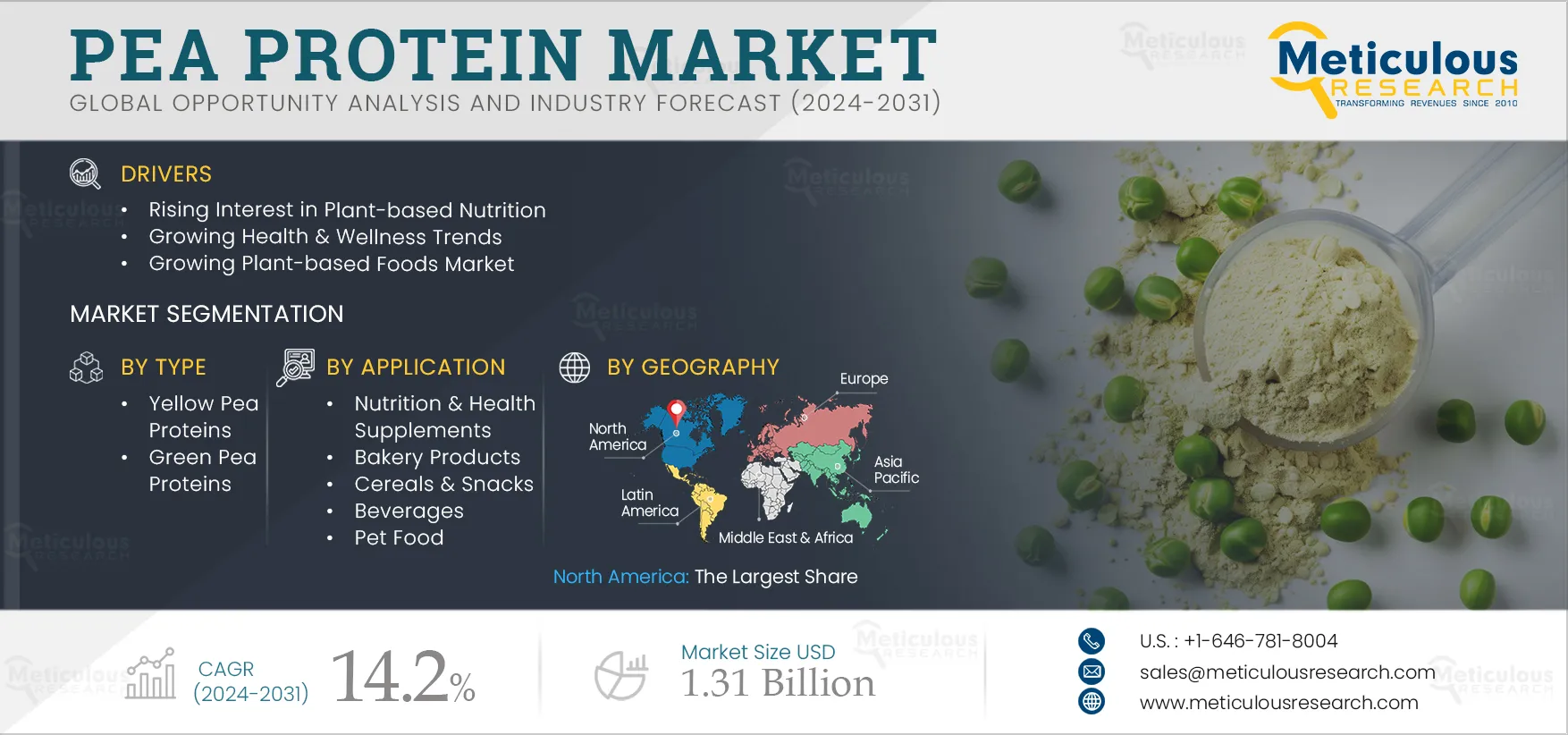
The Pea Protein Market was valued at $0.46 billion in 2023. This market is expected to reach $1.31 billion by 2031 from an estimated $0.52 billion in 2024, at a CAGR of 14.2% during the forecast period 2024-2031. Pea Protein Market Size & Forecast
- Published
- Aug 2024
- Pages
- 198
- Format
- PDF + Excel
- Report ID
- MR-355
- Base year
- 2023
- 2023 · BASELINE
- $460.0M
- 2031
- $1.31B
- CAGR 2024–2031
- 14.2%
2023 baseline · 2024–2031 forecast at 14.2% CAGR · hover a bar for the value
Key highlights
The Yellow Pea Proteins Segment to Dominate the Pea Protein Market in 2024
The Conventional Pea Protein Segment to Dominate the Pea Protein Market in 2024
The Dry Processing Segment to Dominate the Pea Protein Market in 2024
The Solid Segment to Dominate the Pea Protein Market in 2024
The Nutrition & Health Supplements Segment to Dominate the Pea Protein Market in 2024
Report summary
| Particulars | Details |
|---|---|
| Number of Pages | 198 |
| Format | |
| Forecast Period | 2024–2031 |
| Base Year | 2023 |
| CAGR (Value) | 14.2% |
| Market Size (Value) | $1.31 Billion by 2031 |
| Segments Covered | By Type · Yellow Pea Proteins · Yellow Pea Protein Isolate · Yellow Pea Protein Concentrate · Textured Yellow Pea Protein · Yellow Pea Protein Hydrolysate · Yellow Pea Flour · Other Yellow Pea Proteins · Green Pea Proteins · Green Pea Protein Isolate · Green Pea Protein Concentrate · Textured Green Pea Protein · Green Pea Protein Hydrolysate · Green Pea Flour · Other Green Pea Proteins · By Source · Conventional Pea Protein · Organic Pea Protein · By Processing Method · Dry Processing · Wet Processing · By Form · Solid · Liquid · By Application · Nutrition & Health Supplements · Meat & Meat Alternatives · Bakery Products · Dairy & Dairy Alternatives · Cereals & Snacks · Beverages · Pet Food · Other Applications |
| Countries Covered | North America (U.S. and Canada), Europe (Germany, France, U.K., Italy, Spain, and Rest of Europe), Asia-Pacific (China, India, Japan, Australia, and Rest of Asia-Pacific), Latin America (Brazil, Mexico, Argentina, and Rest of Latin America), and the Middle East & Africa |
| Key Companies | Roquette Freres (France), AGT Food and Ingredients Inc. (Canada), Cargill, Inc (U.S.), Ingredion Incorporated (U.S.), Archer-Daniels-Midland Company (U.S.), Axiom Foods Inc. (U.S.), Burcon NutraScience Corporation (Canada), Glanbia Plc. (Ireland), Cosucra Groupe Warcoing SA (Belgium), Sotexpro Sa (a part of GEMEF Industries) (France), Farbest-Tallman Foods Corporation (U.S.), Shandong Jianyuan Foods Co., Ltd. (China), The Emsland Group (Germany), and Nutri-Pea Ltd. (Canada) |
Report overview
Segments covered: type, source, processing method, form, application. Regions: North America, Europe, Asia-Pacific, Latin America.
The growth of this market can be attributed to the rising preference for plant-based nutrition, the growing health and wellness trends, the growing plant-based food market, the growing consumer awareness regarding the nutritional benefits offered by pea-based products, and the growing focus of key players on the development of innovative pea protein ingredients.
However, the high preference for animal-based protein restrains the market’s growth.
Moreover, emerging economies and innovation & enhancements in the new launches of pea protein-based products are expected to offer growth opportunities for the players operating in this market. However, consumer preference for other plant proteins over pea protein poses challenges to the market's growth.
Market dynamics
3 factors across 3 forcesGrowing Focus of Key Players on Developing Innovative Pea Protein Ingredients
Pea protein, with its ability to enhance the nutritional and functional properties of food & beverage products, is a promising ingredient. It is gaining traction as a preferred alternative to traditional proteins like animal, wheat, and soy proteins. Its versatility, sustainability, availability, affordability, and hypoallergenic properties make it a compelling choice over other protein ingredients. The key to successful pea protein processing lies in striking the right balance between gentle handling and effective extraction, ensuring the purity of the final product while maximizing yield.
The purification or extraction process involves separating protein from non-protein components and isolating the target protein from other proteins. It is also crucial to minimize energy & water use, control costs, and reduce the environmental impact. Pea protein ingredients can be produced through wet extraction, dry fractionation, or mild fractionation. Commercial pea protein products include flour (20-25% protein), concentrate (50-75% protein), and isolate (more than 80% protein).
Apart from protein content, these ingredients vary in their chemical composition, which influences their functionality.
Recent advancements in pea protein ingredients have significantly enhanced their performance and reliability in the food industry. Innovations in processing technologies have improved the purity and functionality of pea proteins, making them more effective as a plant-based alternative in various applications. These developments also ensure a more stable and consistent supply, addressing previous concerns about sourcing and availability. To align with consumer expectations for plant-based protein ingredients, manufacturers are focused on developing products with pea protein as an ingredient. Overall, these improvements support the broader adoption of pea proteins in both mainstream and specialty food products.
As the pea protein market continues to evolve, plant protein manufacturers are expanding their production capabilities to include pea protein products. For instance, in February 2024, Louis Dreyfus Company (LDC) announced plans to build a new pea protein isolate production facility at its existing industrial complex in Saskatchewan, Canada, as part of its Plant Proteins division.
Also, in November 2021, Roquette (France) established a pea protein processing plant in Manitoba, Canada, to address the growing demand for alternative protein ingredients. The 200,000-square-foot facility is designed to process 125,000 tons of yellow peas annually.
In July 2024, Ingredion Incorporated (U.S.) introduced Vitessence Pea 100 HD, a pea protein specifically designed for cold-pressed bars. This ingredient enhances the softness of cold-pressed bars throughout their shelf life, meets desired texture and sensory qualities, and increases nutritional value to enhance consumer appeal.
Additionally, in October 2022, Roquette Frères (France) launched a new range of organic pea ingredients, including organic pea protein, to meet the growing demand for organic plant-based products.
Such developments are driving the growth of the pea protein market.
Table of contents
13 chapters · 160 sections · 198 pages · click to expandSegmental analysis
| Segment | Largest share (2024) | Fastest growth (2024–2031) |
|---|---|---|
| By Type | Yellow Pea Proteins | — |
| By Source | Conventional Pea Protein | — |
| By Processing Method | Dry Processing | — |
| By Form | Solid | Liquid |
| By Application | Nutrition & Health Supplements | Meat & meat alternatives |
By Type
- The yellow pea proteins segment is expected to account for the larger share of 94.7% of the pea protein market.
- The large market share of this segment is attributed to the high protein content of yellow peas, the role of yellow pea protein as a key constituent of pea protein isolates, and a larger production volume of yellow pea protein compared to green pea protein.
- Additionally, this segment is projected to register the higher CAGR of 14.3% during the forecast period due to the versatility of yellow pea proteins in a wide array of applications in the F&B industry, especially as an alternative to meat products.
By Source
- The conventional pea protein segment is expected to account for the larger share of the pea protein market.
- The large market share of this segment is attributed to the lower pricing of conventionally grown peas, the longer shelf life of conventional pea proteins, and the substantial availability of crop varieties.
- However, the organic pea protein segment is projected to register the higher CAGR during the forecast period 2024–2031.
- The growth of this segment is driven by the growing demand for organic products with the rising trend of clean-label products and the increasing number of certified organic pea producing farms.
- The growing trend of clean-label products, as consumers opt for natural ingredients with fewer chemicals and additives, is driving the growth of the organic pea protein market.
- Consumers in developed countries are growing increasingly conscious of product specifications such as grass-fed, hormone-free, antibiotic-free, and organic.
By Processing Method
- The Dry Processing Segment to Dominate the Pea Protein Market in 2024
- The dry processing segment is expected to account for the larger share of the pea protein market.
- The large market share of this segment is attributed to the low capital requirement for dry processing, lower energy and water consumption compared to wet extraction, and high demand for dry protein ingredients among food & beverage manufacturers.
- Dry processing involves drying, grinding, and milling whole or dehulled peas to separate protein and starch fractions.
- This is achieved by using air streams to sort the components based on their mass and particle sizes.
- However, the wet processing segment is projected to register the higher CAGR during the forecast period as this process helps obtain higher yield and purity than the dry processing method.
By Form
- The Solid Segment to Dominate the Pea Protein Market in 2024
- The solid segment is expected to account for the larger share of the pea protein market.
- The large market share of this segment is attributed to low bulk weight, ease of use, versatility in applications, higher stability, and potential for high production rates.
- However, the liquid segment is projected to register the highest CAGR during the forecast period as liquid form helps to improve viscosity, mouthfeel, product stability, texture, and pleasant taste.
By Application
- The nutrition & health supplements segment is expected to account for the largest share of 36.4% of the pea protein market.
- The large market share of this segment is attributed to the increased demand for nutritious foods, the benefits of pea protein in increasing the nutritional content of processed food products and sports supplements, and growing health & wellness trends.
- However, the meat & meat alternatives segment is projected to register the highest CAGR of 15.8% during the forecast period as the direct utilization of pea protein in the manufacture of meat products and meat alternatives has been increasing due to the global shortage of animal protein, the increasing consumer preference for meat substitutes is driven by concerns over animal disease contamination in meat products, the strong demand for wholesome and Halal food, and increasing veganism.
Geographic analysis
North America
Largest shareIn 2024, North America is expected to account for the largest share of 42.4% of the pea protein market, followed by Europe and Asia-Pacific. North America's pea protein market is estimated to be worth $219.9 million in 2024. North America's large market share is attributed to the well-established food & beverage industry, increasing concerns over animal products and protein, growing vegan population, rising preference for meat alternatives, increasing demand for healthy & nutritional products, huge pea production, and strong presence of pea protein manufacturers in the region. North America to Dominate the Pea Protein Market During the Forecast Period 2024-2031
Asia-Pacific
Fastest growthHowever, Asia-Pacific is projected to register the highest growth rate of 16.0% during the forecast period. The growth of this regional market is driven by the increasing awareness of protein-rich food, rising health consciousness, the profiting food & beverage industry, rapid urbanization, growing veganism, and food & beverage manufacturers’ focus on launching products fortified with pea protein.
Competitive landscape
- March 2024
Latraps Agricultural Services Cooperative signed an investment agreement with Pfeifer & Langen GmbH & Co. KG (Germany) for the development of a pea protein isolate plant in Jelgava (Latvia).
- February 2024
Roquette Freres (France) expanded its NUTRALYS plant protein portfolio by launching four multi-functional pea protein ingredients: NUTRALYS Pea F853M (isolate), NUTRALYS H85 (hydrolysate), NUTRALYS T Pea 700FL (textured), and NUTRALYS T Pea 700M (textured).
- February 2024
Louis Dreyfus Company (Netherlands) announced the construction of a pea protein production plant in North America.
- Roquette Freres · France
- AGT Food and Ingredients Inc. · Canada
- Cargill, Inc (U.S.)
- Ingredion Incorporated (U.S.)
- Archer Daniels Midland Company (U.S.)
- Axiom Foods Inc. (U.S.)
- Burcon NutraScience Corporation · Canada
- Glanbia Plc · Ireland
- Cosucra Groupe Warcoing SA · Belgium
- Sotexpro Sa (a part of GEMEF Industries) · France
- Farbest-Tallman Foods Corporation (U.S.)
- Shandong Jianyuan Foods Co., Ltd. · China
- Emsland Group · Germany
- Nutri-Pea Ltd. · Canada
Frequently asked questions
The pea protein market study provides valuable insights, market sizes, and forecasts in terms of value and volume by type and geography. Moreover, the study provides market insights, market sizes, and forecasts in terms of value based on source, processing method, form, and application.
Cite this report
Meticulous Research. (2024). Pea Protein Market - Global Opportunity Analysis and Industry Forecast (2024-2031) (Report No. MR-355). Meticulous Market Research Pvt. Ltd. https://www.meticulousresearch.com/reports/pea-protein-market-5054